Understanding Nitro: The First Solana VM Rollup Deployed on Cosmos
TechFlow Selected TechFlow Selected
Understanding Nitro: The First Solana VM Rollup Deployed on Cosmos
Nitro is the first Solana VM chain built on Cosmos.
 Navigating Web3 tides with focused insights
Source: Nitro Labs
Compiled by: TechFlow
What is Nitro?
Nitro is the first Solana VM chain built on Cosmos. As an Optimistic Rollup with Sealevel Virtual Machine (SVM) compatibility, it enables developers to easily launch their Solana dApps on Cosmos and access IBC assets. Applications built on Nitro can leverage the powerful Solana VM to achieve native IBC interoperability.
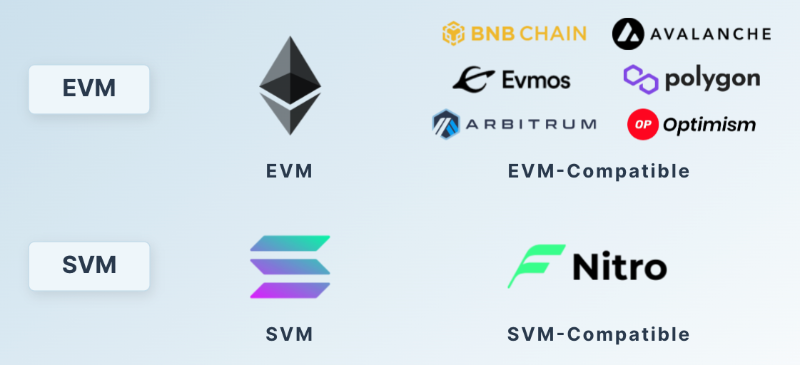
The First Solana VM Chain
Nitro allows developers to deploy existing Solana smart contracts without modifications, while users can seamlessly access these applications using Solana wallets. This creates a low-friction environment for Solana developers and users to access the broader Cosmos ecosystem.
Nitro Vision
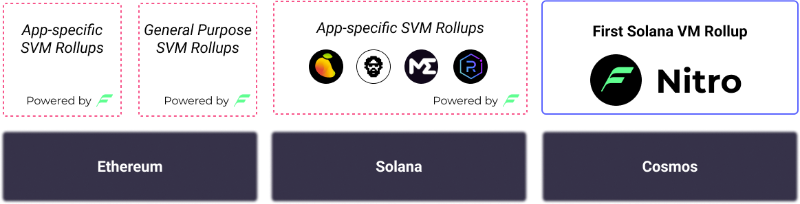
Nitro will become the scalability engine for the Solana VM (SVM)——enabling teams to launch SVM rollups that can use any L1 for data availability and settlement.
Nitro can be used to create app-specific rollups like dYdX or ImmutableX, or general-purpose rollups like Arbitrum.
How Nitro Works
Applications built on Nitro can leverage the powerful Solana execution environment while gaining IBC interoperability.
Developers can deploy existing Solana smart contracts, and users can seamlessly access these applications using familiar Solana wallets.
Nitro runs the Solana Virtual Machine as an Optimistic Rollup on Sei, [Sei being a Cosmos L1 that enables IBC and ICA (Interchain Accounts)]. This architecture allows Solana applications to easily scale into Cosmos and access IBC assets.
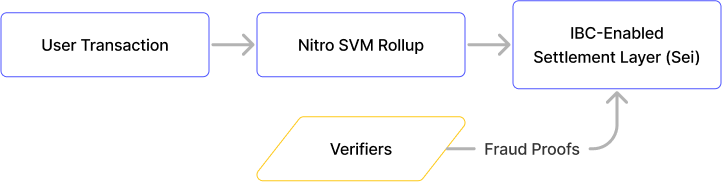
Transaction Lifecycle
Nitro is managed via sequencers similar to Optimism and Arbitrum——providing instant transaction finality.
Afterward, batches of transactions are submitted to Sei, where validators can submit fraud proofs——ensuring state changes are valid.
Use Cases
Here are some fundamental use cases for Nitro SVM:
- Decentralized Exchanges: Traditional AMMs, order book DEXs, and stablecoin swaps leveraging Solana VM capabilities to handle IBC assets.
- High-Performance Gaming: Unlock real-time gaming through instant transaction finality, faster than any other chain.
- NFT Financial Products: Go beyond NFT marketplaces with fast NFT trading, derivatives, and lending.
- Lending: Lending protocols and markets utilizing both Solana and IBC assets.
- Asset Management: An asset management application to manage open positions across Solana and Cosmos DeFi apps.
Nitro's Modular Architecture
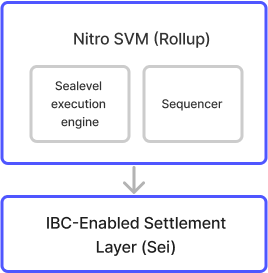
Nitro’s modular architecture separates the two core components of blockchain—execution and settlement. By decoupling these components, each can be independently optimized, creating infrastructure that combines the Sealevel VM with native IBC interoperability.
Nitro’s modularity allows Layer 3 rollups to be launched on top, which can be application-specific and focused solely on execution. Applications wanting to run dedicated execution layers can launch faster on Nitro without worrying about settlement and data availability.
Why Choose Solana VM?
Over the past few years, Solidity and the EVM have emerged as the de facto development standard across crypto, with most L1s adopting EVM compatibility. Nitro takes the first step toward making the Solana VM (SVM) a foundational development standard akin to EVM.
Nitro combines the powerful Sealevel execution environment with the core interoperability of IBC. By advancing SVM standards, Nitro accelerates growth among builders in crypto and DeFi, expanding Solana’s reach.
Building on the Sealevel Virtual Machine
Sealevel refers to the engine that processes transactions on Solana. Sealevel enables massive parallel transaction processing on a single chain, enhancing its capacity to handle more transactions simultaneously. Parallel processing via pipelining is a common design paradigm in CPUs, allowing multiple data streams to be assigned to different parts of processing hardware:
- Sealevel allows the Solana Virtual Machine to run multiple contracts concurrently, without any single contract’s processing affecting overall block latency. This makes Solana’s Sealevel VM an efficient layer for horizontal scaling.
- Another benefit of Sealevel is its reduction in the number of unconfirmed transactions in the mempool. This significantly reduces memory load on nodes and makes block processing more efficient.
Nitro aims to establish the Sealevel Virtual Machine (SVM) as a development standard due to its technical advantages in transaction processing architecture. While Nitro initially deploys SVM within the Cosmos ecosystem, in the long term, Nitro will make SVM a standard across multiple ecosystems.
Why Choose Cosmos?
Cosmos, the Internet of Blockchains, offers a robust ecosystem built on the principles of interoperability and cross-chain communication. With over 50 live zones (blockchains) in the Cosmos ecosystem and over $100 million in monthly IBC transaction volume, opportunities for DeFi, gaming, and NFTs on Cosmos are endless.
We see significant opportunity within the Cosmos ecosystem, with some of the largest players in DeFi already committed to building on Cosmos.
We believe the future of DeFi is multi-chain and interoperable, positioning Nitro at the intersection of the Solana and Cosmos ecosystems. The vast developer base of Solana, combined with the Sealevel Virtual Machine on Nitro and the rapidly evolving Cosmos ecosystem, creates a unique combination that lays the foundation for the next supercycle.
Nitro will play a crucial role in enabling Solana dApps to deploy on Cosmos through the first Solana Virtual Machine. This will help bridge capital, talent, and innovation between the Solana and Cosmos ecosystems.
Join TechFlow official community to stay tuned
Telegram:https://t.me/TechFlowDaily
X (Twitter):https://x.com/TechFlowPost
X (Twitter) EN:https://x.com/BlockFlow_News