








Aave, Curve Protocol Stablecoin Launch Imminent: Will Protocol-Backed Stablecoins Become the Next Market Narrative?
TechFlow Selected TechFlow Selected
Aave, Curve Protocol Stablecoin Launch Imminent: Will Protocol-Backed Stablecoins Become the Next Market Narrative?
With the imminent launch of $GHO and $crvUSD, are protocol-specific stablecoins the next big narrative?
 Navigating Web3 tides with focused insights
By: Westie, Research Analyst at Blockworks Research
Compiled by: TechFlow
$GHO and $crvUSD are launching soon — will protocol-specific stablecoins be the next big narrative?
Among all types of cryptocurrencies, stablecoins still enjoy the strongest product-market fit.
This is because they allow investors to use dollar-denominated exposure within DeFi for trading, payments, value storage, or yield generation.
Today, the total market capitalization of all stablecoins has grown to over $150 billion.
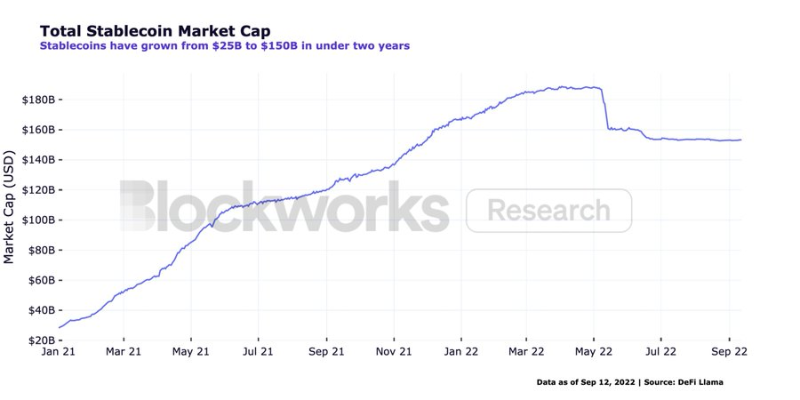
Given the widespread adoption of stablecoins and protocols’ desire to innovate and deliver value to their token holders and users, protocol-specific stablecoins are beginning to emerge.
Recently, both Aave and Curve announced plans to launch their own stablecoins: GHO and crvUSD.
Why would a protocol want to create its own stablecoin?
The primary reason is revenue generation. Under an overcollateralized model, protocols earn income based on the dollar amount of outstanding loans.
To illustrate how stablecoins can boost protocol revenues, consider a forecasted growth in Aave driven by the launch of GHO.
Assume a reserve factor of 10%, an optimal lending rate of 4%, and a GHO borrowing rate of 3%.
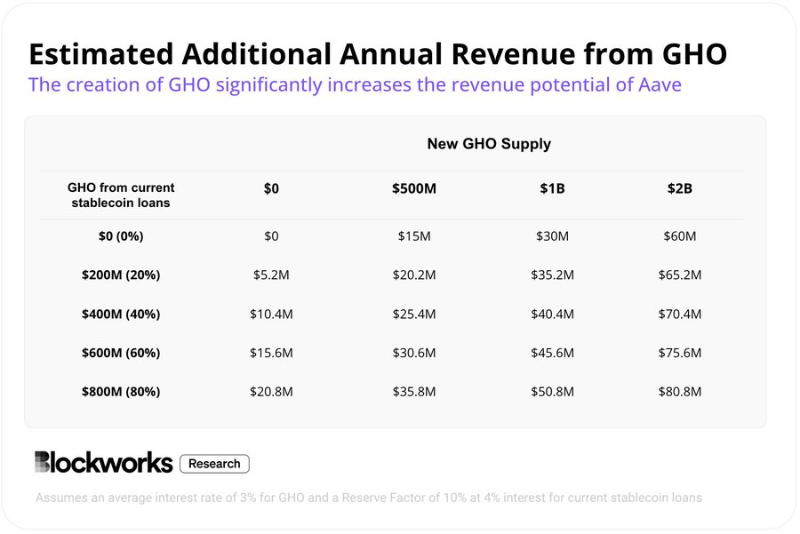
This revenue flows entirely to the protocol. To date, out of approximately $150 million in total interest earned by Aave, about $18 million has been retained by the protocol and distributed to the DAO. Therefore, if GHO’s supply reaches around $700 million, it would double the protocol’s revenue.
Beyond revenue, protocols can also use stablecoins as a mechanism to enhance value accrual and utility for their governance tokens. For example, stkAAVE holders will be able to mint GHO at favorable rates compared to regular borrowers, incentivizing users to buy and stake AAVE.
These protocols also gain the ability to expand or contract the supply of certain strategies or utilize collateral more flexibly. For instance, stablecoin issuers can establish direct deposit modules with other lending markets or deposit collateral into AMM liquidity pools (e.g., Maker’s D3M and FRAX’s AMO).
Ultimately, a protocol capable of issuing its own stablecoin strengthens its competitive moat and becomes less vulnerable to forks or vampire attacks.
All of this sounds promising — but where are the risks?
The main risk lies in increased protocol complexity, which introduces new attack vectors. In recent years, numerous stablecoin exploits (Cashio, Acala, Bean, etc.) have led to complete protocol collapses.
The stablecoin space is also highly competitive, with some decentralized stablecoins having built significant moats in terms of on-chain liquidity and integrations with other protocols (such as Frax and Curve).
It may be difficult — or extremely costly — for protocol-issued stablecoins to achieve deep liquidity.
Moreover, as demonstrated by Maker’s PSM, maintaining strong peg stability while preserving decentralization is extremely challenging, and regulatory or OFAC sanctions could make creating and maintaining protocol stablecoins very difficult.
Finally, a critical consideration is the liquidation mechanism. If not properly executed, the protocol could end up with substantial losses on its balance sheet.crvUSD, due to its significance, features a specially designed novel liquidation mechanism.
So in a future with multiple protocol-issued stablecoins, who will emerge as the winners?
Besides those who successfully launch their own stablecoins, the biggest beneficiaries are projects that directly benefit from increased stablecoin usage and demand for liquidity: Curve and Frax.
- Any stablecoin issuer will need to rely on Curve to ensure sufficient on-chain liquidity — generating more revenue and TVL for Curve.
- Frax also integrates into Curve’s flywheel through CVX accumulation, with its FraxBP pool becoming a primary source of liquidity.
Beyond Aave and Curve, which other projects might follow suit in launching their own stablecoins?
The most likely candidates are those that already demonstrate strong product-market fit and have accumulated substantial TVL or user deposits: Compound, Lido, and Uniswap.
Join TechFlow official community to stay tuned
Telegram:https://t.me/TechFlowDaily
X (Twitter):https://x.com/TechFlowPost
X (Twitter) EN:https://x.com/BlockFlow_News
 @blockworksres






