








A Comprehensive Analysis of the Move Language: Origins, Advantages, and Development Ecosystem
TechFlow Selected TechFlow Selected
A Comprehensive Analysis of the Move Language: Origins, Advantages, and Development Ecosystem
A deep dive into the features of Move, along with a brief introduction to blockchains adopting Move, such as Sui and Aptos.
 Navigating Web3 tides with focused insights
Authors: Mustafa Yilham, Jermaine Wong , Henry Ang
Introduction:
Scrolling through Twitter posts and crypto publications, the names Sui and Aptos frequently appear. What are these new high-throughput Layer 1 blockchains? Why have they attracted investments from firms like a16z, FTX, and Multicoin? We discovered that both blockchains share deep historical roots with Diem and use a new programming language—Move.
In this article, we will dive into the characteristics of Move, briefly introduce Move-based blockchains such as Sui and Aptos, review the emergence of Solidity/EVM, and finally compare whether Move and MoveVM can build their own vibrant ecosystems.
Quick Navigation:
1. The Origins of Move
2. Advantages of Move
3. Move's Developer Ecosystem
4. Solidity/EVM: How It Became the Most Vibrant Developer Ecosystem
5. The Future of the Move Language
1. The Origins of Move
Move is a Rust-based programming language developed for Meta’s Diem blockchain project. At the time, the team was exploring existing smart contract languages but found none that offered scarcity, determinism, and verifiability—acombination of features they ultimately achieved by building Move themselves.
The current Move GitHub repository is now managed by Mysten Labs, whose team—including those behind Aptos and Sui—forms the core development group for Move. The vision for the Move language is to become the JavaScript of Web3, providing a framework that enables developers to build blockchain applications securely, easily, and quickly.
2. Advantages of Move
Move is platform-agnostic, supporting shared libraries, tools, and developer communities across blockchains. The design of Move emphasizes security, aiming to prevent common vulnerabilities that have affected many Web3 users, including re-entrancy attacks, poison tokens, and spoofed token approvals. Digital assets are treated as resources, meaning they cannot be arbitrarily duplicated or accidentally destroyed.
For additional protection, Move supports the Move Prover verification tool, which allows developers to write formal specifications for critical application properties and use a verifier to check code correctness within 30 seconds.
3. Move's Developer Ecosystem
1. Sui by Mysten Labs

(1) What is Sui, and what is the team background?
Mysten Labs’ Sui is a decentralized proof-of-stake blockchain designed with horizontally scalable throughput and storage capabilities. The team behind Mysten Labs originated from Novi Research, Meta’s internal advanced blockchain R&D division focused on operating the Diem blockchain and developing the Move programming language. Founding members include CEO Evan Cheng, CPO Adeniyi Abiodun, CTO Sam Blackshear (creator of Move), Chief Scientist George Danezis, and Chief Cryptographer Kostas Chalkias.
(2) Funding Events
Mysten Labs is in talks to raise $200 million in a Series B round at a $2 billion valuation, led by FTX Ventures. In late 2021, Mysten raised $36 million in a Series A round led by Andreesen Horowitz.
(3) Performance Metrics
Sui is expected to process over 120,000 TPS, handling independent transactions in sub-second times and complex transactions involving shared objects in about three seconds. Transaction dependencies are mapped before execution, enabling independent transactions to be processed via Byzantine reliable broadcast, while transactions involving shared objects are handled by another consensus protocol called Narwhal & Tusk.
(4) Move Language on Sui
When using Move, Sui makes certain modifications to its core functionalities, particularly around global storage operators and key capabilities. These changes preserve Move’s security and flexibility while optimizing storage and addressing mechanisms to improve network performance and reduce transaction confirmation time.
(5) Development Roadmap
Sui’s DevNet has been publicly available since May, and the team announced the launch of an incentivized testnet in August 2022. Registration for the Sui Hackathon opened at the end of June.
(6) Ecosystem Projects
Information about projects building on Sui has remained limited. To date, the Chrome extension self-custodial wallet Sui Wallet has launched, and the third-party Ethos Wallet is already operational on DevNet.
2. Aptos
(1) What is Aptos, and who’s behind it?
Aptos is a Layer 1 blockchain whose mission is to enable universal and fair access to decentralized assets for billions of people. Aptos was co-founded by CEO Mo Shaik and CTO Avery Ching, former lead software engineer for blockchain solutions at Meta. Before joining Meta, Mo worked at ConsenSys, BlackRock, and Boston Consulting Group, while Avery previously worked at Yahoo. Other team members include PhDs, researchers, engineers, designers, and strategists with experience at Meta, Novi, Amazon, VMware, and more.
(2) Funding Events
In March, Aptos completed a $200 million investment led by a16z, with participation from Tiger Global, Katie Haun, Multicoin Capital, 3 Arrows Capital, FTX Ventures, and Coinbase Ventures. On July 25, it secured an additional $150 million funding round led by FTX Ventures.
(3) Performance Metrics
Aptos currently achieves up to 10,000 TPS, with a theoretical maximum throughput of 160,000 TPS. Most transactions are finalized after two network broadcasts, with finality times of 250 milliseconds. Aptos achieves high throughput by decoupling transaction execution from the consensus layer, enabling parallel execution via Block-STM, and achieving sub-second latency through state synchronization. Its consensus engine is adapted from Diem’s HotStuff and represents the team’s fourth iteration.
(4) Move Language on Aptos
Aptos extends the core MoveVM functionality through an adapter layer, adding features such as parallel execution via Block-STM (allowing concurrent transaction processing without user input), tables for large-scale data storage and key management within accounts, and fine-grained storage where data size impacts gas fees for account-related transactions.
(5) Development Roadmap
Aptos DevNet has been publicly accessible since March. The team has completed Phase 1 of the planned four-stage incentivized testnet and is currently running Phase 2. In June, Aptos also announced a grant program to further accelerate ecosystem growth, with applications now open and funded.
(6) Ecosystem Progress
There are now over 1,500 forks on Aptos’ core repositories, and more than 100 projects across DeFi, NFTs, gaming, and other domains are preparing for mainnet deployment. Teams including Pontem Network, Macalinao brothers, Nutrios, PayMagic, MartianDAO, and Solrise are gearing up for the anticipated mainnet launch around the end of September.
3. Other Blockchains Adopting Move
(1) 0L — An L1 blockchain protocol forked from Diem’s open-source codebase. This open-source initiative began in 2019 as a community-driven effort without corporate sponsors, venture capital, or foundation backing.

(2) Starcoin — A smart contract platform using enhanced proof-of-work consensus and the Move language. It optimizes the construction of diverse ecosystems such as DeFi, NFTs, and gaming through layered and flexible interoperability.

4. Comparison Between Sui/Aptos and Other Blockchains
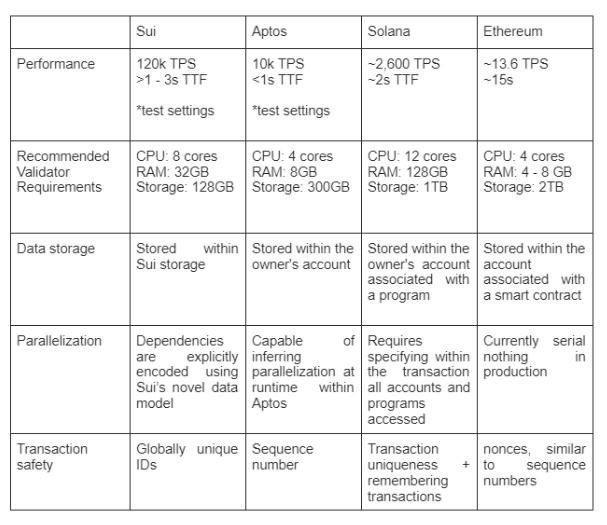
Multidimensional comparison of four public blockchains
Source: Aptos, Solana Explorer, Etherscan, Sui Node, Aptos Node, Solana Node, ETH Node
From the above comparison, Sui and Aptos resemble Solana in their ability to execute transactions in parallel, resulting in higher throughput.
However, when running full validator nodes, Sui and Aptos are closer to Ethereum in terms of lower entry barriers, which may promote greater decentralization through broader community participation.
Interestingly, Sui and Aptos require significantly less storage than Solana and Ethereum. As these newer blockchains accumulate more historical state data, we’ll see whether larger storage capacity proves valuable.
4. Solidity/EVM: How It Became the Most Vibrant Developer Ecosystem
To fully understand the path Move/MoveVM is taking in building its own programming language and virtual machine, we must look back at Solidity/EVM and how they became the de facto standard for smart contract programming today.
In the early days, there were two approaches to writing smart contracts on new blockchains:
a) Use an existing programming language and run it via a general-purpose virtual machine like WebAssembly (WASM)
b) Build a new programming language and a new virtual machine from scratch.
Although Solidity and EVM took the less-traveled path, it appears to have paid off following the DeFi boom of 2020. So how did Solidity/EVM surpass general-purpose WASM VMs? According to Starcoin’s core developer @jolestar, there are three reasons:
a) General-purpose languages are better suited for operating systems than blockchains. Once you strip away OS calls, file I/O, hardware access, networking, and concurrency libraries, the shared library base between smart contracts and general-purpose languages becomes minimal. This undermines the primary advantage of using general-purpose languages—their rich ecosystem of reusable libraries.
b) While WASM theoretically supports multiple languages, in practice, languages with heavy runtime systems (like Go and Java) produce large binaries when compiled, making them unsuitable for blockchain environments. This effectively limits choices to C, C++, and Rust—languages that, from a newcomer’s perspective, offer no significant learning advantage over Solidity. Additionally, supporting multiple languages could fragment the developer ecosystem unintentionally.
c) Given differing state management mechanisms across chains, interoperability remains problematic even when running on the same WASM VM. Since smart contracts cannot be directly migrated between chains, developer ecosystems risk fragmentation.
Moreover, Solidity has demonstrated strong user stickiness due to its reusable, open-source libraries. Access to audited code is a major convenience for app developers—remember, secure smart contracts require costly audits, with each line of code adding expense.
The larger developer ecosystem around EVM has contributed vast amounts of audited code, which in turn attracts even more developers to build on EVM.
5. The Future of the Move Language
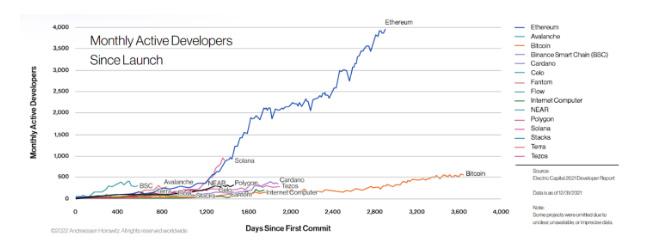
Move/MoveVM is now following the same path as Solidity/EVM, and some data suggests this trajectory is real.
Source: a16z State of Crypto
Solana made a similar choice—building its own VM using the Rust programming language—and we can observe large-scale developer activity on Move-based chains mirroring early Solidity growth patterns. On the user side, Solana has established itself as the chain with the highest number of active accounts across daily, 7-day, and 30-day metrics.
Given that FTX Ventures is an investor in both Sui and Aptos, we believe they can help bootstrap the Move ecosystem much like they did during Solana’s early stages. In summary, both Sui and Aptos are aggressively promoting their DevNets with incubation incentives and hackathons, and we expect developer activity to increase significantly in the coming months.
Additionally, to help overcome the initial lack of developer resources for a new programming language and assist developers transitioning from other languages, projects like Pontem have developed a fork of the Diem MoveVM that can now be deployed on existing chains such as Polkadot, Cosmos, Avalanche, and others, and are actively developing a new EVM compatible with MoveVM.
Overall, we believe Move offers a safer, faster, and simpler way to write smart contracts and will serve as the foundational layer for a robust and vibrant developer ecosystem. We expect developers to build the next generation of Web3 applications using Move, attracting even more Web3 users.
In the coming weeks, we will share deeper insights and analysis on the Sui and Aptos blockchains.
We gratefully acknowledge Jolestar for his technical expertise and insights in completing this article. Jolestar is an early adopter of Move and a core developer of Starcoin.
Join TechFlow official community to stay tuned
Telegram:https://t.me/TechFlowDaily
X (Twitter):https://x.com/TechFlowPost
X (Twitter) EN:https://x.com/BlockFlow_News
 Bixin Ventures






