Heartrate: Can Health-to-Earn Spark a Web3 Health Craze?
TechFlow Selected TechFlow Selected
Heartrate: Can Health-to-Earn Spark a Web3 Health Craze?
Not everyone is enthusiastic about AAA games, NFT collecting, or investing and trading, but everyone cares about their own health.
 Navigating Web3 tides with focused insights
Web3 has become a battleground driven by capital and technology, with diverse narratives constantly colliding. Messari, a leading data analytics firm in the space, defines Web3 as "readable + writable + ownable"—a restructuring of data's production relationship and the return of user data ownership. Technologists take a more purist view: Gavin Wood, former Ethereum co-founder and Polkadot creator, sees Web3 as a blockchain-based decentralized online ecosystem. Yet to most users, both definitions feel abstract and esoteric. X to Earn represents the most intuitive product form of Web3.
Indeed, within the ever-evolving Web3 landscape, GameFi is currently seen as one of the most viable use cases, bridging the gap between crypto and the real world, serving as the first gateway for the general public to enter Web3 from Web2. As A16Z stated in its Future column: “People will work in DAOs and crypto networks, earning continuous rewards. In the future, ordinary people may no longer work for companies. Instead, they’ll earn income non-traditionally—by playing games, learning new skills, creating art, or curating content.”
StepN stands out as a flagship X to Earn project in the Web3 narrative, arguably an industry leader. The current wave of Web3 startups owes much to StepN’s early success. Unexpectedly, however, on May 27th, the team released a notice titled “Account Cleansing for Mainland China Users,” disabling GPS and IP location services for affected accounts. The news spread rapidly, sparking uproar in the community. Within days, StepN’s reputation—which once hailed it as a model Web3 application—plummeted. Both of its native tokens, GST and GMT, entered a sustained downtrend.
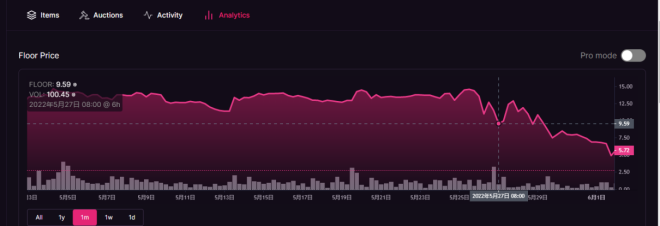
(Data source: Magic Eden)
Beyond falling token values, the deeper threat lies in spreading skepticism. For nearly a month afterward, StepN remained under pressure until June 21, when it launched version v0.7.3—a major update aimed at enabling in-game asset recycling through a deflationary mechanism to boost long-term asset value. Following the official announcement, StepN’s governance token GMT began a steady climb, eventually surpassing $1.
While StepN capitalized on broader market recovery to push positive momentum, the core product still struggles to deliver genuine entertainment value. No matter how many gameplay features are added, everything ultimately hinges on “Move”—and “Move” remains inherently monotonous. For GameFi projects to retain users, they must offer engaging, diverse experiences.
Meanwhile, while reviewing recent Web3 funding announcements, I came across a particularly intriguing project—Heartrate.
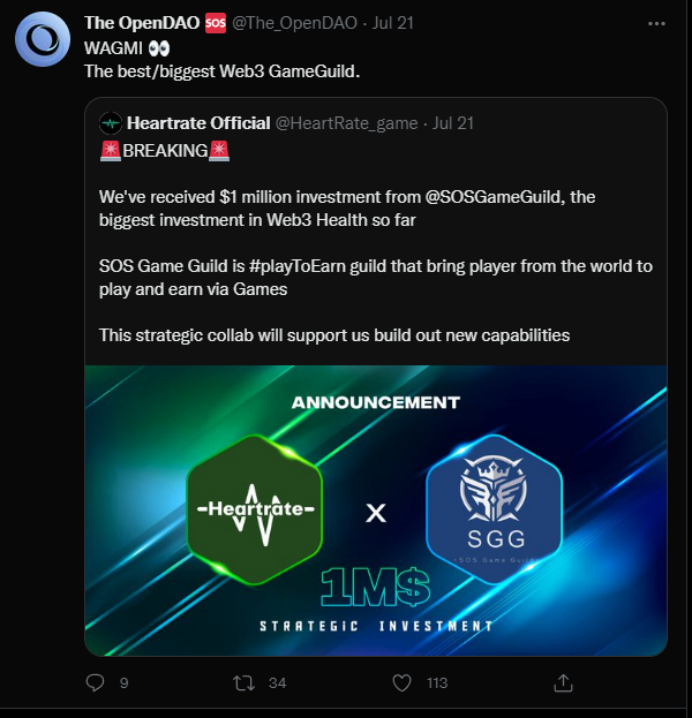
Web3.0 health platform @HeartRate_game has completed a seed round at a $10 million valuation. Investors include Vega Ventures, 7 O'Clock Labs, AP Capital, Impossible Research, K24 Ventures, Cryptograph Capital, UZ Capital, Chainup Capital, Bitwhale Capital, CryptoGraph, and MATTER VENTURES LIMITED. Notably, SOSGameGuild—the gaming guild under OpenDAO—strategically invested $1 million in Heartrate.
Heartrate is a blockchain-powered fitness and sleep wellness program in the Web3.0 space, integrating gamification and social elements. According to Andy Deme, co-founder of Heartrate, the funds raised will be used to build HealthVerse—a decentralized health metaverse ecosystem—and actively explore integration between Web3.0 and smart hardware, returning sovereignty over exercise, heart rate, body fat, and other health data back to users.
After deeper research, I found that Heartrate breaks beyond the limitations of “Move,” introducing multiple modes including outdoor, indoor, and sleep-based GameFi mechanics. Each season features live leaderboards that incentivize users to maintain Health (physical well-being) and Fitness (body composition), unlocking greater Earn potential. Additionally, Heartrate’s SocialFi component aims to financialize personal influence, enhancing user experience through social matching and a DAO forum. Heartrate is the first blockchain-powered fitness and sleep wellness application in the Web3.0 world, complete with game and social features. Focusing on post-pandemic lifestyles, we pioneered the H2E (Health to Earn) concept and model, seamlessly connecting virtual and physical worlds, on-chain and off-chain via NFT-enabled smart fitness bands.
The H2E model includes three modes: outdoor, indoor, and ranked ladder matches. Heartrate offers diverse scenarios—not limited to outdoor workouts. Considering activity restrictions in the post-pandemic era, Heartrate innovatively enables token earnings through indoor activities. Powered by advanced sleep science and enhanced technology, Heartrate’s sleep monitoring app allows users to earn during rest. By purchasing and staking $HTR tokens, users can increase their sleep-based income—enabling modern individuals, overwhelmed by information and stress, to earn rewards simply by relaxing and balancing work with rest.
Everyone today lives under symbol-constructed anxieties around lifestyle. Consumerism exploits human weaknesses like greed and envy, extending these values over longer feedback loops and higher thresholds. But as humans, we must strive toward higher-quality, more advanced values that offer lasting satisfaction and sustainable benefits—shifting naturally from quantitative accumulation to qualitative pursuit, ultimately prioritizing spiritual fulfillment.
Only products capable of continuously attracting users to project spiritual value onto them—and allowing users to reconstruct that value—can attract and retain large audiences. This kind of value must resonate deeply with users’ sense of self-worth. Through Heartrate’s gamified fitness and sleep mechanisms, people gain direct and simple psychological satisfaction: physical activity instills a sense of becoming better through effort, aligning perfectly with postmodern desires to transcend the self and pursue continuous improvement. This pursuit, in turn, strengthens the intrinsic value placed on health.
An often-overlooked aspect of GameFi’s future is the integration of SocialFi. The power of SocialFi lies not just in letting users trade or make friends with others in crypto, but in expanding user identity—fitness isn’t merely a path to physical health; it’s also a cultural symbol in the real world.
Within Heartrate, the HealthVerse ecosystem aims to create a decentralized health metaverse, primarily composed of GameFi and SocialFi components. The ecosystem directly links the native $HTR token to users, enabling monetization of social influence and generating additional income through social financialization—delivering boundless experiential value.
As the first blockchain-powered fitness and sleep wellness application of the Web3.0 era, Heartrate distinguishes itself from other X to Earn projects. Its H2E model extends beyond mere movement, addressing users’ holistic well-being, giving it stronger competitiveness in the Web3.0 space. The team brings extensive experience, having previously launched several “phenomenal” products. While the convergence of smart hardware and Web3.0 may not yet be widely recognized, and HealthVerse adoption remains limited, opportunities outweigh challenges—especially as institutional investors increasingly shift focus toward GameFi. Backed by favorable macro trends, Heartrate stands a strong chance of breaking into the mainstream and capturing ecosystem value.
Heartrate lowers the entry barrier by connecting games, real life, and human nature—while not everyone enjoys AAA titles, NFT collecting, or trading, everyone cares about their health. Heartrate has already taken its first steps into the Web3.0 era—from initial team formation to launching its official website and iterating its product. The team has never wavered in its mission to build HealthVerse, a decentralized health metaverse. It aims not only to break Web2.0 giants’ monopolies over health data but also, during the great migration from Web2.0 to Web3.0, to leverage Social-Fi to financialize social interactions, empowering users to monetize their influence and build a sustainable Web3.0 content platform. By pioneering the integration of Web3.0 and smart hardware, Heartrate returns sovereignty over motion, heart rate, body fat, and other health data to users. Protected by blockchain privacy technologies and eliminating intermediaries and centralized institutions, Heartrate unlocks infinite possibilities for the Web3 health industry!
Join TechFlow official community to stay tuned
Telegram:https://t.me/TechFlowDaily
X (Twitter):https://x.com/TechFlowPost
X (Twitter) EN:https://x.com/BlockFlow_News