








Eight Key Points: Understanding the Ethereum Merge and Fork in One Article
TechFlow Selected TechFlow Selected
Eight Key Points: Understanding the Ethereum Merge and Fork in One Article
What exactly is the Ethereum Merge, and why does it have such a significant impact?
 Navigating Web3 tides with focused insights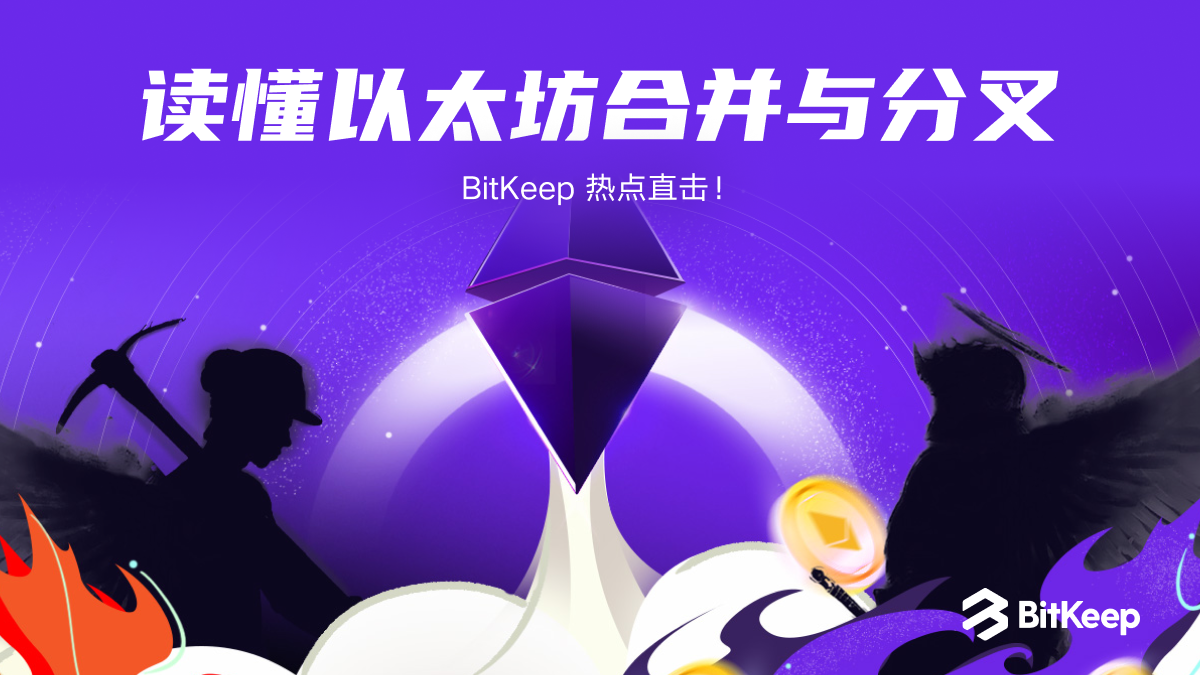
Rising from a low of around $900 to nearly $1,900 today, ETH's surge has left many investors who were waiting to buy the dip at $500 regretting their missed opportunity. This upward trend in ETH is closely tied to the upcoming Ethereum Merge upgrade, and as the Merge draws nearer, the market is responding with increasing optimism. In some ways, the current market momentum could even be described as a "Merge bull run."
What exactly is the Ethereum Merge? Why does it carry such significant implications? How will it affect ordinary users? And how can one participate in the opportunities surrounding the Ethereum Merge and its potential forks?
To address these common questions, BitKeep has launched a special series titled "Hotspot Focus: The Ethereum Merge and Fork," offering in-depth articles to clarify key concepts and uncover new market opportunities.
This article is the first in the series: Understanding the Ethereum Merge and Fork in Three Minutes.
1. What Is the Ethereum Merge?
The "Merge" refers to a major upgrade to Ethereum’s consensus mechanism, transitioning from Proof-of-Work (PoW) to Proof-of-Stake (PoS). It's called a "merge" because this process involves combining the Beacon Chain (the consensus layer) with the existing Ethereum mainnet (the execution layer), thereby discarding the PoW component of the execution layer.
2. Why Is the Merge Happening?
The reason behind the Merge essentially comes down to why Ethereum is shifting to PoS.
Network congestion and high gas fees on Ethereum are well-known issues. To improve Ethereum’s performance, co-founder Vitalik Buterin proposed a sharding solution. However, sharding technology is incompatible with the PoW mechanism, making the transition to PoS a necessary step.
In Vitalik’s view, PoS is a superior blockchain security model compared to PoW: under similar cost conditions, PoS offers stronger security; PoS systems can recover more easily after an attack; and PoS is more decentralized than ASIC-based mining.
Additionally, in the context of global carbon neutrality goals, PoS reduces energy consumption by 99% compared to PoW, addressing widespread criticism of cryptocurrency mining for wasting energy and generating carbon emissions.
3. Why Is the Ethereum Merge So Significant?
The Ethereum Merge is arguably one of the most important events in cryptocurrency history. For a massive, live-running ecosystem and economy like Ethereum, changing the consensus mechanism is akin to replacing the engine of an airplane mid-flight. Its significance is self-evident, and the risks involved are substantial—this is precisely why the Merge has been repeatedly delayed and rigorously tested.
Moreover, the Merge attracts attention because the shift in consensus will bring numerous changes to the blockchain ecosystem, including the obsolescence and migration of miners and computing power, a decline in ETH inflation, the rise of staking ecosystems, and potentially, the emergence of Ethereum forks.
4. What Impact Will the Merge Have on the ETH Token?
Here’s the bottom line: after transitioning to PoS, Ethereum’s inflation rate will drop so significantly that the network may enter a deflationary state. For ETH’s price, reduced supply could serve as strong support and a potential catalyst.
From a data perspective, Ethereum’s annual supply is approximately 5.5 million ETH. Since the London upgrade on August 5, 2021, over 2.5 million ETH have already been burned. Based on current Beacon Chain staking data, post-Merge, only about 600,000 new ETH will be issued annually. This suggests ETH’s annual inflation rate could fall to around -1.6%.
By way of comparison to Bitcoin halvings, the Merge would be equivalent to Ethereum undergoing three consecutive halvings.
5. When Will the Ethereum Merge Take Place?
Although previously delayed multiple times, the Merge now appears imminent, likely occurring around September 15.
On August 12, Vitalik Buterin tweeted that the Terminal Total Difficulty (TTD) for the Ethereum mainnet Merge had been set, and the website bordel.wtf predicts the Merge will happen around September 15, though the exact date depends on hash rate.
The Ethereum Foundation also stated that parameters for the mainnet Merge were agreed upon during a community call. However, since TTD is based on PoW difficulty, the exact timing is hard to predict precisely. The target date remains September 15, 2022, with a possible margin of error of up to one week.
6. What Is the Ethereum Fork Everyone Is Talking About?
For any blockchain, hard forks are typically normal upgrades—planned updates outlined in the roadmap and within the scope of community consensus. However, sometimes hard forks occur without consensus, leading to community splits and the creation of multiple blockchains. For example, in 2016, following the DAO hack, Ethereum split into two chains: Ethereum and Ethereum Classic.
The current discussion around an Ethereum fork stems from the upcoming Merge and transition to PoS. Miners will no longer be able to mine ETH under PoS, prompting certain interest groups to continue supporting the PoW version of Ethereum. Given the presence of various interest groups, multiple forked chains may emerge.
7. How Will the Ethereum Fork Affect Users?
For ordinary users, the Ethereum fork may not be a bad thing—at least not entirely. There could be forked tokens (commonly known as "airdrops" or "fork candy") distributed to holders. On August 17, BitKeep officially announced support for connecting to Ethereum fork chains and will launch new product features to help users claim and trade forked tokens.
8. How Can You Participate in the Ethereum Merge and Fork?
The most direct and beneficial way for users to participate is claiming forked token airdrops directly on-chain. As mentioned above, BitKeep will introduce new features to simplify claiming and trading forked tokens. However, the prerequisite is transferring your ETH or other ERC-20 assets from exchanges or other chains to the Ethereum mainnet beforehand.
Additionally, stay tuned to BitKeep’s official blog and the "Ethereum Merge and Fork"专题 series for further updates and detailed tutorials on how to claim forked tokens.
Join TechFlow official community to stay tuned
Telegram:https://t.me/TechFlowDaily
X (Twitter):https://x.com/TechFlowPost
X (Twitter) EN:https://x.com/BlockFlow_News
 BitKeep Wallet






