
On-Chain vs Off-Chain: How Should Blockchain Games Make the Choice?
TechFlow Selected TechFlow Selected
On-Chain vs Off-Chain: How Should Blockchain Games Make the Choice?
Deciding which aspects of a blockchain game to host on-chain versus off-chain is critical to the project's success.
 Navigating Web3 tides with focused insights
Author: Axel F.
Translation: TechFlow
When reNFT emerged at the end of 2020, not only was the concept still far from the minds of even the most avant-garde leaders and pioneers in the NFT space, but NFTs themselves were still in their infancy: this was before BAYC, and before the unfathomable wave of awareness, acceptance, and adoption that followed their launch.
While NFTs had existed for some time, by late 2020 they were still largely on the fringes of blockchain consensus.
However, since then, growth has been rapid: countless use cases and utilities for NFTs have captured the imagination of Web3 and Web2 entrepreneurs like never before, with industry leaders across sectors seemingly expressing implicit interest in the metaverse every day.
This naturally corresponds to exponential growth in NFT sales and trading volume, with one particular use case leading the charge and dominating both discussion and data points: blockchain gaming.
And it makes sense—by July, users of the casual mobile game Candy Crush had accumulated over 73 billion hours of total gameplay, equivalent to more than 8 million years of combined playtime.

By integrating NFTs, particularly through Play-to-Earn models pioneered by companies like Axie Infinity, players are able to derive economic value from their gameplay and monetize time previously spent purely on leisure activities. While gaming may be enjoyable, if there's an opportunity to earn money while pursuing a hobby, I see no reason or argument against doing so.
The rise of NFTs and blockchain games has brought about the emergence of NFT rental markets—and for good reason: NFTs can be expensive. The cost of assembling an Axie team ranges from several hundred to several thousand dollars depending on NFT quality. This high barrier to entry makes the game and its ecosystem inaccessible to many of Axie’s core users in the Philippines and Southeast Asia.
This is where NFT rental markets come into play: if a user wants temporary access to a blockchain game—whether to claim P2E rewards, qualify for an airdrop, or simply try it out—they no longer need to pay the full price of purchasing an NFT. Instead, they can rent it for just the duration they wish to use it.
However, before potential renters can benefit from the many solutions offered by NFT rental markets, they must first decide which platform to use—a decision made difficult by the range of innovative projects and products that have entered the space since the start of the NFT bull market. For end users, many factors must be considered when making this choice, but arguably the most important is whether the platform they’ll use operates on-chain or off-chain.
The On-Chain vs Off-Chain Dilemma
The debate over the advantages and disadvantages of on-chain versus off-chain platforms goes beyond the topic of NFT rental markets—it is, in fact, a central discussion within the Web3 industry itself.
Security concerns surrounding this topic quickly bring the issue into focus whenever incidents such as the Ronin hack or Polychain exploit occur. More recently, the Tornado Cash situation reignited the debate from the perspective of decentralized finance and on-chain privacy. To understand why this question is so relevant, it’s first necessary to dig deeper into the terms “on-chain” and “off-chain” and break down the differences between them.
Breaking Down the Jargon
In a recent article, CNBC attempted to clarify the difference between these two terms using a rather elegant analogy:
"Imagine blockchain as a cloud storage facility divided into two parts: public and private. On-chain transactions are like the public cloud, visible to everyone, while off-chain transactions are like the private cloud, where data is not publicly accessible."
Simply put, as the analogy above suggests, “on-chain” refers to anything stored or accessed via a public blockchain network, while “off-chain” refers to anything not on that public network (e.g., private chains or exchanges).
There are numerous points of divergence between these two concepts, each carrying unique advantages and disadvantages that may encourage individuals or organizations to adopt one over the other when building or using platforms.
At their core, these divergences can be categorized into three distinct areas: security, privacy, and accessibility.
These factors are highly relevant and significant for the NFT rental industry, both for individuals seeking platforms to rent NFTs and for projects aiming to integrate rental solutions into their protocols.
To understand the strengths and weaknesses of on-chain versus off-chain NFT rental platforms across these dimensions, it is best to examine them through the lens of blockchain gaming. This is not only because gaming presents one of the clearest use cases for NFT rentals, but also because its inherent complexity and functional depth allow for the most detailed and nuanced exploration of each of the three factors under consideration.
Security
The difference between on-chain and off-chain platforms becomes immediately apparent when discussing security. High-profile hacks on on-chain systems have highlighted the security advantages of off-chain setups—or more accurately, the security shortcomings of on-chain platforms. In a 2019 Forbes article, the CTO of blockchain security firm 1Kosmos explained the rationale behind this, stating: "Because off-chain systems aren’t exposed to the public internet, they’re more secure—similar to installing a server or software on an internal network rather than exposing it directly to the internet."
This is a critical consideration for both blockchain game developers and end users. While strong measures—such as thorough security audits conducted by major firms—can be taken to make on-chain protocols as secure as possible, building on a public network inherently carries risks. As a result, developers and users might feel more comfortable opting for private networks.
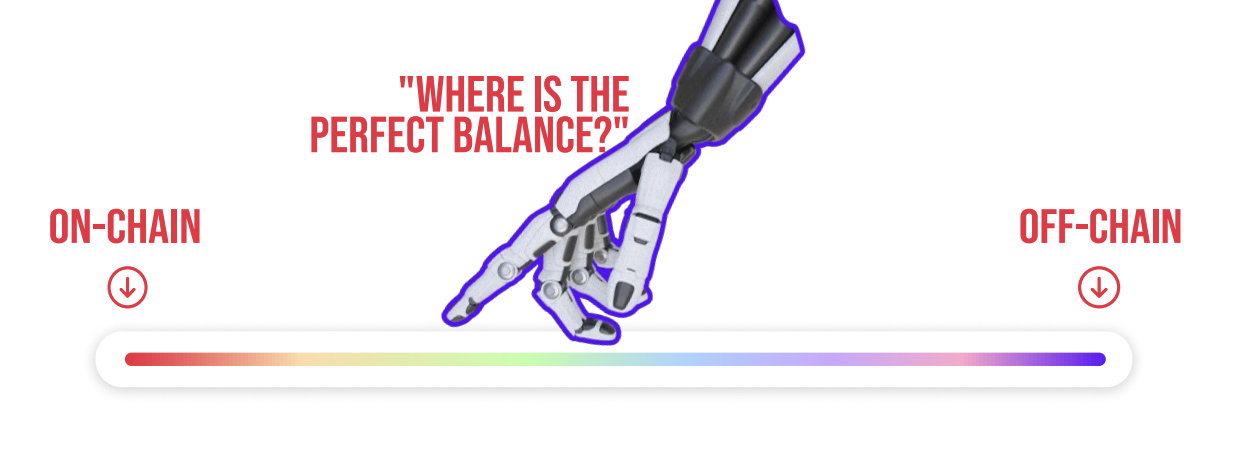
Indeed, a viable and increasingly popular approach to addressing this is the hybrid model, where certain aspects of a blockchain game—typically the gameplay itself—are built off-chain, while others—such as in-game NFT marketplaces—are built on-chain. In fact, Game7’s 2022 development report notes this is a growing trend among developers and represents a practical solution to the dilemma.
However, this model still carries risks. In on-chain NFT markets, sellers or lenders typically lock their NFTs into smart contracts, and buyers or renters unlock them by transferring funds or depositing collateral. At that point, the smart contract sends the NFT to them. While the NFT is held in the smart contract, there remains a risk that vulnerabilities in the contract could be exploited. Thus, while this approach reduces risk by limiting the portion of the game hosted on-chain, it does not eliminate it entirely.
Are off-chain markets risk-free? Certainly not. In 2018, OpenSea’s CTO Alex Atallah explained that their marketplace was shifting toward off-chain operations partly to address security concerns. Yet, several notable hacks have occurred since then.
It is therefore clear that security is a complex and multifaceted issue. While protocols can implement many safeguards and measures to enhance security, any system involving blockchain technology inherently carries some level of risk. Adopting a hybrid model and carefully deciding which components of a game should be hosted on-chain can significantly reduce these risks.
Privacy
Before examining privacy in the context of on-chain versus off-chain systems, it’s important to note that privacy does not necessarily mean complete anonymity. Rather, it ties into the broader discussion around decentralization itself.
As the Tornado Cash case revealed, the core of the privacy debate centers on the ability to transact without oversight or approval from centralized entities. In this regard, on-chain protocols hold a clear advantage. These systems rely on smart contracts that operate trustlessly and permissionlessly. For example, a blockchain game could program its marketplace to include a vesting function—allowing sellers and lenders to deposit NFTs into a smart contract, after which buyers and renters can purchase or borrow them.
These are peer-to-peer transactions, with the smart contract acting as an automated escrow agent, eliminating the need for game developers to personally approve purchases or rentals. More broadly, for general blockchain payments or transactions, it is the network itself (or more specifically, validators) that verify and approve transactions, requiring a sufficient number of distributed signatures for a transaction to be deemed valid and processed.
The benefits for blockchain games are evident—and indeed, this principle was precisely why Vitalik Buterin originally created Ethereum.
However, full privacy and decentralization are not without drawbacks. Some traditional Web2 gamers may dislike having their actions and activities fully visible and traceable on a public blockchain. Thus, privacy in Web3 is somewhat paradoxical. While you can interact anonymously, your behavior is fully traceable; if you use a suspicious wallet, other users, individuals, and organizations will be able to see exactly when and how you conduct transactions.
Accessibility
Accessibility is a broad topic, but it essentially boils down to two core and critical components: speed and cost.
On the surface, off-chain platforms appear to have advantages in both areas. Starting with speed, off-chain protocols are inherently faster than on-chain ones. Platforms built on public blockchains require network confirmations—typically from multiple validators—before transactions are finalized. While this supports decentralization, it introduces latency, and the network can become congested during periods of high transaction volume.
This is especially important for gaming protocols, which often need to process thousands, tens of thousands, or even hundreds of thousands of responses per minute. While networks like Avalanche and their innovative subnet system partially address this issue, off-chain platforms remain fundamentally faster.
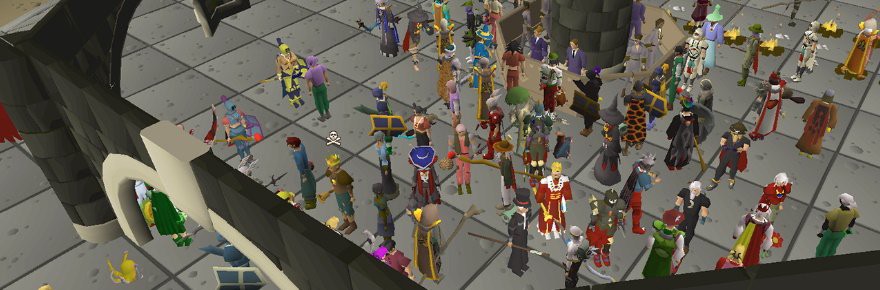
Take the Grand Exchange in Runescape as an example—even in its early stages in the 2000s, it handled millions of transactions. Replicating such volume on a blockchain would likely be impractical—or, due to congestion, would take an extremely long time to process each transaction.
The second core component of accessibility is cost, where off-chain platforms again seem to have the upper hand for similar reasons: off-chain transactions are typically free, whereas on-chain transactions require fees. These fees incentivize individuals or miners who participate in processing transactions.
Therefore, for the reasons outlined above, incorporating blockchain elements into a game project should prompt developers to think carefully. However, as noted in this report, the answer lies in identifying the best aspects of blockchain technology and integrating them into existing and proven Web2 practices.
A Third Way: The Hybrid Model
After a deep dive into the characteristics of on-chain versus off-chain platforms, it appears that the decision about which aspects of a blockchain game to host on-chain versus off-chain is crucial to a project’s success.
In fact, this reflects current thinking and widely accepted best practices. As Game7 observed, "Only a few developers build entirely on-chain: Dark Forest, Conquest, Topology, DeFi Kingdoms, and Cometh… Most game developers choose to keep the majority of game mechanics and gameplay off-chain, while hosting Web3 assets (tokens, NFTs) and transaction data on-chain."
Thus, when deciding how much of their project should go on-chain and which aspects should be hosted on a public blockchain, it is equally critical for developers to find a seamless solution and service provider. Likewise, gamers should pay attention to how Web3 elements are integrated into games and the extent to which on-chain functionality plays a role in a project.
Whether a project aims for fully on-chain, fully off-chain, or something in between, reNFT is capable of providing the necessary infrastructure. With fully customizable solutions, reNFT can equip projects with the NFT rental capabilities they need to elevate their offerings and deliver the quality of service gamers deserve.
Join TechFlow official community to stay tuned
Telegram:https://t.me/TechFlowDaily
X (Twitter):https://x.com/TechFlowPost
X (Twitter) EN:https://x.com/BlockFlow_News