








A Comprehensive Overview of the zkSync Ecosystem: Infrastructure Dominates Half of the Landscape
TechFlow Selected TechFlow Selected
A Comprehensive Overview of the zkSync Ecosystem: Infrastructure Dominates Half of the Landscape
zkSync's scaling solution has not only gained favor with substantial capital but also attracted projects and infrastructure from other ecosystems.
 Navigating Web3 tides with focused insights
Original author: Karen
This article was first published in March 2022, compiling over 70 projects that already support or will support zkSync.
In recent months, new projects (or those expanding from other networks) have emerged on the zkSync ecosystem, including the DEX SyncSwap, lending protocol Nexon Finance, Play-to-Earn game MiniMiniDungeon, gaming project Crypto Maze, DeFi protocol Trustless, cross-chain Web3 protocol SpaceFi, and Web3 computing platform 4EVERLAND. Additionally, blockchain security service providers Go+ Security and Verilog Solutions have begun offering security and audit services for projects on the zkSync platform.
Meanwhile, in June, zkSync released an update to its V2 testnet, introducing account abstraction—enabling smart contracts, not just externally owned accounts, to initiate Ethereum transactions. This feature moves signature verification, gas payment, and replay protection functions from the core protocol to the Ethereum Virtual Machine (EVM), allowing contracts themselves to include logic for verifying and paying gas fees that miners must validate. Furthermore, the new version enables real-time message passing from Layer 2 to Layer 1.
Today, it is widely recognized by the market that Layer 2 will become a critical infrastructure layer for the blockchain industry, with Rollups—solutions that move computation and state storage off-chain—having significant potential to become key scalability solutions for Ethereum.
Vitalik Buterin has stated that in the short term, Optimistic Rollups may dominate general-purpose EVM computation, while ZK Rollups may lead in simple payments, exchanges, and other application-specific use cases. However, in the medium to long term, as ZK-SNARK technology improves, ZK Rollups are expected to outperform across all use cases.
zkSync, developed by Matter Labs as a scaling solution based on ZK Rollup architecture, has launched its mainnet 1.0 focused primarily on payments, along with a fully EVM-compatible general-purpose 2.0 testnet. In zkSync 2.0, Layer 2 states are divided into zkRollup with on-chain data availability and zkPorter with off-chain data availability, both of which can be combined and interoperable. This month, zkSync also upgraded its 2.0 portal to support network fee payments in any token, greatly enhancing user flexibility.
The zkSync scaling solution has attracted substantial capital investment. As of last November, Matter Labs raised $58 million from a16z, Union Square Ventures, and Placeholder. It has also drawn interest from projects and infrastructure across other ecosystems.
According to zkSync’s official ecosystem map and previously disclosed information, there are currently over 70 projects in the zkSync ecosystem, more than half of which are infrastructure-related—such as around 10 wallets, 15 bridges or cross-chain solutions, and payment gateways. Several exchanges are also preparing to support deposits and withdrawals on zkSync. Additionally, about 30 DeFi projects have already integrated or plan to support zkSync.
However, since zkSync 1.0 does not support EVM compatibility, only around 10 projects have currently integrated zkSync, mostly wallets and payment gateway solutions such as Argent, ZigZag, Ramp Network, Banxa, wallet Numio, imToken, Orbiter Finance, MathWallet, payment gateway Sprintcheckout, and The Graph. The AMM protocol Mute.io has already launched on the zkSync 2.0 testnet. Users can currently also participate in Gitcoin donation campaigns via zkSync. The broader development of the ecosystem in DeFi and NFT sectors is expected after the official launch of zkSync 2.0.
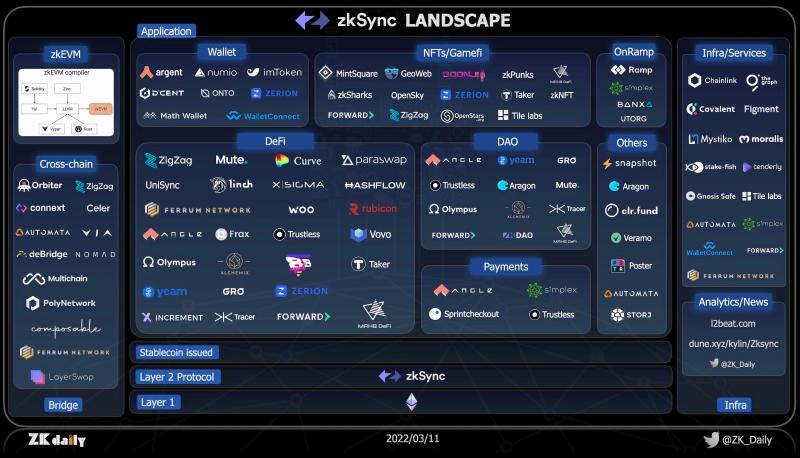
Image: zkSync ecosystem map created by ZK Daily
Infrastructure
Wallets
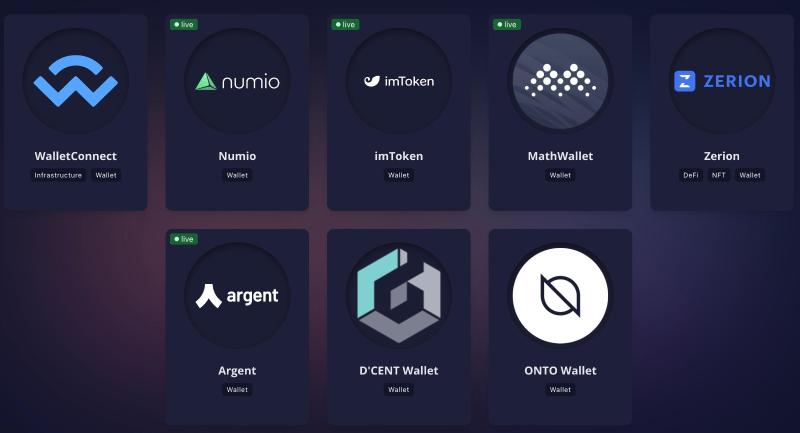
Argent (Live)
Earlier this month, Argent fully opened Layer 2 account registration, enabling anyone to access its Layer 2 wallet on the Ethereum zkSync network.
Numio (Live)
Numio is a mobile Layer 2 wallet app built on Ethereum and zkSync, integrating cryptocurrency purchase and exchange functionalities. According to its roadmap, Numio will later integrate additional Layer 2 solutions and add NFT and DeFi features such as yield farming and lending.
imToken and MathWallet have also integrated zkSync. Zerion, D'CENT Wallet, and ONTO Wallet are expected to follow.
Additionally, zkSync supports logging in via WalletConnect or Ethereum wallets like MetaMask, Formatic, Trezor, and Ledger on its official wallet page. Support for MetaMask, 1inch Wallet, and MyKey will be added soon.
Bridges
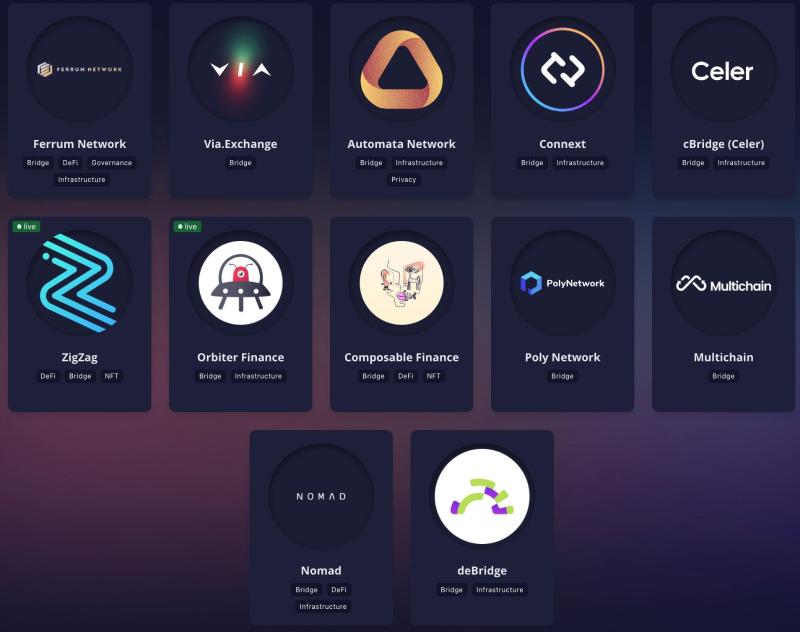
Currently, 15 cross-chain solutions or bridges have either integrated or are planning to integrate zkSync. Among them, ZigZag and Orbiter Finance already support cross-chain functionality between zkSync and other blockchains.
ZigZag Bridge (Live)
ZigZag Exchange is an order-book DEX built on ZK Rollup. Its bridge function supports asset transfers between Ethereum and zkSync, and has launched a zkSync-to-Polygon bridge. However, the zkSync–Polygon bridge is still in alpha mode and not yet integrated into the UI; users must manually send assets to designated addresses for now.
Orbiter Finance (Live)
Orbiter Finance is a cross-Rollup bridge currently supporting ETH and USDC transfers between Ethereum, zkSync, Arbitrum, Polygon, and Optimism. Recently, it added support for StarkNet Goerli testnet.
Ferrum Network
Ferrum Network is a cross-chain blockchain-as-a-service DeFi company whose core products include a cross-chain bridge. Ferrum Network also participated in Matter Labs’ $50 million Series B funding round. Earlier this month, Ferrum Network announced plans to integrate its product suite with zkSync, including traditional staking, VIP staking, NFT staking, multi-asset staking, LP staking, and its cross-chain aggregator InfinitySwap.
Via Protocol
Via Protocol is a cross-chain liquidity aggregation protocol currently supporting Ethereum, BNB Chain, Fantom, Avalanche, Polygon, Arbitrum, Harmony, HECO, Optimism, OEC, Gnosis Chain, and Moonriver, with future support planned for zkSync.
According to its website, Via.Exchange's partners include NEAR and Biconomy. It previously completed a $1.2 million pre-seed round led by Ravikant Capital and Shima Capital.
Other bridge infrastructures preparing or actively integrating zkSync include Automata Network, Connext, Celer, Composable Finance, Poly Network, Multichain, Nomad (a cross-chain communication solution with a token bridge live on Ethereum and Moonbeam), and deBridge, which will not be detailed further here.
Additionally, according to zkSync’s updates last month, upcoming supported bridges will include DAI Wormhole (built by Maker, enabling DAI transfers across Layer 2s), Hop Exchange, and LayerZero.
Payments/Gateways/CEX (5)
Payment gateways that provide fiat-to-crypto on-ramps—Banxa, MoonPay, Ramp Network, Simplex, and UTORG—will enable direct crypto purchases on zkSync through various payment methods. Banxa and Ramp Network already support zkSync.
Sprintcheckout, a Layer 2 payment gateway built on zkSync, is now live. It offers merchants a payment gateway allowing customers to pay via zkSync using ETH or ERC-20 tokens. Customers incur no transaction fees, while merchants pay a 0.5% Sprintcheckout transaction fee plus zkSync network fees.
LayerSwap, which enables transferring crypto from centralized exchanges (CEX) to Layer 2, also supports moving ETH or USDC from Coinbase, FTX, Binance, OKX, KuCoin, and Huobi to zkSync.
Block Explorers (3)
Matter Labs previously launched its own zkSync block explorer and analytics platform, zkScan. Additionally, Matter Labs stated that users will soon be able to access zkSync data through Etherscan and Blockscout.
Others (8)
Blockchain development platform Tenderly will integrate zkSync, enabling developers to monitor and test smart contracts. Ethereum development tool Hardhat will allow developers to easily compile contracts and run them on dev networks.
The Graph and Covalent will both integrate with zkSync 2.0 to provide efficient ways to query blockchain data.
Chainlink previously announced that developers building on zkSync 2.0 will be able to access off-chain data via Chainlink oracles.
Digital asset management tool Gnosis Safe will allow users to custody assets and offer multisig capabilities.
Other infrastructure listed by zkSync includes staking provider stakefish and decentralized storage project Arweave.
Exchanges
Major exchanges including Crypto.com, Bybit, Huobi, Blockchain.com, OKX, and Ripio are building direct deposit and withdrawal functionality for zkSync for their users.
DeFi (30 Projects)
As of now, zkSync lists 30 projects in its DeFi ecosystem, some overlapping with previously mentioned ones. Currently, only the order-book DEX ZigZag is live on the zkSync mainnet. The AMM protocol Mute.io is already deployed on the zkSync 2.0 Goerli testnet.
Other projects planning to build on zkSync include:
-
Babylon Finance (asset management protocol)
-
Dank Protocol (fixed-rate protocol)
-
CVI (crypto volatility index protocol built by COTI)
-
Hedgey (DeFi derivatives protocol)
-
Angle Protocol (stablecoin protocol)
-
Gro Protocol (stablecoin yield aggregator)
-
Increment (perpetual contracts protocol built on zkSync using Curve V2 AMM execution, received an Aave Grant in February)
-
Yearn Finance
-
Mute.io (AMM and IDO platform based on ZK-Rollup, live on zkSync Goerli testnet)
-
Frax (algorithmic stablecoin protocol)
-
WOO Network
-
Taker Protocol (liquidity protocol for NFTs and synthetic assets)
-
1inch Network
-
88mph
-
Tracer DAO (decentralized derivatives protocol)
-
Hashflow
-
Alchemix
-
Vovo Finance (structured products protocol, previously launched on Arbitrum)
-
OlympusDAO
NFT/Gaming
Due to zkSync 1.0’s lack of EVM compatibility, the only available NFT functionality at present is the built-in wallet minting feature. Other projects exploring construction on zkSync 2.0 include NFT platforms, games, and marketplaces such as:
-
Mint Square (an NFT marketplace based on Layer 2 ZK Rollup, previously supported NFT minting on StarkNet Goerli testnet and will later support zkSync 2.0)
-
tofuNFT (a multi-chain NFT marketplace focused on GameFi and collectibles)
-
OpenStars (a P2E space strategy game)
Others
Other ecosystem projects exploring development on zkSync include Snapshot, Aragon (which allows anyone to create and manage decentralized organizations), Forward Protocol, and clr.fund.
Forward Protocol uses an easy-to-use, WordPress-like model to facilitate a no-code environment, enabling even non-technical users to interact. Its modular design allows organizations to select suitable modules and customize them for specific use cases.
clr.fund is a quadratic funding protocol on Gnosis Chain that efficiently allocates matching funds to public goods in the Ethereum ecosystem. Combining quadratic funding, zk-SNARKs, Minimal Anti-Collusion Infrastructure (MACI), and Sybil-resistance mechanisms, it aims to democratize and increase funding for public goods.
Conclusion
zkSync has previously confirmed its transition toward decentralization and token issuance. In its recent updates, zkSync noted that the current system is fully operated by servers controlled by the zkSync team, making it centralized. While currently near break-even, fees are occasionally adjusted based on gas costs. However, zkSync plans to move toward full decentralization and introduce a native token. Its current priority remains solving Ethereum’s scalability challenges.
When zkSync becomes fully decentralized, it will introduce an independent consensus mechanism with two distinct roles: Validators, who must stake tokens, and Guardians—major token holders who nominate validators by staking their share.
Risk Warning: Most native projects on zkSync are still in testing phases and have not sufficiently disclosed information about their teams or security audits. Users are advised to conduct their own risk assessments.
Related zkSync Links:
zkSync 2.0 Testnet Faucet for Test Tokens: Faucet
zkSync 2.0 Testnet Portal
zkSync Tutorial (including L1-L2 transfers, L2 transfers, NFT minting, etc.)
zkSync 2.0 Testnet Documentation: Docs
zkSync Fee Details
zkSync Ecosystem Projects
Join TechFlow official community to stay tuned
Telegram:https://t.me/TechFlowDaily
X (Twitter):https://x.com/TechFlowPost
X (Twitter) EN:https://x.com/BlockFlow_News
 Foresight News






