TechFlow wants to issue a stablecoin — why are DeFi protocols rushing to launch their own stablecoins?
TechFlow Selected TechFlow Selected
TechFlow wants to issue a stablecoin — why are DeFi protocols rushing to launch their own stablecoins?
$USDC, $FRAX, $DAI, $sUSD, $MIM, now $GHO, and soon $dpxUSD—when will it end?
 Navigating Web3 tides with focused insights
Written by: Haym Salomon
Translated by: TechFlow intern
$USDC, $FRAX, $DAI, $sUSD, $MIM, now $GHO, and soon $dpxUSD—when does it end??? Everyone is launching their own stablecoin. Why are they doing this? What’s the point? Is it good for DeFi?
This article dives deeper into stablecoins and their role in DeFi.
Yesterday, Aave announced $GHO, a new collateral-backed stablecoin.
Deposit collateral → Mint $GHO, Burn $GHO → Withdraw collateral.
Essentially inspired by $DAI as well.
Think about how Aave works. It generates revenue by lending out user deposits and incentivizes deposits by paying interest. With $GHO, Aave becomes the liquidity provider, and all interest payments flow directly back to the DAO.
Aave is taking inspiration from @fraxfinance by deploying an AMO-style system.
"Facilitators"—whitelisted entities—can mint and burn GHO trustlessly. This allows Aave to automatically stabilize $GHO and farm yields.
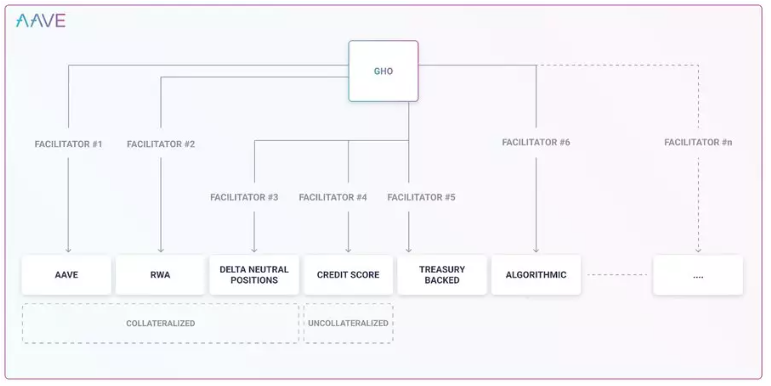
For Aave, $GHO sounds like a solid idea—but what’s the bigger picture? There are already so many stablecoins in the market. Now we add GHO—does life just become an endless string of letters pegged to one dollar?
Let’s step back and think holistically about stablecoins. Stablecoins are extremely important:
- They’ve surpassed $150 billion in total value.
- @samkazemian calls them “crypto’s third trillion-dollar opportunity.”
- @stablekwon ended the bull market.
But why do they have such massive impact?
Ethereum is the world computer; DeFi is the internet economy. On this world computer, liquidity is bandwidth, liquidity is connection, liquidity is rocket fuel—and liquidity controls everything.
It’s simple: liquidity measures how much of an asset you can buy or sell without causing slippage. What is slippage? It’s the difference between what you expect to get from a trade based on exchange rates and what you actually receive. For example:
10 $ETH trading at $2,000 = $20K
Pool A: $FRAX:$ETH, both at $1 million, totaling $2 million
Pool B: $FRAX:$ETH, both at $10,000, totaling $20,000
Pool A can support your trade, but Pool B effectively has no $FRAX. To execute your trade, Pool B must slide the price significantly.
Imagine you’re a new DAO trying to drive growth—perhaps you want to acquire strategic assets or need to pay developers. Your ability to convert tokens into treasury funds depends entirely on liquidity. If liquidity is too thin, selling will crash your token price.
This isn’t just about traders and DAOs—liquidity has existential implications for everyone. Without deep, pervasive liquidity, liquidations cause cascading failures. Large-scale liquidations create massive slippage, which sets new prices and triggers death spirals.
By nature, liquidity has two components: base asset (the asset you care about) and quote asset (the asset you trade against). In the real world, liquidity is quoted against fiat currencies.
Stablecoins attempt to replicate this behavior on-chain—providing an asset with universally accepted value that reliably stores value over time and functions as a medium of exchange. Stablecoins are the medium through which protocols forecast and manage liquidity.
Aave holds billions of dollars in assets within its smart contracts, but these assets lack liquidity. $GHO enables Aave to provide liquidity to DeFi without exposing its TVL. Aave increases the liquidity available across DeFi and earns returns in return (via $GHO interest payments).
In many ways, it's the same principle as $FRAX. @fraxfinance doesn't use user deposits but instead uses $FRAX to unlock liquidity for the assets held within its protocol. Issuing a stablecoin means returning liquidity to DeFi without sacrificing TVL.
So yes, I do believe we’re moving toward a world with thousands of stablecoins… but that doesn’t scare me. First, we’re building systems specifically designed for efficient value transfer between stablecoins.
More importantly, while I believe an overwhelming number of stablecoin options will become reality, I don’t think most people will notice. Just like grandma’s wallet won’t hold $dpxUSD, $VST, or even $FRAX… In fact, I’m surprised she’s even heard of them.
We’re still far too early. Everything you see today isn’t built for humans—if it happens on-chain, it’s meant for protocols, other chains, and non-human consumers. It’s like this:
Grandma doesn’t know what TCP/IP is, but she has no problem using her iPhone to access Facebook.
Therefore, when I see another stablecoin announcement, I don’t panic—I think the more, the better. For stablecoin newcomers, here’s some advice:
- Choose larger, more established stablecoins
- Pair with FRAXBP (@fraxfinance offers voting incentives)
Join TechFlow official community to stay tuned
Telegram:https://t.me/TechFlowDaily
X (Twitter):https://x.com/TechFlowPost
X (Twitter) EN:https://x.com/BlockFlow_News