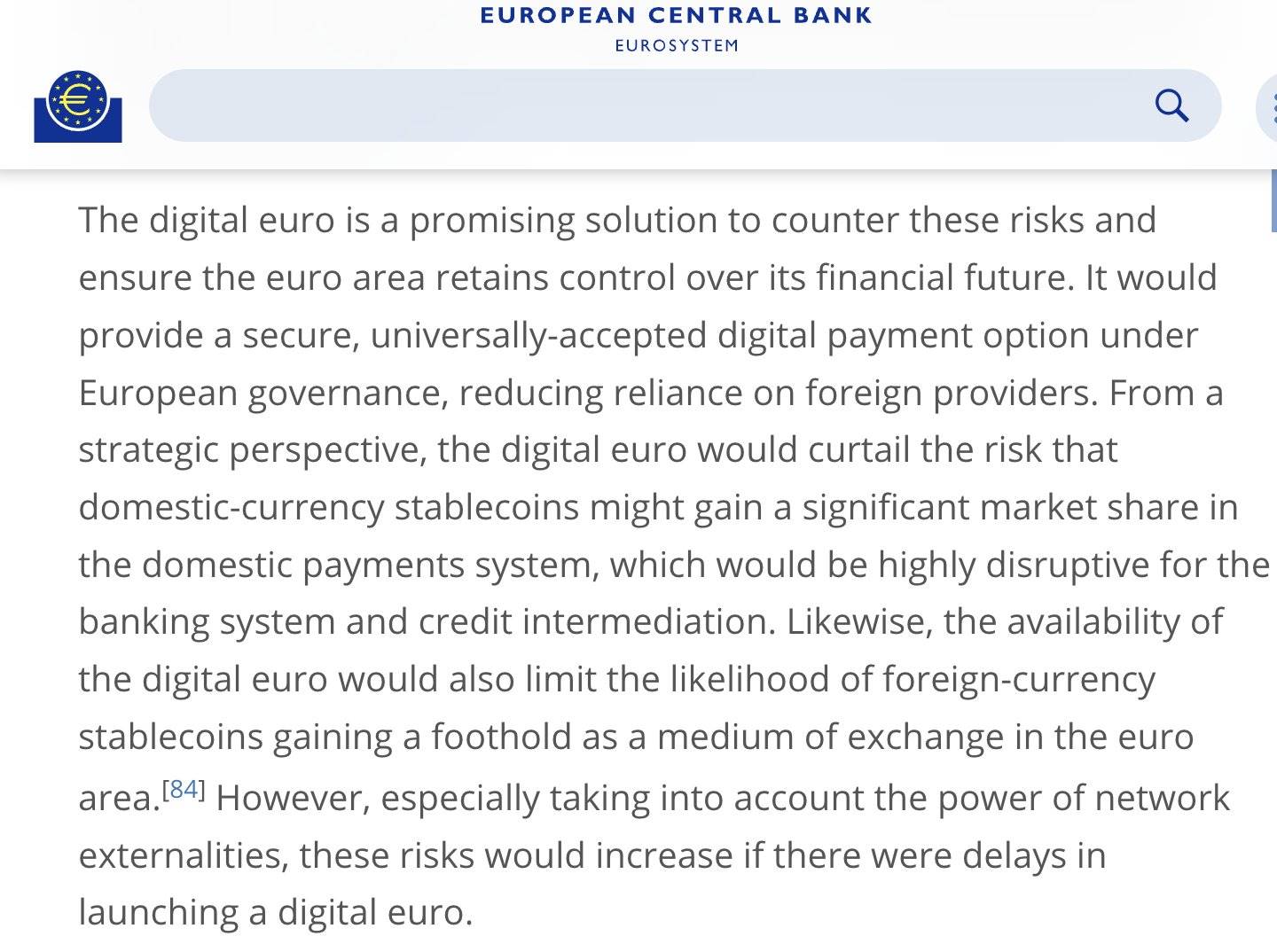
TechFlow news, on March 20, members of the Executive Board of the European Central Bank (ECB) recently stated that a digital euro is an effective solution to mitigate risks posed by stablecoins and will ensure the euro area retains control over its financial future. The digital euro would provide a secure and widely accepted digital payment option under European governance, reducing dependence on foreign providers. Strategically, the digital euro would contain the risk of domestic currency stablecoins gaining significant market share within domestic payment systems—a development that could have highly disruptive effects on the banking system and credit intermediation.
Philip R. Lane, a member of the ECB's Executive Board, delivered a keynote speech at the 2025 University College Cork Economics Society Conference in Ireland, noting that stablecoins have already gained prominence as a medium of exchange within the crypto-asset space. Although stablecoins are attractive for facilitating low-cost cross-border transactions, their growth could lead households and businesses to shift transactional accounts to stablecoin providers, diminishing the relevance of bank deposits and physical cash as means of exchange.
Lane examined two potential scenarios: first, a euro-denominated stablecoin becoming dominant, which would preserve the two-tier structure of the euro system but introduce new regulatory challenges; second, dollar-backed stablecoins gaining a foothold in the euro area, potentially anchoring the region’s domestic payment systems—directly or indirectly—to the US dollar rather than the euro.
The ECB emphasized that delays in launching the digital euro would heighten these risks due to the power of network externalities. Introducing the digital euro would limit the possibility of foreign-currency stablecoins establishing themselves as a medium of exchange in the euro area, thereby safeguarding Europe’s financial autonomy.