Interview with GenLayer Co-founder & CEO Albert: When AI Agents Start Trading, Who Will Serve as the Judge of the Digital World?
Author: Nina
AI Agents have begun to take on an increasing number of tasks once handled by humans, ranging from information retrieval and content generation to autonomous trading. In the future, they may independently sign contracts, purchase services, and even engage in commercial partnerships with other agents. A new question is emerging: if two AI Agents encounter a dispute, who determines right from wrong?
Under traditional legal systems, resolving a single commercial dispute often takes months or even years, and attorney and litigation costs can easily exceed the value of the claim itself. Such cost structures and efficiency levels are clearly unsustainable for the high-frequency, low-value agent transactions that will likely emerge in the future.
GenLayer aims to provide a new solution to this problem. Through Intelligent Contracts and the Optimistic Democracy consensus mechanism, it introduces AI's judgment capabilities into smart contracts, enabling blockchains to handle issues that require real-world contextual analysis, such as content quality, contract fulfillment, and dispute adjudication.
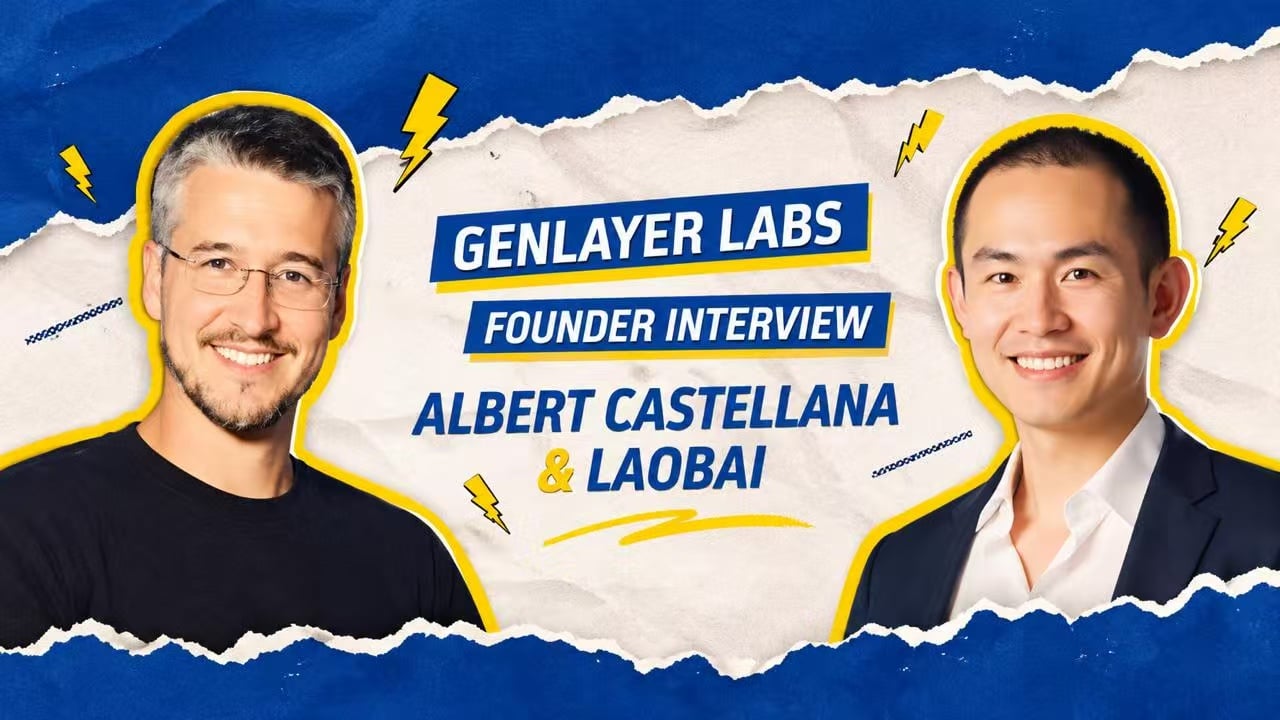
This idea stems from the personal experience of GenLayer co-founder Albert Castellana. He has participated in early blockchain projects such as NEM and Radix DLT, and co-founded the liquid staking platform StakeHound. A legal dispute involving approximately $250 million led him to rethink dispute resolution mechanisms in the digital economy.
In this episode, former ABCDE investor Lao Bai sits down with Albert for an in-depth conversation. Together, they explore trust issues in the AI agent economy, covering GenLayer’s origins, the technical principles behind its AI adjudication mechanism, real-world use cases, and future roadmaps.
From a Legal Dispute to a Digital Court in the AI Era
Lao Bai: What prompted you to start building GenLayer?
Albert: I entered the crypto industry in 2013, participating in early blockchain projects like NEM and Radix DLT. Later, I co-founded the liquid staking platform StakeHound with Edgars. The project grew rapidly, reaching a managed asset volume of around $350 million within five months.
However, a major custody incident occurred shortly after. Due to errors made by the custody provider during private key backup processes, approximately 50% of the assets became inaccessible. Based on the market value of these assets at the time or subsequently, the dispute scale reached roughly $250 million. The litigation spanned multiple jurisdictions including Israel, the United States, the UK, and Switzerland, with legal fees alone amounting to millions of dollars.
This experience highlighted the severe limitations of traditional judicial systems regarding cost and efficiency. For example, filing a $100 million lawsuit in Israel may require upfront court fees of $1 million to $2 million. Oftentimes, the act of defending one's rights demands enormous sacrifices.
Bitcoin gave us decentralized currency, and Ethereum enabled decentralized applications. At the time, I wondered if we could go further and build a decentralized decision-making system where disputes could also be resolved digitally.
This challenge becomes even more pronounced as AI agents become increasingly prevalent. In the future, there could be trillions of agents trading with each other, purchasing services, and signing contracts. If two agents located in different countries face a dispute, which country's laws should apply? Who would adjudicate it? These questions are difficult to resolve using traditional judicial procedures.
We hope to establish a global digital adjudication mechanism through GenLayer, enabling unfamiliar human users and AI agents to build transactional trust at a much lower cost.
Giving Smart Contracts Judgment Capabilities: How GenLayer Achieves AI Adjudication
Lao Bai: Decentralized arbitration projects like Kleros have emerged before, and a16z has also discussed using LLMs to solve prediction market adjudication problems. What sets GenLayer apart from these approaches?
Albert: We have maintained a collaborative relationship with Kleros; in fact, early on, we introduced GenLayer using concepts like "Kleros + AI." Kleros primarily relies on human jurors for adjudication, whereas we aim to directly integrate AI judgment capabilities into smart contracts.
Traditional Smart Contracts excel at handling deterministic logic, but many real-world scenarios cannot be simply judged by code. For instance, a marketing contract might stipulate that creators only receive rewards upon completing deliverables that meet specific requirements. However, determining whether content is original, meets quality standards, or genuinely satisfies brand expectations requires a degree of subjective judgment.
GenLayer's Intelligent Contracts can access the internet, fetch real-time data, and invoke AI models to analyze relevant information. This allows smart contracts to handle far more complex, real-world tasks.
Lao Bai: But individual LLMs can suffer from biases, and correlated errors may arise across different models. How does GenLayer improve the reliability of adjudication outcomes?
Albert: That was a core consideration when designing our Optimistic Democracy consensus mechanism. GenLayer has built a scalable verifier network. Each adjudication initially involves five verifiers; if the result is contested, the system expands the verifier committee and can progressively scale up to a larger set of active verifiers.
This mechanism draws inspiration from the Condorcet Jury Theorem. In simple terms, provided certain conditions are met, if each participant has a probability greater than 50% of making a correct judgment, increasing the number of participants helps improve the reliability of the majority decision.
Of course, different AI models might share similar training data or inherent biases. Therefore, we allow verifying nodes to utilize different models, prompts, and evaluation criteria, ensuring diverse perspectives throughout the decision-making process.
We aim for the system to produce neutral, consistent, and reproducible adjudication outcomes within reasonable costs and timeframes. Many real-world issues lack absolute standards, and traditional courts cannot guarantee that every ruling aligns perfectly with everyone's expectations. For a digital adjudication system designed for large-scale operation, decision stability and enforceability are paramount.
From Content Incentives to Prediction Markets: AI Adjudication Enters Real-World Application
Lao Bai: GenLayer sounds highly suited for the future agent economy, but what existing application scenarios have already been deployed?
Albert: Many of the tasks we currently handle actually originate from human users. For example, Collective Memory is a platform that gathers real-world data through user-submitted photos and videos, which can then be used for AI model training. The platform needs to verify whether submitted content is authentic and assess its quality to determine appropriate rewards. GenLayer evaluates content based on quality, authenticity, and context to decide reward amounts per user. For instance, one user might receive $3 while another receives $20, with the entire process automated by the AI adjudication system.
Another case is Rally, primarily used for distributing performance-based rewards in marketing campaigns. After users post content on X as instructed, GenLayer automatically assesses originality, quality, and task completion before distributing rewards accordingly. As of this interview, GenLayer processes approximately 16,000 decisions daily. Beyond these use cases, we are also exploring applications in prediction markets, insurance, and DAO governance.
Lao Bai: Compared to traditional manual review or arbitration, how significant are the improvements in cost and efficiency offered by AI adjudication?
Albert: For straightforward issues, such as determining whether an X post complies with campaign guidelines, involving five verifying nodes in the adjudication might cost only around $0.50, or even less. Under current designs, the system can deliver preliminary results in roughly three minutes, with final confirmation completed within about thirty minutes. For more complex disputes, users can escalate the appeal to bring additional verifying nodes into the evaluation process.
If a dispute escalates to the largest verifier committee, the entire process is estimated to take around three hours, costing approximately $100. As the inference costs of AI models continue to drop, operating expenses for this system are expected to decrease further. This means that in the future, many small-claim disputes previously deemed too insignificant to justify attorney and litigation fees could potentially be resolved via smart contracts.
The Next Step for the AI Agent Economy: Making Trust Infrastructure
Lao Bai: As AI agents begin autonomously executing trades, what do you see as the biggest challenge ahead?
Albert: I believe one highly complex issue is accountability. Suppose you instruct an agent to purchase goods on your behalf, but it makes a flawed decision. Should responsibility fall on the user, the developer, or the model provider?
This problem will grow even more intricate because one agent can create another, which in turn spawns even more agents. We are already utilizing such multi-agent ecosystems. If a fifth-generation agent malfunctions during task execution, should the original user bear full liability? There is currently no definitive answer.
Meanwhile, many future contracts may be drafted, read, and executed directly by AI. Agents will need a shared set of rules to confidently partner with unknown counterparts. We envision GenLayer providing such a mechanism. Two agents can agree prior to a transaction that any ensuing disputes will be adjudicated via GenLayer, with settlements executed automatically by smart contracts based on the rulings.
For traditional legal systems, processing micro-disputes is often prohibitively expensive. GenLayer aims to address this long-neglected demand, ensuring reliable dispute resolution services become accessible for smaller transactions as well.
I don't want to just resolve a single $100 million dispute; I want to be able to resolve 100 million problems worth $1 each.
Lao Bai: What are GenLayer's key development plans moving forward? How can developers and regular users participate?
Albert: For the past three years, we focused primarily on protocol research and development. Moving forward, we will prioritize token distribution and network deployment, targeting a mainnet launch by the end of 2026, followed by broader application integration. Currently, four to five prediction market projects are eager to build products atop GenLayer, and we are also engaging with insurers and potential partners to explore expanded automation use cases.
For developers, GenLayer can function as a standalone adjudication layer integrated into other blockchains. For example, a prediction market could continue operating on Solana, with corresponding assets remaining on Solana, while only the evaluation components are routed to GenLayer, returning adjudication outcomes back to the original chain to finalize settlements.
Regular users can also join the verifying node network. Since most AI inference is handled through external model services, running a node does not require expensive GPUs; the primary requirement is maintaining stable online connectivity. Our goal is to keep operational costs per node around $50–$100 monthly, enabling more individuals and institutions to participate. We strive to minimize participation barriers, allowing community verifiers to collectively make decisions. This decentralization is a core pillar of GenLayer's architecture.
From content moderation and marketing incentives to prediction markets and automated insurance, GenLayer has already begun exploring AI adjudication across various scenarios. As AI agents increasingly participate in economic activities, establishing trust between transacting parties and resolving conflicts will become critical challenges for developers and enterprises alike.
GenLayer hopes to address these challenges through Intelligent Contracts and a decentralized AI consensus mechanism, offering a low-cost, scalable solution. For Albert, the most compelling aspect of this technology lies in its ability to provide practical resolutions for the vast volume of micro-disputes previously rendered unworkable due to excessive costs.