Interview with Robinhood CEO: In the AI Era, How Can Ordinary People Seize Wealth Growth Opportunities?
Compiled & Translated: TechFlow
TechFlow Digest: While the entire tech sector is immersed in the narrative of explosive growth driven by Large Language Models (LLMs), retail investors are facing an unprecedented crisis of asset polarization. In past bull markets, retail traders could ride Amazon or Microsoft from billions to trillions in the secondary market; yet amid today's AI tsunami, most unicorns have already carved up massive valuation premiums during their private stages, postponing IPOs and effectively depriving the public of sharing in technological dividends.
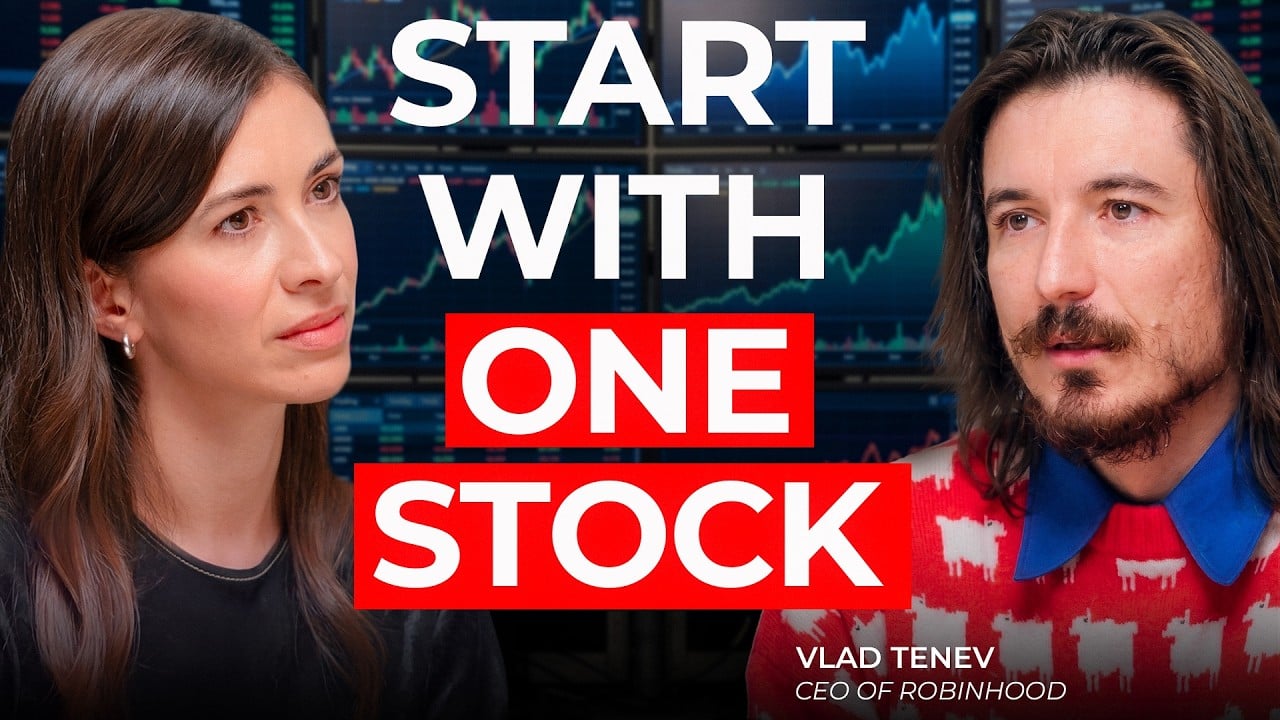
Facing this dilemma, Robinhood Co-founder and CEO Vlad Tenev, in a one-hour in-depth interview with Silicon Valley Girl, comprehensively deconstructs the path for individuals to break through in building wealth during the AI era. From how Robinhood's technical architecture provides compliant automated trading pipelines for AI Agents, to why "make me money" is the most dangerous open-ended prompt; from how executives can transform employees into "Agent Managers" overseeing dozens of 24/7 operating agents, to why statistical code generation alone cannot lead to AGI, and only the integration of Formal Verification can lay a reliable foundation. With a hardcore STEM background and a top-tier fintech leadership perspective, Vlad delivers a highly practical framework for wealth and cognition.
Guest: Vlad Tenev (Co-founder and CEO of Robinhood, Founder and Chairman of Harmonic, a mathematics-focused AI company)
Host: Marina Mogilko (Creator of Silicon Valley Girl, technology podcast producer, and entrepreneur)
Podcast Source: Silicon Valley Girl (https://www.youtube.com/watch?v=drrMoBocXZ0)
Original Title: Robinhood CEO: How to Build Wealth in the AI Era (Before It's Too Late)
Air Date: Beijing Time: 2026-11-25 01:20
Key Takeaways
The pre-IPO private stage consumes most AI wealth dividends: Traditional wealth-building narratives rely on companies going public early, enabling retail investors to grow alongside giants valued at hundreds of millions. Today, frontier AI leaders such as OpenAI, Anthropic, and SpaceX reach valuations exceeding $100 billion while still private, with the vast majority of growth benefits monopolized by venture capital and ultra-high-net-worth groups. Robinhood is tackling underlying regulatory and clearing channel barriers, striving to open regulated private unicorn equity investment windows for the general public.
The cornerstone of AI Agent managed trading lies in independent sub-accounts and hard sandbox risk controls: Unrestricted connection of primary financial accounts to general-purpose LLMs poses catastrophic risks. Robinhood advocates establishing dedicated "AI isolated sub-accounts" via APIs for ChatGPT or Claude, setting extremely strict fund allocation caps, asset whitelists, and mandatory stop-loss conditions, executed by automated schedulers at designated times or market conditions, without granting black-box AI open-ended access to fund withdrawal permissions.
"Make me money" is the most dangerous and inevitably zero-out speculative prompt: Simply issuing open-ended profit commands to AI will inevitably cause models chasing local maximum returns to slide into speculative traps involving leverage and buying high-risk junk assets. An effective personal finance Prompt must include rigorous quantitative constraints and defensive logic, explicitly defining asset pools, P/E ratios, margin of safety, and hard downside stop-loss lines, using precise rules to frame model actions.
Statistical AI coding alone cannot lead to Artificial General Intelligence (AGI): Current programming LLMs are essentially probabilistic imitations of open-source code, unable to guarantee absolutely zero logical loopholes when facing complex financial systems, aerospace engineering, or core infrastructure. Harmonic, co-founded by Vlad, is advancing mathematical formal verification through the Lean language. Only when every line of code passes strict mathematical logic checks can AI completely eliminate hallucinations and become a reliable foundational pillar.
Organizational restructuring: Every employee should transition into an Agent Manager overseeing 24/7 operations: Internally at Robinhood, AI is not a chat toy for typing assistance, but an organizational multiplier. Top performers are transforming into managers directing 5 to 10 specialized vertical Agents, setting strategic goals and auditing output quality by day, while schedulers drive Agents to continuously run stress tests, clean data, and generate code by night, achieving seamless 24/7 organizational productivity.
The core growth principle for CEOs: Must decisively "fire your past self" with each new cycle: The core competencies required differ entirely as a company scales from 2 people to 20, then to thousands. Facing the 2021 retail frenzy crisis and macroeconomic cycle reversal, Vlad realized that founders indulging in startup-era technical micro-details and fighting solo would become bottlenecks; only by courageously firing your past self psychologically can you rebuild into a mature leader adapted to a hundred-billion-dollar scale.
Highlight Quotes
"If a company lists at a $10 billion valuation and grows to $100 billion, public investors can share a tenfold era dividend; but if a company fundraises up to $150 billion during its private phase before even considering an IPO, the most explosive value-creation curve has long been shut to the average person. Smashing the class barriers of private markets is the most pressing battle for financial democratization in the AI era."
"Never tell your AI assistant 'make me money'; it's as absurd as handing a three-year-old a gun and saying 'fix my life problems.' To fulfill your command, the model will unhesitatingly plunge into illiquid, high-leverage gambling casinos. The essence of finance is always risk management; what you need to give it is a defense manual, not greedy instructions."
"Software is not dead, but the old world of writing and distributing software has passed away. Previously, you needed to hire dozens of engineers and spend half a year building a rough backend prototype; now, anyone with clear logic can use natural language to drive Agents to assemble a complete product within a single weekend. Productivity inflation means mediocre code will become worthless, while rigorous business insight and architectural judgment will become incredibly expensive."
"Current AI programming assistants are more like highly skilled stenographers; they write seemingly polished code, but you cannot mathematically prove whether fatal edge-case crash vulnerabilities exist. In financial trading and core infrastructure, '99% correct' equals 0. This is why formal mathematical verification is so crucial—it gives code absolute certainty akin to the Pythagorean theorem."
"As an entrepreneur and CEO, your biggest enemy is often not competitors, but the version of yourself that once led you to early success. At every critical growth inflection point, you must calmly stand before the mirror and, from the board's ruthless perspective, say to your past self: 'Thank you for your contributions, but you are no longer qualified for today's scale. You're fired.' Then step back into the role in a completely new professional manager capacity."
Full Dialogue Transcript
Retail Investors Missing Pre-IPO Windfalls: Breaking Through from Secondary Markets to Private Equity
Marina Mogilko: Vlad, in today's tech investment circle, everyone is talking about the massive wealth effects brought by AI. But for many ordinary wage earners or retail investors, they often feel a strong sense of powerlessness: top companies like OpenAI, SpaceX, and Anthropic have inflated to staggering valuations, yet they do not trade on public stock markets. How do you view this wealth disconnect faced by ordinary people in the AI wave?
Vlad Tenev: Marina, you have pinpointed the most severe structural problem currently facing global capital markets.
We can look back at history: in the 1990s or even early 2000s, giants like Amazon, Microsoft, or Apple went public at very early stages, when their market caps were merely hundreds of millions or billions of dollars. What does this mean? It means any ordinary retail investor with basic industry knowledge could buy shares for a few hundred dollars on the public market and grow alongside them by hundreds or even thousands of times over the next two decades. The public shared in the sweetest portion of the technological revolution's value curve.
However, over the past ten to fifteen years, the game rules of the entire capital market have undergone severe distortion. Due to extremely abundant venture capital, sovereign wealth funds, and ultra-high-net-worth private capital in the primary market, modern startups often choose to stay in the private market for as long as possible. They complete Seed, Series A through F financing rounds in non-public markets, with valuations skyrocketing from $1 billion to $50 billion or even $150 billion.
This leads to a cruel reality: when a company finally rings the bell on the NYSE or Nasdaq, its most explosive compound growth phase has already ended. Retail investors in the public market often only get to take over at peak valuations, gambling for standard annualized returns of 8% to 10%, while early-stage excess wealth worth hundreds of times has already been divided up among a privileged few in closed-door meeting rooms.
In the current AI revolution, this phenomenon has been amplified to the extreme. OpenAI's valuation has reached $157 billion, while Anthropic and SpaceX valuations are equally staggering. Retail investors simply cannot buy their primary market equity.
This is also one of our core focus areas we are tackling with all our force internally at Robinhood. We are exploring a series of compliant technical architectures and financial instruments, attempting to fragment and legitimize private market liquidity, allowing ordinary registered users to indirectly hold economic rights to top-tier private unicorns at an extremely low threshold. Enabling every ordinary person to equally share in the top-level prosperity brought by AI productivity is the mission we have steadfastly upheld since our founding.
Why Beginners Are Advised to Start by Buying Their First Stock
Marina Mogilko: Many financial advisors usually tell young people: "Don't pick individual stocks; dollar-cost averaging into the S&P 500 index or broad market ETFs is the only wise choice." But I know you encourage beginners in many settings to seriously buy their first individual stock. What is the logic behind this?
Vlad Tenev: From the perspective of pure Modern Portfolio Theory (MPT) and statistical expected returns, the financial advisors' advice is certainly correct; passively DCA-ing into broad-based indices is the most robust asset defense strategy for the vast majority.
But humans are not cold mathematical models; we are emotional creatures with curiosity. If you tell a twenty-something just entering society: "Throw your money into a ticker called VOO, then turn off the screen and wait forty years," it's hard for him to develop any genuine passion or deep thought about investing.
I recommend beginners start by buying their first specific single stock. The core purpose is to build "cognitive skin in the game."
You can pick a company you are extremely familiar with and love in daily life: perhaps a phone brand you use every day, a coffee you drink daily, or software you browse constantly. The moment you truly buy one share or even fractional shares with your hard-earned money, a wonderful chemical reaction occurs.
You start following the company's quarterly earnings, noticing what its competitors are doing, pondering why supply chain disruptions affect its gross margins, and even caring about how macro interest rates influence its valuation multiples. That small investment is actually a lifetime ticket you buy for yourself to understand the business world and macroeconomics.
Once this business intuition and cognition are gradually established, you can naturally expand your portfolio into broad ETFs and stable assets. Stimulating curiosity through specific single stocks first, then building a defensive system through asset allocation—this is the sustainable path to growth.
The Safety Red Line for Connecting AI to Financial Accounts
Marina Mogilko: Many people are now trying to connect ChatGPT, Claude, or custom AI Agents to their financial brokerage accounts via API, letting large models automatically scan markets and place orders. As the head of a platform managing millions of users' assets, do you think directly connecting AI to bank or stock accounts is safe?
Vlad Tenev: This is an extremely serious and hazardous topic. My direct answer is: given current LLM maturity, handing full global control permissions of a primary financial account directly to a black-box LLM is tantamount to a suicidal financial gamble.
We must recognize the underlying mathematical nature of LLMs: they are probabilistic completion models trained on massive corpora, lacking true logical certainty. They suffer from severe hallucinations, are vulnerable to Prompt Injection attacks, and lack hard causal understanding of physical and financial realities.
If left unconstrained to trade on behalf of clients, a large model could misinterpret an unverified tweet or be lured by maliciously constructed web data, launching extremely dense irrational trades in a very short time, potentially swapping all your principal into illiquid junk micro-caps.
Therefore, in Robinhood's engineering design, we emphasize "Security Sandbox and the Principle of Least Privilege":
First, strict account isolation must be implemented. If you want to use AI-assisted trading, you must never let it touch your main or long-term retirement accounts. Instead, establish a dedicated "AI experimental sub-account" containing only a small amount of risk capital whose total loss would not disrupt your normal life.
Second, hard deterministic risk control gates must be set by underlying code. This includes: hard caps on maximum transaction amounts, daily trade limits, whitelist-only trading for pre-audited compliant large-cap assets, and mandatory circuit-breaker stop-loss mechanisms when drawdowns hit specific thresholds.
Large models can only propose trade suggestions or execute predefined actions within these ironclad fences. They must never be granted supreme privileges to bypass rules.
Why "Make Me Money" Is the Worst AI Prompt
Marina Mogilko: For many new to AI finance, the most common prompt entered into the chat box is: "I have $10,000, please help me earn as much profit as possible through US stocks next month." Why do you consider this prompt disastrous?
Vlad Tenev: This is a classic objective function mismatch. When you tell AI "make me money" or "pursue maximum profit," how will the model's optimization algorithm interpret it?
From a mathematical expectation standpoint, the only path to pursue the highest potential returns in an extremely short time is to bear ultimate tail bankruptcy risk: going all-in on deeply out-of-the-money short-term call options, or maxing out leverage to bet on after-hours volatility of small-cap stocks. The system might occasionally bring huge profits, but across 99% of evolutionary paths, this strategy's endgame is complete liquidation to zero.
The eternal core of financial investment is never pursuing peak returns, but "managing downside risks under the premise of ensuring survival." A professional investor always calculates the maximum loss they can withstand first, then seeks matching risk premiums.
Therefore, a qualified, actionable AI finance Prompt must be filled with rigorous conditional constraints. For example, you should instruct the model like this:
"Please screen within S&P 500 constituents to identify resilient targets with free cash flow yields in the top 20%, net debt ratios below the industry median, and drawdowns exceeding 15% over the past three months. Position sizing must not exceed 3% of the sub-account's total assets each time. After purchase, strictly set a hard trailing stop-loss of 7%. If no opportunities matching these factors appear in the market, maintain cash position."
See, under this framework, you are not asking it to work miracles, but transforming it into a tireless execution machine strictly enforcing quantitative discipline. The more constraints, the more predictable the AI's actions, and the more real the value it brings.
Software Is Not Dead, But the World of Writing and Distributing Software Has Completely Changed
Marina Mogilko: A radical argument circulating in Silicon Valley recently claims "Software is Dead," because anyone can use AI to write code in minutes, rendering traditional software moats obsolete. Coming from a technical background yourself, do you agree with this notion?
Vlad Tenev: I completely disagree with this sensationalist phrasing. Software is not dead; on the contrary, humanity's demand for software is experiencing an exponential explosion.
The so-called "Software is Dead" fundamentally means the death of the "traditional costly and slow software development and outsourcing delivery model."
In the past, if a small enterprise wanted to customize a proprietary internal customer management or logistics dispatch system, it needed to find an outsourcing team, expend hundreds of thousands of dollars and a half-year development cycle, ultimately receiving a clumsy, hard-to-maintain system. Today, with cutting-edge tools like Cursor and Claude 3.5 Sonnet, a business leader with zero formal computer science background merely needs to describe their workflow in clear natural language to assemble a fully functional, highly tailored agile software within a single weekend.
This means the supply-side cost of software has been infinitely compressed to near zero, and software is becoming a ubiquitous infrastructure like electricity. Every tiny business process around the world originally relying on paper, Excel, or human memory can now—and should—be digitized into software.
Therefore, the actual volume of source code itself has completely lost its moat status. True moats are irreversibly shifting to both ends:
One end is "deep proprietary data and regulated financial network infrastructure," such as Robinhood's broker clearing channels, compliance licenses, and real-time matching engines built over years—these physical barriers cannot be replaced by a few snippets of AI-generated code under any circumstances;
The other end is "profound understanding of real-world business pain points and architectural taste." Knowing which problems to solve is often a thousand times harder than figuring out how to type out the code.
Formal Mathematical Verification and Harmonic: The True Foundation for Superintelligence
Marina Mogilko: Besides managing Robinhood, you founded and serve as chairman of Harmonic, a hardcore AI company focused on mathematical and logical verification. Why are you so fascinated by the extremely dry and abstract "Formal Mathematics" when everyone else is chasing LLMs for storytelling and copywriting?
Vlad Tenev: It stems from my profound anxiety regarding the underlying flaws of current large models.
The existing Transformer architecture is essentially pattern matching and statistical inference within an enormously vast high-dimensional parameter space. When it writes a captivating essay or common web frontend code, humans are highly tolerant of potential minor flaws.
But in the core pillar fields of human civilization, such as high-reliability aerospace systems, foundational code controlling nuclear power plant operations, and modern financial settlement/clearing systems processing trillion-dollar fund flows instantaneously, the tolerance for error is strictly zero. In these domains, a single logic boundary violation or null pointer exception in the code results in instantaneous evaporation of hundreds of millions of dollars or even loss of life.
And current AI programming assistants, regardless of how smart they appear, still generate code prone to unpredictable hallucinations and logical pitfalls. You must deploy senior engineers to spend multiple times the effort auditing and debugging line by line.
Harmonic's foothold is to introduce "Formal Verification" into artificial intelligence. Under the framework of formal mathematics (such as through interactive theorem provers like Lean), whether a piece of logic or code is correct is not judged by human intuition or checked via a few test cases, but proven at the level of mathematical axioms through absolutely rigorous logical steps by a computer.
Once code passes the scrutiny of a formal verifier, its correctness becomes as irrefutable as Euclidean geometric theorems, 100% immune to logical loopholes.
I believe true AGI (Artificial General Intelligence) cannot be born in a black-box system riddled with statistical hallucinations. Future superintelligence must possess rock-solid logical deduction capabilities, and formal mathematics is the hardest foundation for endowing AI with certain truth cognition. The technology we accumulate at Harmonic will also feed back into the forefront risk control of financial systems in the future.
How AI Is Implemented Internally at Robinhood: Employees Become 24/7 Operating Agent Managers
Marina Mogilko: As the CEO of a public company with thousands of employees, how do you push for organization-wide AI adoption internally at Robinhood? Many worry that introducing AI will lead to layoffs, or that employees will just lazily use it to draft emails.
Vlad Tenev: Organizational change has never been achieved by issuing official documents or holding a few training sessions. At Robinhood, we implement a management philosophy that completely reconstructs the human-machine collaboration paradigm: we require every engineer and key business personnel to learn how to transform from traditional "frontline executors" into "Agent Managers" overseeing multiple all-day autonomous operators.
In the traditional model, a senior engineer's day is typically fractured into: meetings, writing dozens of lines of code, waiting for lengthy code reviews, manual debugging, submitting to test environments. Human biological clocks are limited; once work hours end, all progress stalls.
In our newly implemented workflow, an engineer's core energy should focus on macro-architecture design and precise definition of system specifications. Subsequently, they can invoke multiple AI Agents that have been deeply fine-tuned for specific codebases:
Agent A is responsible for writing underlying interfaces according to spec sheets; Agent B automatically traverses thousands of extreme edge conditions in the background to generate unit tests; Agent C conducts static performance analysis and memory leak troubleshooting across the entire codebase at night.
When the engineer wakes up the next morning and opens their laptop, they no longer face a blank code editor, but Pull Requests completed by various Agents accompanied by detailed verification reports. The human role transforms into a top-tier system architect, code reviewer, and taste arbiter.
The standard we use to measure a team's AI adoption is absolutely not "how many Prompts you wrote," but rather whether your business delivery cycle has shortened from weeks to hours, and whether your system has achieved tenfold throughput and robustness without increasing labor costs. Once this leverage effect is rolled out across the company, organizational competitiveness will leap in a dimensionality-reduction manner.
CEO Cognitive Transformation: Why You Must "Fire Your Past Self" at Every New Scale
Marina Mogilko: Vlad, from a Stanford math physics grad student, to founding a high-frequency trading system, to leading Robinhood into a global giant with hundreds of billions in trading volume, you've experienced countless highlights and extreme trials like the 2021 retail-vs-WallStreet showdown (GameStop event). Looking back, what is your most important realization as a manager?
Vlad Tenev: If this decade-plus entrepreneurial career taught me one most important rule, it is this: founders must possess the courage to personally "Fire Yourself" at every critical growth milestone.
Many startup founders die in their own strength-trap. In the seed phase when a company has only five or ten people, the best founders are often that hardest-core super-individual: you personally write the core matching algorithm, you personally deal with server rooms, you personally handle every severe live Bug. This extreme obsession with micro-details is the sole reason a startup can break out from zero.
But when a company grows to five hundred or three thousand people, facing complex listed-company compliance, global geopolitical regulation, capital market expectation management, and massive organizational synergy networks, if you still try to grab every line of business code, if you still cling to being the "smartest person in the company" making single-point decisions, you will become the largest single-point failure node and bottleneck for the entire organization.
Experiencing that globally shocking extreme liquidity stress test in 2021 brought me the deepest epiphany of my life. I realized that the Vlad who initially hacked together solutions in a Palo Alto garage relying on geek inspiration was no longer qualified to manage the role of a public institution leader wielding the financial trust of tens of millions of users.
I had to ruthlessly fire that old version of myself from deep within. I needed to build a completely new understanding system for system dynamics, organizational delegation, risk governance, and public communication.
To this day, I maintain this regular psychological review mechanism: every twelve to eighteen months, I step back one pace, pretending to be a cold, objective independent external director, examining current business challenges against my management radius. If certain past thinking habits are hindering the company's next evolution, I must bury them without hesitation and reconfigure myself as a brand-new CEO adapted to the next decade's challenges.
Join TechFlow official community to stay tuned
Telegram:https://t.me/TechFlowDaily
X (Twitter):https://x.com/TechFlowPost
X (Twitter) EN:https://x.com/BlockFlow_News
 深潮TechFlow