The Rise and Fall of Sovereign-Grade Assets (Part One): Who Created the First Ponzi?
Author: Zuo Ye
The crypto market has recently performed poorly. This slump stems partly from stagnant token prices and declining trading volumes, but more importantly, it reflects the disillusionment of prevailing narratives. There was a time when SBF genuinely blew bubbles to the skies, channeled crypto capital toward integration with AI, and envisioned alternative, uncharted frontiers for the metaverse.
You can't make bricks without straw; the core issue remains a lack of asset creation models. Regarding liquidity exit strategies, the crypto sector is forced to choose between two paths: direct retail issuance via TGEs, or public offerings via IPOs targeting traditional markets. Meanwhile, outside capital rarely opts for M&A, nearly zero PE firms are counter-cyclically buying the dip, and even worse, many projects simply rug pull and vanish.
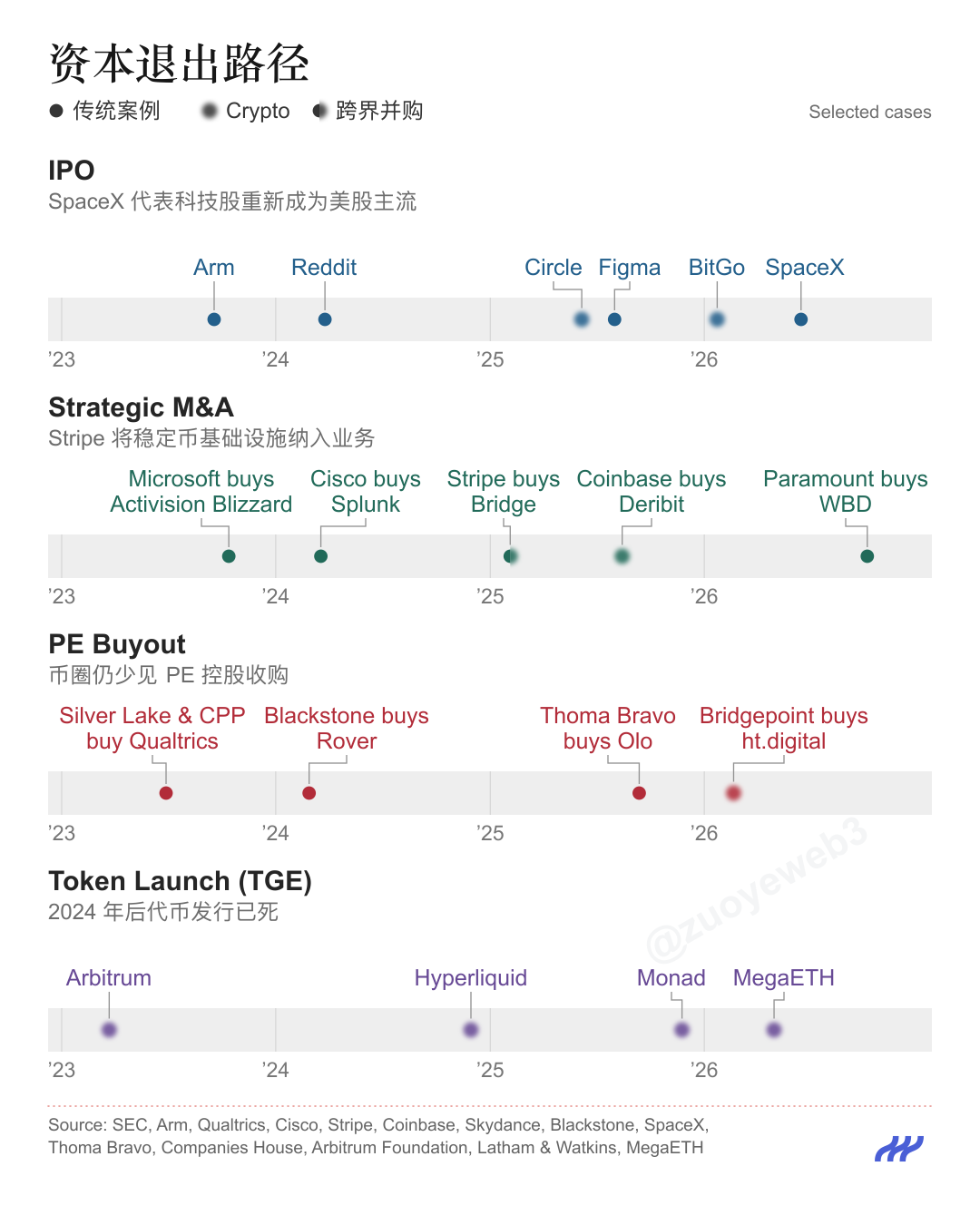
Fig: Capital Exit Paths
To put it bluntly, creative innovation in cryptocurrency keeps diminishing. It boils down to the same old cycle: Meme tokens, perpetual futures (Perps), and prediction markets. We've entered a repetitive, almost delusional loop where everything must be Perp-ified, followed by brokerages easily manipulating retail investors during the new listings for SpaceX and ANT.
In other words, crypto launches can no longer attract external user acquisition. The art of project distribution has hit its lowest point, making it necessary to study how the original Ponzi scheme has been repeatedly reinvented, and somehow survived to this day.
Let's give the answer first: the state itself is the first Ponzi scheme. Ponzis are not a financial anomaly; they are the essence of finance. Sovereign-grade assets represent the most successful Ponzi model, born of war, expanded through securitization, and granted a sense of eternity by time. The problem in crypto isn't that there are too many Ponzis; it's that the sector cannot issue sovereign-grade Ponzis.
War Invented Government Bonds
The origin of sovereign-grade assets does not lie in finance, but on the battlefield.
In the Middle Ages, the only enterprise requiring massive capital investment was governing a state, and the only large-scale ventures demanding vast funds were wars.
The invention of government bonds is tied exclusively to one thing: national foreign wars. Whether it was medieval Venice raising funds for the expedition to Constantinople, Britain issuing bonds to fight Napoleon and cementing the Rothschild legend, or Jay Cooke socializing investment in the U.S. during the Civil War, these events are what truly transformed government debt into modern bonds.
Feudal lords' conflicts birthed the precursor to modern finance, while the financial sector's risk-adjusted returns fueled the Age of Discovery, capitalism, and scientific advancement.
It wasn't that the economy shifted from real to virtual after the Industrial Revolution; rather, the creation of sovereign-grade assets drove the Industrial Revolution.
Moreover, the mobilizing nature of war bonds extends beyond wartime fundraising; it functions as the everyday operational model of modern democratic politics, where votes act as donations and election campaigns function as internal civil conflicts.
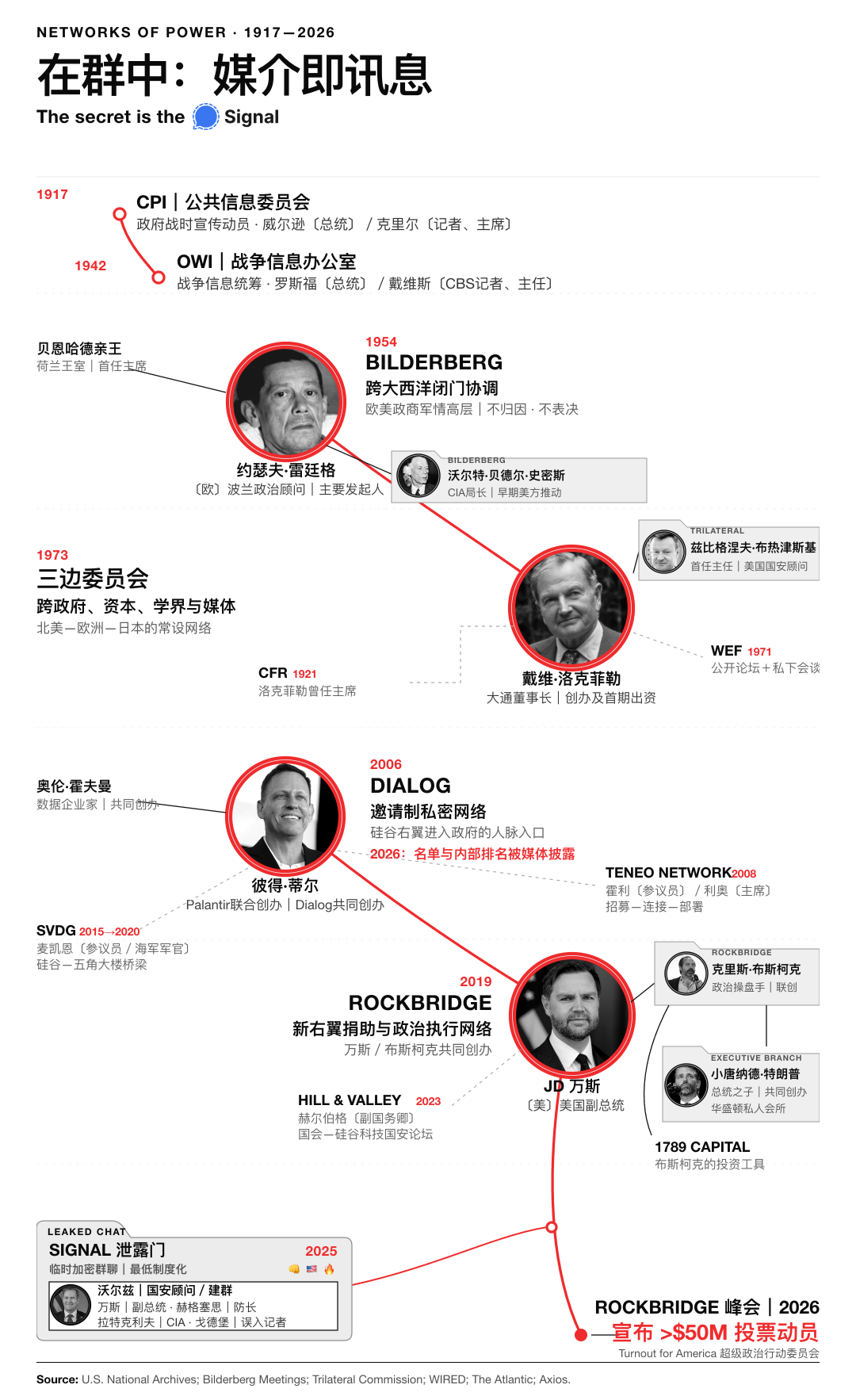
Fig: Fundraising as Mobilization
Although the Republican Party did not win the midterm elections, its candidate alone raised over $50 million in political donations. The struggle never ends, and capital matters far more than approval ratings.
One could even argue that political donations are more scientifically effective than distributing welfare to buy votes, since welfare represents long-term liabilities with exceptionally low returns.
You might even consider the South Sea Bubble a minor issue for Britain, easily digested over a long timeline, but war is unforgiving. You can lose the Boer War once, but you must reclaim victory, otherwise financial confidence will collapse—just as failing to defeat Iran would cost you both chambers of Congress.
Business consequently became militarized, utilized across the Western world as a tool for social mobilization, and methods of credit creation were continuously invented.
Wealth accumulation followed the continuous opening of sovereign-grade assets to commerce and individuals. British privateers were essentially public-private partnerships; pirates plundering Spain acted as partners to the English Crown; and the East India Company secured equity valuation benchmarks by managing cash flows across India.
In our conventional view of sovereign-grade assets, ordinary individuals merely serve as funders. However, Western history shows that regular citizens and enterprises can absolutely be the main entities, operating as acknowledgments or ratifications of innovators—not deliberate inventions by the government.
Ponzi Schemes Generate Liquidity
Wars taught nations to borrow money, but what truly transformed debt into assets was the fractionalization and retail sale of these obligations.
To be extreme, it is not an exaggeration to claim that war bonds catalyzed the emergence of stocks, social insurance systems, and even the modern monetary system.
The South Sea Company and Mississippi venture were essentially the British and French governments packaging state debts and tax collection rights into specific corporations to resolve fiscal imbalances. These corporations further securitized the assets for retail distribution, effectively birthing the modern stock market, while financial instruments like options and short selling, repeatedly banned thereafter, were virtually invented overnight.
Bugs were never eradicated, and derivatives were never actually banned.
Neither the British Empire nor the post-WWII American empire could maintain their currencies' gold peg. Amid the foreign exchange liberalization wave of the 1970s–80s, the CME Group pioneered interest rate futures. Prior to this, all options/futures essentially required physical delivery—even FX involved currency exchange—but interest rates fundamentally lacked a physical counterpart.
Ultimately, innovation outpaced regulation, and the CFTC eventually granted retroactive approval, permitting USD settlement and creating the modern differential clearing version. This marks the true starting point for Arthur Hayes inventing perpetual contracts.
By 2025, the largest lending institution is not JPMorgan Chase, but BlackRock, which dwarfs the entire banking system with a $32 trillion scale, with bonds as its core assets. We can even argue that monetary banking theory centered on central banks no longer aligns with reality.
Nixon's inability to withstand dollar inflation pressures serves as the origin point for the entire crypto leverage mechanism. History is remarkably humorous, repeatedly attempting to re-teach humanity under the guise of technological innovation.
Gutenberg's printing press not only raised literacy rates and sparked the Protestant Reformation, but also enabled mass paper currency printing, acting as a catalyst for severe inflation.
Derivatives are merely a side branch. The greater offspring of sovereign-grade assets is the nationwide mania that erupts roughly every century.
Debt is merely a credit certificate; the actual swap of capital and resources is far more tangible.
The logic isn't complex. Creditors invest in foreign assets—for example, the French frenzy for Mississippi in the 1720s, Britain's obsession with Latin American minerals, or even the original Ponzi prototype, the 1637 Dutch tulip mania, which itself was a derivative product of actual profits earned by the Dutch East India Company.
Since the end of the Middle Ages, human history shows that roughly every century, societies fall into a collective mania. Beyond narrow-sense war bonds, most assets capable of triggering nationwide frenzy are represented by bonds:
- 1637: Tulip Mania
- 1720: South Sea Bubble, Mississippi Bonds
- 1820: American Railroad Fever
- 1920: Coolidge Prosperity
- 2020s: AI Mega Funds
Naturally, not all the above cases involve bond trading. However, Nvidia's AI chip revolving loans, the stock market surge of the Coolidge era, and the capital forms behind the railroad fever generally follow a path initially driven by bonds, later taken over by retail stock market investors.
The equity-to-bond conversion isn't a Jia Yueting invention; it's merely an unintentional tribute to early 18th-century Britain and France. MicroStrategy's STRC BTC-based reissuance is just the accumulation phase of the South Sea Bubble. Returns must ultimately be guaranteed by real-world production, or fueled by mania for AI factories. Perhaps, this time is different.
During the dull interwar years, bankers and ordinary citizens who had enjoyed high interest rates eagerly sought the next high-yield project. Ordinary investors were often even more frenzied than bankers, much like Hyperliquid community members showing more devotion than the project developers themselves.
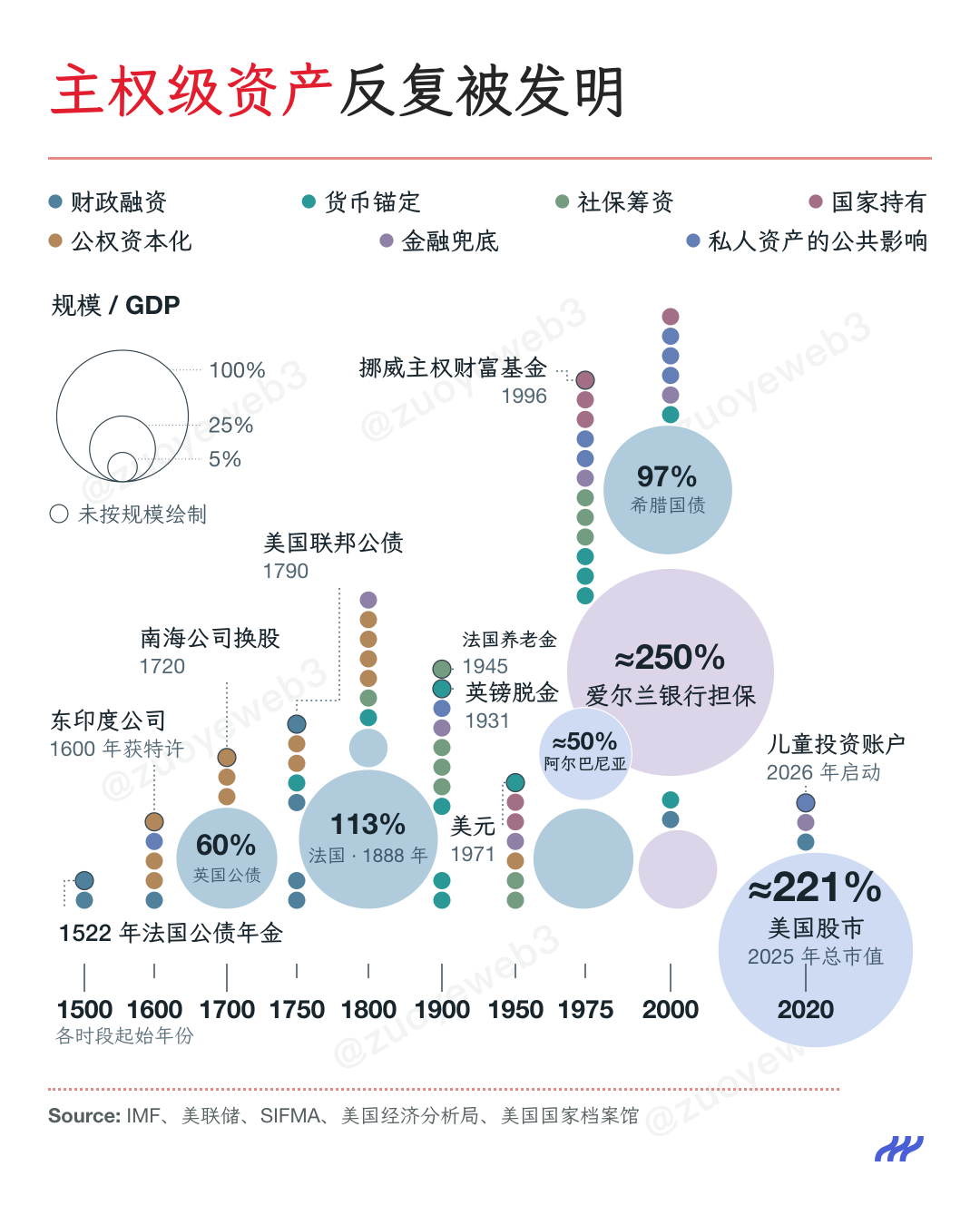
Fig: Sovereign-grade Assets Repeatedly Invented
The sovereign asset-ification of US equities is far from a romantic tale under the sycamore trees. Even though the Great Depression of 1929 originated from a stock market crash, it cannot prove that the stock market hijacked the US economy. The modern stock market remains a latest invention of the 20th century's 70s. Employee pensions, executive options, and corporate share buybacks comprehensively funneled all Americans' wealth into equities, truly transforming the stock market into a national asset.
Even day traders are creations of this current wave; Robinhood is merely their re-invention for the internet age.
Therefore, Peter Thiel placed a "Conquer the World Index" in the PayPal office. Despite being nothing more than user counts bought with cash burn, wrapped in the miraculous packaging of growth rates, it served as a discount metric based on expectations. Everything was financialized.
Entering the new century, the only enterprise requiring massive capital investment is conquering the world, and the only large-scale venture demanding vast funds is innovation.
From the South Sea Company to the CME Group, from interest rate futures to perpetual contracts, and to PayPal's Conquer the World Index, crypto's Perps and TGEs inherently belong within this genealogy; they simply hold the lowest generation status.
Furthermore, when a Ponzi encounters a state entity and becomes a sovereign-grade asset—especially a regime temporarily holding hegemony, channels, or resources—it evolves into a mechanism that repeatedly extracts wealth from counterparties. When the Ponzi reaches its tail end and debt hits its limit, eliminating creditors is far simpler than paying interest.
Nations Do Not Go Bankrupt
The question is, if every mania eventually crashes, why can sovereign-grade assets restart again and again?
In the news, we frequently encounter abstract cases like the US government shutdown, the Eurozone debt crisis, or even Sri Lanka's sovereign default. This contradicts common sense: how can a sovereign nation go bankrupt due to mismanagement like a corporation?
In reality, compared to wars and sanctions, the international debt system exerts stronger constraints on governments, because credit ratings genuinely determine whether a state can access external funding. Compared to domestic taxation, borrowing for projects is often more direct and can yield higher returns.
Moreover, contrary to intuition, the consequences of most sovereign defaults are not as terrifying as imagined. Taking Argentina as an example, it still secures IMF loans and US financial aid after default.
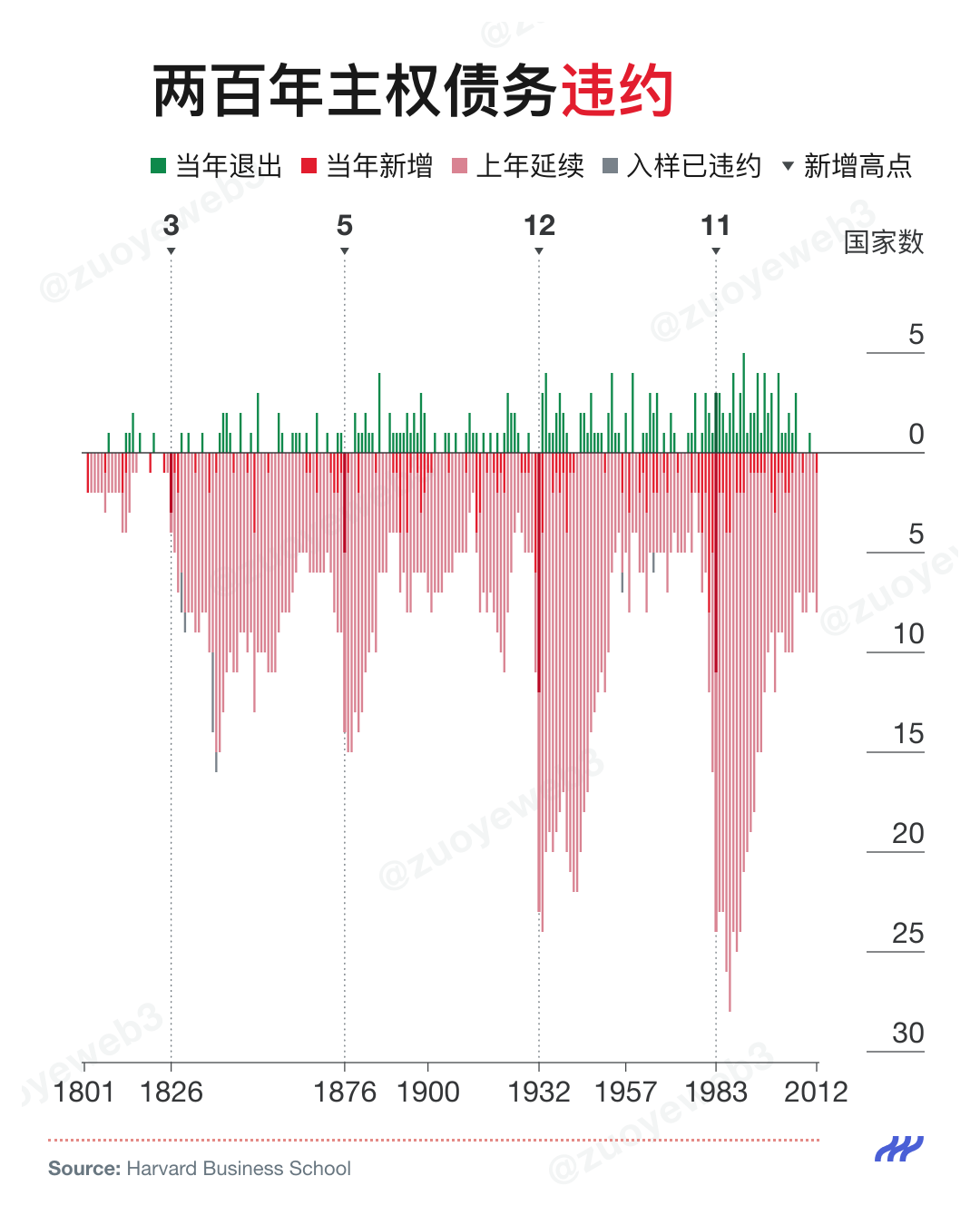
Fig: Sovereign Debt Default
Historically, war bonds have hindered states' ability to pay personal pensions, leading to multiple collapses. The state's repeated credit defaults against its own citizens form the historical basis for the notion that "domestic debt is not debt."
When sovereign-grade assets ultimately fail to redeem, they devolve into Ponzi mechanisms, but this itself is not a problem. Indeed, within lengthy debt resolution cycles, humanity invented capitalism and modern science, with the price tag merely being two World Wars.
As for the 2008 financial crisis era we inhabit, we remain trapped in its aftermath phase. As previously noted, Europe resolved its debt crises through two World Wars, and the Federal Reserve certainly won't solve America's debt crisis. If we don't await a Third World War, it's best to hope the promises of AI hold true.
Especially now, central banks are fundamentally powerless to stop the continuous erosion by administrative systems. Yet, to prevent a total collapse of the credit system, they must perform on stage, pretending to care about money supply.
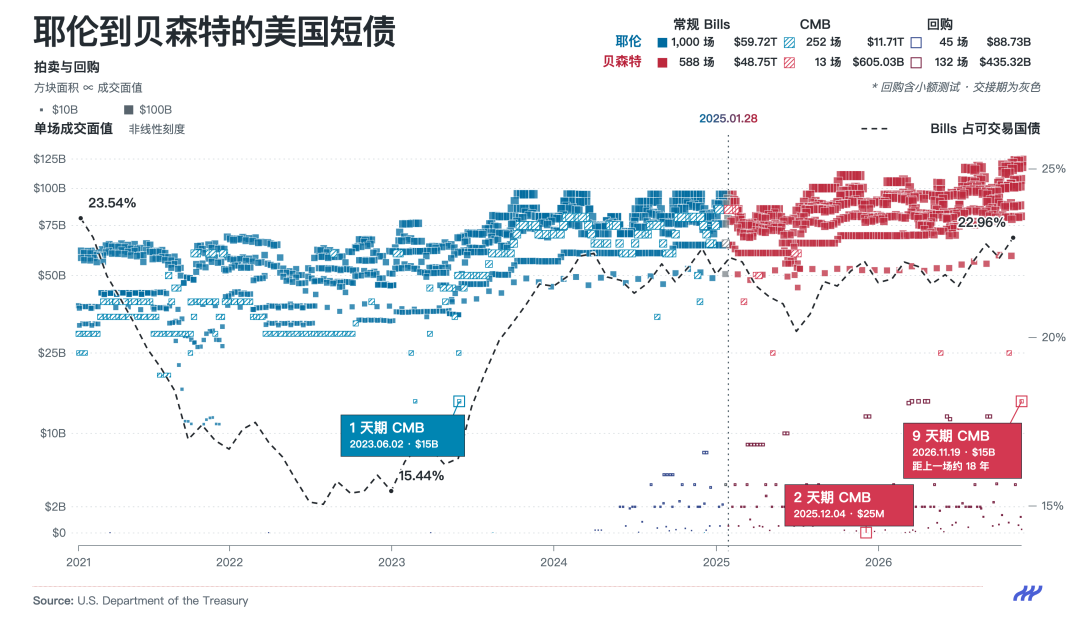
Fig: Treasury QE
During the Biden administration, Treasury Secretary Yellen boldly executed financial innovation in 2023 by swapping long-term US Treasuries for short-term ones, and even CMB ultra-short-term tools, thereby suppressing long-bond yields. A brief explanation here: long-term US Treasury rates represent the true "risk-free rate," which dictates baseline rates for student loans, mortgages, etc.
Conducting such operations before the Biden election year drew repeated criticism from Bessent, who argued it was a deliberate maneuver to aid reelection. Swapping long and short bonds rapidly drains government cash reserves since repayment looms for the following year. However, for Biden at that moment, losing the election meant a complete future blackout. Besides, if he loses, it could simultaneously create massive funding headaches for Trump.
As expected, although Trump won the 2024 presidential election, facing structural fiscal crises, voter campaign promises, and tariff-war expenditures, Bessent is forced to channel Yellen, continuing to issue short-term bonds to quench thirst with poison.
This can be understood as the Treasury bypassing the Federal Reserve, forcibly using fiscal tools to manufacture short-term market liquidity, at the cost of ever-growing interest burdens year by year.
Yet, even so, compared to European and Japanese government/corporate bonds, US Treasuries and AI-themed bonds offer better value. At least they fund military spending rather than welfare, at least they invest in productivity rather than distribution.
We all know US Treasuries are collapsing, yet we continue to treat them as the risk-free foundation of the global financial system. These two realities coexist simultaneously. Ponzis aren't terrifying; sovereign-grade assets are inherently Ponzis that simply cannot fully collapse.
Conclusion
Why can sovereign-grade assets be repeatedly invented?
It is neither national sanctity and repayment accountability (evidenced locally by Sri Lanka, historically by French pension reforms), nor national scale: corporate and sovereign bonds differ fundamentally only in guarantee mechanisms, both relying on profitability, yet both ultimately get crushed by their own interest burdens.
A more reasonable explanation is time. When any system spans a generational cycle, it is perceived by the world as eternal. From the establishment to the collapse of the Bretton Woods system took merely 27 years, and contemporary observers never considered its inherent collapse possibility. During the Clinton era, the US government even posted surpluses. Strictly speaking, the current Treasury rally is a direct consequence of 2008.
According to calculations, government bailouts of the financial sector typically trigger a 188% impulse toward tax hikes. Debts never vanish; they only shift onto ordinary individuals. Sovereign governments possess the audacity for repeated defaults precisely because they control the population.
They are not pure scams. Even after deleveraging, they can persist long-term, evolving into a daily mechanism devoid of windfall profits.
Back to crypto.
Starting in 2025, the "PE Guy" meme went viral across American networks. As US equities approach their peak, newer (repeatedly invented) asset forms continue to emerge. Conversely, the crypto industry falls into bewilderment, fearing everything is ending, when it really shouldn't. The road to innovation is long, and even disruption itself holds value waiting to be absorbed.
Viewing the developmental history of sovereign-grade assets, what crypto lacks is actually quite clear:
- Lacks war. Without a collective goal forcing everyone to pay up, DeFi Summer and the metaverse briefly played this role; now only AI is relied upon;
- Lacks securitization channels. Perp-ification remains an internal echo chamber, failing to tap external cash flows. Brokerages manipulating SpaceX/ANT new listings proves the channels aren't under its own control;
- Lacks time. No crypto system has survived a full generational cycle, so naturally none are viewed as eternal.
As for corporate and individual Ponzi schemes, they are merely clumsy imitations of sovereign-grade assets. Their degree of imitation depends entirely on how much sovereign credit can be borrowed. Further details will be elaborated in subsequent articles of this series.
Join TechFlow official community to stay tuned
Telegram:https://t.me/TechFlowDaily
X (Twitter):https://x.com/TechFlowPost
X (Twitter) EN:https://x.com/BlockFlow_News
 @zuoyeweb3