$3.52 Billion Surpasses Ondo, Franklin Tops Tokenized U.S. Treasury Market: How Weekend Liquidity Is Becoming a New Competitive Barrier?
Author: Alea Research
Compiled by: TechFlow
TechFlow Editorial:Crypto markets operate 7x24 without pause, whereas traditional money market funds are bound by standard business hours, leaving institutions facing prolonged settlement delays when margin calls arise on Friday evenings. Franklin Templeton’s tokenized fund platform, Benji, bypasses these temporal bottlenecks by using the public blockchain as its legal register of share ownership.
Through the introduction of Sunday dividends, multi-chain cross-chain coordination, and off-chain collateral mirroring channels, the AUM under Benji quickly surpassed Ondo to take the industry lead. This evolution indicates that the key to winning in tokenized US Treasuries lies not just in asset size, but in the ability to provide seamless capital allocation and risk hedging capabilities for major market makers and institutions during liquidity voids like weekends.
Crypto assets trade 24/7 without interruption, but money market funds cannot. Their shares are held by transfer agents that adhere to traditional business hours, meaning margin calls triggered Friday night require waiting until Monday to access fund cash. Franklin Templeton’s solution is its tokenized fund platform, Benji.
The fund’s legal official share register is deployed directly on public blockchains, with each token representing one fund share. Although cash redemptions still require waiting for business days, Sunday interest distributions break convention: on the Stellar network, Sunday dividends are issued directly as new shares to every holder’s wallet.
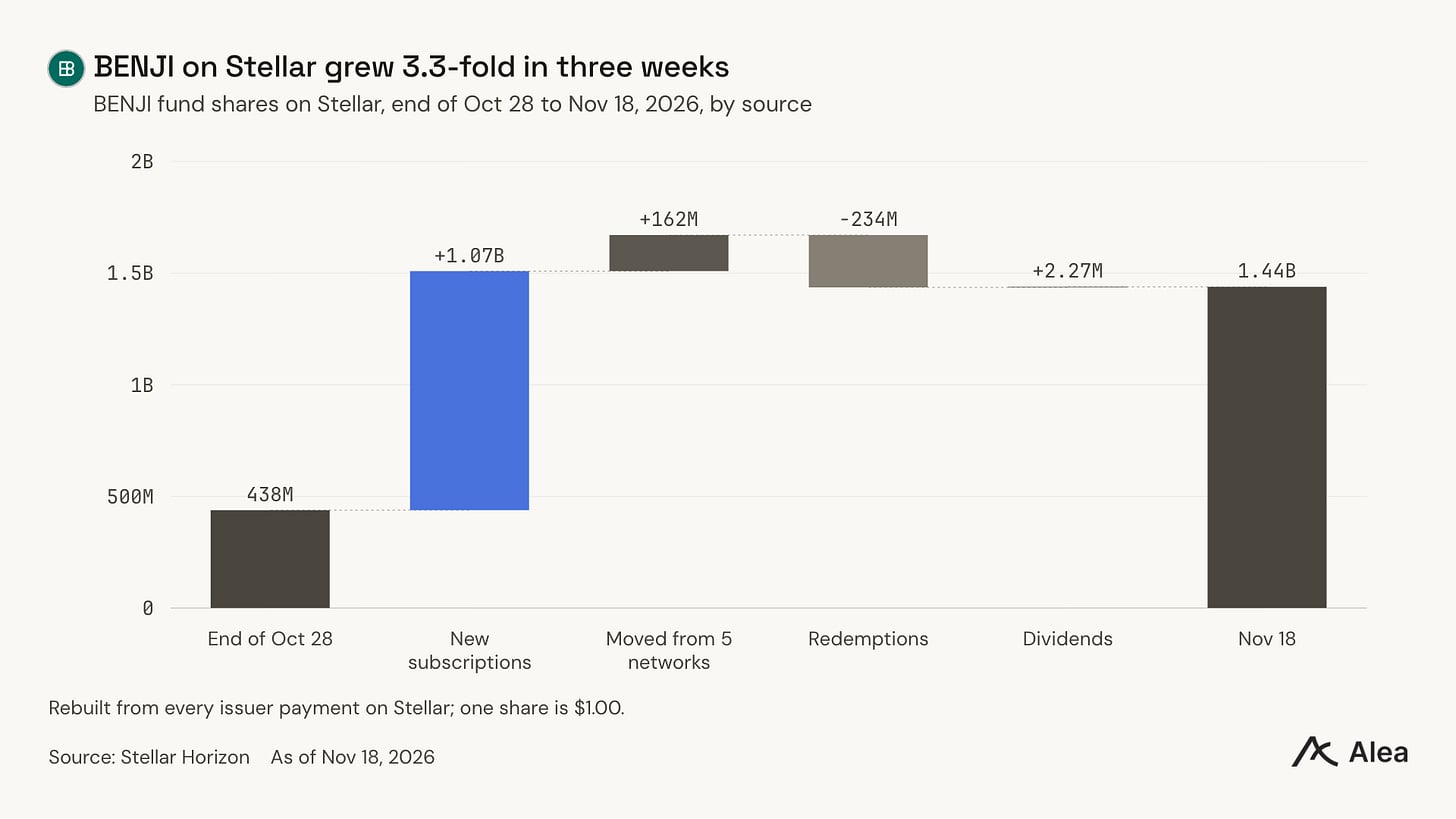
Figure: Distribution of BENJI shares on the Stellar network by funding source (reconstructed based on issuer payment records, data source: Stellar Horizon)
In the three weeks leading up to November 18, BENJI shares on the Stellar network surged 3.3 times, jumping from 438.2 million to 1.44 billion. When consolidating tokenized fund assets across issuers, on October 28, Ondo’s USDY notes and OUSG fund led Franklin’s four Benji funds at $2.70 billion versus $2.68 billion; however, by November 18, Ondo’s two products remained flat in scale, while Franklin overtook them to lead by $825 million.
According to industry ranking lists (based on the platform’s statistical methodology for institutional products), Franklin also tops the industry with an advantage of $427 million.
Key Takeaways
• Franklin leads Ondo by $825 million: Benji funds hold $3.52 billion in assets, compared to $2.69 billion combined for Ondo’s USDY and OUSG.
• Top three whale wallets accounted for 69% of purchases: Over the past three weeks, 109 wallets participated in purchases totaling $1.07 billion.
• Weekend dividends are highly anchored to the fund’s officially reported yield: Since June 2025, monthly spreads have remained within 10 basis points.
• Stellar currently hosts 43% of Benji tokens: A significant increase from 20% three weeks ago.
• Redemptions still require waiting for business days, but Sunday dividends are distributed instantly: Sunday dividends are issued directly as new fund shares to holders’ Stellar wallets.
Public Chains as Legal Share Registers
As a unified tech platform, Benji operates five share token classes across four Franklin funds under a single transfer agent system. The uppercase BENJI represents FOBXX, a US-registered government money market fund; the other four tokens (iBENJI, gBENJI, grBENJI, and sgBENJI) belong to Franklin’s other three Benji fund products.
Since February 8, 2022, Benji has officially served as the legal registry system for FOBXX share ownership, with on-chain recorded balances strictly synchronized in real-time with SEC filings. The fund’s October regulatory filing shows total shares outstanding reached 833.6 million as of October 31; on that same evening, BENJI contracts deployed across eight networks collectively held only 200,000 shares more than the reported figure.
Within just 13 minutes on November 4, Franklin’s transfer agent consolidated 161.7 million fund shares from five different networks onto the Stellar chain. Its official issuer account minted an equivalent amount of new shares on Stellar while simultaneously burning them on the remaining five networks. Viewed purely by volume, this single-day asset rebalancing exceeded the fund’s entire external purchase volume for the month of October.
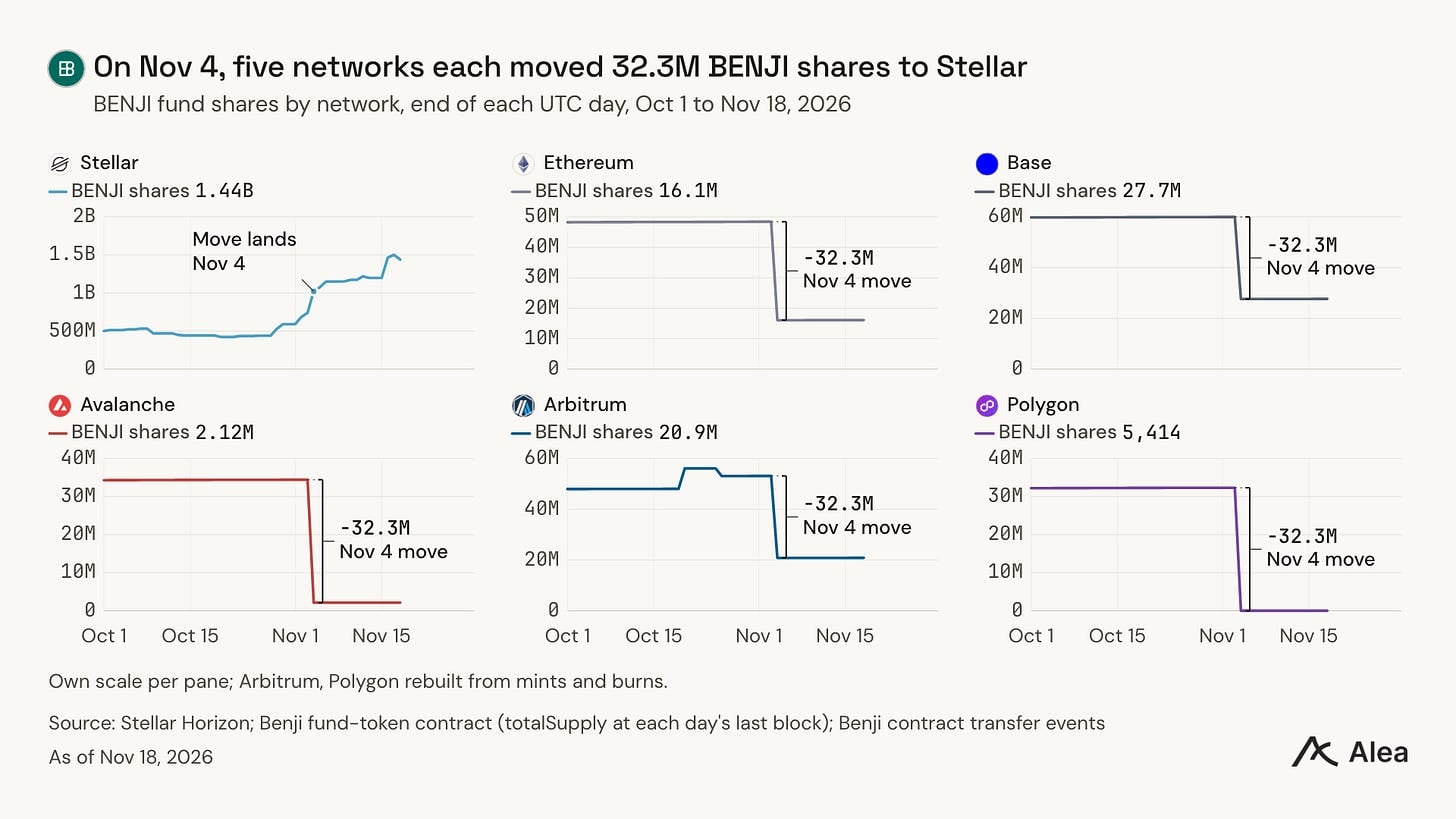
Figure: Daily BENJI share trends across six networks (based on on-chain contract data, Arbitrum and Polygon reconstructed from event logs)
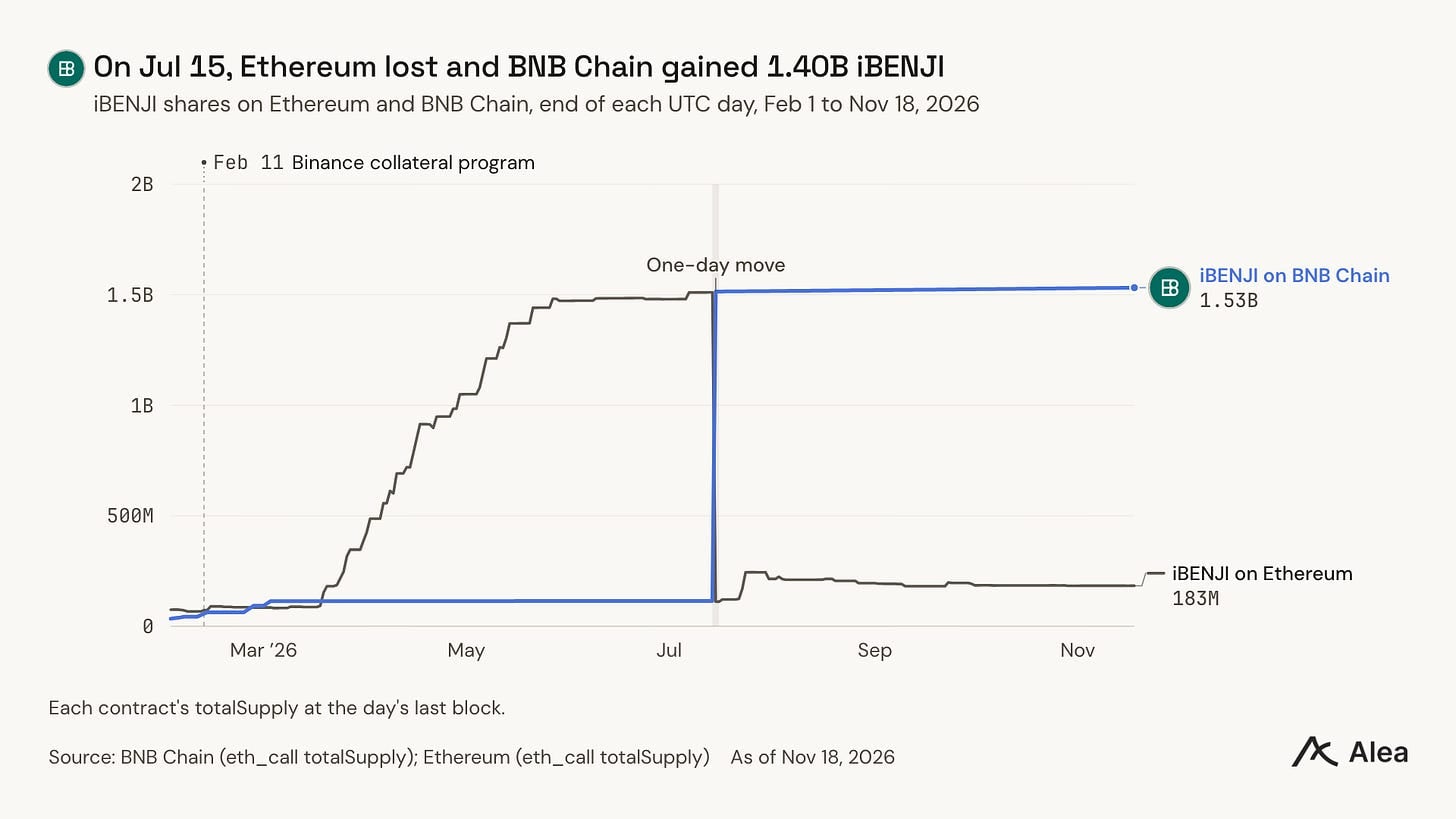
Figure: iBENJI share trends on two networks (read directly from token contracts)
On July 15, iBENJI shares on Ethereum plummeted by 1.4 billion, while iBENJI on BNB Chain surged by nearly the same magnitude on the same day. This mirrors the situation with FOBXX on November 4: public chains faithfully recorded this cross-chain capital movement, yet no open matching trades occurred on-chain. Essentially, a large institution simply migrated its asset position from one chain to another, while the fund’s legal share register precisely tracked and mapped this asset transfer.
Sunday Dividends: Breaking Through Traditional Financial Settlement Latency
Benji fund interest accrues daily. Prior to May 2025, Friday’s minting operation bundled interest dividends for Friday, Saturday, and Sunday into a single payout on Monday. This kept the blockchain synchronized with traditional fund operating cycles: when the transfer agent closed for business on Friday, the share register also effectively shut down.
Starting May 31, 2025, Franklin broke this convention by beginning to distribute new shares directly to holders as interest dividends on Saturdays and Sundays. On June 10, Franklin officially announced the launch of the “Intra-day and Weekend Yield” mechanism, prominently targeting institutional clients: while other traditional funds shut down, capital continues earning returns for institutions around the clock.
These weekend-distributed shares directly project the fund’s actual yield onto the blockchain. Annualized based on the previous day’s total shares, the average net yield corresponding to October weekend dividends was 4.31% on Saturdays and 4.30% on Sundays, almost perfectly aligning with the 4.30% disclosed in the fund’s monthly regulatory report filed with the SEC.
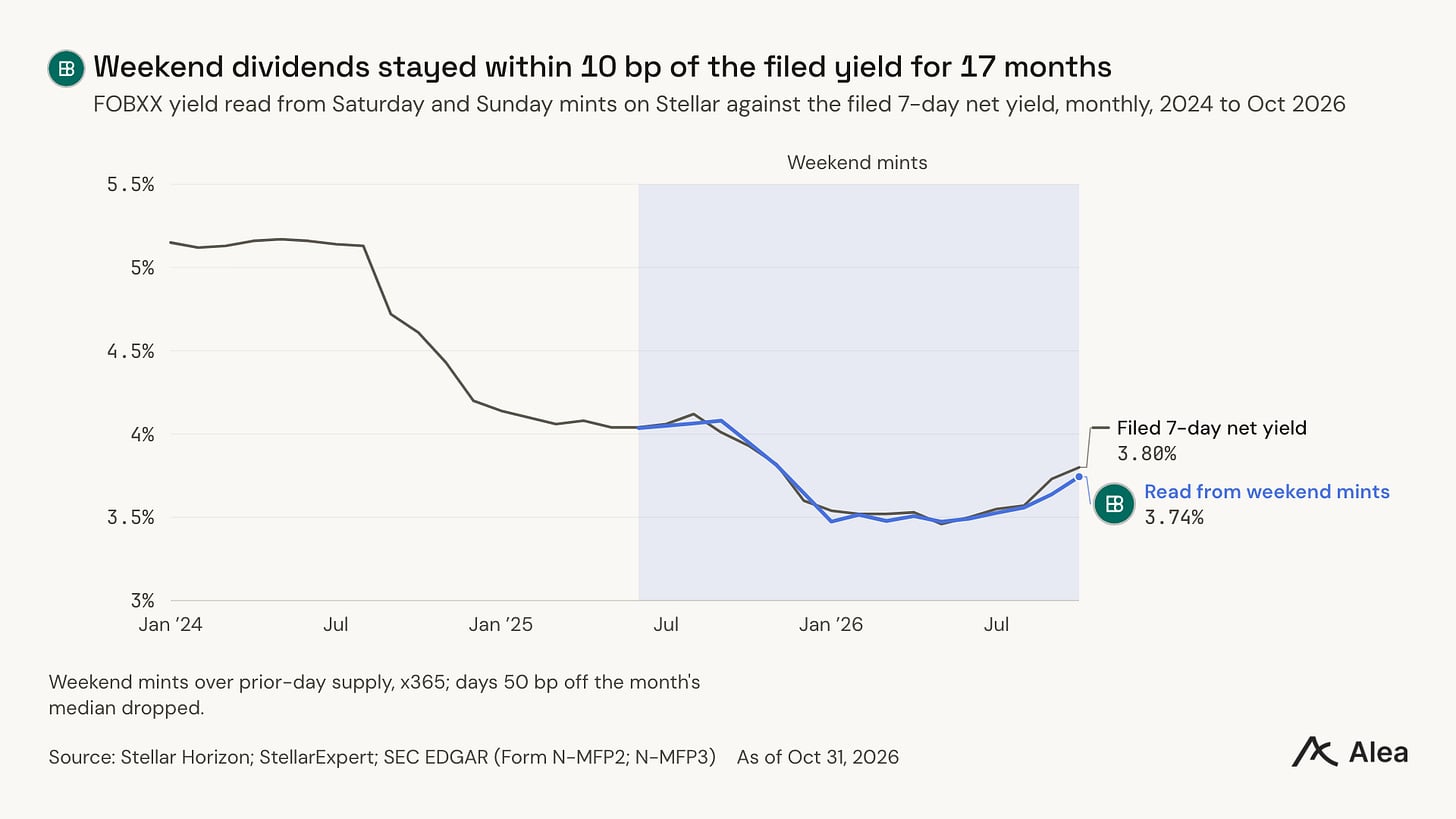
Figure: Comparison of FOBXX weekend minting yield vs. SEC-reported 7-day net yield (data sources: Stellar Horizon & SEC filings)
Every month since June 2025, the spread between on-chain weekend yields and regulated net yields has been strictly maintained within 10 basis points. Across 148 monitored weekend days, the issuer account failed to pay out only 11 times; however, in these exceptional cases, next-day mints fully compensated for the missed interest, with reconciliation and full payouts completed no later than Monday.
During regular New York City nighttime hours, the issuer account distributes current dividends in a single batch to approximately 1,010 wallet addresses on the Stellar chain. Payouts typically arrive around 11:30 PM, by which time the transfer agent has completed the day’s financial accounting and settlement. Each holder wallet receives new fund shares proportional to its asset balance, maintaining a constant NAV of $1.00 per share.
FOBXX charges an annual management fee of 0.15%, already deducted from the published net yield, with the tokenization structure itself incurring no additional fees. Based on November 18 data, a weekend yield of 1.2 basis points per day means an institution with a $100 million position earns a net return of $12,000 on both Saturday and Sunday, credited instantly that same day as 12,000 new fund shares.
Top Three Whale Wallets Account for the Vast Majority of Purchases
Benji’s entry threshold spans a wide range: from a minimum of $20 for retail investors on Stellar to a minimum of $5 million for institutional clients via iBENJI. Of the 1,015 Stellar wallets holding BENJI balances, half hold less than $100, and an overwhelming 95% hold under $10,000. Only 25 whale wallets hold individual positions exceeding $1 million, yet collectively they control 99.4% of all BENJI shares on the network.
Among these 25 whale addresses, the top three alone accounted for 69% of the $1.07 billion total purchased across 109 buy addresses since October 28. After deducting $234.1 million in redemptions, BENJI on Stellar netted an increase of $835.9 million over these three weeks, while its circulating supply on other networks remained largely flat. The largest single wallet accumulated $246.3 million through 14 transactions, reaching a total holding of $407.9 million by November 18, representing 28.4% of Stellar’s total supply.
The other two whale wallets also received asset shares transferred from other networks on November 4, accumulating a combined holding of $570.9 million by November 18, or 39.7% of Stellar’s total supply. Excluding these three core wallets, the actual net growth of BENJI on the Stellar chain over these three weeks was merely $78.7 million, rather than the final reported $835.9 million.
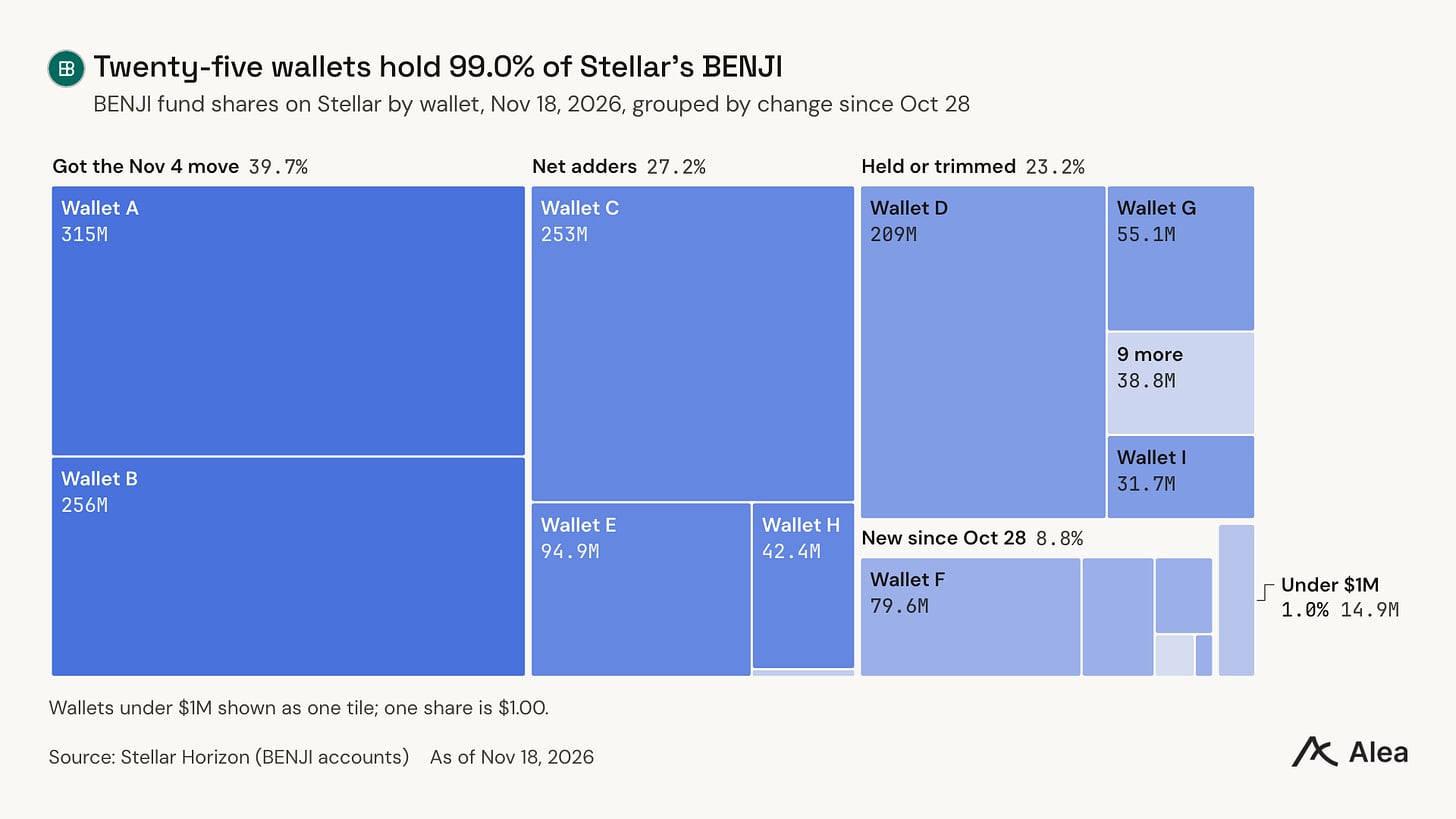
Figure: BENJI share distribution by Stellar wallet address (Data source: Stellar Horizon)
On-chain data clearly records the transfer agent’s complete process of moving fund shares to these wallets, but does not directly disclose the controlling identities behind them; all three whale addresses were created just a few days before initiating their first large-scale purchases. This clearly points to a trend of large institutional users deploying substantial cash into tokenized US Treasuries year-end, utilizing Stellar’s extremely low transaction fees to execute multiple ultra-large purchase settlements in batches.
Institutional-facing iBENJI accounts for 49% of Franklin’s total 3.52 billion tokenized assets. If iBENJI is excluded, the remaining three Franklin funds hold a combined $1.8 billion, which would fall below Ondo’s dual-token products and sit within $150 million of BlackRock’s BUIDL.
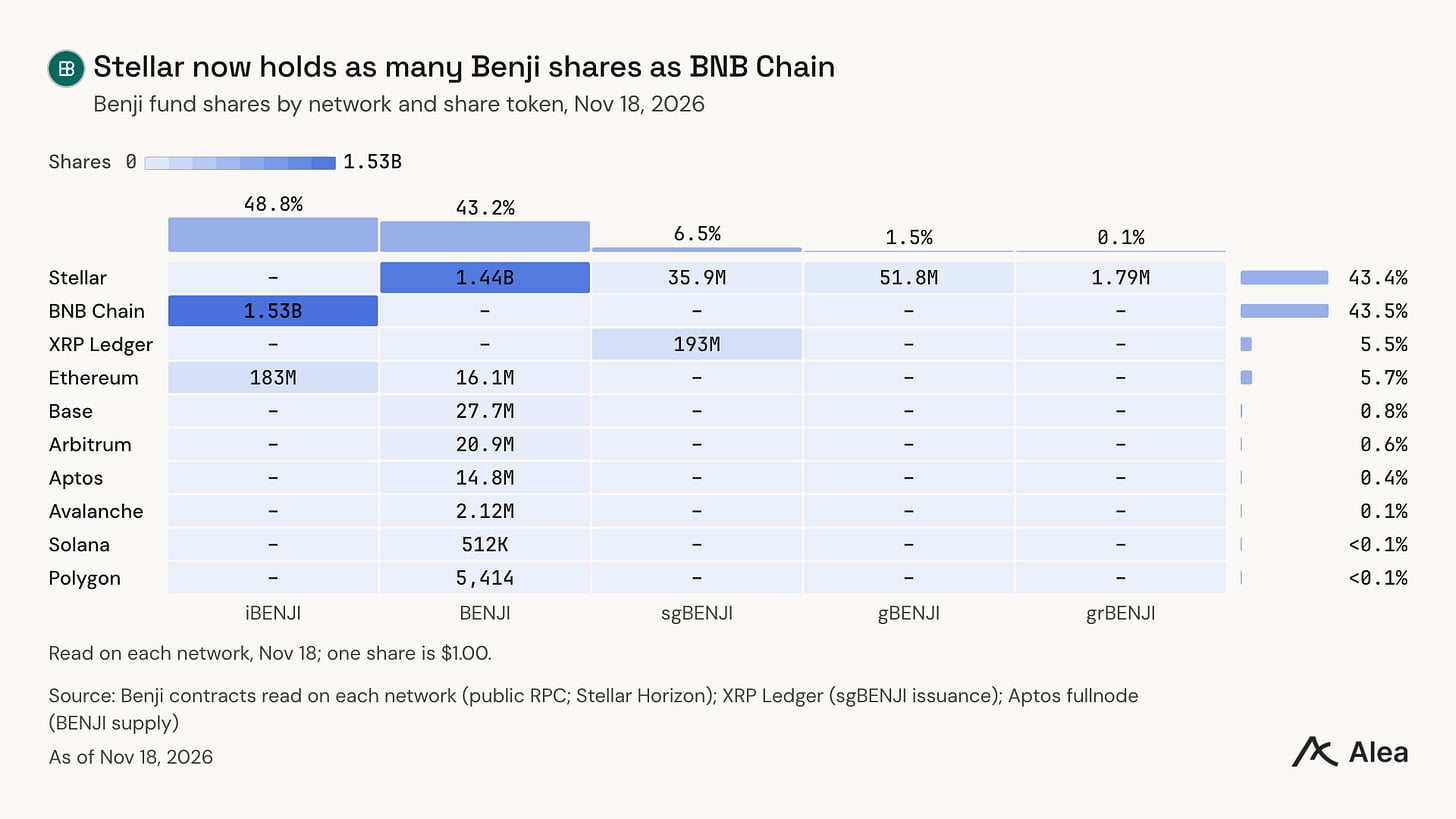
Figure: Benji fund share distribution by network and token class, valued at $1.00 per share (Based on on-chain read data)
Across all five share token classes, the asset share hosted on the Stellar network surged sharply from 20% on October 28 to 43% on November 18, now rivaling BNB Chain.
Four Major Exchanges and SEC Letters Clear Institutional Pathways
On April 10, 2025, OKX launched the Collateral Mirroring Program in Dubai, pioneering the first integration channel. Standard Chartered serves as the independent custodian for this initiative, designating Franklin’s money market funds as the primary eligible collateral.
On February 11, Binance and Franklin Templeton jointly announced that qualified institutional clients could pledge Benji fund shares as OTC trading margin, while assets remain securely held in independent custody via Ceffu. On June 2, MoonPay enabled a direct conversion channel for institutions between stablecoins and tokenized funds. On September 28, Bybit also officially launched a similar OTC collateral partnership program.
On August 12, a no-action letter from the SEC division opened an internal capital conduit for Franklin: it formally permitted other registered funds under Franklin to directly hold FOBXX tokens as cash reserves via Stellar wallets created by its transfer agent. In Alea Research’s Market Cap podcast series, Chetan Karkhanis, Senior Vice President of Franklin’s Asia Digital Assets team, also deeply deconstructed the core logic and risk control framework for using tokenized funds as collateral.
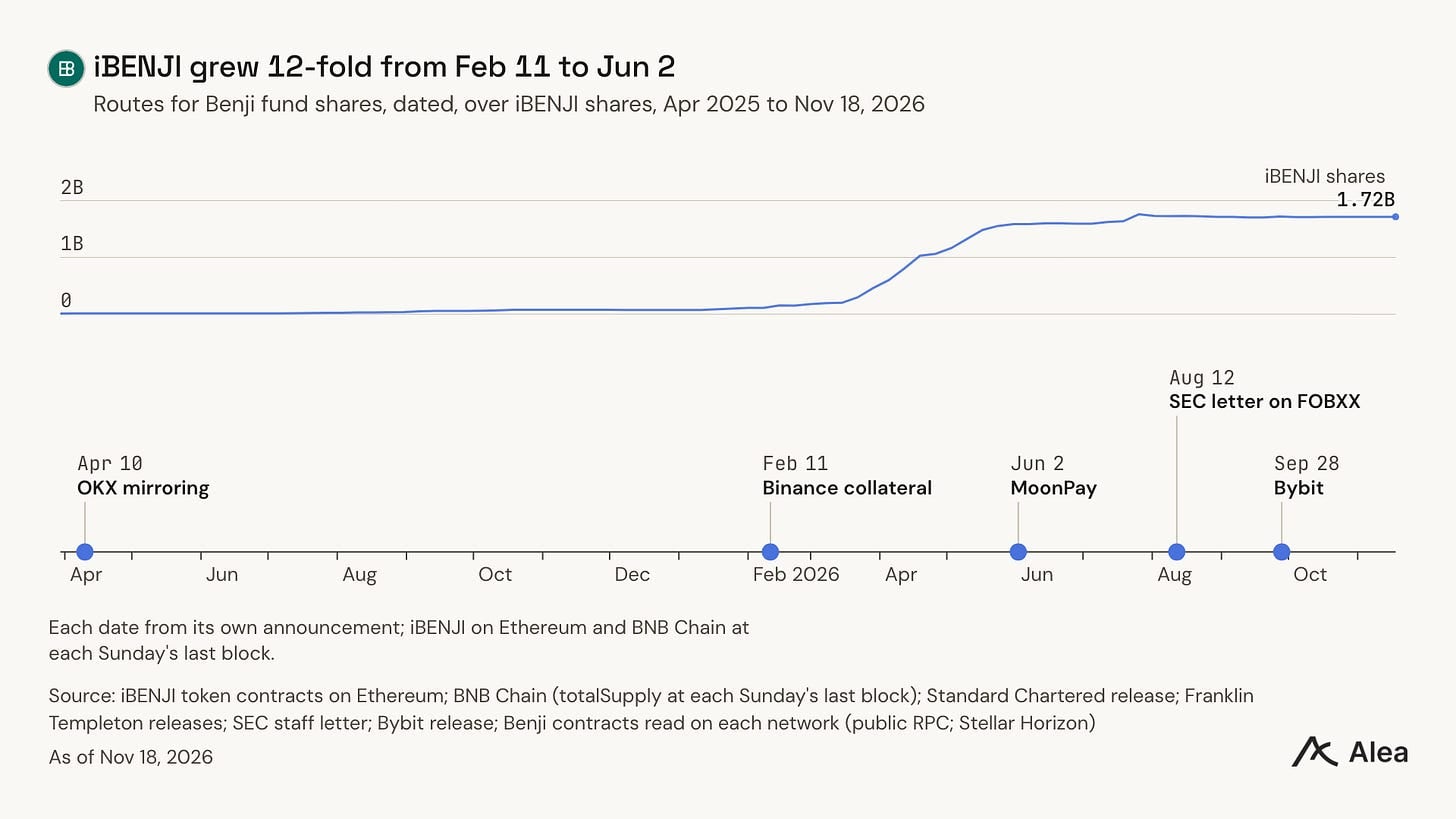
Figure: Primary Benji fund share access channels (with announcement dates highlighted) vs. iBENJI share growth
iBENJI shares surged rapidly from 130 million upon Binance listing to 1.59 billion when the MoonPay partnership landed, exploding 12-fold in under four months; while on-chain data cannot attribute this remarkable growth to a single channel, it peaked near 1.76 billion by late July and maintained a resilient level of 1.72 billion on November 18. Meanwhile, the strong new inflows throughout November were primarily driven by the breakout of BENJI on the Stellar chain.
As of October 30, 68.0% of FOBXX’s assets were allocated to cash or high-liquidity assets that can be liquidated within a single day at no loss, far exceeding the SEC’s 25% minimum liquidity regulatory threshold. In other words, the wait for weekend redemption proceeds stems solely from the operating hour constraints of traditional fund transfer systems; meanwhile, the excess high-liquidity underlying assets required to cover any potential redemptions have long been fully reserved on the books.
On every routine Sunday night, the on-chain legal register updates punctually: that night’s interest yield lands promptly in Stellar wallets, transforming into weighty new fund shares. Yet the actual fiat cash remains quietly awaiting the tolling of Monday’s settlement bell.
Join TechFlow official community to stay tuned
Telegram:https://t.me/TechFlowDaily
X (Twitter):https://x.com/TechFlowPost
X (Twitter) EN:https://x.com/BlockFlow_News
 @AleaResearch