The real profit opportunity for RWA isn't in tokenization: shifting from earning transaction fees to capturing credit spreads, the next round of competition has already begun.
Author: Yaroslav Writtle, DeFi & RWA Investment Researcher
Translated by: TechFlow
TechFlow Guide: For years, the core narrative of the RWA space has consistently focused on “bringing assets on-chain,” where infrastructure providers often earn only meager token issuance and custody channel fees. However, simple on-chain mapping does not touch upon the most lucrative aspects of finance. The intermediary liquidity and bridge financing after asset generation are demonstrating commercial imagination far beyond tokenization itself.
Real-world lending institutions are trapped by liquidity lock-ups during capital return cycles, while billions of dollars in on-chain stablecoins are urgently seeking robust yield-generating scenarios. By connecting real-world credit assets with on-chain liquidity pools through warehouse financing, RWA platforms are evolving from mere technological intermediaries into core financial nodes capturing spread margins across the entire credit cycle.
For years, the core focus of the Real World Asset (RWA) space has revolved around how to bring off-chain assets on-chain.
Government bonds, private credit, real estate, corporate bonds... The industry's core narrative and ultimate goal once equated to getting as many assets as possible to complete their tokenized mapping.
However, a completely different and more explosive new commercial opportunity is quietly emerging.
What if, rather than simply turning assets into tokens, providing liquidity financing for these assets after their generation represents a much larger, more highly profitable commercial essence?
Tokenization Is Merely the Tip of the Iceberg for the Full Commercial Landscape
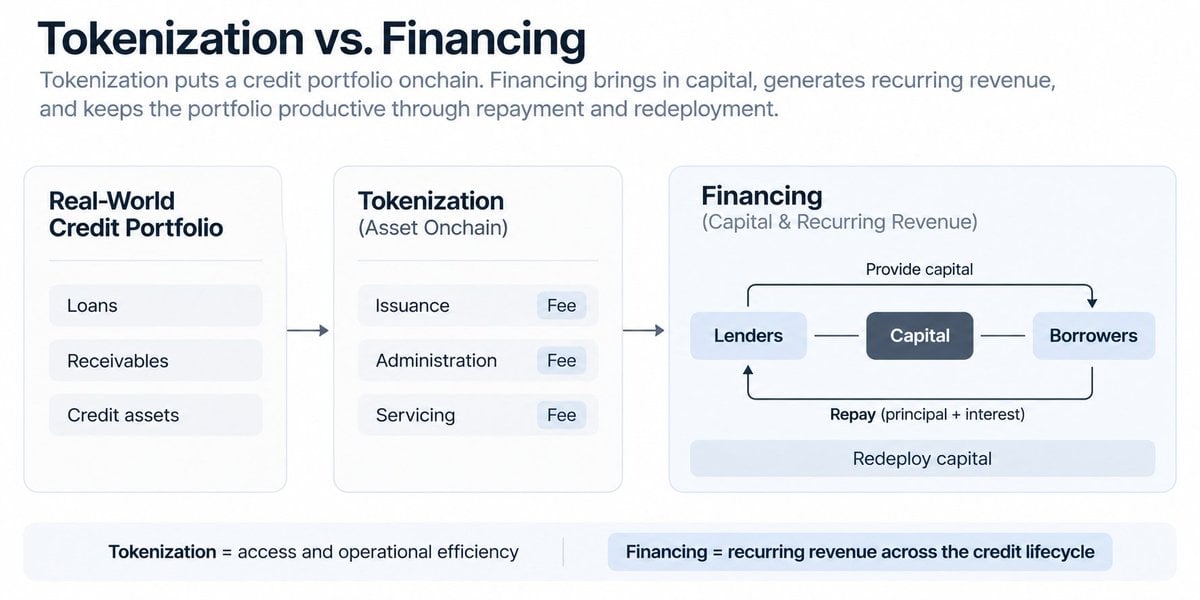
When a company tokenizes its credit asset portfolio on-chain, infrastructure providers primarily earn service commissions through token issuance, administration, and daily custodial maintenance.
While some of these fees indeed constitute recurring revenue, fundamentally these earnings are tightly confined within the scope of managed asset scale or purely technical services, leaving an obvious ceiling.
However, the operational logic of asset financing is entirely different.
Lenders earn high interest rates and structured fees by supplying ample liquidity capital. As underlying loans are gradually repaid with principal and interest, the recycled principal can be immediately redeployed in continuous cycles.
For platforms possessing stable asset generation capabilities that can continuously provide financing for high-quality underlying assets, this unlocks a steady stream of monetization opportunities throughout the entire lifecycle of credit assets.
Real-World Lending Institutions Face Persistent Liquidity Gaps
Consider a lending institution that specializes in providing short-term working capital to micro, small, and medium-sized enterprises.
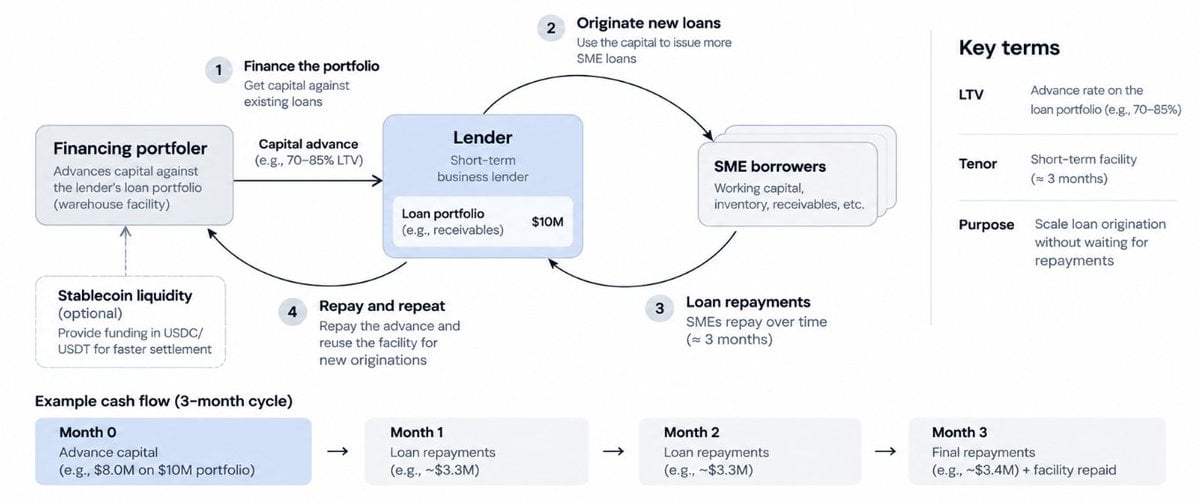
It lends out funds today, but may receive absolutely no principal and interest repayments from borrowers over the next three months.
During this lengthy repayment window, the institution's own working capital is completely locked up. If it wishes to continue expanding operations and issuing more loans, it must urgently seek external funding injections.
This is precisely the fundamental reason why warehouse financing thrives in traditional finance.
In such structures, professional funding providers use existing eligible loan portfolios or accounts receivable under the lending institution as underlying collateral to prepay liquidity funds. Lenders use this bridge capital to continue expanding and issuing new loans, while original borrowers continue to service existing debts on schedule.
Acting as the liquidity provider, the financing institution earns substantial interest spreads and arrangement fees for assuming the bridging capital role.
In highly mature traditional credit markets, this has long been an indispensable standard financial infrastructure.
Stablecoin Liquidity Pools Forge New Financing Leverage Points
Meanwhile, on-chain investors hold massive amounts of stablecoin capital, the vast majority of which are urgently seeking stable and attractive real-yield scenarios.
On the real economy side, physical enterprises are constantly in desperate need of low-cost capital inflows for daily operational turnover, including credit expansion, inventory procurement, and accounts receivable discounting.
Seamlessly stitching together these two originally fragmented markets gives birth to a highly imaginative, expansive blue ocean.
Real-world businesses can bundle their credit assets and obtain highly efficient stablecoin financing support on-chain; on-chain investors can directly pierce through to share the robust yields of high-quality underlying credit assets, while real-world borrowers achieve high-frequency capital rollover without agonizingly waiting for existing assets to mature and generate cash flows.
Within this new paradigm, tokenization merely serves as a highly efficient technological tool for underlying collateral registration, verifiable ledger auditing, and instant settlement.
The underlying engine truly driving commercial value explosion has never been cold code, but rather the financial essence of perfectly matching genuine borrowing demands with abundant capital supply.
Leading Players Are Collectively Shifting Toward Asset-Side Financing
The wind vane of the entire RWA industry is steadily and comprehensively turning in this direction.
In November this year, RWA issuance giant Securitize officially completed its heavy-weight acquisition of River One, a leading enterprise deeply specialized in credit asset warehouse financing and professional credit risk control underwriting.
The profound significance of this merger extends far beyond the territorial expansion of a single corporate entity.
It marks a major incursion by previously purely foundational vendors focused solely on tokenization tech middleware issuance, advancing boldly into the core territory of credit asset origination, end-to-end bridge financing, and active management of credit asset portfolios.
Meanwhile, an increasing number of innovative platforms are beginning to directly hook tokenized credit assets into deep on-chain liquidity pools via cutting-edge decentralized lending protocols like Morpho and Kamino.
All signs clearly point to one thing: the next phase of qualitative transformation in RWA infrastructure will inevitably fully penetrate and reshape the entire asset financing process.
The Price of High Yields: Bearing Genuine Credit and Default Risks
Why does engaging in credit asset financing yield orders-of-magnitude higher excess returns compared to merely providing a technical issuance channel?
There is no free lunch; higher returns essentially stem from someone having to backstop the genuine credit quality of underlying assets and assume risk management responsibilities.
A truly mature asset financing business must possess comprehensive capabilities to rigorously evaluate borrower qualifications, monitor collateral health in real-time, finely tune liquidity allocation, and ruthlessly handle bad debt defaults.
The interest spreads collected by fund providers are by no means pure windfalls. Capital acquisition costs, daily operational expenses, and potential bad debt provisioning losses will all substantively erode final returns.
A harsher reality is that merely wrapping junk assets in a tokenized on-chain veneer will absolutely never transform credit-flawed borrowers into reliable entities overnight.
Therefore, although asset financing demonstrates vastly more tempting commercial ROI, it belongs exclusively to mature operators who genuinely possess hardcore risk control and underlying risk navigation capabilities.
Future Evolution: From Digital Tokenization to Deep Financial Integration
I firmly believe that, in the future, more and more RWA platforms will decisively leap beyond mere token issuance and routine administrative frameworks.
Some platforms will strive to act as high-throughput super connectors, perfectly welding premium asset originators with abundant on-chain stablecoin liquidity; other platforms will step directly onto the field to play the role of liquidity capital providers, even actively managing large-scale consolidated credit asset packages on behalf of clients.
The most gripping suspense lies in determining to what extent these emerging platforms can truly pierce through and control the core links of traditional finance.
Simply moving a loan onto the blockchain yields nothing but static digital asset code; whereas once you deeply intervene and provide liquidity financing for it, you forge a long-term, deep financial symbiotic relationship with the physical asset.
And within the value distribution laws of the entire financial industry, the latter is invariably the absolute king truly grasping the largest profit cake across the sector.
Join TechFlow official community to stay tuned
Telegram:https://t.me/TechFlowDaily
X (Twitter):https://x.com/TechFlowPost
X (Twitter) EN:https://x.com/BlockFlow_News
 @yaroslavwr_