
Can DeFi truly price real-world loan risk?
Author: Fran Palminha
Translated by: TechFlow
TechFlow Summary: As tokenized real-world assets (RWA) and private credit continue to penetrate, decentralized lending protocols are facing a completely new paradigm of risk. Traditional DeFi relies on real-time oracle price feeds to drive automatic liquidations, whereas non-standard private credit in the real world exhibits severe liquidity frictions and long-cycle valuation lags.
Solely relying on historical net asset value (NAV) not only fails to timely capture the deterioration of borrowers' actual repayment capacity, but also exposes fatal liquidity gaps in secondary liquidation markets during bank runs. This article deeply analyzes the logic of how on-chain credit rating migration, information asymmetry arbitrage, and dynamic risk parameter regulation will reconstruct the future DeFi lending ecosystem.
In terms of borrowing using tokenized real-world assets (RWA) as collateral, DeFi is making significant progress.
However, when dealing with private credit, the entire system exposes an intractable underlying contradiction.
Lending protocols can read real-time market prices of tokens, calculate their collateral value, and trigger automatic liquidations when thresholds are breached. But what should the on-chain world do if the underlying real-world loan has already begun to deteriorate, yet the publicly reported token price remains unchanged?
This is precisely the core reason why traditional credit risk is difficult to directly bring on-chain.
Stable Prices Never Equate to Low Risk
ETH benefits from continuously updated real-time secondary market trading prices, but private loans typically lack this condition entirely.
A private credit fund calculates its net asset value (NAV) on a cycle that is often weekly, monthly, or even quarterly. During the interval between two valuation reports, the book price of the token often appears virtually absolutely stable.
However, the underlying real-world borrowing entity could fall into operational distress at any moment: declining revenue, failure to pay interest on time, or substantive depreciation of collateral assets. Yet before the next formal valuation is completed, the lending protocol still sees that unchanged old NAV.
This creates a highly misleading trap for DeFi risk models: an asset lacking real-time price fluctuations is often mistakenly identified as "highly safe" by algorithms and statistical models.
Traditional Lending Institutions Focus on Far More Than Price
The information dimensions relied upon by commercial banks and professional credit funds when assessing borrowers are rarely accessible natively on-chain.
They thoroughly analyze the borrower's cash flow status, existing debt stock, historical repayment records, the actual difficulty of disposing of collateral, and financial restrictive covenants. More critically, traditional risk control rigorously calculates two core metrics: the borrower's actual probability of default (PD), and the loss given default (LGD) rate—the proportion of funds recoverable once a default occurs.
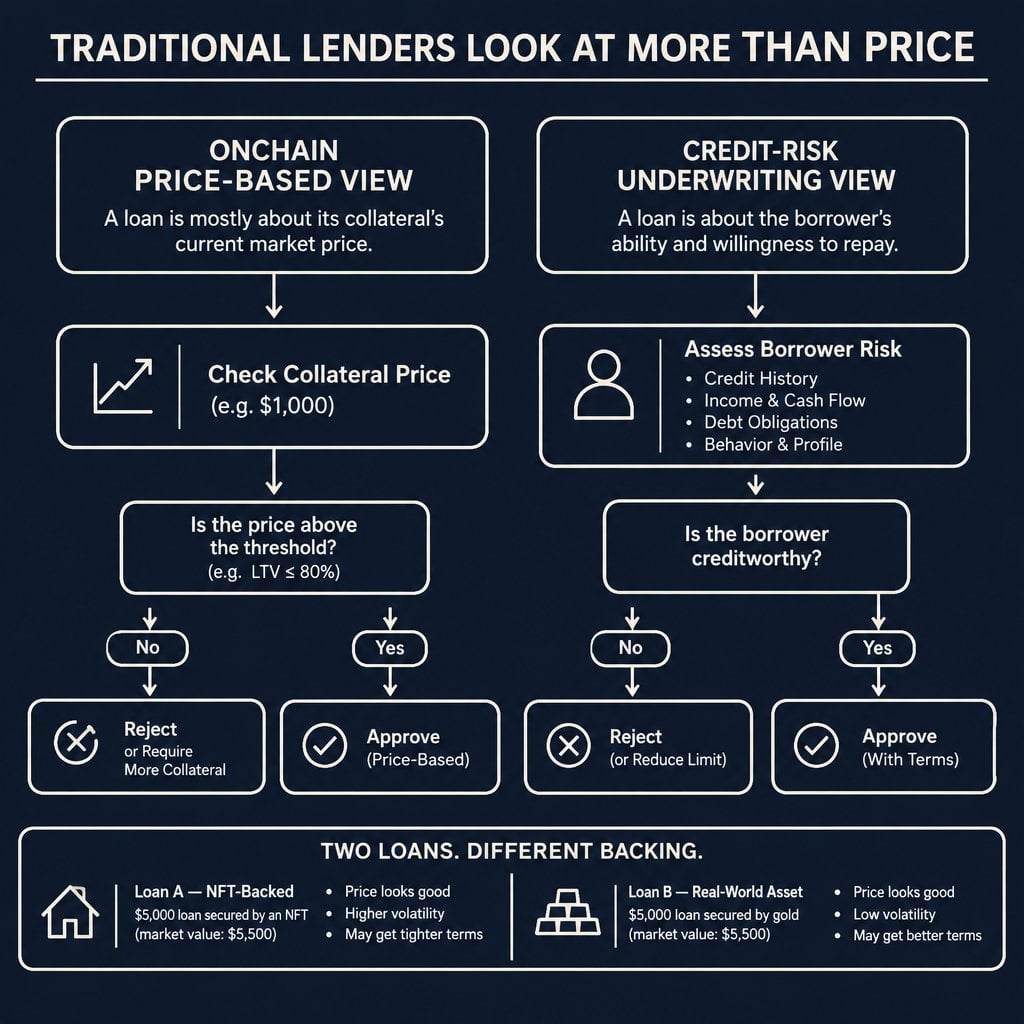
Figure: Comparison of On-Chain Pricing Models and Credit Risk Underwriting Models
A loan fully collateralized by high-liquidity securities and a loan collateralized by second-hand heavy equipment or accounts receivable differ vastly in their essential risk profiles. Even if both types of assets currently have book valuations equivalent to 100% of their par value.
If DeFi wishes to truly possess the ability to reasonably price these types of assets, it must obtain reliable operational data from the underlying borrowing entities, rather than merely relying on token book balances and historical yield metrics.
Credit Ratings Are Gradually Entering the On-Chain World
It is precisely under this practical pain point that recent industry dynamics reveal important infrastructure evolution directions.
On November 10, Moody's and Chainlink jointly announced the successful completion of a cross-chain pilot test for distributing credit rating information. The test was conducted based on representative data, and real-time credit ratings have not yet been officially published on-chain.
Meanwhile, S&P Global continues to develop a professional risk assessment system specifically for DeFi lending vaults, comprehensively covering dimensions such as credit quality, liquidity depth, and underlying operational risk.
These advancements will help decentralized lending protocols access independent third-party risk control assessment data with lower barriers. However, it must be recognized that ratings are ultimately just subjective professional assessments, far from rigid redemption guarantees; simply moving rating data to the blockchain cannot spontaneously make the underlying commercial information more accurate or possess stronger real-time capabilities.
Even With Completely Accurate Oracle Data, Underlying Loans Can Still Be Overvalued
Let's envision a typical scenario: a tokenized credit fund reports a latest book NAV of $100 per token.
The DeFi lending protocol faithfully adopts this price and allows on-chain users to borrow stablecoins using it as full collateral. Subsequently, multiple underlying corporate borrowers begin to experience overdue payments and defaults one after another. Since the fund has not yet completed its next round of audits and quarterly valuation, the on-chain oracle continues to faithfully broadcast the $100 quote.
From a technical perspective, there is no malfunction in the oracle; it accurately and faithfully disseminates the official latest effective NAV.
But this book NAV obviously can no longer represent the amount this asset can realize in a real non-standard transfer market. Borrowers holding an advantage in internal information asymmetry can easily use their tokens as collateral to extract liquidity before bad debt losses are formally reflected in the NAV, thereby directly shifting unrecoverable hidden bad debts onto the lending protocol and liquidity providers.
Liquidation is Another Core Pain Point
Even if a lending protocol can timely perceive the deterioration of underlying credit quality through external channels, it still faces a brutal dilemma: how to successfully exit liquidation?
When liquidating native crypto assets (like ETH), liquidation bots can anytime dump collateral into deep secondary DEXes or automated auction markets. But when facing non-standard private credit, potential taking buyers in the market are extremely scarce, realizing and transferring underlying debt assets may take weeks or even months.
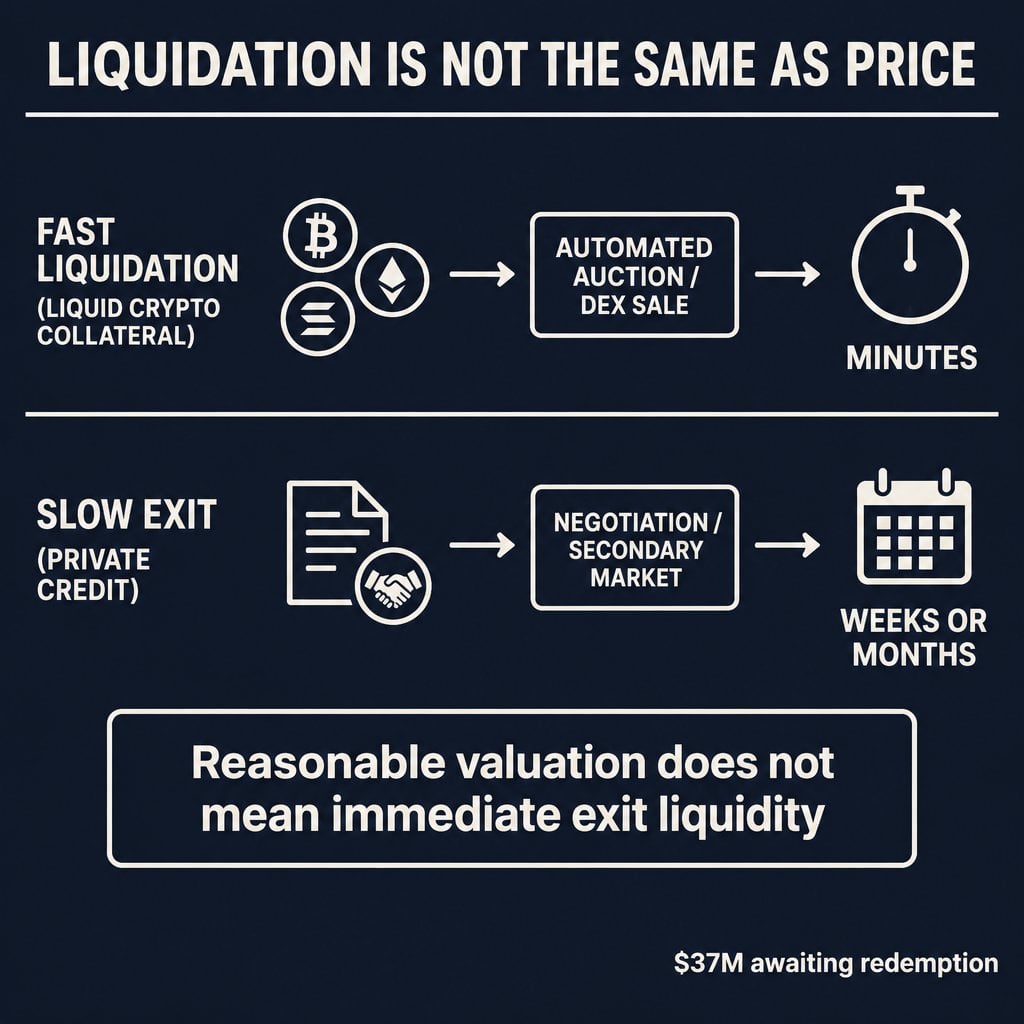
Figure: The Essential Difference Between Asset Liquidation Realization and Book Valuation Prices
An on-chain analysis of the tokenized private credit fund mF-ONE clearly shows: in February 2026, the fund once had up to approximately $37 million worth of tokens stuck in a congested backlog queue waiting for redemption.
This case vividly demonstrates the massive gap between a token's reported book value and the investor's actual realization speed. Even if a credit token possesses a relatively fair audited valuation, it remains an extremely difficult-to-dispose-of collateral in the automation liquidation lending market that highly pursues capital turnover.
How Dynamic Risk Data Will Reconstruct Lending Protocols
Currently, mainstream DeFi lending protocols still heavily rely on fixed collateral prices, fixed liquidation thresholds, and pre-hardcoded borrow caps.
If more granular and timely on-chain credit data can be integrated in the future, protocols will be able to proactively respond to dynamic changes in borrower qualifications. For example: automatically lowering borrow caps when underlying asset performance deteriorates, suspending new lending permissions, or dynamically increasing minimum collateralization ratio requirements.
However, these risk control decisions still heavily depend on the input of external real information, coordination with specialized off-chain risk management institutions, and liquidation mechanism design that matches asset characteristics. Smart contracts can ruthlessly execute code-driven decisions automatically, but they absolutely cannot independently verify a real enterprise's actual financial statements, nor can they assist the protocol offline in collecting unpaid loans.
Future Development Trends
The on-chain digitization of credit risk data will undoubtedly become one of the most critical core puzzle pieces in future RWA lending infrastructure.
But for DeFi, merely distributing static credit ratings of a few letter grades through oracles is far from enough.
The ecosystem needs penetration into real-time borrower financial and operational dynamics, completely independent third-party cross-valuations, extremely conservative and prudent collateral parameter designs, and pragmatic and reliable offline asset recovery paths. Otherwise, the protocol is merely deceiving itself by treating those assets with long reporting cycles and lackluster price volatility as naturally low-risk premium collateral.
The touchstone of whether DeFi can truly mature lies in: whether the decentralized lending system can identify and defend against deteriorating real-world loans before bad debts and major losses are finally reflected in official reported prices.
Join TechFlow official community to stay tuned
Telegram:https://t.me/TechFlowDaily
X (Twitter):https://x.com/TechFlowPost
X (Twitter) EN:https://x.com/BlockFlow_News
 @FranPalminha