Utility Beyond Issuance: 2026 Stablecoin Payment Breakthroughs and the $120 Billion Tokenized Asset Landscape
Author: Four Pillars
Compiled by: TechFlow
TechFlow Briefing: After early stages of speculation and issuance-driven growth, digital assets reached a fundamental inflection point in 2026, dominated by genuine utility. From stablecoin payment networks surpassing $480 billion, to tokenized US Treasuries, equities, private credit, and gold/real estate breaking through $120 billion, on-chain finance is now fully integrated into the core of global economic settlement.
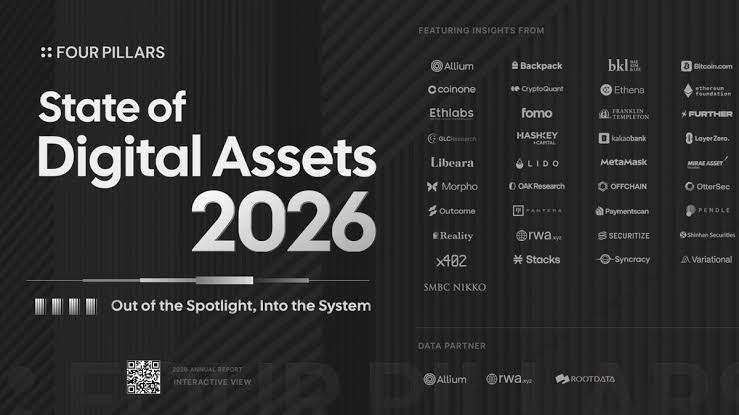
This excerpt is from the core chapters of Four Pillars' flagship annual report, "State of Digital Assets 2026," providing a comprehensive breakdown of how stablecoin velocity has surpassed US M1 velocity, the compliance pathway for tokenized US equities, the entry of Robinhood and DTCC, and features interviews with industry leaders such as Backpack, Securitize, and Bitget, revealing the next wave of opportunities for utility-driven assets.
Stablecoins as a payment rail, and the scale of tokenized assets surpassing $120 billion.
Stablecoins Are Shifting from Issuance to Utility
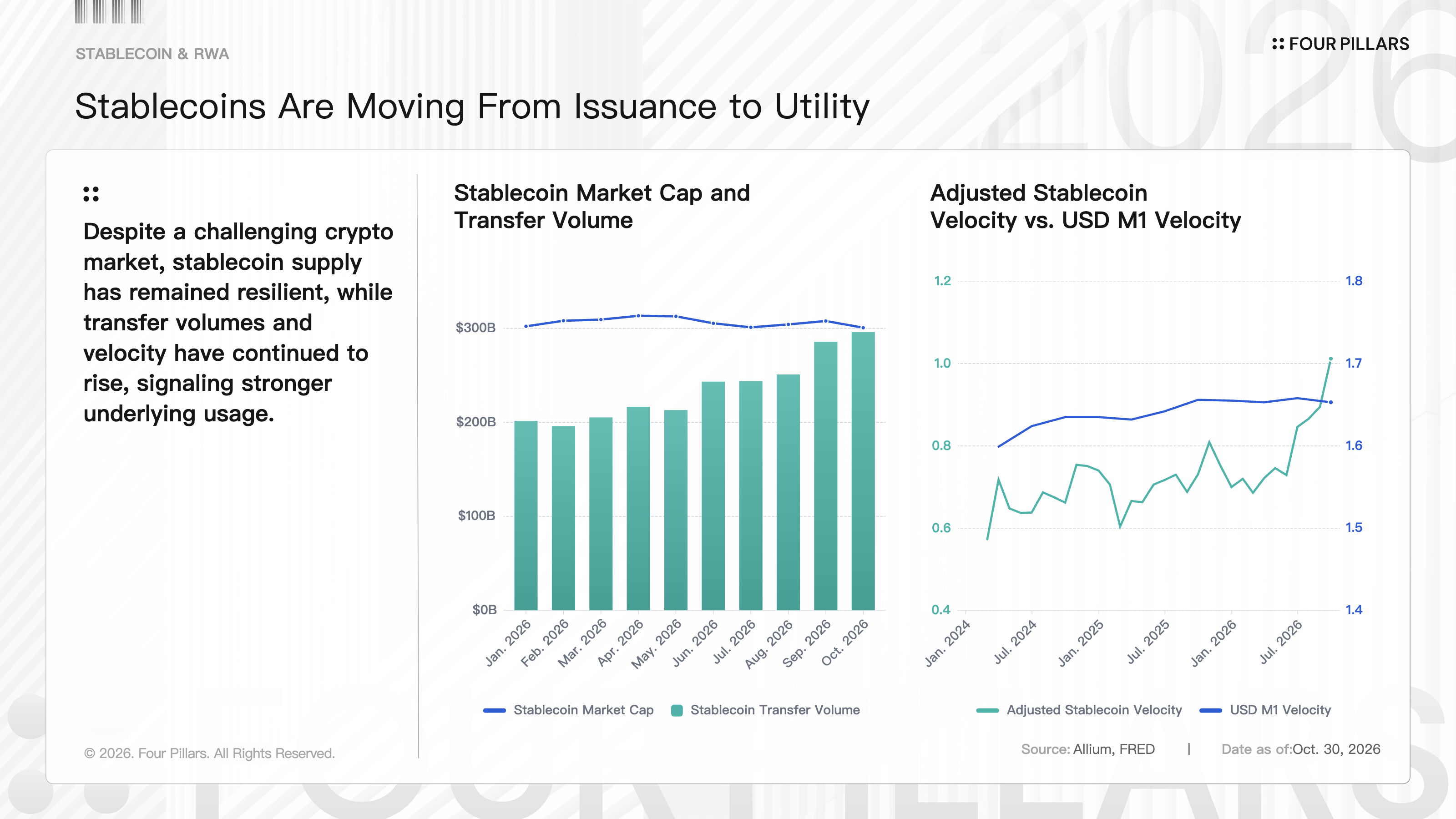
Source: Allium, FRED · As of October 30, 2026
Despite a challenging crypto market in 2026, stablecoins demonstrated extraordinary resilience. The annual supply remained around $300 billion, reaching approximately $305 billion by the end of Q3, even amid significant pressure across the broader crypto market. More importantly, usage continued to expand: stablecoin payments grew 45% to $482 billion through September, with adjusted transaction activity also rising steadily. This divergence between relatively stable supply and increasing activity indicates that stablecoins are moving beyond their issuance-driven phase toward deeper adoption. Adjusted stablecoin velocity has continued to climb, surpassing US M1 money velocity in the latest period shown in the chart. In other words, existing stablecoin supplies are circulating more actively, reinforcing the view that they are increasingly being utilized as financial and payment infrastructure rather than merely held on-chain.
Interview: Elton Shehdula, Head of Research at Allium
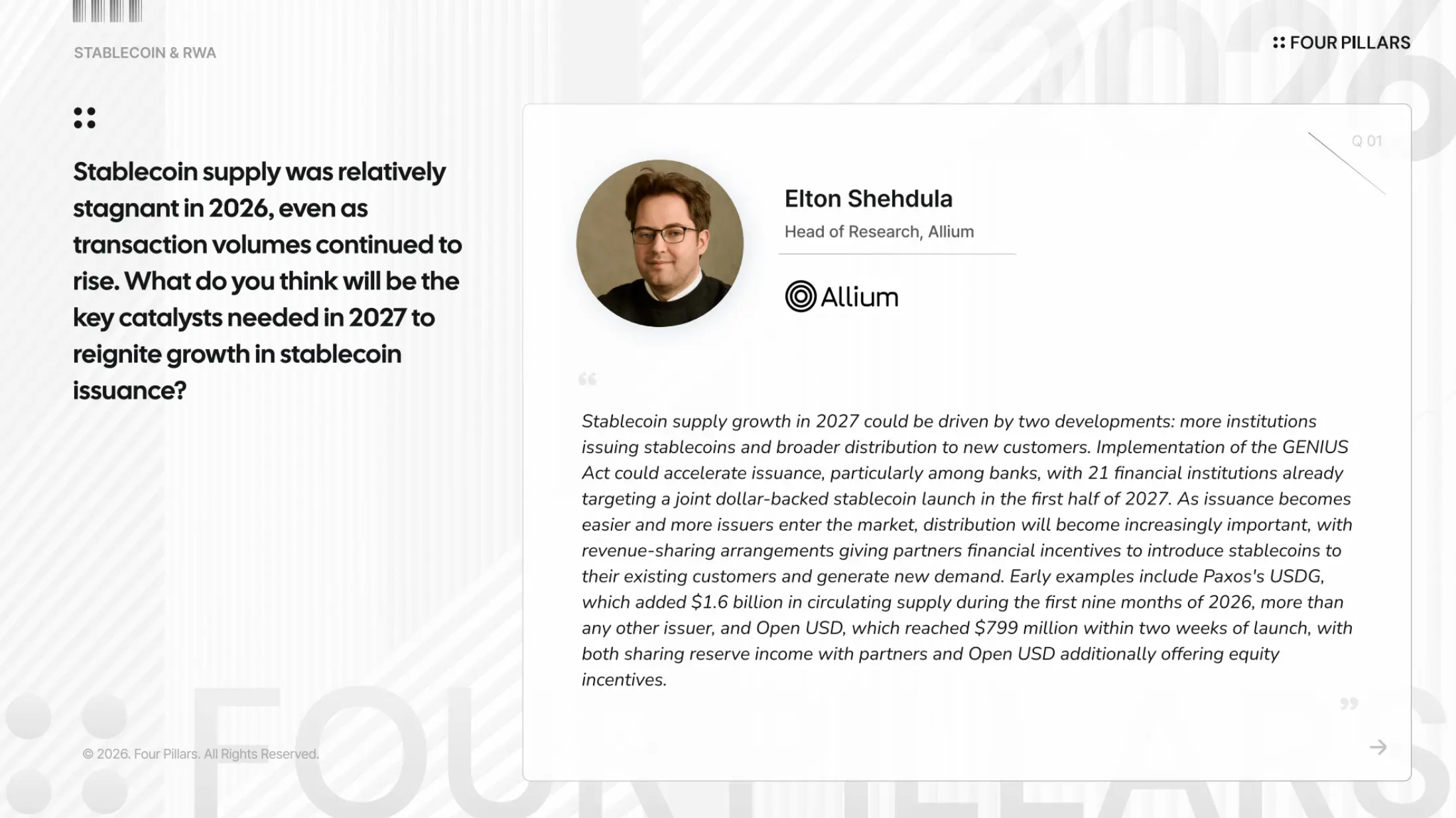
Figure: Interview with Elton Shehdula, Head of Research, Allium
Figure: Stablecoin supply stagnated in 2026 despite continuous volume growth. What key catalysts do you believe are needed to reignite stablecoin issuance growth in 2027? Stablecoin supply growth in 2027 may be driven by two major developments: increased institutional issuance and broader distribution to new customers. The implementation of the GENIUS Act could accelerate issuance, particularly among banks, where 21 financial institutions have already planned to jointly launch dollar-backed stablecoins in the first half of 2027. As issuance becomes easier and more players enter the market, distribution will become crucial. Revenue-sharing arrangements will provide partners with financial incentives to introduce stablecoins to their existing customers and generate new demand. Early examples include Paxos’s USDG, which added $1.6 billion in circulating supply over the first nine months of 2026, outpacing any other issuer, and Open USD, which reached $799 million within two weeks of launch. Both share reserve income with partners, while Open USD additionally offers equity incentives. — Elton Shehdula, Head of Research, Allium
Stablecoin Payments Rise Continuously
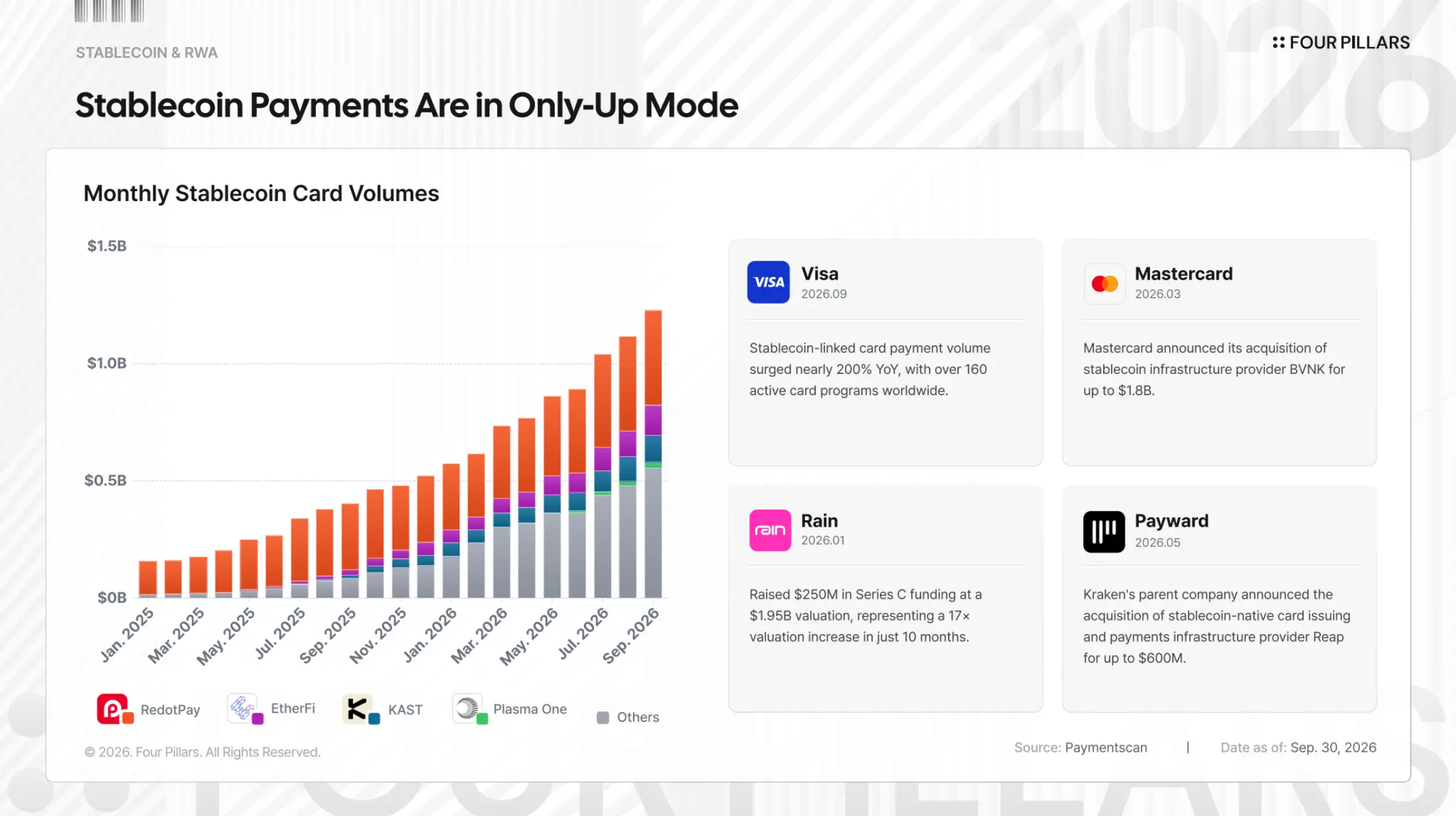
Source: Paymentscan · As of September 30, 2026
Stablecoin payments are emerging as one of the fastest-growing segments within the broader stablecoin ecosystem. Monthly card volumes rose steadily throughout 2026, surpassing $1 billion in Q3, while Visa reported near 200% year-over-year growth across its global network of over 160 stablecoin-linked card programs. More importantly, this category is beginning to transcend its crypto-native niche. Visa and Mastercard are expanding stablecoin payment infrastructure, and acquisitions such as Mastercard’s purchase of BVNK and Payward’s acquisition of Reap highlight the growing strategic interest from established financial and payment companies. Stablecoin cards are increasingly serving as a bridge between on-chain balances and everyday spending, laying the foundation for broader mainstream adoption.
Open USD Is Quietly Building Momentum
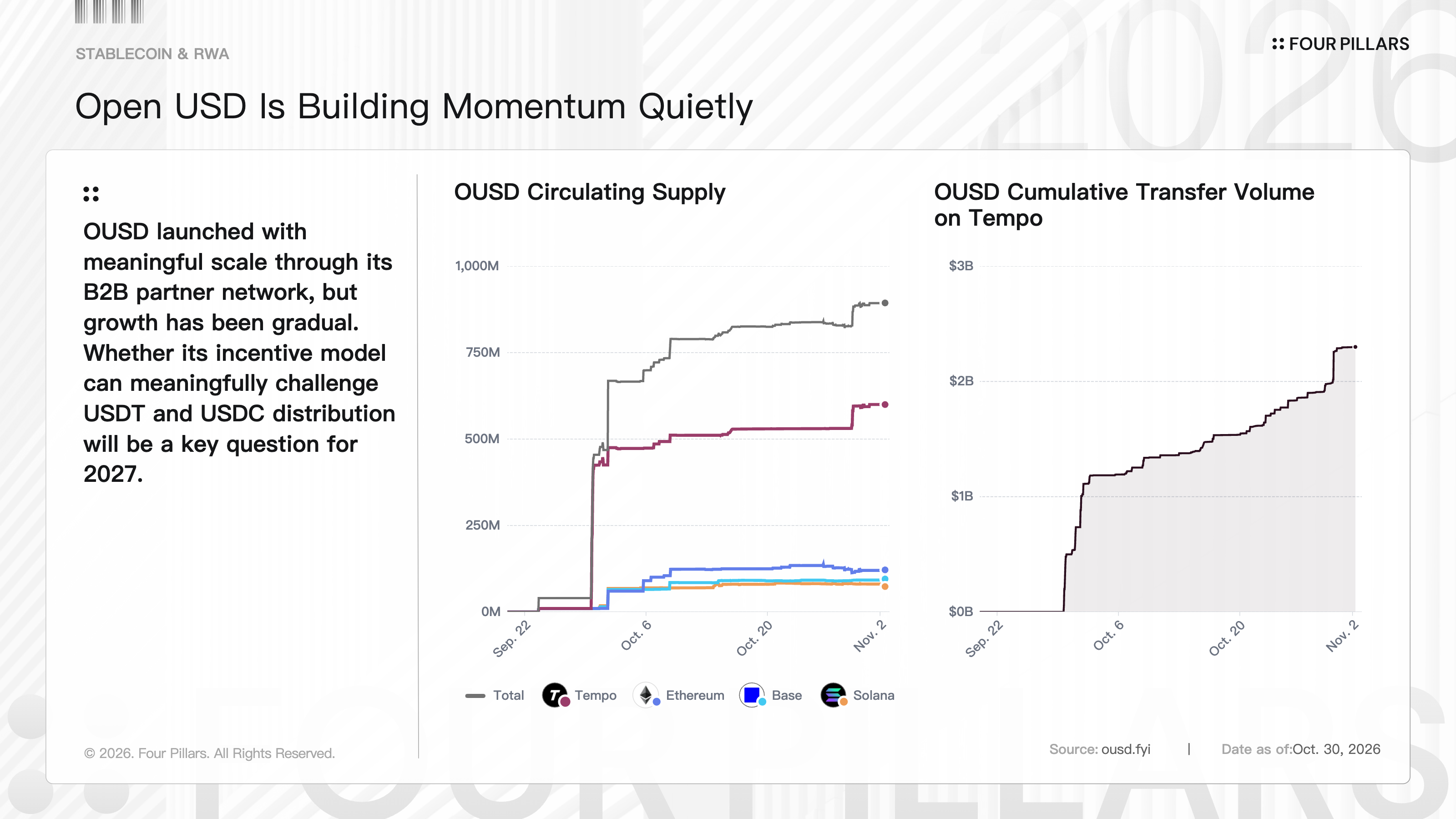
Source: ousd.fyi · As of October 30, 2026
Open USD has taken a different path compared to retail-first stablecoins. Instead of relying on organic consumer adoption, OUSD launched with a B2B distribution network comprising over 200 banks, fintechs, payment companies, and crypto platforms, including Coinbase, Mastercard, Shopify, Stripe, and Visa. This partner-led model helped OUSD quickly establish a substantial supply, securing over $1 billion in initial liquidity commitments during the period shown in the chart, with circulating supply approaching $900 million.
Interview: Thomas Bush, Co-Founder of Paymentscan
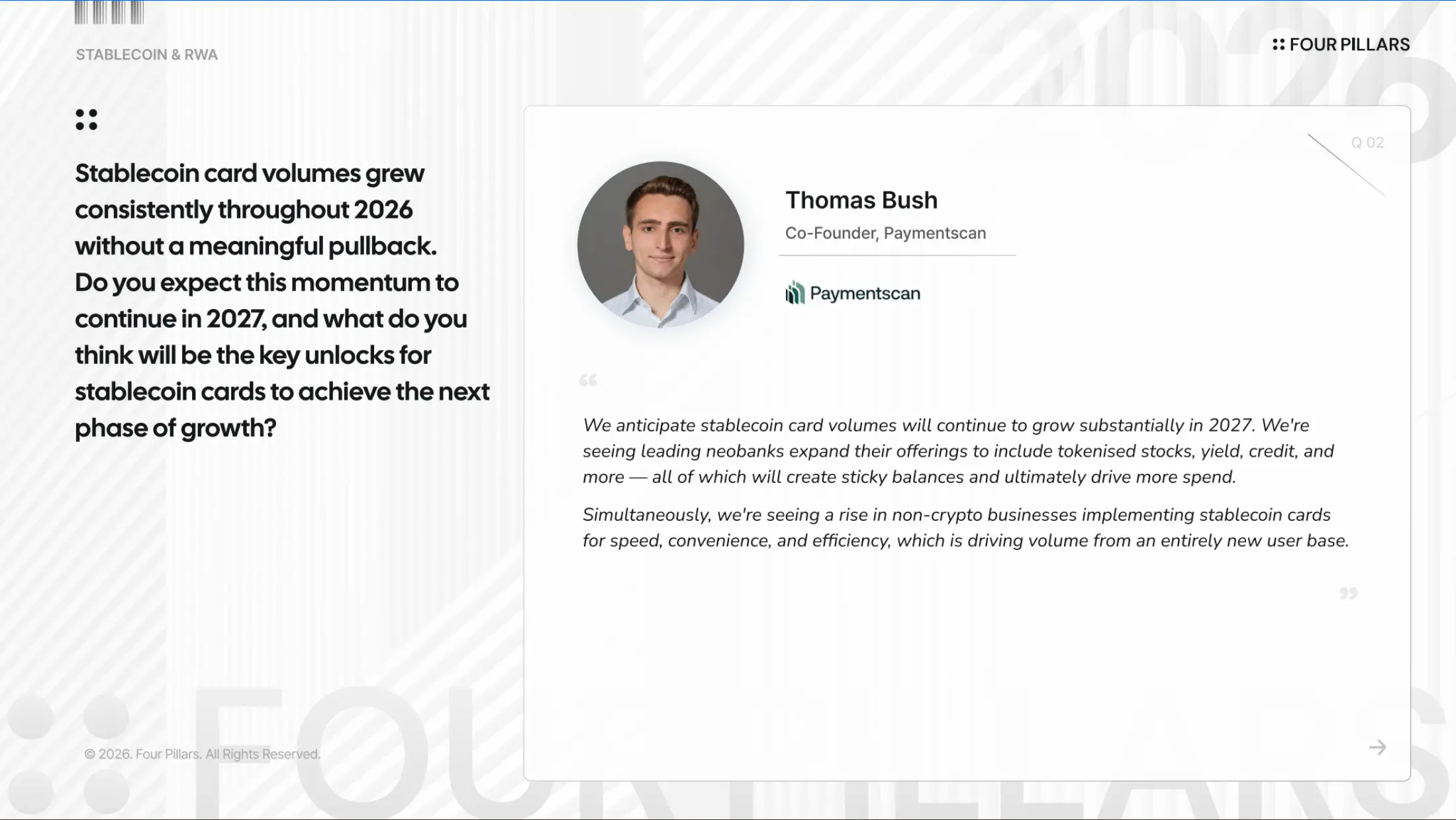
Interview: Thomas Bush, Co-Founder, Paymentscan
Stablecoin card transaction volumes have grown consistently throughout 2026 without any meaningful pullback. Do you expect this momentum to continue into 2027? What key unlocking factors do you believe are necessary for stablecoin cards to achieve their next phase of growth? We expect stablecoin card transaction volumes to continue surging significantly in 2027. We are seeing leading neobanks expand their product offerings to include tokenized equities, yields, credit, and more, all of which will create sticky balances that ultimately drive further consumption. Meanwhile, we are observing an increasing number of non-crypto businesses adopting stablecoin cards for speed, convenience, and efficiency, generating volume from entirely new user segments. — Thomas Bush, Co-Founder, Paymentscan
Tokenized Treasuries Are Maturing Beyond Growth
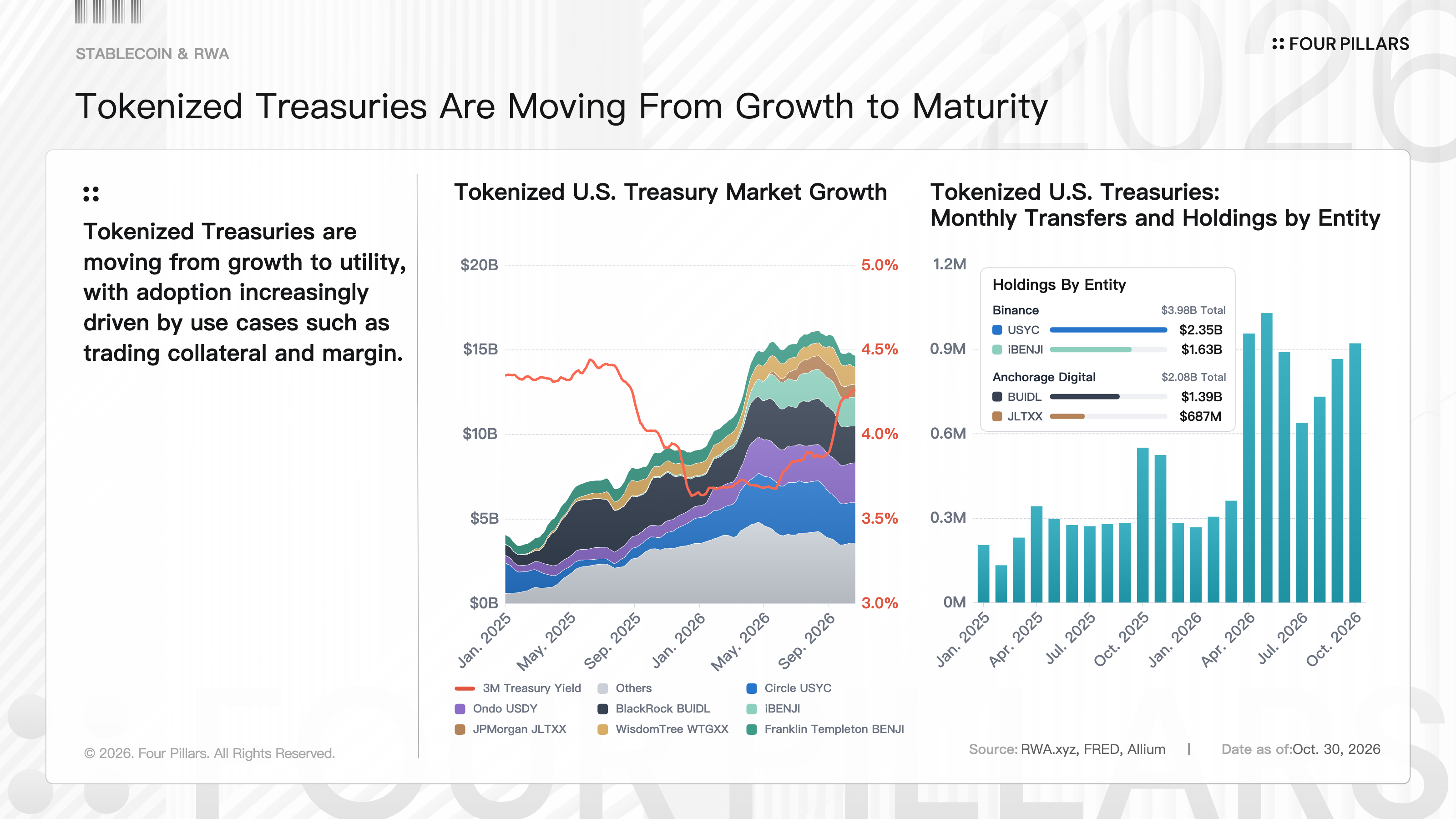
Source: RWA.xyz, FRED, Allium · As of October 30, 2026
Figure: Tokenized US Treasuries are entering a more mature phase. After growing from approximately $3 billion in early 2025 to a peak near $16 billion in 2026, the market size has recently stabilized around $14–15 billion. However, activity continues to expand, with monthly transfers rising from roughly 200,000 in early 2025 to approximately 900,000 by October 2026. Future growth will increasingly focus on utility rather than mere issuance. Major institutions hold billions in tokenized Treasuries, which are now being integrated into trading, collateral, custody, and margin processes. For example, Binance has permitted tokenized Treasury products like BUIDL to serve as institutional OTC collateral. Consequently, the market is shifting from simply putting Treasuries on-chain to enabling them to play functional roles within broader financial infrastructure.
Tokenized Treasuries Grow Simultaneously in Assets and Investors
Source: RWA.xyz · As of October 25, 2026
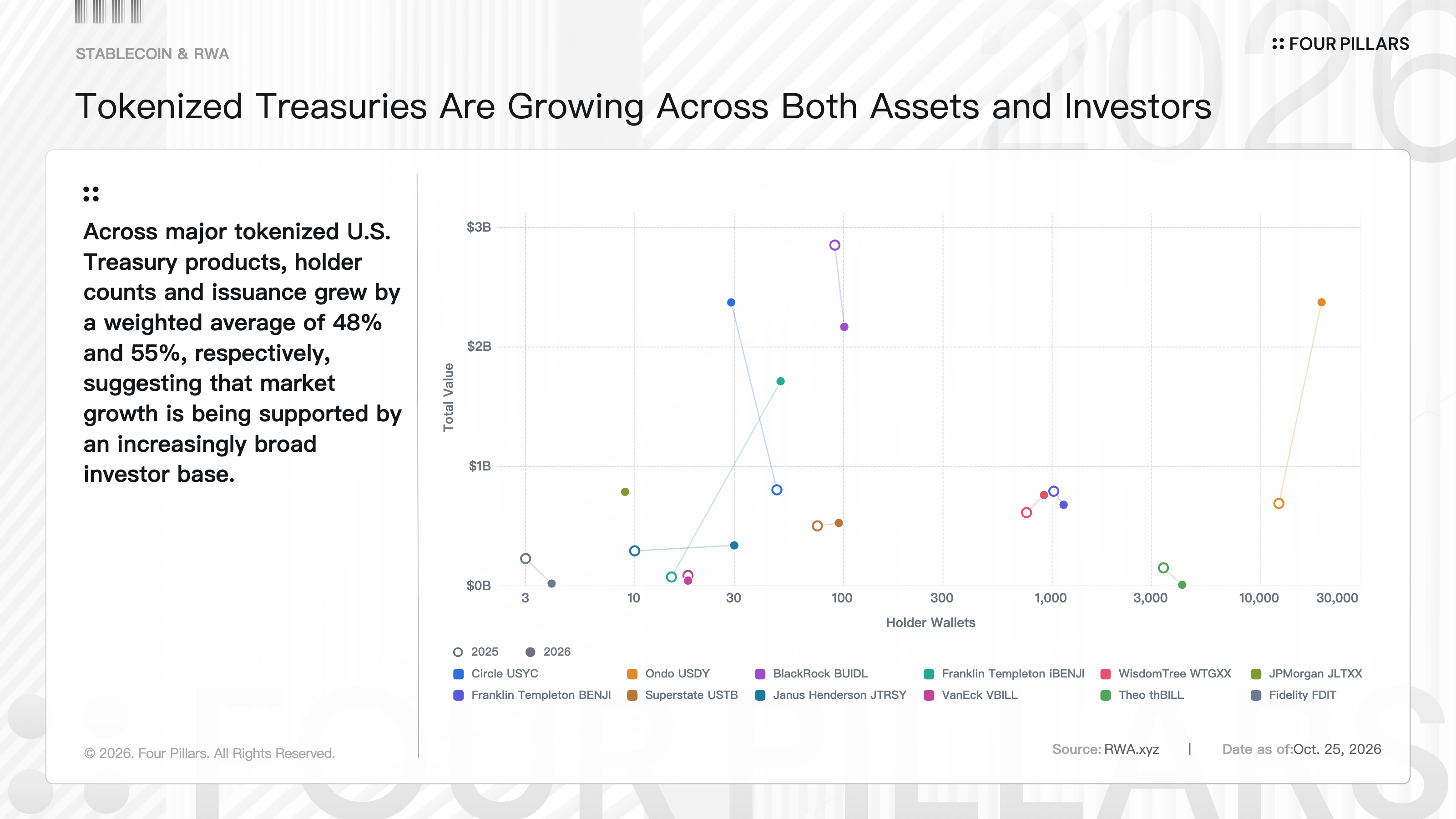
In 2026, tokenized US Treasuries continued to expand, with both market size and investor participation showing upward trends year-over-year. Across the major products shown in the chart, issuance-weighted averages grew by 55%, while the number of holders increased by 48%. Importantly, this growth is not solely asset-scale-driven. As more products simultaneously expanded both their outstanding values and user wallet bases, it indicates that tokenized Treasuries are attracting a broader range of investors, rather than just concentrating additional capital among existing holders.
Interview: Chetan Karkhanis, Senior Vice President of Digital Assets Client Engagement at Franklin Templeton
Interview: Chetan Karkhanis, SVP Digital Assets Client Engagement, Franklin Templeton
Tokenized US Treasuries have seen rapid growth in recent years, but the issuance pace appears to be slowing now. As the market shifts from issuance toward broader distribution and utility, what key catalysts do you believe will drive the next wave of growth for tokenized Treasuries? The market for tokenized money market funds and Treasury solutions has indeed shifted from proof-of-concept and go-live phases to a focus on scaling. Key catalysts may include: 1) Greater recognition by both institutional and retail use cases of the advantages of tokenized products over traditional forms; 2) The strengths of tokenized money market funds in specific verticals such as corporate treasury management and collateral; 3) Deeper adoption of on-chain yield solutions by native Web3 platforms like crypto exchanges, vaults, and digital wealth platforms; 4) Regional expansion as regulated and licensed tokenized assets gain support and adoption in Asian and other global markets. — Chetan Karkhanis, SVP Digital Assets Client Engagement, Franklin Templeton
On-Chain Government Debt Remains US-Centric
Source: RWA.xyz, OECD, Fed · As of December 31, 2025
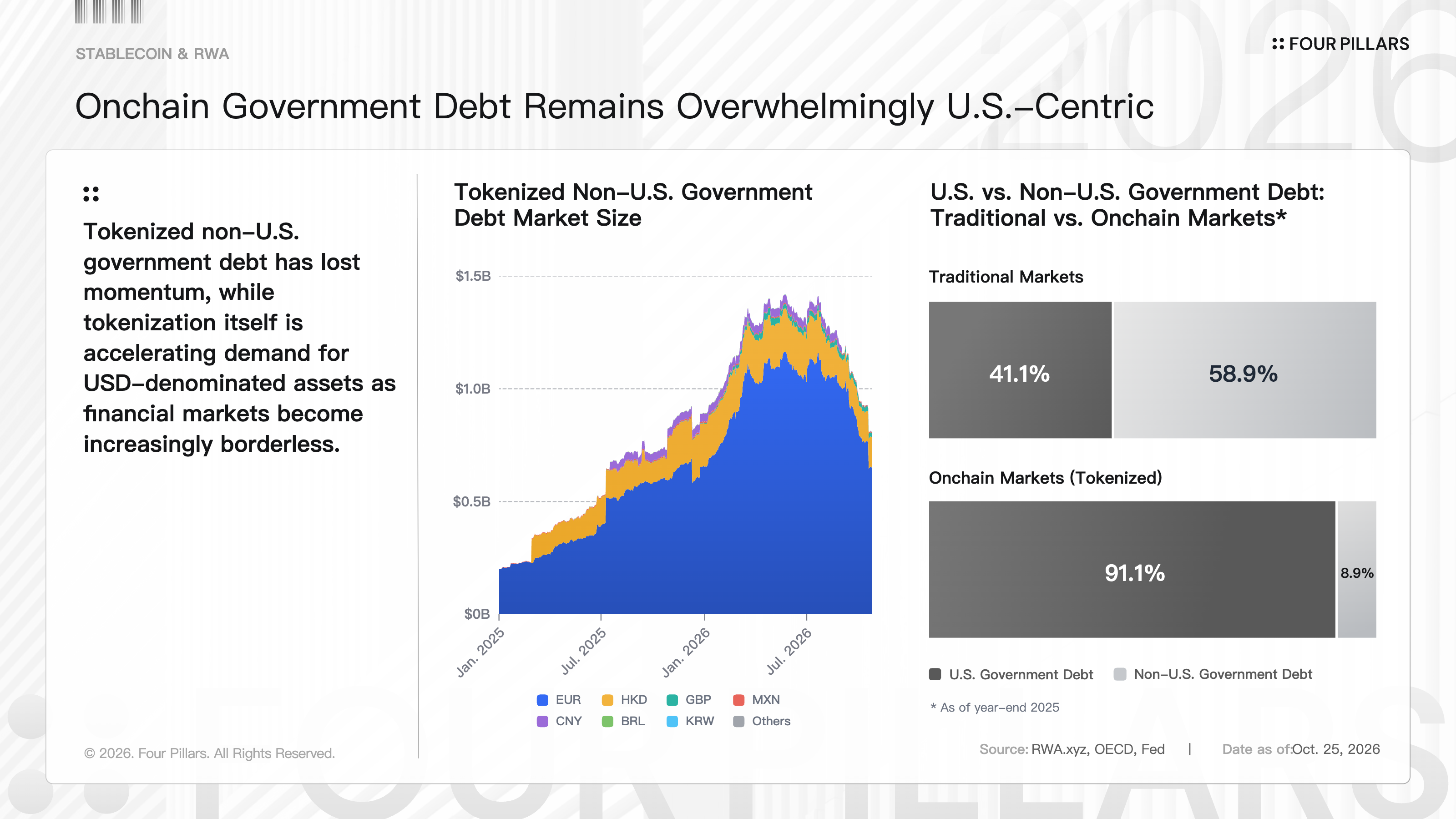
The composition of government debt looks starkly different on-chain compared to traditional markets. In traditional markets, non-US government debt accounts for 58.9% of the total, while US government debt makes up 41.1%. On-chain, however, the situation is almost entirely reversed: US government debt represents 91.1% of tokenized government debt, with non-US sovereign debt accounting for only 8.9%. This gap highlights both an opportunity and a structural reality. The limited presence of non-US sovereign debt suggests significant room for expansion in bond markets across Asia and other regions on-chain. Meanwhile, the dominance of US Treasuries indicates that when geographic barriers are lowered, global demand tends to concentrate in the deepest, most liquid dollar-denominated assets. Thus, tokenization may broaden access to financial assets while simultaneously reinforcing the global influence of the US dollar.
Interview: Jeseok Hong, Associate, Shinhan Securities Digital Asset Department
Interview: Jeseok Hong, Associate, Shinhan Securities Digital Asset Dept.
Tokenized US Treasuries are maturing, while non-US sovereign bond scales remain small. What are the key unlocking factors for scaling tokenized non-US government debt? The rise of tokenized US Treasuries stems from the fact that the dollar itself is already on-chain. For investors holding dollar stablecoins, tokens for non-US government bonds still imply foreign exchange risk, so demand fluctuates with interest rate spreads and FX outlooks. From a broker’s perspective, purchasing bonds on-market and settling into custody happens instantly, but converting stablecoin funds via banks into local currency takes time. For non-US government debt to scale on-chain, local currencies must come on-chain first, allowing investors to purchase tokens using those currencies and utilize them as collateral. — Jeseok Hong, Associate, Shinhan Securities Digital Asset Department
Tokenized Equities Break Through in 2026
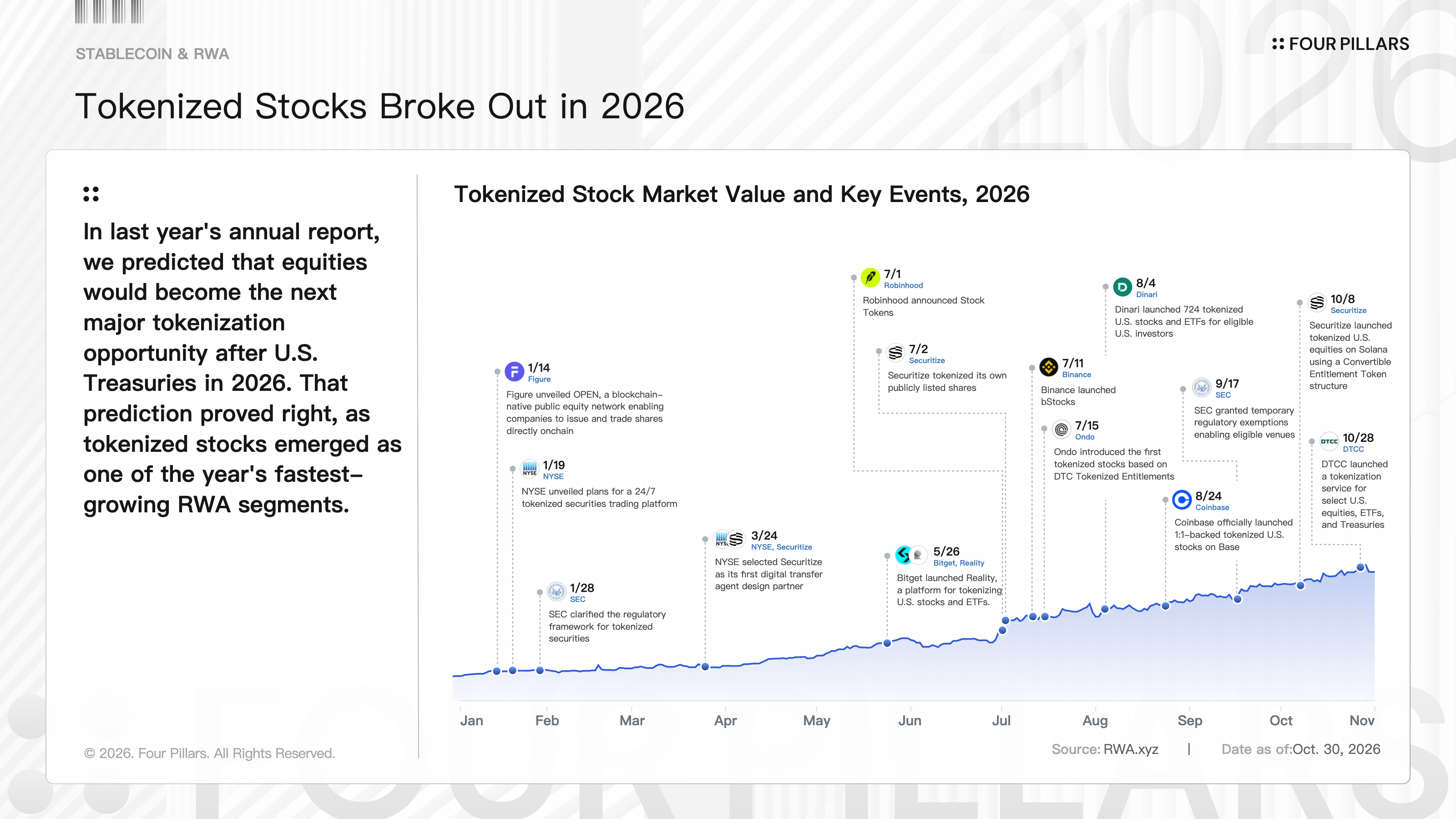
Source: RWA.xyz · As of October 30, 2026
Figure: 2026 was a breakthrough year for tokenized equities, with the market expanding rapidly in both scale and depth. The chart shows accelerated market cap growth throughout the year as new platforms and products entered the market and distribution channels widened, particularly from mid-2026 onward. This growth also reflects improved quality. Robinhood, Dinari, Binance, Ondo, Coinbase, Securitize, and DTCC have all launched or expanded tokenized equity products, while US regulators began providing clearer frameworks for the issuance and trading of tokenized securities. In September, the SEC granted temporary exemptions for on-chain trading of certain tokenized NMS stocks, marking a meaningful step toward regulated adoption. Overall, the combination of platform expansion, institutional participation, and regulatory progress suggests that tokenized equities will likely remain one of the fastest-growing RWA categories in 2027.
Interview: Armani Ferrante, CEO of Backpack
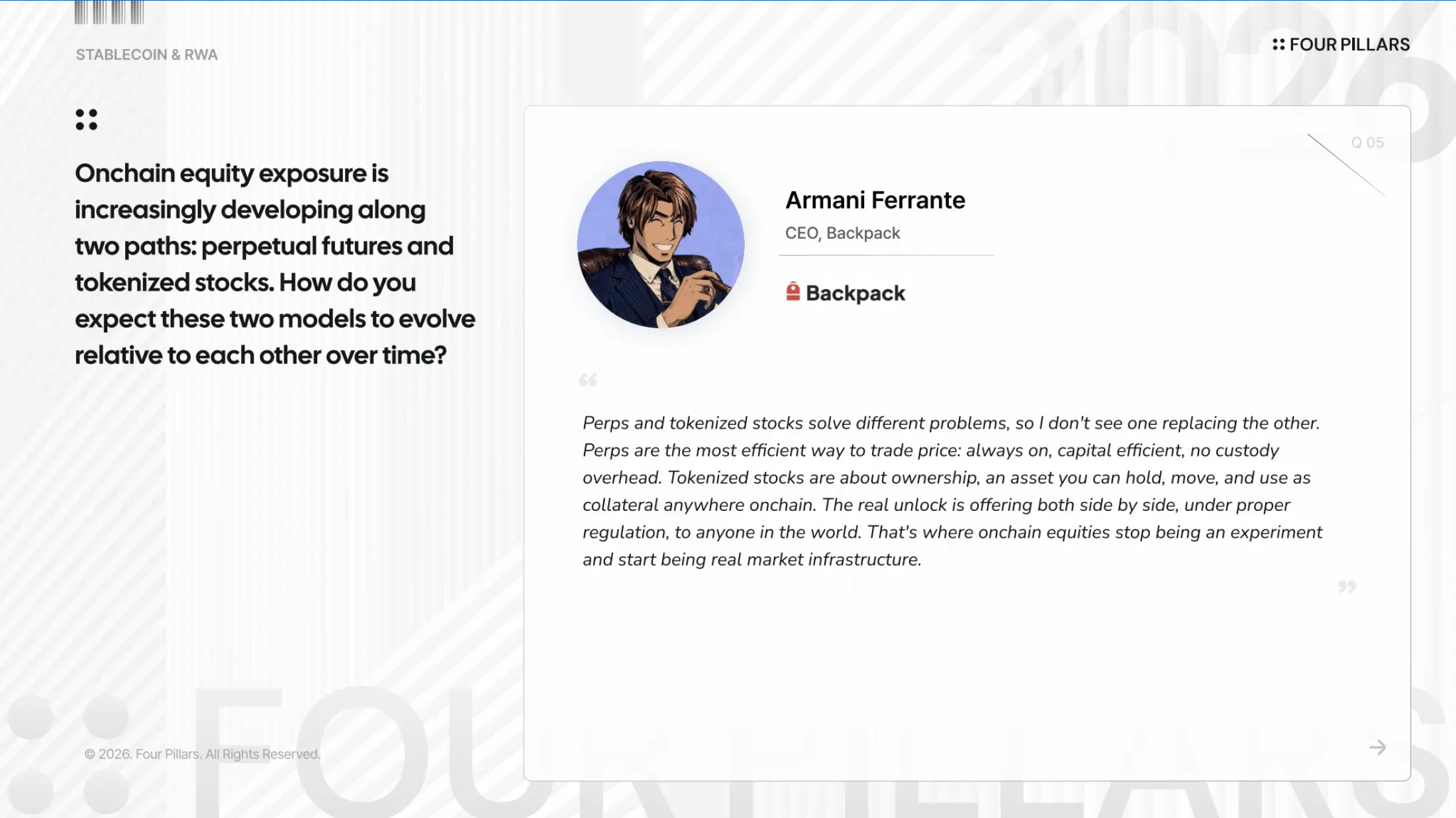
Interview: Armani Ferrante, CEO, Backpack
On-chain equity exposure is developing along two paths: perpetual swap futures and tokenized equities. How do you envision these two models evolving relative to each other over time? Perpetuals and tokenized equities solve different problems, so I don’t believe one will replace the other. Perpetuals are the most efficient way to trade price: 24/7, highly capital-efficient, and free of custody overhead. Tokenized equities are about ownership—they are assets you can hold anywhere on-chain, transfer, and use as collateral. The true unlock lies in offering both side-by-side to anyone globally under appropriate regulation. This is exactly where on-chain equities transition from experiments to actual market infrastructure. — Armani Ferrante, CEO, Backpack
Tokenized Equities Move Toward Regulatory Compliance
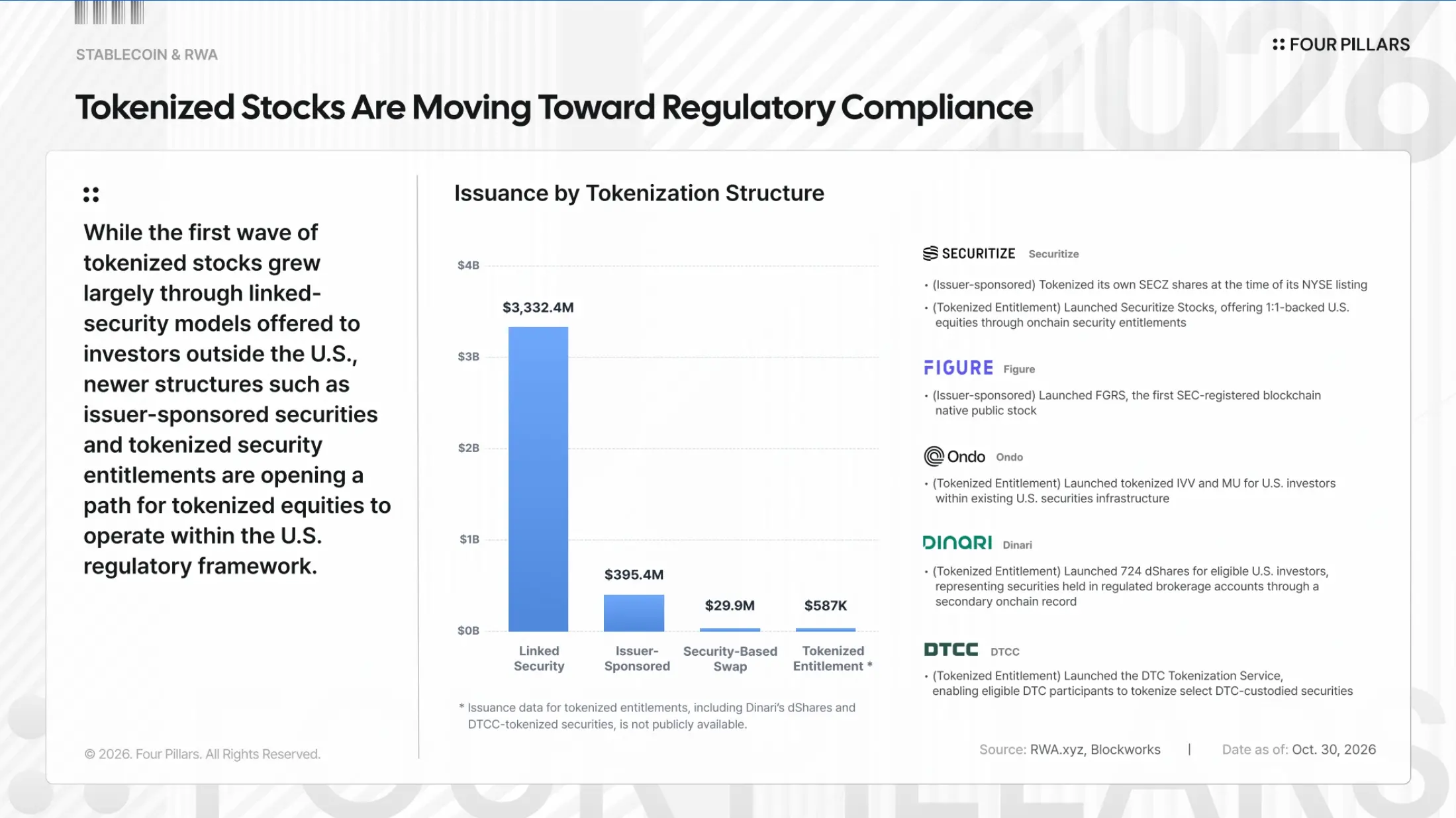
Source: RWA.xyz, Blockworks · As of October 30, 2026
The first wave of tokenized equities primarily relied on securitized note structures, offering global investors easier access and greater on-chain flexibility. This model still dominates issuance, with an outstanding scale of approximately $3.3 billion, compared to issuer-originated securities totaling around $395 million. However, the trajectory is shifting. In 2026, US regulators provided clearer guidance on issuer-originated securities and tokenized equity interests, while companies like Figure, Securitize, Dinari, Ondo, and DTCC launched products designed to operate within existing US securities law frameworks. Therefore, the next phase of tokenized equities will focus not just on putting shares on-chain, but on doing so through structures that preserve ownership rights, investor protection, and regulatory compliance.
Interview: Graham Ferguson, Head of Ecosystem at Securitize
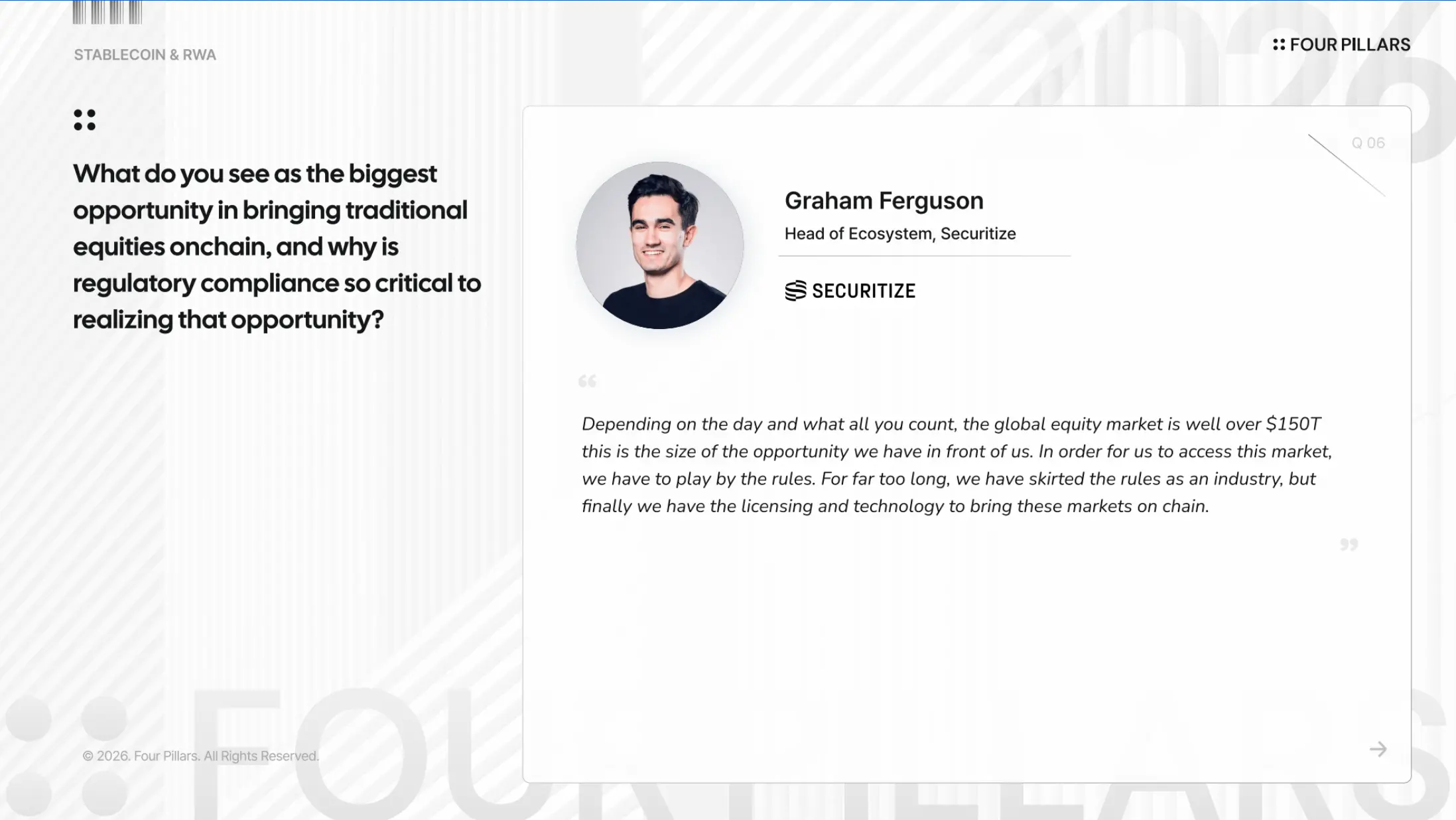
Interview: Graham Ferguson, Head of Ecosystem, Securitize
What do you see as the biggest opportunity in bringing traditional stocks on-chain? Why is regulatory compliance so critical to realizing this opportunity? Depending on the exact day and what you include, the global stock market vastly exceeds $150 trillion—that is the scale of opportunity before us. To access this market, we must adhere to rules. Our industry has long skirted regulations, but today we finally possess both the licenses and technology to bring these markets on-chain. — Graham Ferguson, Head of Ecosystem, Securitize
Asia: The Hidden Engine Behind Tokenized Equities
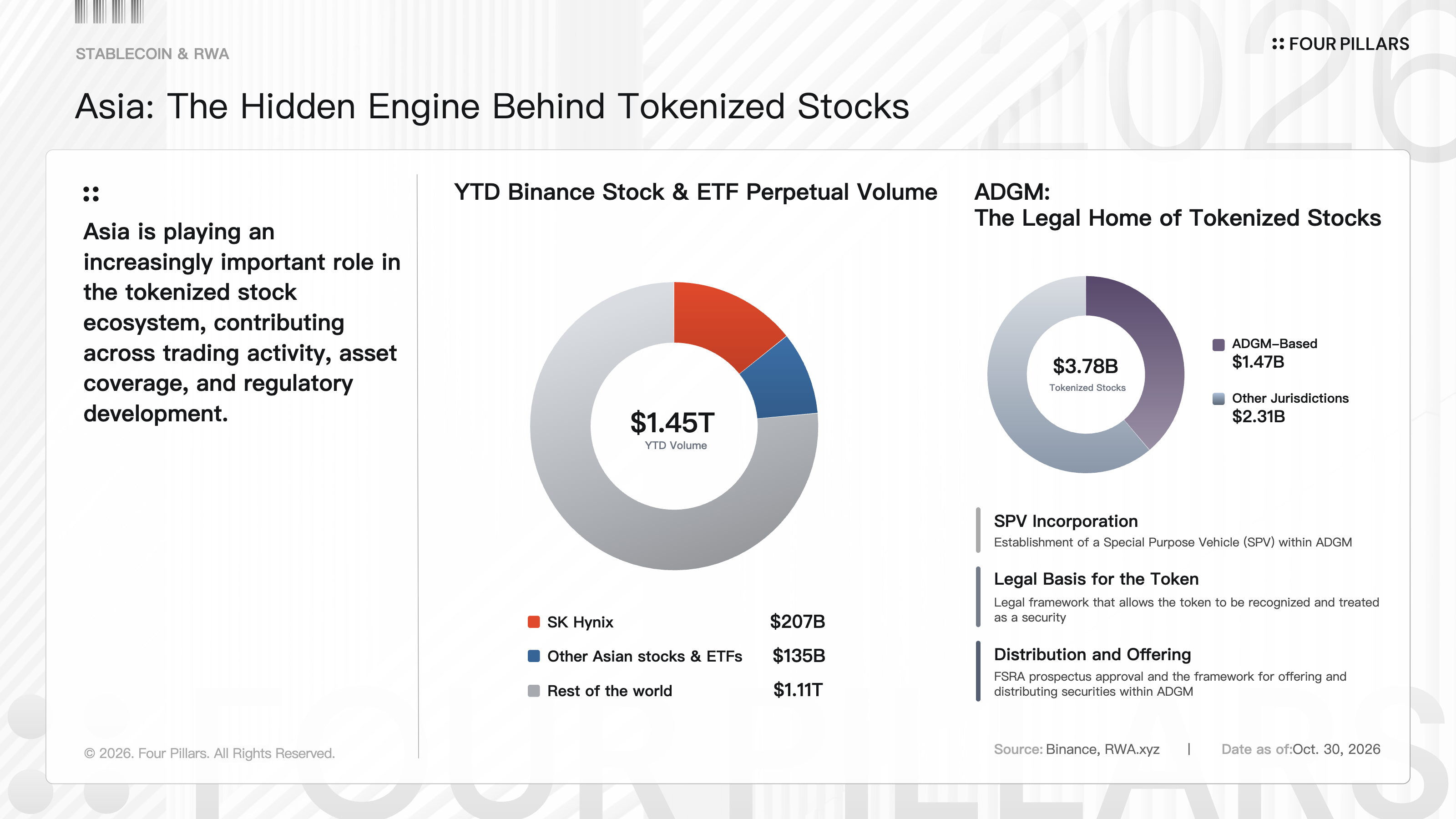
Source: Binance, RWA.xyz · As of October 30, 2026
Figure: Asia plays a larger role in the tokenized equity ecosystem than simple surface-level market share figures suggest. On Binance, Asian stocks and ETFs accounted for approximately $342 billion in year-to-date perpetual swap trading volume, with SK Hynix alone contributing $207 billion, highlighting strong demand for Asian equity exposure through crypto-native venues. Asia is also emerging as a critical regulatory hub for tokenized equities. Of the $3.78 billion in tokenized equities shown in the chart, $1.47 billion (roughly 39%) was issued under ADGM (Abu Dhabi Global Market) structures. ADGM provides a regulated framework for digital securities, while major platforms like Binance and Coinbase are increasingly establishing Abu Dhabi as a base for tokenized securities activity. Taken together, data shows Asia contributes not only demand and trading volume, but also the regulatory infrastructure supporting the next phase of growth for tokenized equities.
Interview: Alice, Head of Reality at Bitget
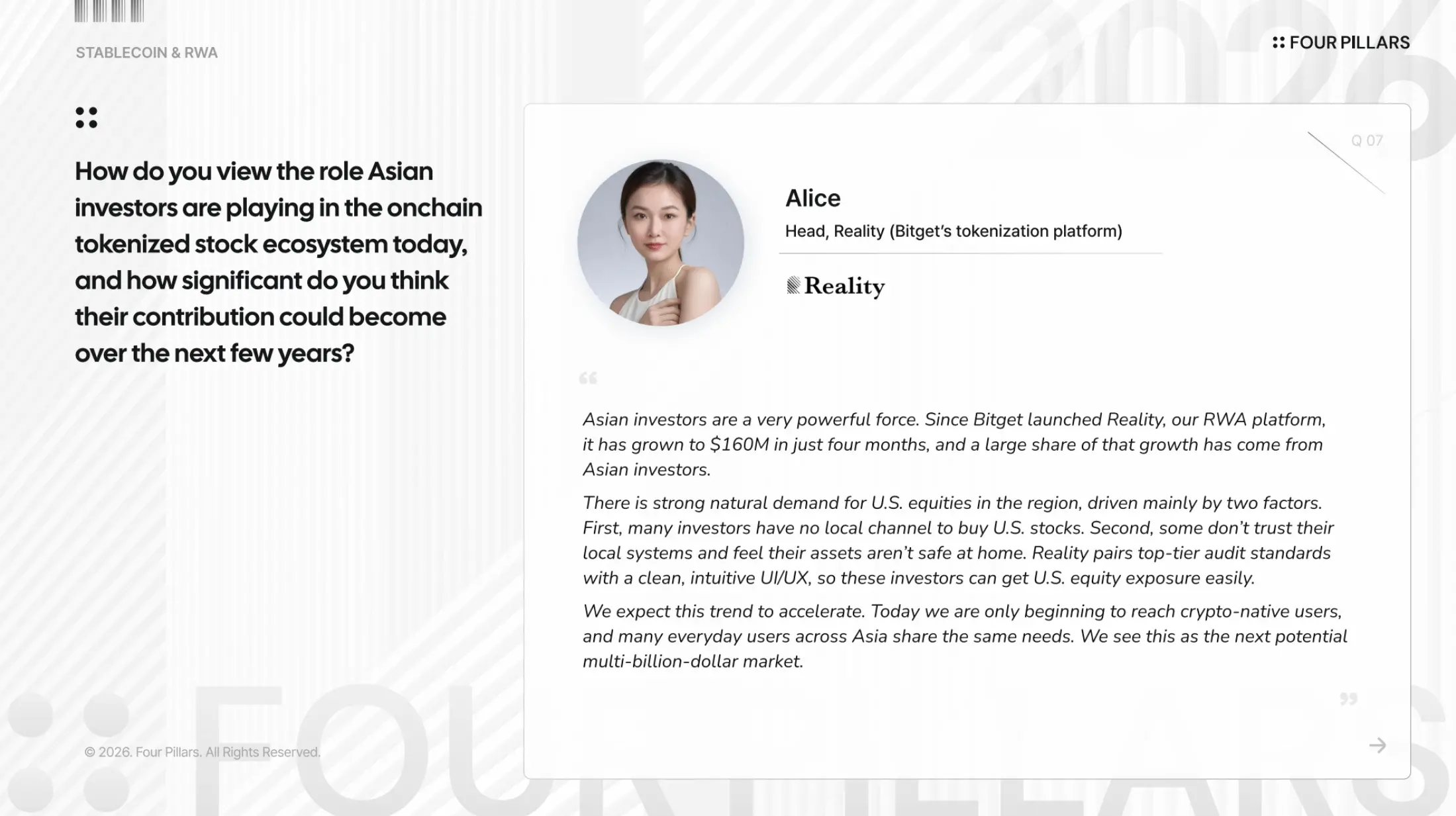
Interview: Alice, Head of Reality, Bitget
How do you view the role Asian investors currently play in the on-chain tokenized equity ecosystem? How significant do you think their contributions will be over the coming years? Asian investors are a formidable force. Since Bitget launched our RWA platform Reality, it has grown to $160 million in just four months, with a large portion of that growth coming from Asian investors. The region has strong organic demand for US equity exposure, driven by two main factors. First, many investors lack local channels to buy US stocks. Second, some distrust domestic systems and feel their assets are unsafe domestically. Reality combines top-tier audit standards with a clean, intuitive UI/UX, enabling these investors to easily gain US equity exposure. We expect this trend to accelerate. We’ve only just begun reaching crypto-native users, yet many traditional users in Asia share the same needs. We view this as the next potential multi-billion-dollar market. — Alice, Head of Reality (Bitget Tokenized Platform)
Although Smaller Than Other Asset Classes, Tokenized Private Credit Is the Most Widely Used in DeFi
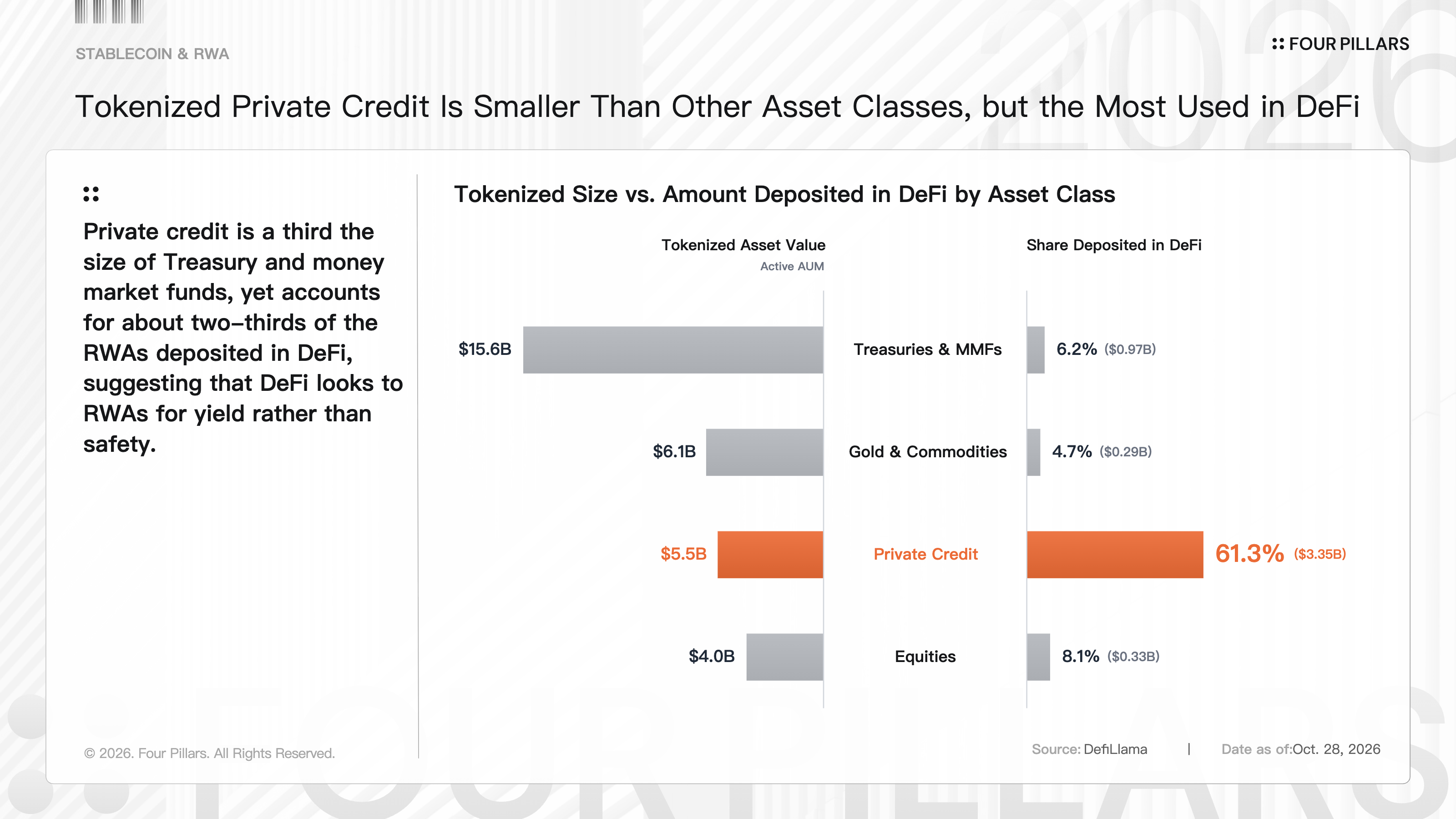
Source: DefiLlama · As of October 28, 2026
Figure: As of October 2026, the tokenized private credit market reached $5.5 billion. This represents roughly a third of the Treasury and money market fund category ($15.6 billion) and falls short of gold and commodities ($6.1 billion). By issuance volume alone, private credit ranks lower in the tokenized landscape.
Gold Prices Turn Lower in 2026, Yet On-Chain Gold Holdings Continue to Grow
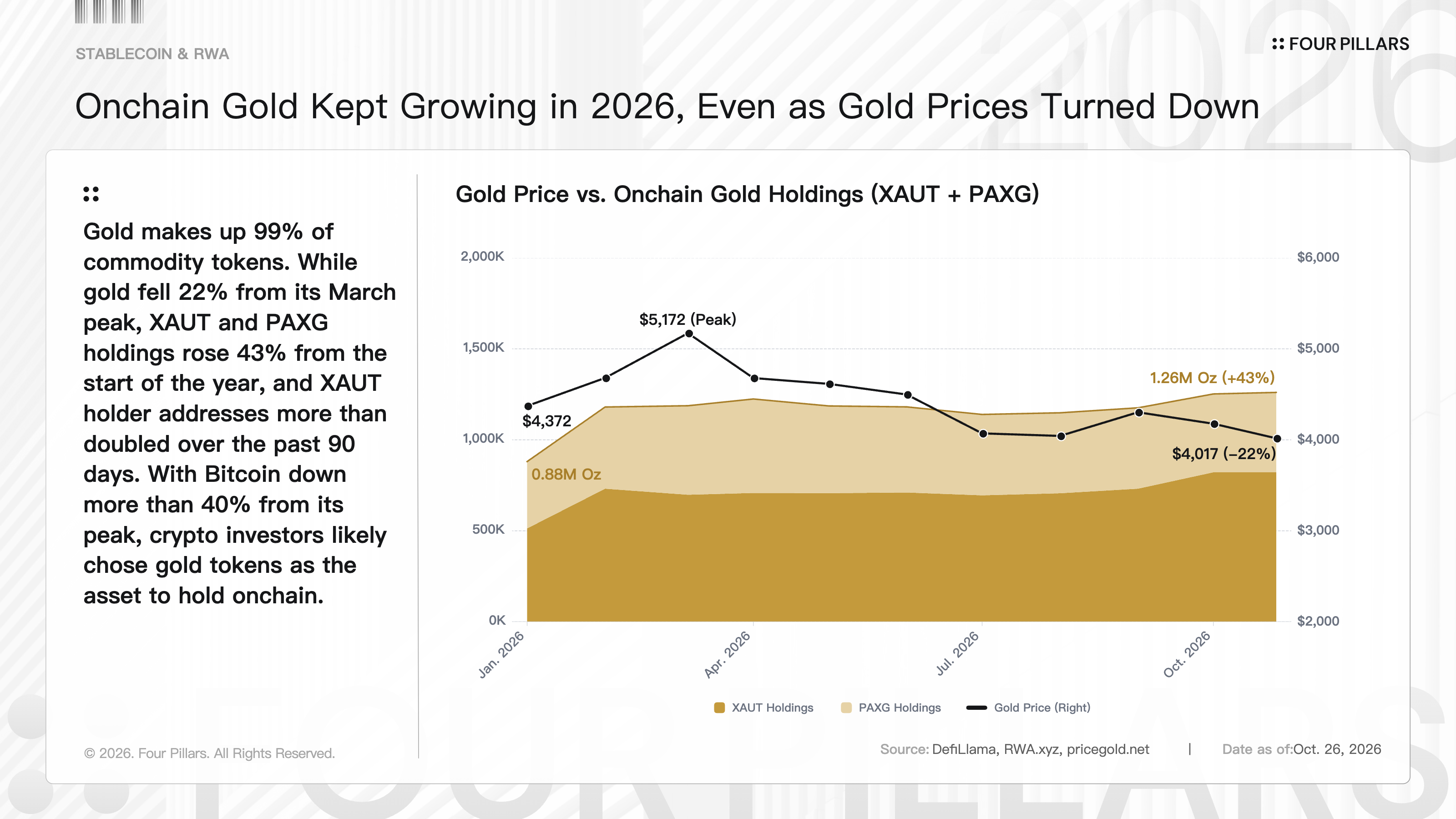
Source: DefiLlama, RWA.xyz, pricegold.net · As of October 26, 2026
Gold accounts for 99% of tokenized commodities. Spot gold peaked at $5,172 per ounce in March this year, falling 22% to $4,017 by October 26. On-chain gold holdings moved in the opposite direction. Combined holdings of Tether Gold (XAUT) and PAX Gold (PAXG) grew 43%, rising from 880,700 ounces at the start of the year to 1.2605 million ounces. Approximately 300,000 ounces were added in January and February ahead of the price peak, and holdings did not decline after the subsequent price drop.
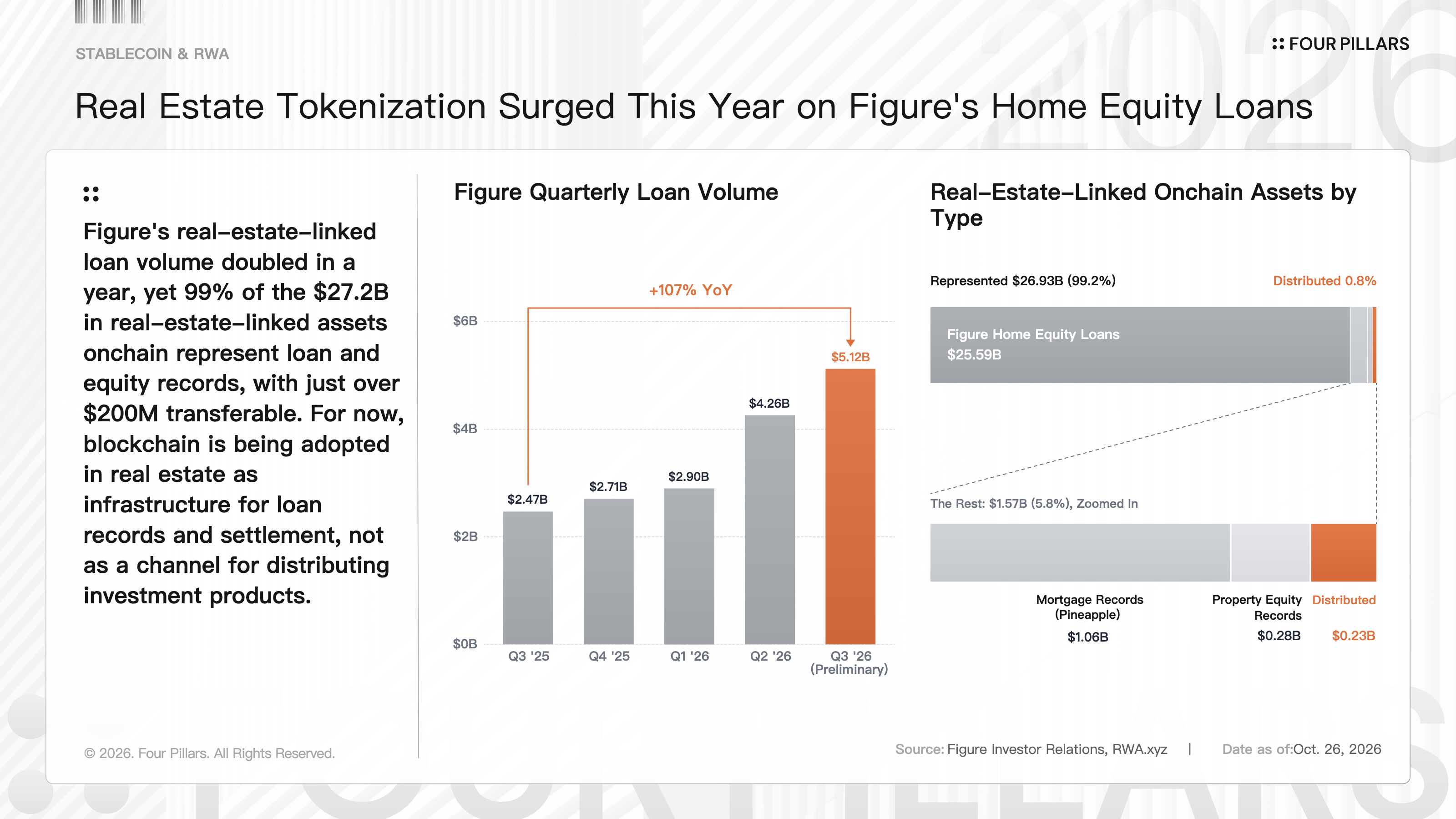
Figure’s Home Equity Loans Drive Real Estate Tokenization Surge This Year
Source: Figure Investor Relations, RWA.xyz · As of October 26, 2026
Figure’s home equity loans fueled growth in the real estate tokenization market this year. According to investor disclosures from Figure, quarterly loan volume more than doubled year-over-year, rising from $2.47 billion in Q3 2025 to $5.12 billion in Q3 2026 (preliminary data). In Q2 2026, volume hit $4.26 billion, representing roughly a 47% quarter-over-quarter increase, with growth continuing into the third quarter.
Interview: Bryan Choe, Head of Research at rwa.xyz
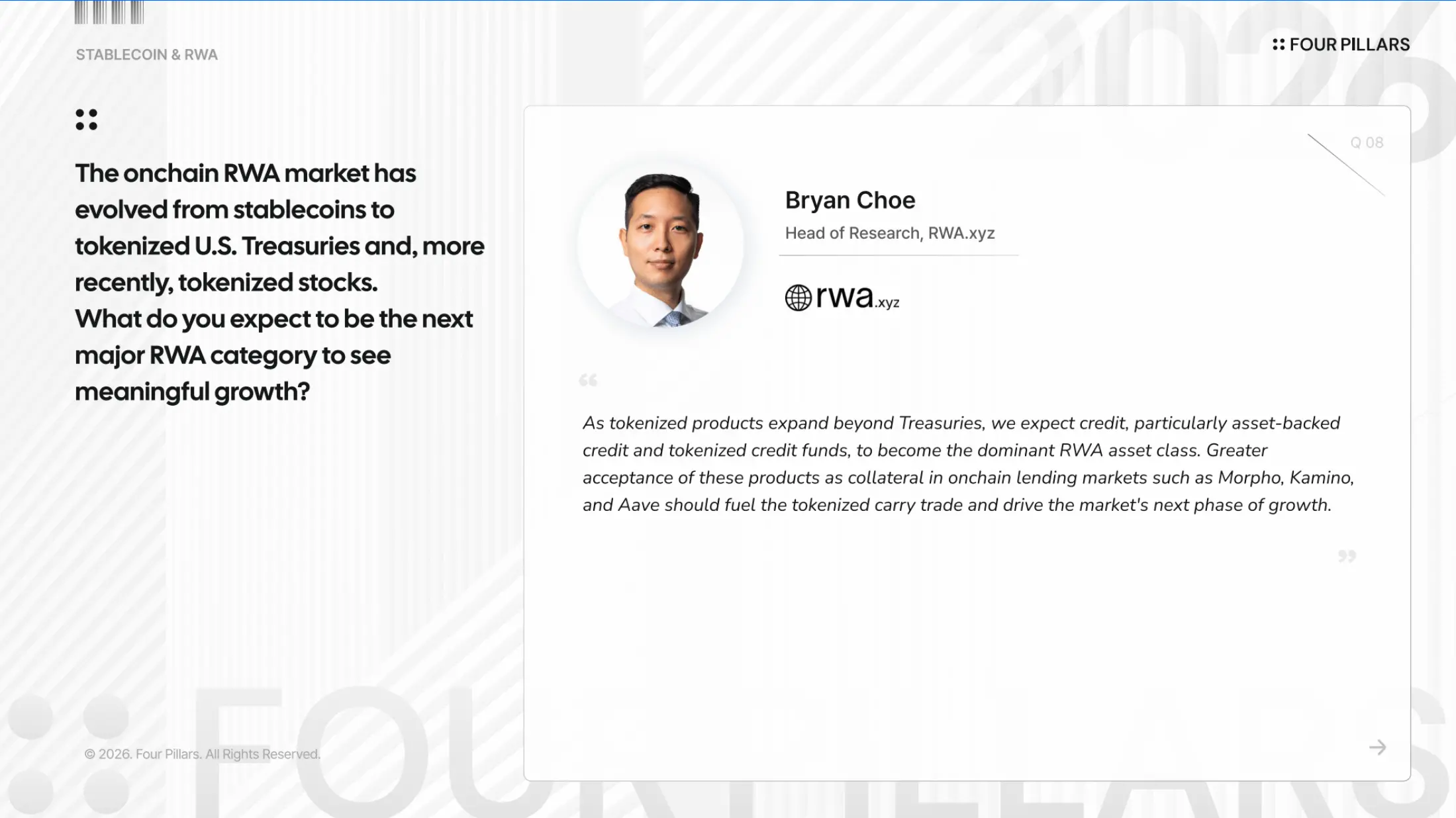
Figure: Interview: Bryan Choe, Head of Research, RWA.xyz
The on-chain RWA market has evolved from stablecoins to tokenized US Treasuries, and most recently to tokenized equities. What major RWA category do you anticipate will see meaningful growth next? As tokenized products move beyond Treasuries, we expect credit—particularly asset-backed credit and tokenized credit funds—to become the dominant RWA asset class. These products are gaining wider acceptance as collateral in on-chain lending markets like Morpho, Kamino, and Aave, which should catalyze tokenized arbitrage strategies and drive the market’s next phase of growth. — Bryan Choe, Head of Research, rwa.xyz
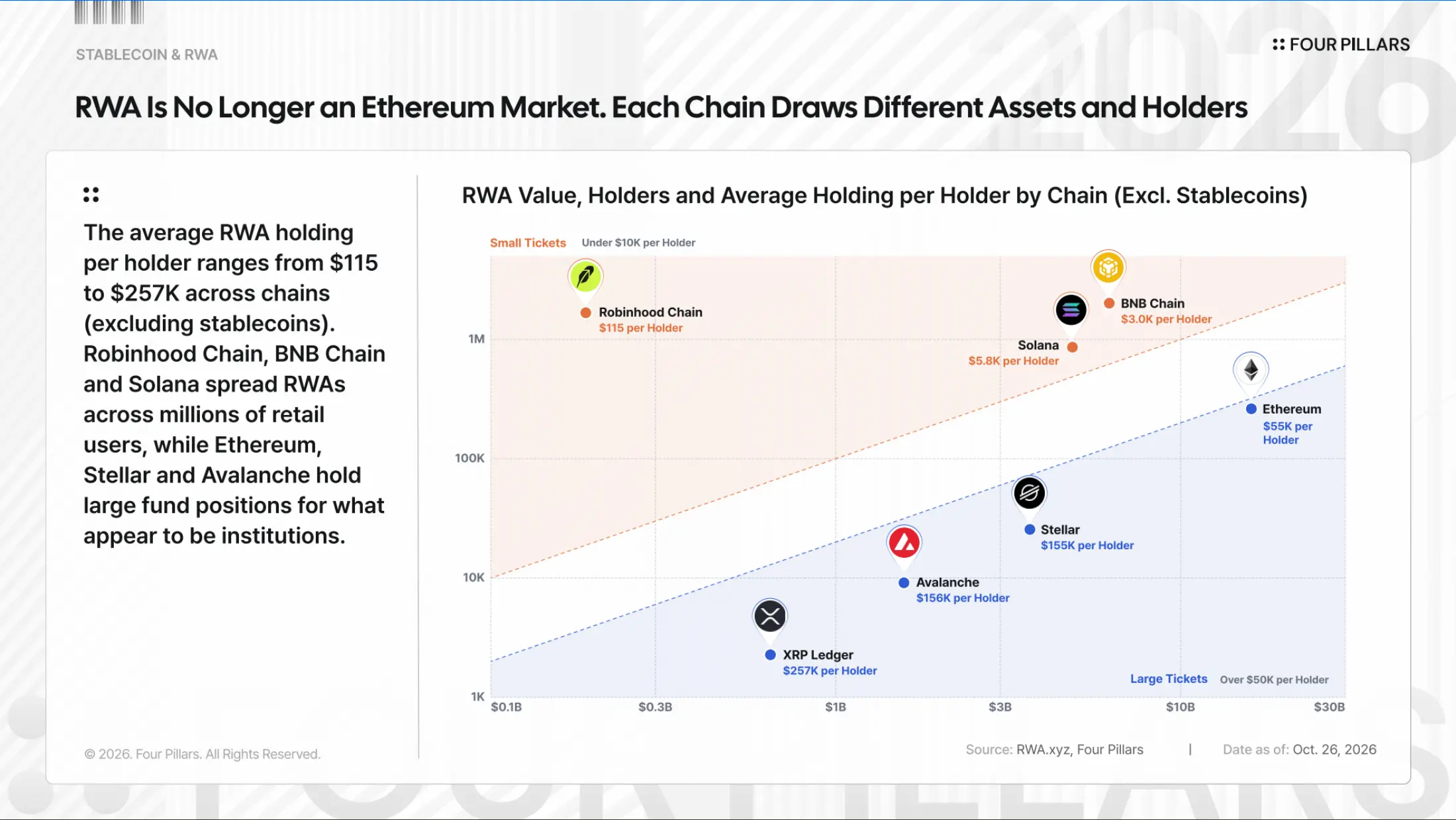
RWA Is No Longer Dominated Solely by Ethereum, With Each Chain Attracting Different Assets and Holders
Source: RWA.xyz, Four Pillars · As of October 26, 2026
Excluding stablecoins, Ethereum remains the largest chain for RWA issuance, with a scale of $15.92 billion, followed by BNB Chain ($6.26 billion), Solana ($4.87 billion), and Stellar ($3.76 billion). Ethereum’s issuance volume is 2.5 times that of the second-largest chain, but examining holder counts reveals a more tiered market.
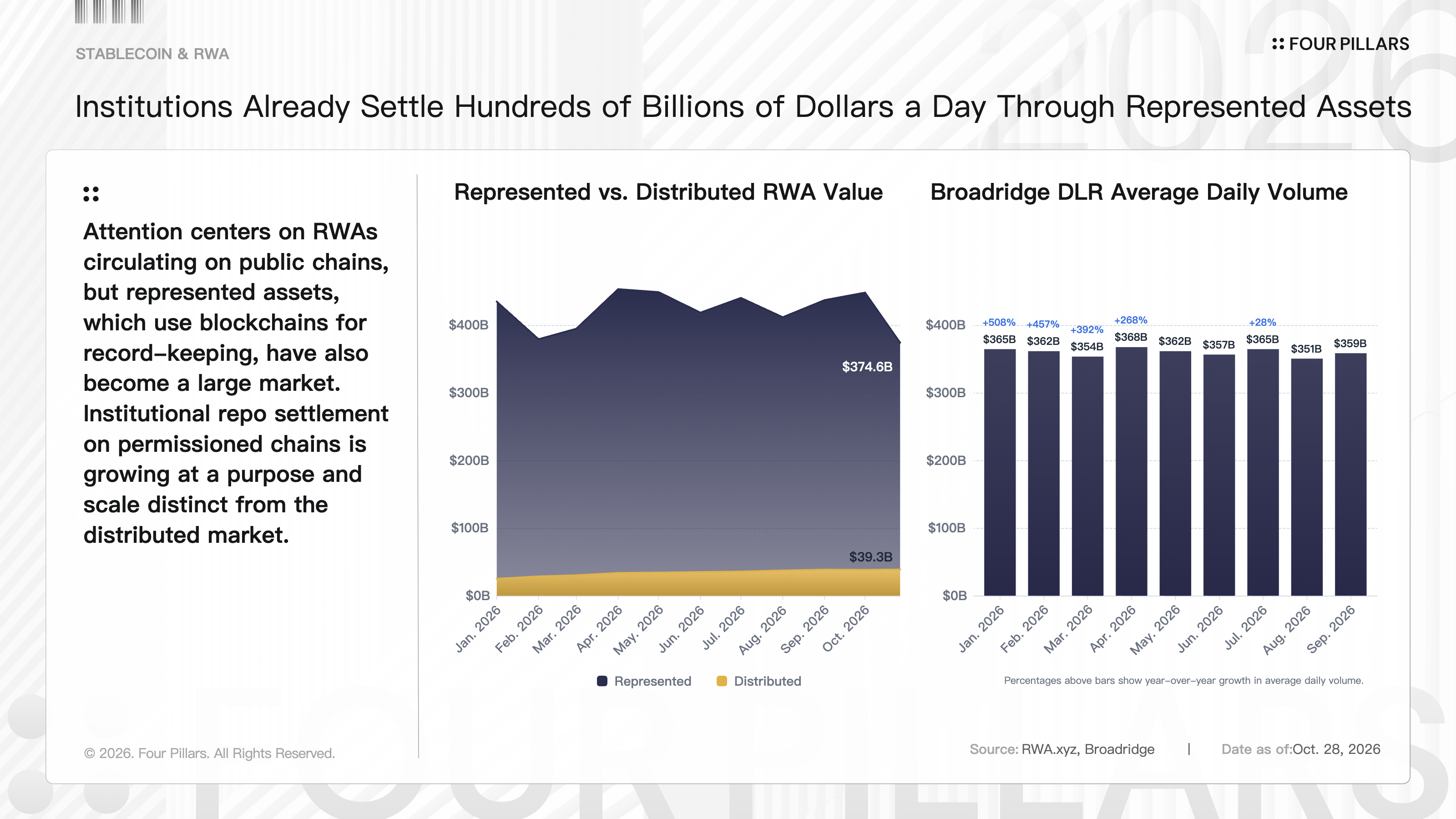
Institutions Already Settle Hundreds of Billions Daily Via Represented Assets
Source: RWA.xyz, Broadridge · As of October 28, 2026
Market attention has focused on RWAs circulating on public chains, but represented assets (assets whose record-keeping utilizes blockchain) are significantly larger. As of October, the total value of represented assets reached $374.6 billion, roughly 9.5 times the $39.3 billion for transferable distributed assets between wallets. While distributed assets have grown steadily from $25.6 billion at the start of the year, represented assets have remained in the $370–450 billion range throughout the year.
Robinhood Chain Has Not Died
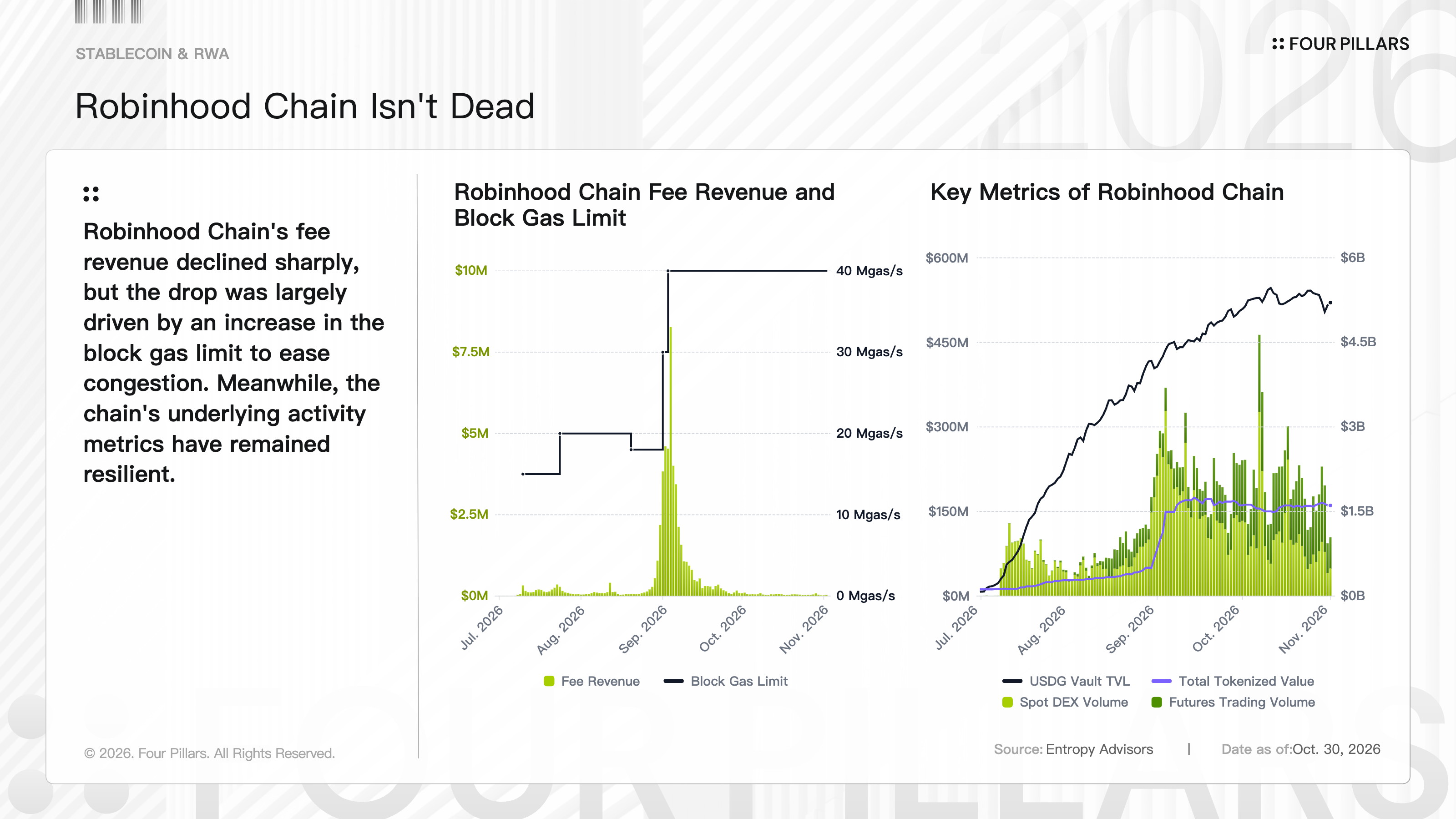
Source: Entropy Advisors · As of October 30, 2026
Fee revenue on Robinhood Chain dropped sharply after September, but this decline does not necessarily reflect a collapse in underlying network activity. The drop coincided with the block gas limit increasing from approximately 20 Mgas/s to 40 Mgas/s, expanding block capacity and helping alleviate congestion. Thus, lower fees are at least partly the result of decreased network usage costs, rather than a simple exodus of users. The broader activity picture remains relatively resilient. Robinhood reported over $8 billion in DEX volume and more than $50 million in chain fees during its mainnet’s first quarter, and the chart shows tokenized value and USDG vault TVL remained at meaningful levels through October. Trading activity has returned to normal following the September spike, but the chain still appears to retain considerable liquidity and usage.
A Compliant, Liquid Secondary Market Is the Next Frontier for Tokenization
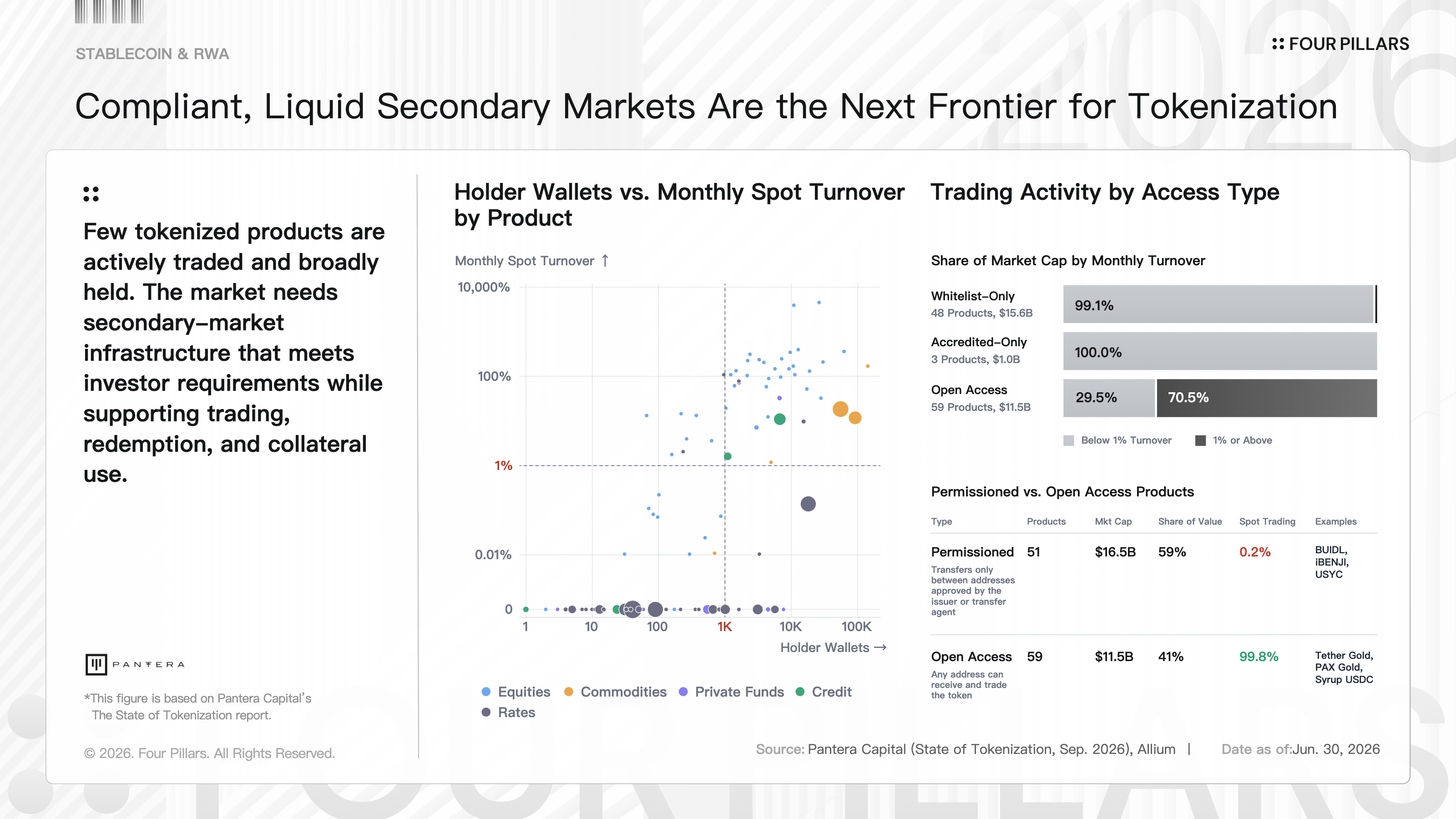
Source: Pantera Capital (State of Tokenization, September 2026), Allium · As of June 30, 2026
This section is based on Pantera Capital’s "State of Tokenization" report.
Interview: Danning Sui, Research Director at Pantera Capital
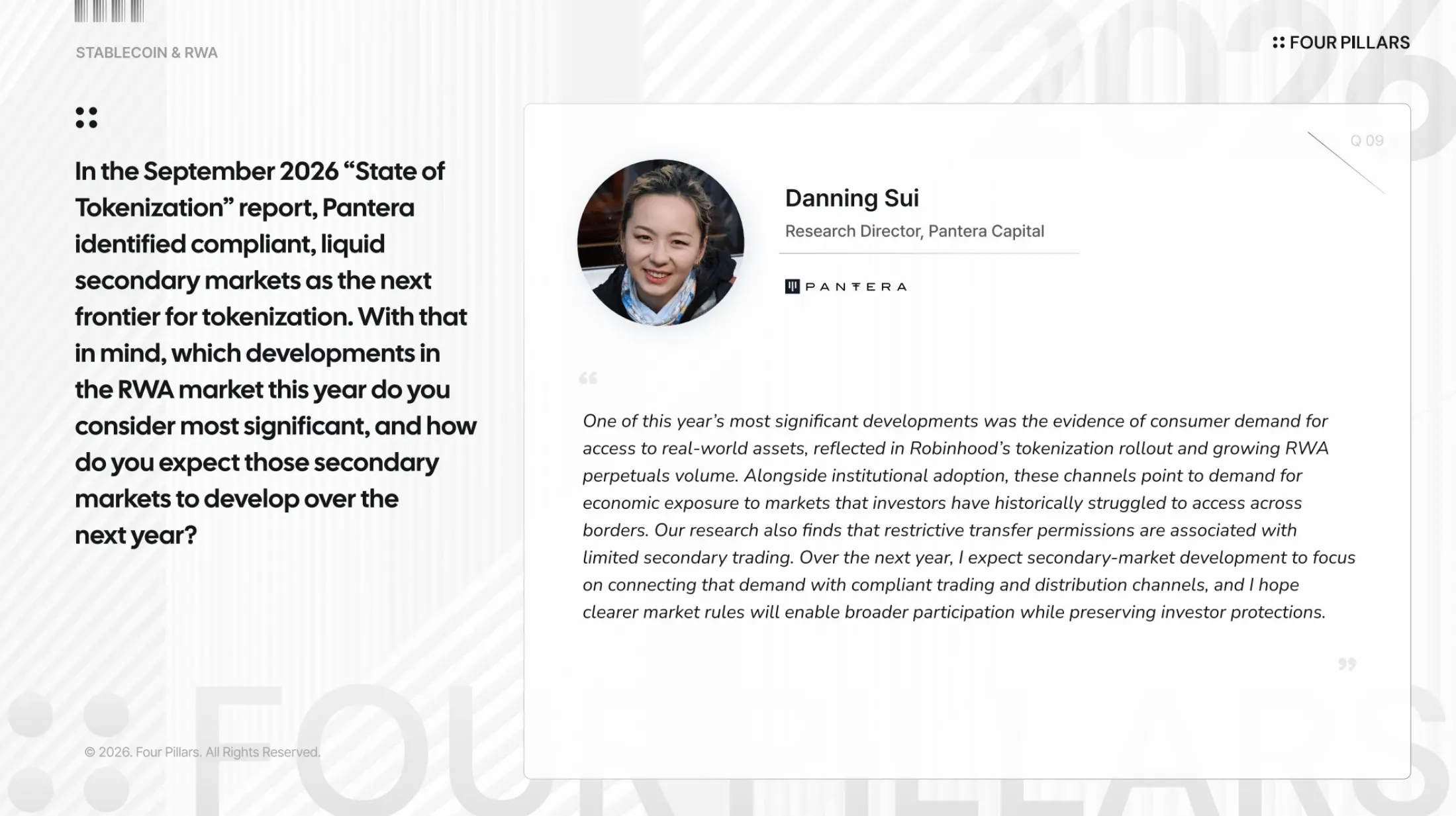
Interview: Danning Sui, Research Director, Pantera Capital
In Pantera’s September 2026 "State of Tokenization" report, the firm identified a compliant, liquid secondary market as the next frontier of tokenization. Given this, what do you consider the most important developments in the RWA market this year? How do you expect these secondary markets to evolve over the next year? One of the most significant developments this year is clear evidence of consumer demand for access to real-world assets, reflected in Robinhood’s tokenized launch and the steadily growing volume of RWA perpetual swaps. Coupled with institutional adoption, these channels highlight a demand for economic exposure to markets historically difficult for investors to access cross-border. Our research also found that restrictive transfer permissions correlate with limited secondary trading. Over the next year, I expect secondary market development to focus on connecting this demand with compliant trading and distribution channels. I hope that clearer market regulations can enable broader participation while safeguarding investor protection. — Danning Sui, Research Director, Pantera Capital
Join TechFlow official community to stay tuned
Telegram:https://t.me/TechFlowDaily
X (Twitter):https://x.com/TechFlowPost
X (Twitter) EN:https://x.com/BlockFlow_News
 Four Pillars