Out of ammo? How to borrow against your idle BTC to dip-buy and add to your position?
Authors: Rejamong, Four Pillars
Compiled by: TechFlow
TechFlow Summary: Amid the crypto market's sharp pullback, many holders are trapped in a dilemma: highly bullish on the long-term outlook yet lacking liquidity to add to their positions. As the largest asset with the deepest liquidity pool, the vast majority of bitcoins remain dormant in cold wallets and traditional institutional vaults, while cross-chain wrapping and lending penetration rates remain at historically low levels.
This article systematically breaks down the four core custody architectures for integrating bitcoin into the smart contract ecosystem, providing a comprehensive overview of interest rates, liquidation thresholds, and liquidity distribution across leading lending protocols. With spot ETFs and traditional financial giants entering the space, bitcoin's role as a high-quality base collateral is undergoing a qualitative shift, though the divergence between on-chain and off-chain ecosystems will continue to widen.
The price of every asset I hold continues to fall. At current levels, I desperately want to buy more and average down, but cash flow is stretched thin. In this moment, I recall those bitcoins stashed in a hardware cold wallet ages ago, nearly forgotten. They are undoubtedly excellent collateral. Below is my complete roadmap for leveraging them on-chain through collateralized borrowing to unlock liquidity.
Who Custodies My "Real" Bitcoins?
The Bitcoin network itself does not natively support general-purpose smart contracts. Strictly speaking, DeFi protocols cannot directly seize native BTC on the Bitcoin mainnet as lending collateral. While each protocol handles custody through different mechanisms, their underlying fundamentals are identical: they lock native BTC on the Bitcoin mainnet and mint equivalent representative tokens (Wrapped Tokens) on smart contract-enabled target chains. Before I can actually use my own BTC for collateralized borrowing, I must first determine who will safeguard my actual coins and how cross-chain wrapped tokens are issued.
Fixed-rate lending has not yet established a mature and efficient on-chain market. Given volatile market conditions, floating lending rates could fluctuate wildly in a short span. But before comparing interest rates across major protocols, I must first make a choice: which custody mechanism am I willing to trust?
Currently, four mainstream custody models dominate the market:
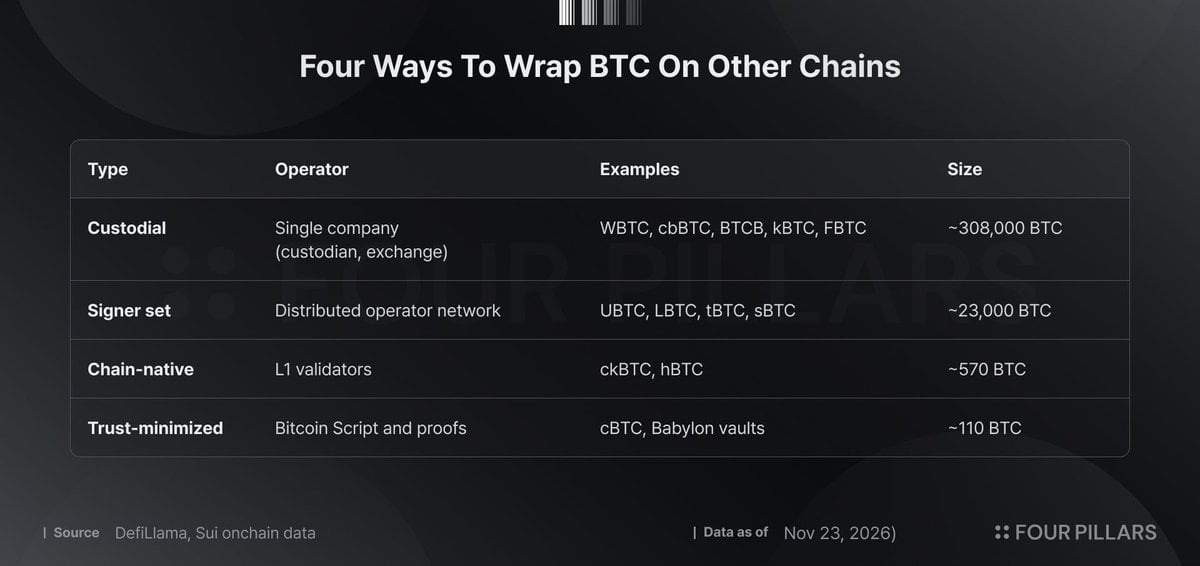
Figure: Comparison of Four Core Custody Models for Cross-Chain Wrapped Bitcoin (Source: Four Pillars)
Custodied by Centralized Entities
The centralized custody model is the lowest-barrier and most intuitive mechanism. A single commercial entity (such as a licensed custodian or centralized exchange) holds native BTC on the Bitcoin mainnet and issues an equal amount of pegged tokens on a smart contract platform at a 1:1 ratio. Launched in 2019, WBTC is the paradigmatic example of this camp; Coinbase released cbBTC in September 2024; and Circle officially launched cirBTC on Ethereum on June 8, 2026.
Centrally custodied tokens account for approximately 85% of the circulating BTC supply across other public chains. On the Morpho cbBTC market alone on the Base chain, locked collateral value reaches roughly $2.5 billion, with borrowers having already drawn out approximately $1.4 billion in USDC stablecoin liquidity against it.
The core drawback of this model is that holders must place unconditional trust in a single centralized entity to safeguard their bitcoins. Yet, many dedicated long-term bitcoin accumulators are staunch proponents of cold wallet self-custody. Their motto is "Not your keys, not your coins." For this demographic, centrally custodied tokens struggle to offer significant appeal.
Multi-Signature Collector Custody
Under multi-signature collector custody, multiple signatories jointly partition control over the private keys governing the BTC vault on the Bitcoin mainnet. Within the tBTC architecture, transferring BTC from the vault requires gathering 51 valid signatures from 100 randomly selected node operators; in the sBTC model, the private keys are collectively managed by a group of signatories on the Stacks network. Compared to relying on a single centralized custodian, this is a clear advancement, as any unauthorized fund transfer would necessitate simultaneous malicious collusion or compromise among multiple independent signatories. Currently, this custody model secures approximately 23,000 BTC, representing roughly 6% of the total cross-chain BTC supply on other public chains.
The scale of signatory collectors varies drastically across projects. Under Hyperliquid's UBTC mechanism, authorization requires signatures from 2 out of 3 guardians; Lombard's LBTC is controlled by an alliance of approximately 15 industry institutions; and within the sBTC framework, the underlying BTC behind a transfer requires approval from a 70% supermajority of its roughly 10 curated signatories.
Native Public Chain Validator Node Custody
If I choose to borrow within a specific public chain's DeFi protocol, it implies I already fully trust that chain's underlying validator node network. Therefore, entrusting my BTC to these same validators introduces no additional third-party risk into the trust assumption. This is essentially an evolutionary variant of multi-sig collector custody: the entity managing the multi-sig setup happens to be the very validator nodes of the Layer 1 blockchain where the token circulates. Internet Computer (ICP) pioneered this path back in 2023 via ckBTC; Hashi, which officially launched on Sui on November 19, 2026, adopts the exact same architecture.
Trust-Minimized Cross-Chain Bridges & Vaults
In this model, BTC is locked on the Bitcoin mainnet via native Bitcoin Script, with funds only released upon the occurrence of specific events on the target chain accompanied by valid cryptographic proofs. Designs based on the BitVM philosophy operate on the assumption that the presence of at least one honest participant across the entire network is sufficient to safeguard the vault's security. The Clementine cross-chain bridge, launched alongside Citrea's mainnet on January 27, serves as a prime example; another key battleground is Babylon's self-custody Vaults. On November 9, 2026, the Aave DAO formally passed a governance proposal to include BTC locked in Babylon Vaults as core lending collateral in Aave V4.
However, the fatal flaw of such solutions lies in lengthy withdrawal cycles and constrained initial liquidity. Under Babylon's current architecture, redeeming BTC from a vault requires enduring a prolonged fraud challenge period, typically spanning several days. On November 23, 2026, a research team led by Babylon co-founder David Tse publicly demonstrated a novel witness encryption technology that enables BTC release solely through a one-way withdrawal proof. By completely removing the interactive fraud challenge phase, this approach promises to significantly compress or even eliminate withdrawal wait times.
Many protocols often market the aforementioned architectures under the banner of "Native BTC." Here, however, "native" typically merely signifies the absence of a single centralized commercial entity issuing the wrapped token. Across all four models, genuine BTC remains dormant within the Bitcoin mainnet vault, and what DeFi lending protocols actually receive and accept as collateral are invariably just on-chain receipt tokens representing fractional shares.
Which DeFi Lending Protocol Should I Choose?
Once I identify and hold a specific wrapped token, the subsequent lending decision path narrows considerably. Each wrapped token is exclusively issued on particular public chains, and the underlying lending protocols offering deep liquidity differ substantially. Currently, the total value of various BTC wrapped tokens deposited into the DeFi lending market stands at approximately $11 billion. Of this, Aave alone accounts for roughly $4.7 billion, and Morpho holds about $3.8 billion, with the two protocols collectively dominating 77% of the total market share.
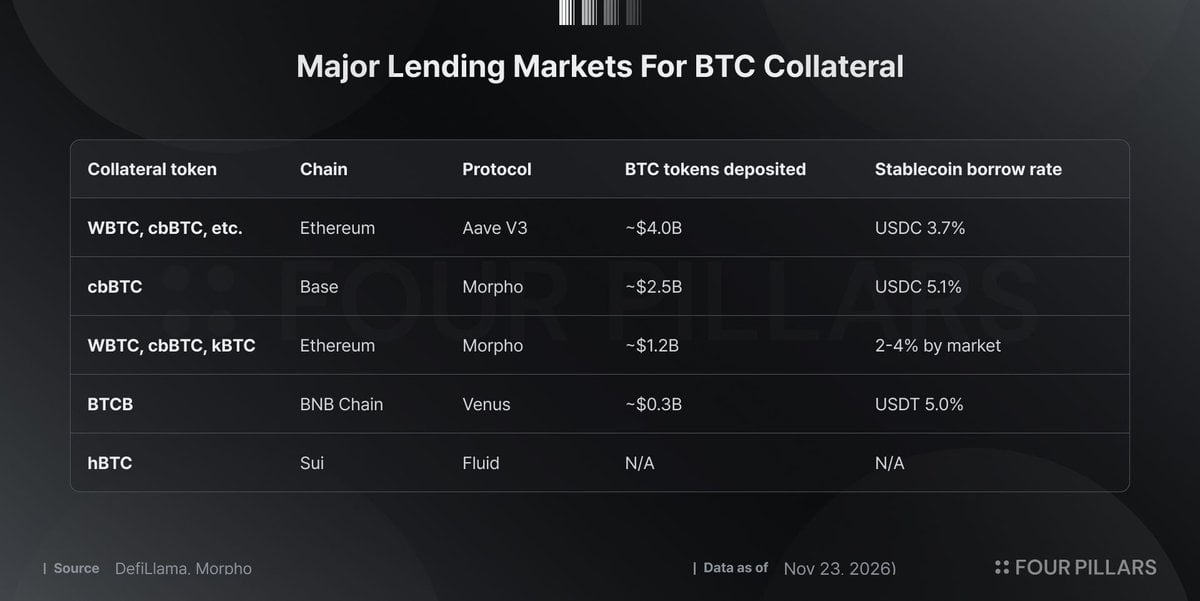
Figure: Distribution of Mainstream Bitcoin Collateralized Lending Markets and Key Parameters (Source: Four Pillars)
For users holding WBTC or cbBTC on the Ethereum mainnet, Aave is undoubtedly the most logical choice. All depositors share a unified mega-pool, ensuring the deepest capital depth. Its USDC annualized borrowing rate is relatively highly competitive at just 3.7%. Borrowers can extract up to 81% of their collateral value in stablecoins (maximum LTV); when the loan-to-value (LTV) ratio hits the 85% liquidation threshold, positions will trigger forced liquidation.
If my native BTC were already custodied within a Coinbase account, I would likely opt for borrowing via Morpho. The bitcoin collateral loan feature offered in Coinbase's official mobile app directly taps into this underlying market. Morpho constructs isolated lending markets for each pair of collateral and borrowed assets, meaning that if another asset pool faces bad debt risks, the contagion will not spill over into other markets. In the Base chain's cbBTC lending pool, the liquidation threshold is set at 86%.
On the BNB Chain, borrowers can deposit BTCB into Venus as collateral to borrow stablecoins; on the Sui chain, users can utilize the Fluid protocol, launched alongside Hashi, to pledge hBTC, although the total circulating supply of hBTC currently amounts to merely around 276 BTC. Aave V4 is expected to comprehensively support Babylon's trust-minimized vaults in the future, but this integration has not yet been formally deployed on mainnet.
How Many Bitcoins Are Actually Active On-Chain?
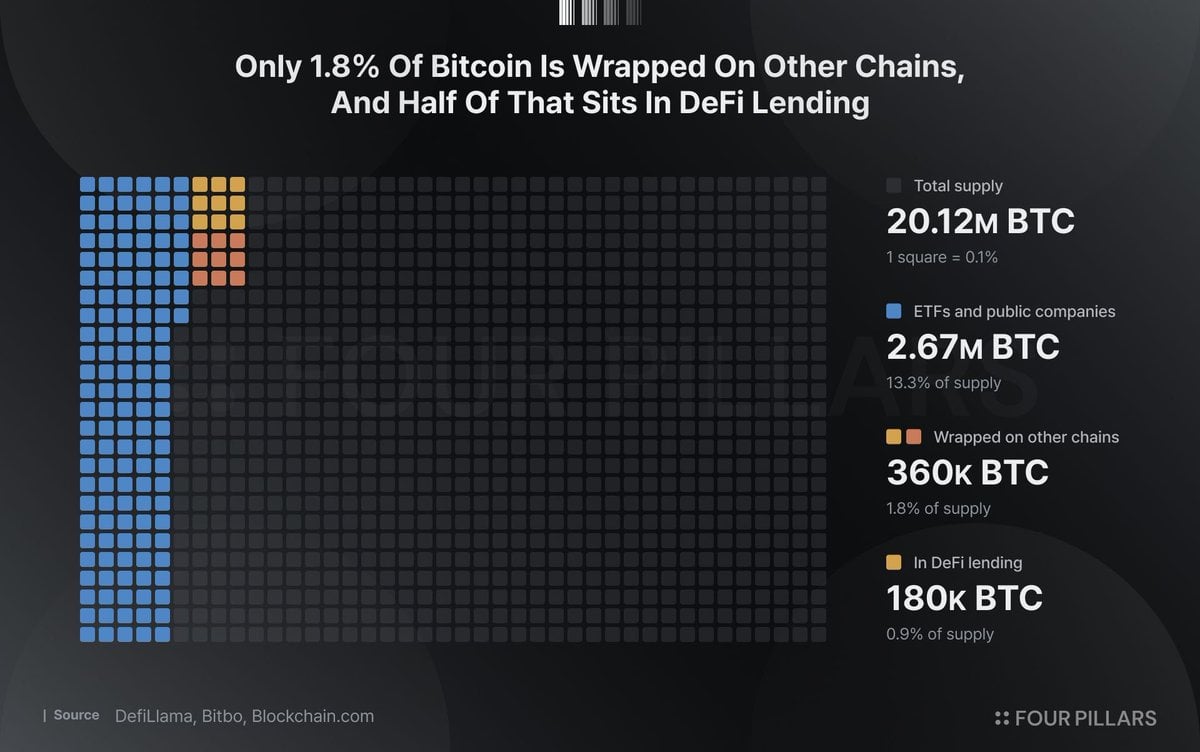
Figure: Global Bitcoin Ownership Distribution and Share of On-Chain DeFi Lending (Source: Four Pillars)
As of November 23, 2026, the cumulative number of mined BTC across the network stands at approximately 20.12 million. Yet, the total volume of wrapped tokens mapped across chains to smart contract public chains amounts to a mere ~360,000 BTC, representing just 1.8% of the total circulating supply.
Even within this negligible 1.8% slice, centrally custodied tokens maintain absolute dominance. The top five tokens—WBTC, cbBTC, BTCB, kBTC, and FBTC—collectively account for 85% of these 360,000 cross-chain BTC. Among this batch, only approximately 180,000 BTC are truly deposited as collateral across various DeFi lending markets. This figure equals just half the total cross-chain token volume, dropping to a mere 0.9% of the global bitcoin supply. Ethereum and the Base chain together absorb 82% of this lending deposit volume; broken down by protocol, the overwhelming majority of capital remains sunk into the duopoly of Aave and Morpho.
In stark contrast, global bitcoin spot ETFs currently hold around 1.44 million BTC, while various publicly traded corporate treasuries stockpile approximately 1.23 million BTC. Together, their combined 2.67 million BTC holdings represent 13.3% of the total supply—a volume more than seven times the sum total of all cross-chain wrapped BTC.
Despite a steady stream of innovative new use cases designed to empower bitcoin, the total capital flowing across chains into other ecosystems has remained largely stagnant. WBTC's circulating supply once hit a historical peak of ~285,000 in May 2022 before plummeting to its current level of ~116,000. A portion of this lost market share migrated to cbBTC (launched in September 2024, now scaled to ~103,000). However, even combining the volumes of WBTC and cbBTC (~219,000), it still falls far short of the single-peak era for WBTC in 2022. As a globally recognized bedrock for value storage and the internet's native currency, bitcoin proves remarkably inert in practical circulation, rarely moved compared to any other asset class.
Will More Holders Awaken Sleeping Bitcoins?
Nevertheless, I firmly believe that a massive volume of dormant bitcoin will very likely be activated and put to work in the future, as the power structure among holder demographics is undergoing a fundamental shift. Previously, native bitcoin hodlers maintained strong vigilance and distrust toward other public chains outside the bitcoin ecosystem. Today, however, institutional ETFs and publicly traded companies have become the primary force driving accumulation. Even if these institutions lean toward long-term holding, they face rigid daily liquidity expenditure requirements and financial incentives to maximize capital yields. Should even a tiny fraction of these institutions choose to put their bitcoin into motion for collateralization, the overall market size will experience exponential expansion.
Many forward-thinking protocols have already begun actively courting these institutions. Circle aggressively markets its pedigree as a compliant issuer during institutional roadshows; Sui has invested heavily in paving institutional access channels for Hashi, rivaling the technical R&D required to let validator nodes take over BTC management: federally regulated institutional custodian Anchorage Digital now supports direct integration into Hashi via its institutional wallet; a tripartite clearing and settlement architecture slated for deployment in early 2027 will further enable institutions to conduct BTC staking and pledging while retaining full underlying custody rights; additionally, Hashi has secured an authoritative legal opinion from top-tier firm Fenwick confirming that deposits and withdrawals to/from Hashi do not trigger taxable gains under current US tax law. Meanwhile, Aave is closely partnering with Babylon to push for direct acceptance of BTC vault collateral without any centralized custodians in Version 4.
With the mass adoption of crypto assets, I anticipate that bitcoin's legal status as collateral will rapidly gain recognition within the traditional finance (TradFi) system. Back in December 2025, the US Commodity Futures Trading Commission (CFTC) launched a pioneering pilot program formally allowing market participants to use BTC, ETH, and USDC as margin for derivatives trading. Concurrently, reports indicate Wall Street banking giant JPMorgan is also urgently planning to permit its institutional clients to borrow fiat currency against their held BTC and ETH as credit collateral.
However, once bitcoin is widely accepted as qualified collateral in the traditional financial world, demand for on-chain cross-chain wrapped BTC could ironically be further diluted or displaced. Hardcore geeks who view bitcoin as the antithesis of fiat currency and fundamentally refuse to hand over private key control to anyone will never transfer their tokens out of cold wallets under any circumstances; meanwhile, institutional capital with rigid lending needs may ultimately borrow vastly larger volumes through traditional financial institutions than what the native on-chain lending market achieves.
Conclusion & Reflection: On-Chain Lending Is Not the Endgame
When people discuss going "all in" on an investment opportunity, they frequently mention tapping severance packages or mortgaging real estate for loans. The unique allure of bitcoin as a ultimate safe haven and last-resort collateral perfectly validates its near-flawless asset endowment within the financial collateral hierarchy. Prior to now, borrower options were extremely narrow and inherently fraught with trust deficits regarding service providers; today, however, we possess multiple collateralized lending pathways grounded in divergent trust assumptions.
Yet, I remain highly skeptical whether the majority of such lending demand will ultimately stay on-chain. Lending entities can easily accept high-quality bitcoin collateral directly without migrating loans onto the blockchain. On-chain, anyone enjoys 24/7 permissionless borrowing, all positions are transparent to the entire network, and liquidations are rigidly executed by base-layer code. To large traditional institutions, however, these crypto-native "virtues" transform into fatal vulnerabilities: counterparty anonymity obscures identity, exposed position data lays portfolios completely bare to public scrutiny, and maintenance margin calls allow zero room for manual negotiation or grace periods. Furthermore, a substantial portion of funds borrowed against pledged BTC will inevitably be spent outside the crypto ecosystem: publicly traded corporations require USD for daily operational expenses or legacy debt repayment; retail individuals may need it to purchase real estate or settle tax liabilities. For these pragmatic demands, securing financing directly through traditional financial institutions and depositing USD straight into bank accounts is undeniably a far more convenient and seamless pathway.
At present, I believe the core appeal of bitcoin-based on-chain collateralized lending primarily remains concentrated among niche demographics like myself: individuals eager to deploy borrowed capital to accumulate additional crypto assets during market drawdowns. At the very least, utilizing this method spares me from wagering my home equity to apply for mortgage loans at banks.
Join TechFlow official community to stay tuned
Telegram:https://t.me/TechFlowDaily
X (Twitter):https://x.com/TechFlowPost
X (Twitter) EN:https://x.com/BlockFlow_News
 Four Pillars