
Overseas KOLs Fiercely Debate Bitcoin’s “Midlife Crisis”: With All Bullish Catalysts Since 2021 Fully Realized, What Will Drive Future Gains Over the Next Five Years?
Author: Kuli, TechFlow
TechFlow Editor's Note:
Early Bitcoin investor Vinny Lingham posted a roundup on Twitter outlining the reasons many were bullish on Bitcoin in 2021, including massive global money printing, inflation hitting a 30-year high, institutional buying, and halvings... Now that all these events have unfolded, the price still hovers around $59,000, underperforming its high from five years ago. The post sparked intense discussion between bulls and bears. Bulls are pushing new narratives like native yield generation and inclusion in mainstream portfolio models, while skeptics highlight the reality of elevated macro interest rates and a lack of real-world utility. This marks the end of the industry's reliance on stale slogans to drive narratives, forcing everyone to seriously address the actual catalysts for Bitcoin's next chapter.
Those who have held Bitcoin for five years likely feel a bit tongue-tied watching the market recently.
In 2021, Bitcoin briefly touched nearly $69,000, and after five years, it still lingers around $59,000.
Vinny Lingham, a veteran in the crypto space, shared a striking post on social media. He didn't beat around the bush; instead, he laid out the core bullish narratives for Bitcoin from five years ago, one by one, such as:
- Governments worldwide printed trillions of dollars to combat the pandemic, causing the M2 money supply to surge by over 40% compared to early 2020;
- U.S. inflation hit a 30-year high, with real interest rates lingering deeply in negative territory;
- The hard cap of 21 million coins cemented Bitcoin's status across the web as the ultimate inflation hedge and digital gold;
- Traditional giants like MicroStrategy and MassMutual actually added Bitcoin to their balance sheets with real capital;
- The 2020 halving occurred on schedule, coinciding precisely with a wave of retail and institutional capital entering the market.
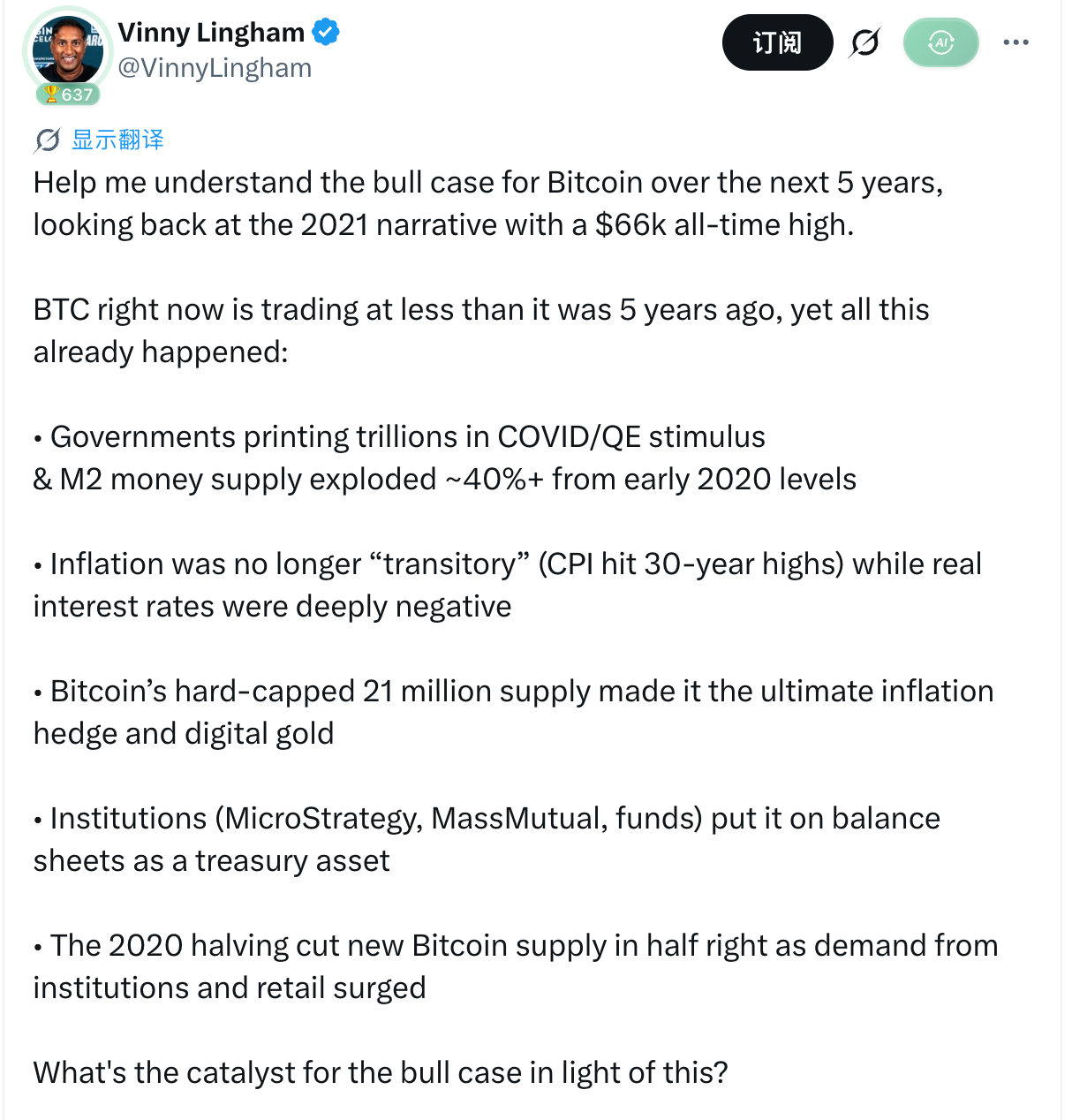
The logic used by the crypto community back then to justify a super bull market not only proved true over these five years, but every single thesis was exceeded.
He then posed a question that left many speechless: if all the biggest cards from back then have been played out, why is the price still below last cycle's highs? If the old stories are exhausted, what exactly can we rely on to drive growth over the next five years?
New Cards Played by Bulls: Can't Just Be a Silent Gold Bar, Must Generate Yield and Fit Into Portfolios
This tweet quickly drew the attention of many familiar faces in the industry. Bulls in the comments section stopped repeating the old "digital gold" mantra and instead brought out new tools to push the narrative forward.
Some industry participants argue that Bitcoin needs to learn from Ethereum and evolve into a yield-generating productive asset.
For instance, Stacks founder Muneeb believes:
If Bitcoin merely acts as a silent collateral sitting in cold wallets, it won't cut it anymore. He pins the catalyst for the next phase on native Bitcoin yield, similar to how Ethereum transitioned to PoS, allowing holders to earn interest, supplemented by upcoming technical upgrades and the next halving in 2028, giving capital a reason to stay on-chain.
Of course, this perspective also stems from his own product development, with clear ties to his business interests.
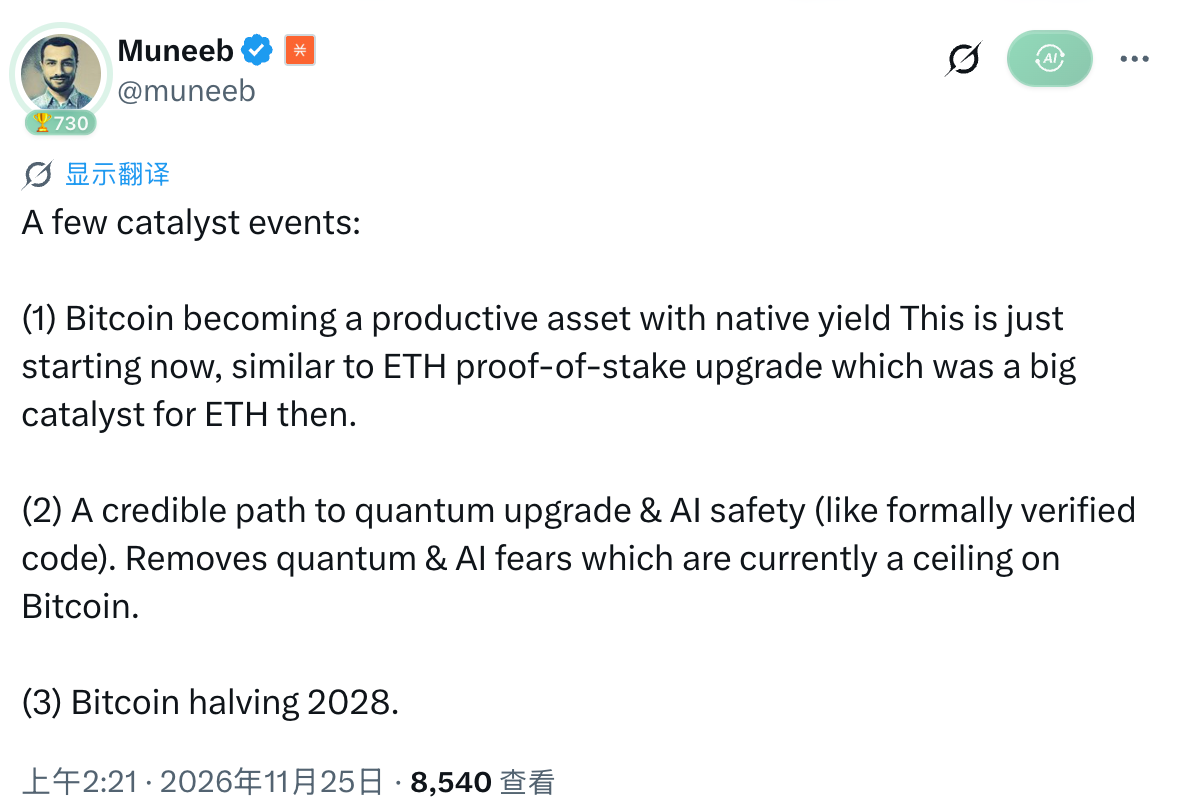
However, he also pointed out the most universal catalyst: another Bitcoin halving in 2028. As widely known, mining rewards keep diminishing. After the next halving, the block reward for miners verifying and packaging blocks will drop by half from the current 3.125 BTC to 1.5625 BTC.
Others believe that true institutional capital is just arriving at the door.
Nick Ducoff, Head of Institutional Business at the Solana Foundation, takes a different angle, suggesting there's no need for excessive pessimism. Although spot ETFs have been approved, mainstream Wall Street wealth advisors still view Bitcoin as an eccentric niche asset. The real future catalyst lies in its inclusion in traditional private banking's standard model portfolios. Even if official guidelines only recommend a 1% allocation, the incremental impact would be completely different.
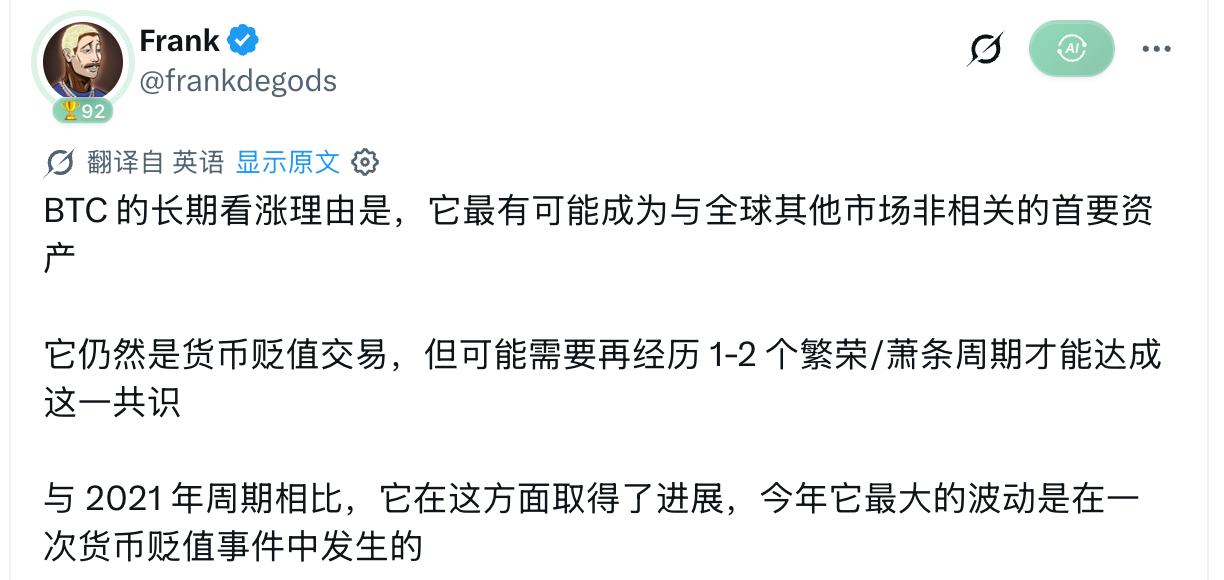
Well-known NFT and Meme trader Frank looks even further ahead. In his view, Bitcoin has the potential to become an uncorrelated standalone asset against other global markets, but convincing the traditional world to fully embrace it might take another one or two bull-bear cycles.
Currently, the Federal Reserve is in a rare hawkish phase for three decades, meaning headwinds persist. But long term, the government's overarching direction of continuing to fuel inflation remains unchanged.
As for early adopter Charlie Shrem, his attitude is more detached. He thinks there's no need to obsess over so-called catalysts, arguing that bull markets never arrive because a specific thesis proves correct; rather, prices rise first, and people retrospectively assign credit to a narrative during post-mortems.
As long as the bottom of each pullback gradually lifts, the market will naturally progress to the next cycle.
Skeptics: Don't Fight the Fed + Quantum Resistance Isn't on the Agenda Yet
While bulls eagerly search for new logic, industry insiders on the other side are thoroughly dousing the hype with reality checks.
Bloomberg Intelligence Senior Commodity Strategist Mike McGlone offers a more direct warning: Don't fight the Federal Reserve.
He believes Bitcoin's current high volatility and elasticity essentially remain characteristics of a high-risk asset tied to macro liquidity. It surges most vigorously during periods of abundant liquidity, but in a high-rate environment, liquidity tightness acts as its largest ceiling. It is not the risk-free haven some imagine it to be, capable of decoupling from real economic cycles.
Beyond the macro environment and utility, underlying security vulnerabilities have also been brought to light.
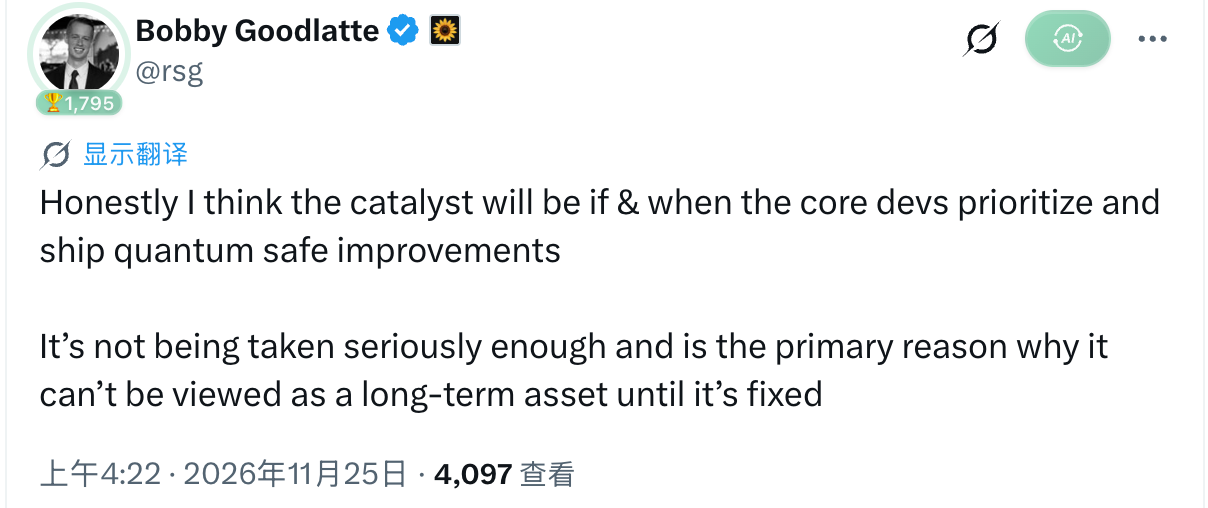
Former Facebook product designer and prominent angel investor Bobby Goodlatte, who has backed projects like Coinbase, points out that Bitcoin core developers still haven't treated quantum-resistant security as an urgent priority. As long as legacy addresses that directly exposed public keys remain vulnerable at the code level, this looming threat will persist, leaving large capital inherently cautious when considering multi-decade time horizons.
This discussion is highly noteworthy because stakeholders have finally stopped shouting empty slogans in echo chambers.
Over the past decade-plus, every major Bitcoin rally has been propelled by a grand narrative. The community grew accustomed to concluding that prices must rise simply by discussing inflation and fiat currency depreciation. But as these once-held expectations materialize one by one while prices stall, relying purely on sentiment makes it difficult to sustain consensus.
Debates in the comments reveal that bulls are being forced to seek more concrete fundamentals, such as generating cash flow and integrating into traditional wealth managers' systems, while skeptics remain fixated on macro rates and practical adoption hurdles.
For those holding positions, this debate at least clarifies one thing:
The era of winning passively on old stories is over. In the upcoming cycle, if Bitcoin aims to reach new heights, it must provide more tangible proof based on real yields and the broader macro liquidity environment.
Join TechFlow official community to stay tuned
Telegram:https://t.me/TechFlowDaily
X (Twitter):https://x.com/TechFlowPost
X (Twitter) EN:https://x.com/BlockFlow_News
 深潮TechFlow