Claimed an airdrop but can’t sell? How to trade Arthur Hayes’ FLOP when testing begins tomorrow?
By: Lucas, TechFlow
On November 24, 2026, Flop Labs (FLOP Network), spearheaded by CEO Arthur Hayes, will officially launch a 90-day public testnet and genesis airdrop cycle.
When he returned to the forefront this August to take charge of this AI compute network, Arthur Hayes publicly placed a contrarian bet. He believes the bubble surrounding capital-intensive AI data centers is on the verge of bursting, which will leave behind a surplus of consumer-grade GPUs that ordinary people can use at home to mine for profit with just an Nvidia RTX 5080 or even a Mac mini.
As the node launch date for the November 24 testnet approaches, community interest is rapidly heating up. Looking at the economic model and participation guidelines published by Flop Labs, this testnet rewrites the traditional rules of airdrops.
Spend 3 Tokens on Compute to Unlock 1 Airdrop Token
In recent years, crypto project airdrops taught retail investors to freely farm testnet interactions and dump their allocations for cash immediately upon mainnet launch. FLOP completely blocks this path.
According to Flop Labs' disclosed token allocation plan, the network has no private sale, no presale, and no VC allocations. Approximately 3.5 billion to 4.4 billion FLOP tokens are pre-allocated during the genesis phase as testnet ecosystem incentives. When the mainnet launches in Q1 2027, all wallets receiving the airdrop will face strict vesting lockup restrictions.
For ordinary users who obtain the genesis airdrop through the AI agent experience path, the tokens are locked by default. These locked tokens can only be used to pay for AI inference fees or staked for yield on the network. For every 3 FLOP worth of inference compute actually consumed on-chain by a user, the system simultaneously unlocks 1 freely tradable FLOP.
The unlocking schedule for compute miners and validators is equally tied to actual work. Testnet miners providing GPU or Mac mini compute can only unlock about 25% of their airdrop rewards on mainnet launch day; the remaining 75% must be released gradually as they continuously provide valid AI inference on the mainnet. Meanwhile, the top 1,000 validators ranked by testnet points will have their genesis airdrops directly serve as mainnet staking collateral, forcibly locked until after the network's first halving.
Regarding block reward distribution, each FLOP block yields 96 tokens, halving every 730 days (permanently settling at 3 tokens per block after five halvings). Of this, 75% goes to miners, 10% to validators, 10% is refunded to AI agent users invoking compute, and 5% goes to stakers. Additionally, miners take a direct cut of 85% of each inference transaction fee.
The intent behind these rules is straightforward: airdrops are no longer free-floating tokens, but rather a mechanism designed to force early recipients to invoke models and consume compute, ensuring real inference trading volume ramps up on the mainnet's very first day of cold start.
Three Participation Paths and Threshold Comparison
For participants preparing to join the testnet tomorrow, the official portal divides entry into three tiers based on hardware conditions, each with entirely different thresholds and returns.
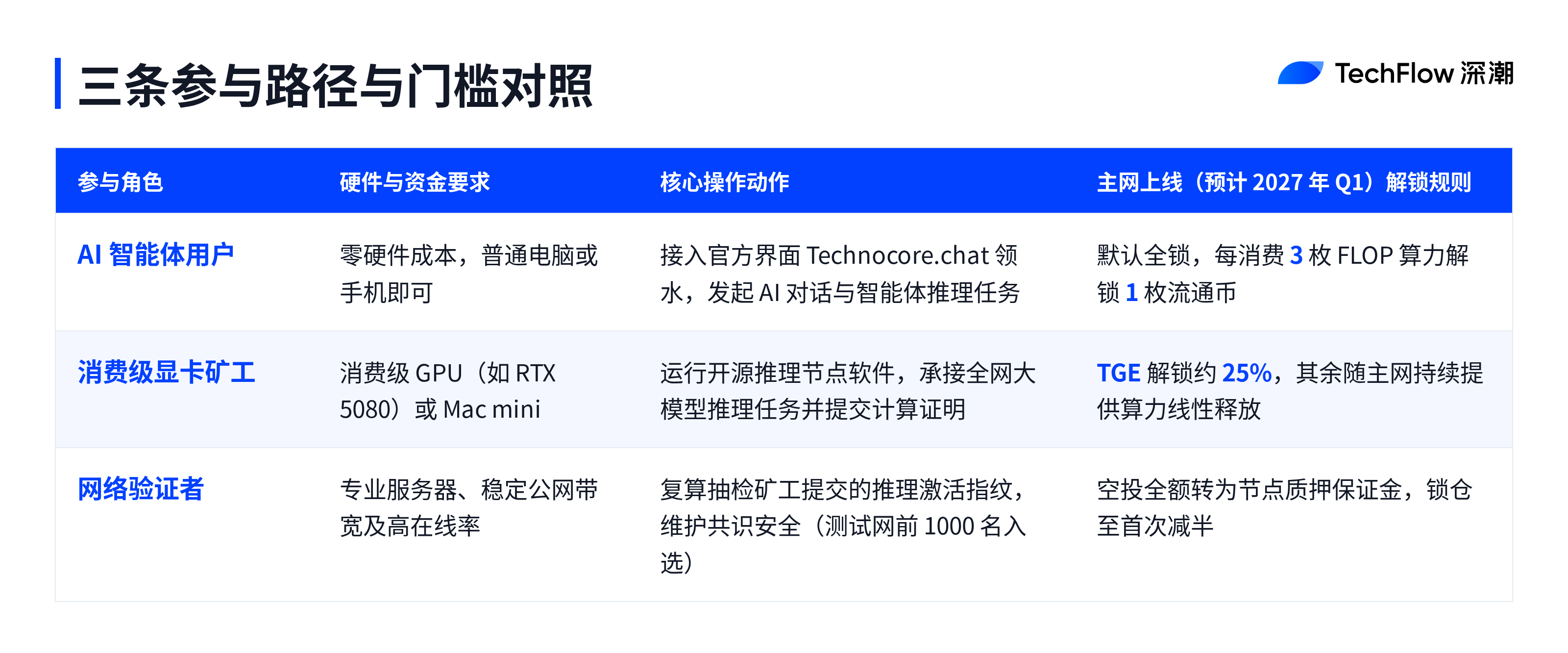
On November 9, a developer successfully completed 12 rounds of on-chain inference settlements using a single Nvidia RTX 5080 graphics card in an open test with zero failures. If you don't have high-end graphics cards on hand, directly experiencing AI inference through the official portal is the only zero-cost way to accumulate test credits.
Rules Are Still Being Revised, But Fake Coins With the Same Name Have Already Popped Up
On the eve of the testnet launch, FLOP's file cabinets still hold plenty of drafts that haven't been finalized.
As of November 23, Flop Labs' official whitepaper remains unfinalized, with the 10-year total supply estimate significantly adjusted from an initial 2.48 billion to approximately 17.2 to 18.1 billion. Even the official number of slots for testnet validators hasn't been decided between "fully open" and "limited to 20 to 100 seats," pending stress-test data from the upcoming testnet run.
Anti-cheating mechanisms also won't be truly tested until tens of thousands of home GPUs flood in tomorrow. To prevent miners from fraudulently claiming block rewards with fake inferences, FLOP has designed four defense lines: TEE (Trusted Execution Environment) proofs, TOPLOC model activation fingerprints, random validator recalculation audits, and 100% staking slash penalties. The early internal test across dozens of nodes ran smoothly, but whether validation node recalculation latency can withstand high concurrency depends on actual performance over the next two weeks.
Compared to variable technical parameters, the financial security minefield is already laid out in plain sight.
On the same day Arthur Hayes announced his appointment as CEO this August, multiple fake coins with the same name emerged on Pump.fun on the Solana chain for speculative trading. Flop Labs has repeatedly issued security notices clarifying that there are currently no formally issued tokens, and all real rewards will only be claimable when the mainnet launches in Q1 2027, following the 90-day testnet period. The official team has not established any Telegram groups or Discord servers either. All testnet portals and node codes should only be trusted via the official website and official X account. Any DMs sending airdrop links or selling whitelist spots are scams.
Join TechFlow official community to stay tuned
Telegram:https://t.me/TechFlowDaily
X (Twitter):https://x.com/TechFlowPost
X (Twitter) EN:https://x.com/BlockFlow_News
 深潮TechFlow