Goldman Sachs Lowers Kioxia's FY2028 Operating Profit Forecast; Over 30% Shareholder Return Becomes Stock Price
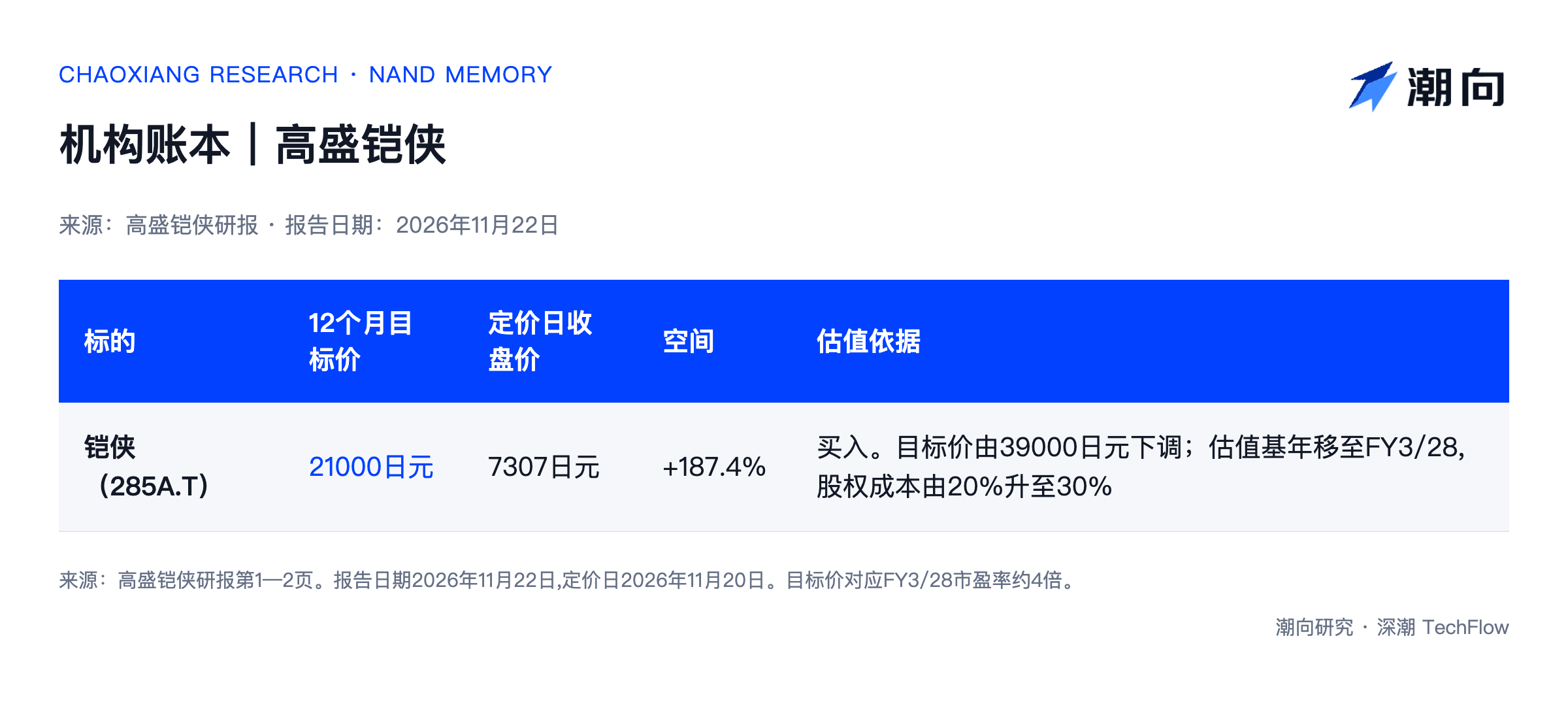
Driven by expectations of a balanced supply and demand for NAND flash in 2028, Kioxia Holdings' (285A.T) stock price has corrected sharply by 58.6% over the past three months. In its latest research report released on November 22, 2026, Goldman Sachs lowered its 12-month target price from 39,000 yen to 21,000 yen. However, the Goldman Sachs team pointed out that the company's current forward P/E ratio has plummeted to a historical low of 1.5 times. Coupled with management's commitment to return 100% of excess free cash flow to shareholders, total shareholder returns are projected to exceed 30% in fiscal 2028, leaving extremely limited room for further downside in the stock price.
NAND Supply-Demand Balance Expected in 2028; Stock Decline Actually Boosts Buybacks
Demand for AI data centers remains robust, but weakness in consumer electronics and capacity expansion by Chinese manufacturers are shifting the long-term supply-demand balance.
The Goldman Sachs Japan semiconductor research team (Shuhei Nakamura, Kaho Otake) has revised forecasts based on the latest model from the global storage group. While the NAND market will remain undersupplied through 2026 and 2027, sluggish smartphone and PC demand alongside increased bit-level supply from Chinese vendors will push NAND supply and demand toward equilibrium in 2028.
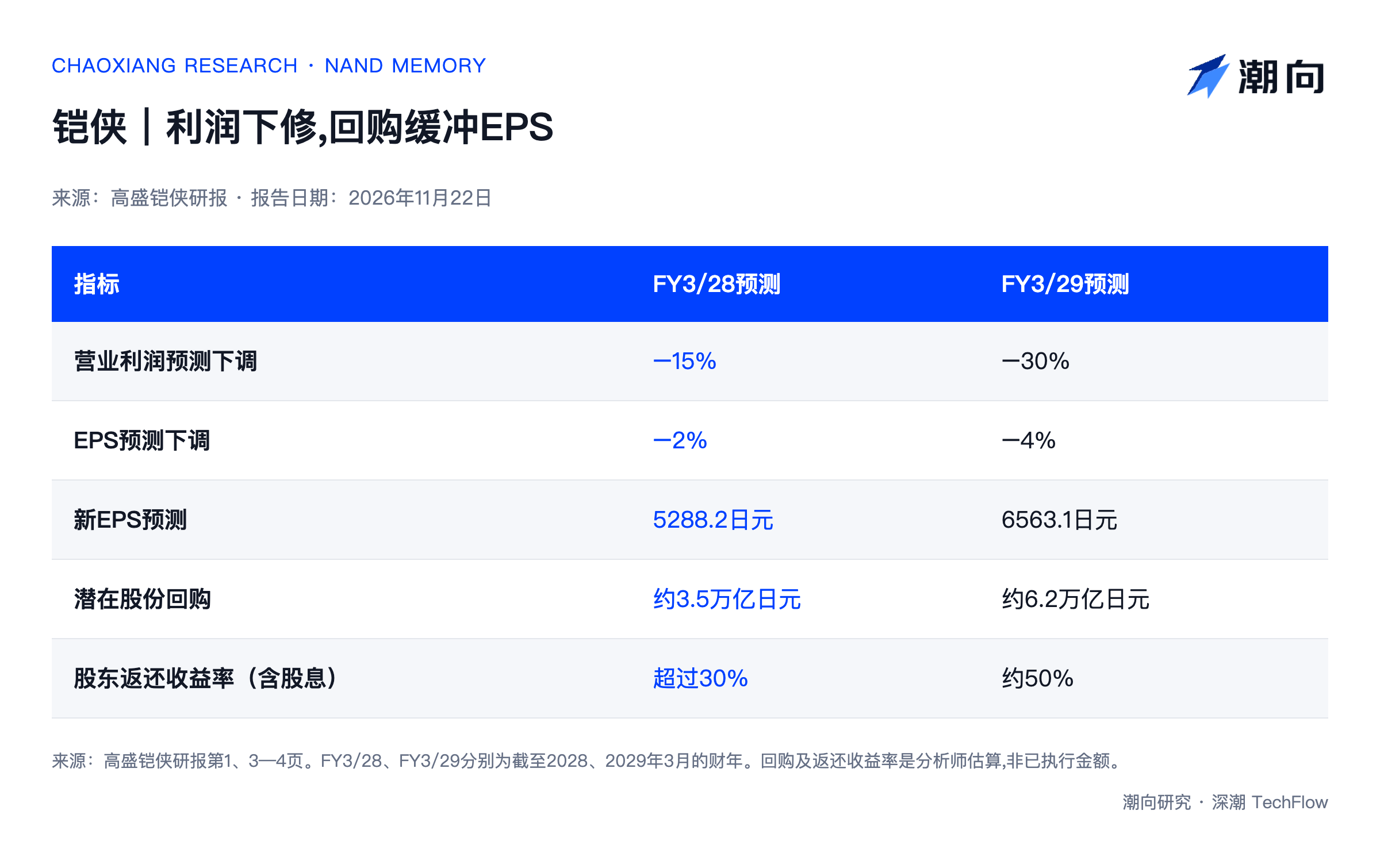
Accordingly, Goldman Sachs has included for the first time in its model the assumption that NAND prices will gradually decline starting from the April-June 2027 period, forecasting that the average flash memory price in calendar year 2028 will fall by over 20% (with Kioxia's calendar year 2028 average USD price expected to drop 18% YoY). Affected by the price cuts, Goldman Sachs has lowered its operating profit forecasts for Kioxia's fiscal year 2028 (ending March 2028) and fiscal year 2029 by 15% and 30%, respectively, to 10.19 trillion yen and 9.93 trillion yen.
However, the decline in earnings per share (EPS) is minimal. Due to Kioxia's recent sharp stock price drop, the number of shares eligible for retirement during future buybacks will increase significantly. Goldman Sachs reduced its forecast for total shares outstanding, resulting in only minor downward adjustments of 2% and 4% to EPS estimates for fiscal 2028 and fiscal 2029, respectively.
Valuation Compressed to 1.5x P/E, Hitting Historical Bottom Range
The stock price crash has already compressed valuations to extreme levels.
As of the closing bell on November 20, 2026, Kioxia's stock traded at 7,307 yen, registering a cumulative decline of 58.6% over the past three months and underperforming the Tokyo Stock Exchange Index by 54.3 percentage points. The current stock price implies an expected P/E ratio of merely 1.5 times for fiscal 2028 (roughly 1.4 times based on the latest EPS), far below the typical market valuation of 3 to 4 times observed during peak profitability phases of previous storage cycles, and substantially lower than the cycle mid-range of 8 to 10 times.
From a price-to-book (P/B) standpoint, the margin of safety is equally evident. Goldman Sachs calculates that even if the company undertakes zero additional share repurchases, book value per share will reach approximately 9,120 yen by the end of fiscal 2028, bringing the current P/B ratio below 1. Historical data indicates that storage giant stock prices typically find a bottom and reverse trend when the P/B ratio approaches 1.
Based on the downward revisions to earnings forecasts, Goldman Sachs has shifted its valuation benchmark from the average of fiscal 2027 and 2028 to fiscal 2028 alone. Simultaneously, referencing peer levels, it raised its equity cost assumption from 20% to 30%, thereby lowering the target price from 39,000 yen to 21,000 yen. The new target price corresponds to a 4x P/E ratio for fiscal 2028, representing potential upside of 187.4% from the current stock price.
100% Excess Cash Flow Return to Shareholders, Total Shareholder Return Exceeds 30%
Goldman Sachs maintains a "Buy" rating on Kioxia, with the core thesis hinging on its exceptional cash generation and return capabilities.
Despite lowering operating profit forecasts, Goldman Sachs expects Kioxia to still achieve annual operating profits of approximately 10 trillion yen in both fiscal 2028 and fiscal 2029, generating 6.14 trillion yen and 6.84 trillion yen in free cash flow, respectively.
In its Q2 earnings report, the company explicitly announced it would distribute 100% of excess free cash flow to shareholders. Applying management's guideline to "retain cash and deposits of at least three months' worth of sales," Goldman Sachs estimates Kioxia's share buyback volume could reach approximately 3.51 trillion yen in fiscal 2028 and 6.16 trillion yen in fiscal 2029.
Including dividends, Kioxia's total shareholder return (TSR) for fiscal 2028 will surpass 30%, rising to approximately 50% in fiscal 2029. Referring to historical trends in shipping equities, Goldman Sachs points out that even if industry prosperity peaks and begins to recede, continuous and substantial shareholder returns can still propel the company's stock price and valuation multiples upward.
This article is a synthesis and interpretation by TechFlow Research of third-party brokerage research reports. The ratings, target prices, earnings forecasts, and related assessments quoted herein represent solely the viewpoints of the respective broker analysts, reflecting only the stances of their affiliated institutions, not those of TechFlow Research, and do not constitute any investment advice.
Markets carry inherent risks; all decisions require independent judgment. This article should not be relied upon as a basis for trading any securities.
Join TechFlow official community to stay tuned
Telegram:https://t.me/TechFlowDaily
X (Twitter):https://x.com/TechFlowPost
X (Twitter) EN:https://x.com/BlockFlow_News
 @chaoxiangooo