IOSG|Bitcoin Must Hit $250,000 for Mining to Catch Up with AI Rental Income
Author: Mario Chow, IOSG Ventures
Stock prices are closing prices as of Nov 13, 2026; Bitcoin price is $64,400 as of Nov 16. MW in the text refers to critical IT load, i.e., power actually delivered to servers. Gross MW refers to total campus power consumption, including cooling, typically 20% to 40% higher than IT load.
TL;DR
Why the pivot.
CoinShares values built-and-leased AI data centers at approximately $27 million per MW, while valuing powered mining capacity without tenants at less than $3 million.
This 9x gap isn't entirely due to grid interconnection costs, as the former includes construction investments of $8 million to $15 million per MW. After deducting construction costs, the gap remains 4 to 6 times larger.
On a per MW operating profit basis, mining nets roughly $230,000 annually at current hashprice, while AI leases yield about $1.9 million. Bitcoin would need to rise to around $250,000 to close this gap. The underlying driver is an AI power shortage: connecting a new grid for the hottest US markets takes three to four years, whereas miners already possess powered interconnections.
The mid-term elections on Nov 3 made these interconnections even scarcer, as Texas elected a governor promising to pause data center approvals.
How the pivot works.
Grid interconnections, substations, land, and permits can be reused; almost everything else must be demolished and rebuilt at a cost of $8 million to $15 million per MW, comparable to greenfield projects. Miners aren't selling properties; they're selling the two-to-four-year waiting period that tenants can skip.
Who is pivoting.
Eight publicly listed mining companies have signed contracts covering approximately 6.3 GW of IT capacity. The morning after the election, Riot leased its entire 910 MW Corsicana campus. Additionally, Cipher has 700 MW of gross power. Only about 1 GW is actually operational. CoreWeave alone accounts for 24%, with no guarantor behind the rent.
Riot's AI lab tenant (reported to be Anthropic) now represents 18%, nearly matching CoreWeave's share.
Revenue & Costs.
After deducting operating costs, disclosed leases show an NOI ranging from $1.85 million to $2.15 million per MW annually. Galaxy Helios Phase II's NOI was projected based on its margins at approximately $2.3 million, an outlier. Construction cost returns range from 15% to 20% annually.
Riot's Corsicana lease breaks this range at approximately 33%, because the data halls are built by the tenant on Riot's already-powered land. The spread in nominal rent stems primarily from lease structures rather than compensation for credit risk.
Impact.
A few miners sticking to pure mining have sold about 40% of their Bitcoin holdings. The remaining sell pressure mainly rests with MARA. Riot sold 20,264 coins this year, leaving only 2,418; MARA sold 13,597 coins post-quarter-end to repay its Bitcoin mortgage loan.
MARA, CleanSpark, and Riot now collectively hold about 36,000 coins, down from 60,500 in August, with MARA's ~20,400 coins most likely to continue flooding the market. Hashrate dropped then recovered; miner exits haven't weakened the network. Mining stocks are no longer proxies for Bitcoin.
Post-election, they diverged by state: Riot rose 25% while Bitcoin fell 12% over the same period. Several companies with projects pending delivery in Texas and Georgia fell 15% to 18%.
IOSG View
CoreWeave poses uncompensated rental risk, and Texas poses the second risk.
Galaxy charges the highest industry rents to CoreWeave, yet achieves the lowest building return, roughly 15% annually. CleanSpark leases to Meta at ~16%, Hut 8 leases to investment-grade tenants at 17% to 21%. Ideally, weaker tenant credit should mean higher landlord returns; reality shows the opposite.
CoreWeave accounts for 100% of Galaxy's AI business, ~53% of Core Scientific, and 28% of Applied Digital. Hut 8, CleanSpark, Riot, and TeraWulf have no CoreWeave exposure.
CoreWeave's Nov 10 earnings beat expectations, triggering a 25% stock surge the next day. However, recourse debt increased by ~$10 billion during the quarter to $41.6 billion, and shares reverted to $53 by Nov 13.
The election added a second stress test. MWs for approved, leased, and funded companies rose, while those awaiting Texas or Georgia approvals fell. Galaxy failed both tests: its business is entirely tied to CoreWeave, and its Helios campus is in Texas, with Helios II unleased.
Until CoreWeave's credit stabilizes and the Texas pause order has a clear end date, landlords with high CoreWeave exposure should trade at a deeper discount than those with low exposure. Core Scientific serves as the cleanest sample for CoreWeave exposure; its stock stabilized post-election because 485 of its 590 MW allocated to CoreWeave are already generating rent.
Grouping the landlords based on these two stress tests:
Group 1: Leased, outside TX/GA, funding secured: TeraWulf (NY and KY, Google guarantees financing for its Anthropic project at River Bend), Hut 8's River Bend (LA, non-recourse bonds), and Applied Digital (ND, guaranteed notes).
Group 2: Leased, but in TX or GA, future phases dependent on state permits or unsecured loans: Riot's Rockdale and Corsicana, Hut 8's Beacon Point, Galaxy's Helios Phase I, and CleanSpark's Sandersville.
Group 3: Unleased or unapproved: Galaxy's Helios Phase II, MARA's Matagorda campus, and Cipher's pipeline projects in TX. Group 1 should receive the smallest discount, Group 3 the largest. Galaxy straddles Groups 2 and 3, plus adds CoreWeave exposure.
Miner sell-off catalysts align with expectations: the primary sellers are the dedicated miners; the rest are mostly MARA.
In August, transitioning landlords held virtually no Bitcoin, while MARA, CleanSpark, and Riot held ~60,500 coins combined, all needing capital for AI projects. Two of the three sold subsequently. Riot sold 20,264 coins in the first nine months (~$1.5B), primarily for data center construction, leaving 2,418 by late Sept.
MARA sold 13,597 coins at an average price of ~$81K post-quarter-end to pay off a $750M Bitcoin margin loan, stating it will continue using Bitcoin to fund AI ventures. The three now hold ~36,000 coins (~$2.3B), representing a ~40% reduction, leaving 60%. Whether the remainder gets sold depends on cash needs.
Riot's 2,418 coins are immaterial; its Corsicana CapEx will be covered by cash and project loans. CleanSpark's 13,530 coins remain untouched; its Sandersville project is funded via guaranteed notes, making it the least reliant on coin sales. Notably, it paused monthly production reports starting in Oct.
The ~20,400 coins (~$1.3B) held by MARA are the sell pressure to watch: it stated it will continue selling. If its TX campus gets grid approval, it faces up to $600M in additional costs. It's also negotiating two leases that would require self-funding construction upon signing. Inventory selling has peaked but isn't over.
Mining stocks are now AI credit trades, compounded post-election by TX permit trades.
Transitioned landlords track CoreWeave and Nebius, not Bitcoin: when Bitcoin rose in Oct, they fell alongside CoreWeave bonds.
Between Nov 3 and 13, Bitcoin fell 12%, while Riot rose 25% on a 910 MW TX lease with pre-approved power. Galaxy, Cipher, and CleanSpark, with projects pending delivery in TX and GA, fell 15% to 18%.
Buying this basket stakes on AI data center financing and state permits, with Bitcoin playing only a minor role.
Why Miners Are Pivoting
Rising Coin Price, Deteriorating Mining Economics
Hashprice is the expected daily revenue per PH/s of hashrate (pre-cost), determining miner survival, and it has been consistently declining.
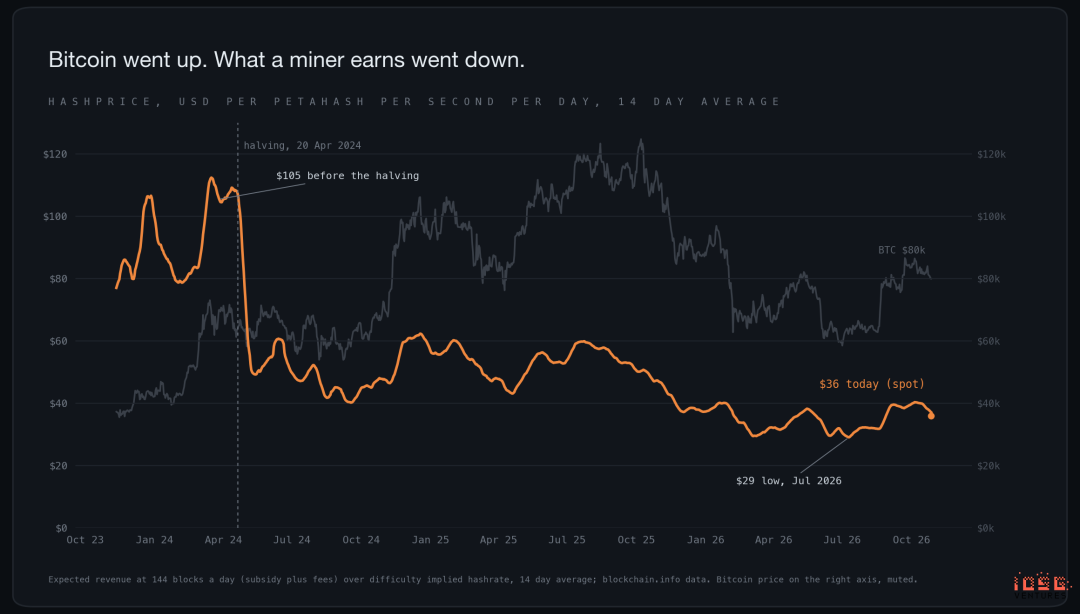
Pre-2024 halving, 1 PH/s earned ~$105 daily. Now it's ~$30, despite Bitcoin returning to similar price levels. The halving cut block subsidies by half, while network hashrate grew ~70%, compressing per-machine yields twice over.
This approaches summer lows: hashprice briefly dipped below $30. CoinShares estimated the average cash cost for public miners at $75,500 per coin, while the price hovered around $60,000, putting the industry in loss-making territory.
Bitcoin rallied to $84,000 in Oct, then fell back to $64,400 this month. Neither shift matters much because the alternative path offers vastly superior returns.
Same 1 MW, Two Different Algorithms
The chart below uses late-Oct hashprice of ~$35; at current $30, the mining column would be even lower.
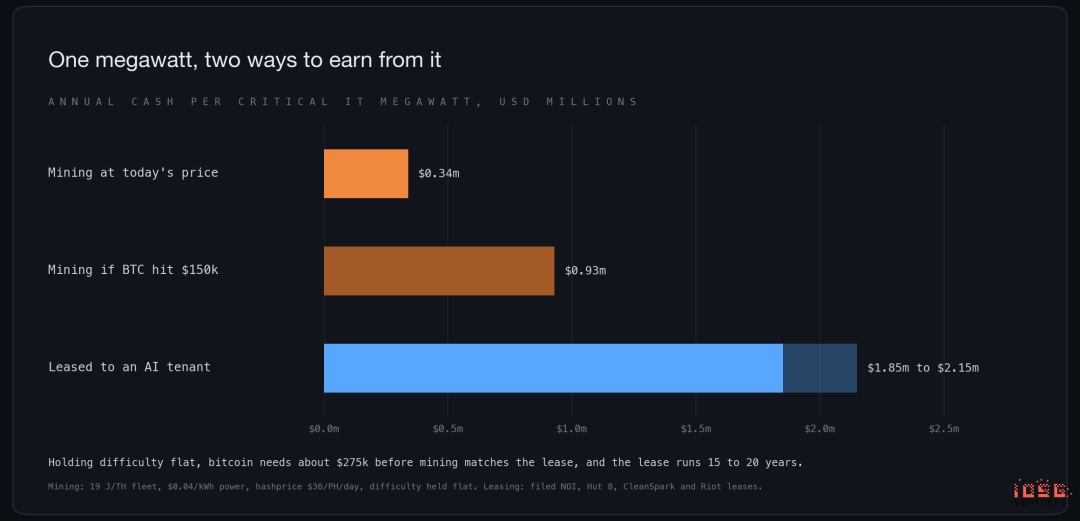
On a per MW operating profit basis, one MW of next-gen miners nets ~$230,000 annually at current hashprice after electricity costs, and next-gen hardware requires separate capital expenditure.
Leasing to an AI tenant generates $1.85M to $2.15M in NOI for the same 1 MW, with 15 to 20-year contracts featuring annual escalators. Even if Bitcoin hits $150,000 and difficulty remains constant, mining yields only ~$1M annually, with zero contractual guarantees.
One advantage favors leases: the $1.9M NOI requires $8M-$15M construction spend per MW, versus ~$800K for mining equipment. CoinShares' valuation comparisons are apples-to-oranges.
They value built-and-fully-leased AI DCs at ~$27M per MW, while valuing powered mining capacity without tenants at <$3M. These compare two different asset classes, not the same campus pre- and post-leasing.
Deducting construction costs from the leased valuation leaves $12M-$19M per MW, still 4x-6x the tenant-less valuation. This excludes construction completion risk and the two-year ramp-up period. The direction is clear; exact multiples are imprecise.
The most compelling evidence is what miners are willing to pay to exit. Core Scientific spent ~$42M to cancel a 15 EH/s next-gen machine order. Keel (formerly Bitfarms) halted mining in June. Galaxy retrofitted its Helios site and recorded impairment charges.
How Mine Sites Become Data Centers
Keep the Outlet, Rebuild Everything Else
Post-retrofit, only assets outside the utility meter (on the grid side) can be retained.
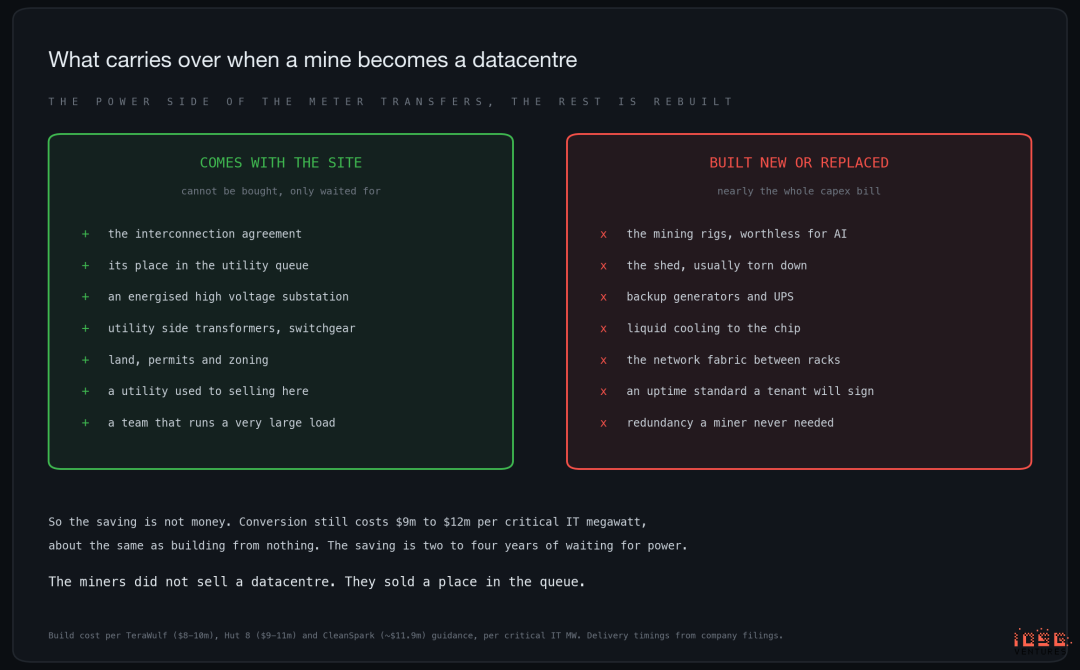
Grid-side assets are reusable; premise-side assets are largely obsolete. ASIC miners are useless for AI, and sheds typically need demolition. Miners voluntarily curtail load when electricity prices spike, so they never installed backup generation or redundant distribution, failing to meet AI tenant uptime commitments.
An NVIDIA GB300 rack draws 130-140 kW, vs. ~9 kW for standard server racks. Heat must be dissipated via liquid cooling lines connected directly to chips.
Thus, retrofit costs run $8M-$15M per MW: TeraWulf guides $8M-$10M, Hut 8 $9M-$11M, CleanSpark ~$11.9M, Galaxy Helios Phase II ~$15.4M—basically equivalent to greenfield development.
Savings were never monetary; they were temporal.
Three Ways to Monetize MW
Landlords can lease a shell, lease compute, or sell the campus outright.
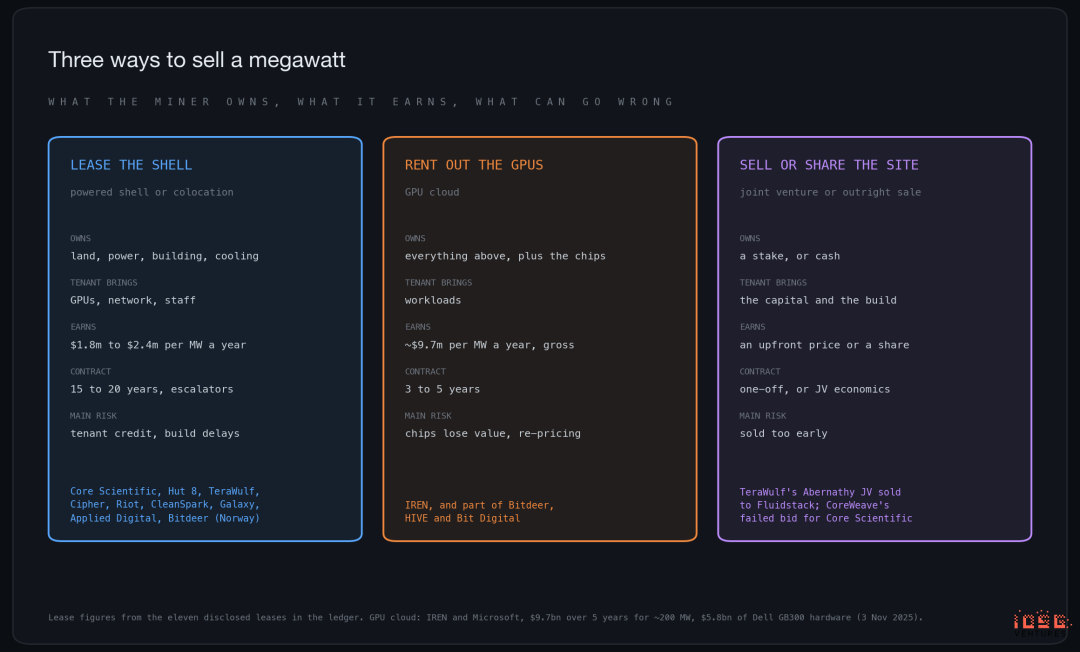
Most industry deals involve "powered shells": land, power, structures, and cooling are provided; GPUs, networking, and ops staff are tenant-provided. This division of labor allows transitioning miners to be valued like real estate operators.
Riot's Corsicana lease goes further, selling "powered land": Riot delivers only land, power, and pad sites; the data hall is built and operated by the tenant.
IREN pursues the compute leasing route, exemplified by a 5-year, $9.7B contract with Microsoft requiring $5.8B in Dell hardware procurement. Its per MW revenue is ~5x lease rates, but chip depreciation erodes most value within five years, and the contract term is only 1/3 the length of typical leases.
Comparing IREN's per MW revenue directly with landlord metrics is a common sector misstep.
The third path is campus sale. TeraWulf sold its Abernathy JV equity to Fluidstack for ~$530M, with $250M collected in Q3.
CoreWeave attempted a full acquisition of Core Scientific in 2025, rejected by shareholders.
Where Does the Money Come From
A 200 MW campus at $10M/MW requires $2B, with CapEx front-loaded ~2 years ahead of initial lease dates.
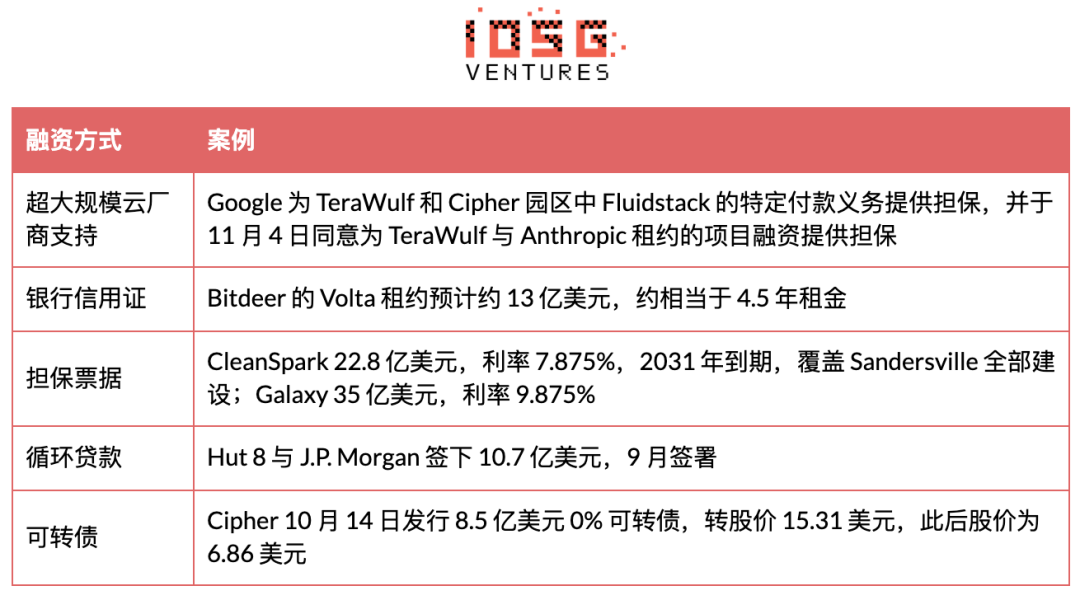
The most critical time risk remains Riot. Its $573M Morgan Stanley bridge loan matures Dec 31, 2026, but Rockdale's first 96 MW won't generate rent until Dec 2027, with the investment-grade guarantee on the $9.1B lease still being finalized.
Riot had $950M in cash and Bitcoin by late Sept, ruling out equity dilution while arranging project financing for Rockdale and Corsicana. Funding must be secured before revenue starts.
Who Is Doing It Now
Landlords: Signed ≠ Operational
The Corsicana lease made Riot the second-largest landlord by committed capacity, but almost nothing is live yet.
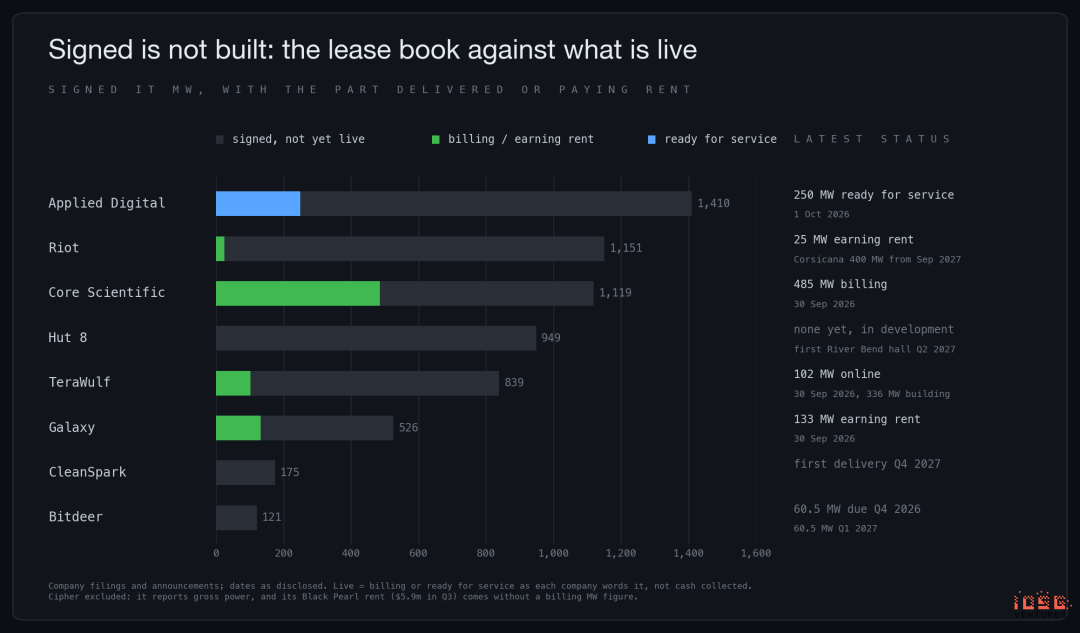
Committed MW includes future deliveries; billable MW reflects actual rent generation. Galaxy leased 526 MW to CoreWeave, of which 133 MW is billing. The remaining 393 MW isn't idle; it's contracted and under construction.
Core Scientific had 485 MW billing as of Sept 30 (up from 395 MW on June 30); Dalton's remaining 100 MW is expected online early 2027.
Grid interconnection solves only one bottleneck; financing, construction, cooling, redundancy, and tenant acceptance remain. Low near-term billable capacity relative to large forward pipelines doesn't indicate weak demand.
Cipher's 700 MW represents gross campus power, not IT load, so it's excluded from capacity shares. Its filings show Amazon's Black Pearl lease IT load at 216 MW, translating to ~$1.7M annual rent per MW.
Black Pearl generated $5.9M in lease revenue in Q3—Cipher's first.
The sector's largest deal debuted the morning after the election. On Nov 4, Riot leased its entire 910 MW Corsicana campus for 15 years at ~$28B to the same AI lab behind Rockdale.
Prior to this, no new leases were signed since Sept 18. Cipher extended its Barber Lake lease to 20 years, increasing contract value by $5.2B, but added zero new MW.
Tenants
With Corsicana, direct AI lab leasing more than doubled.
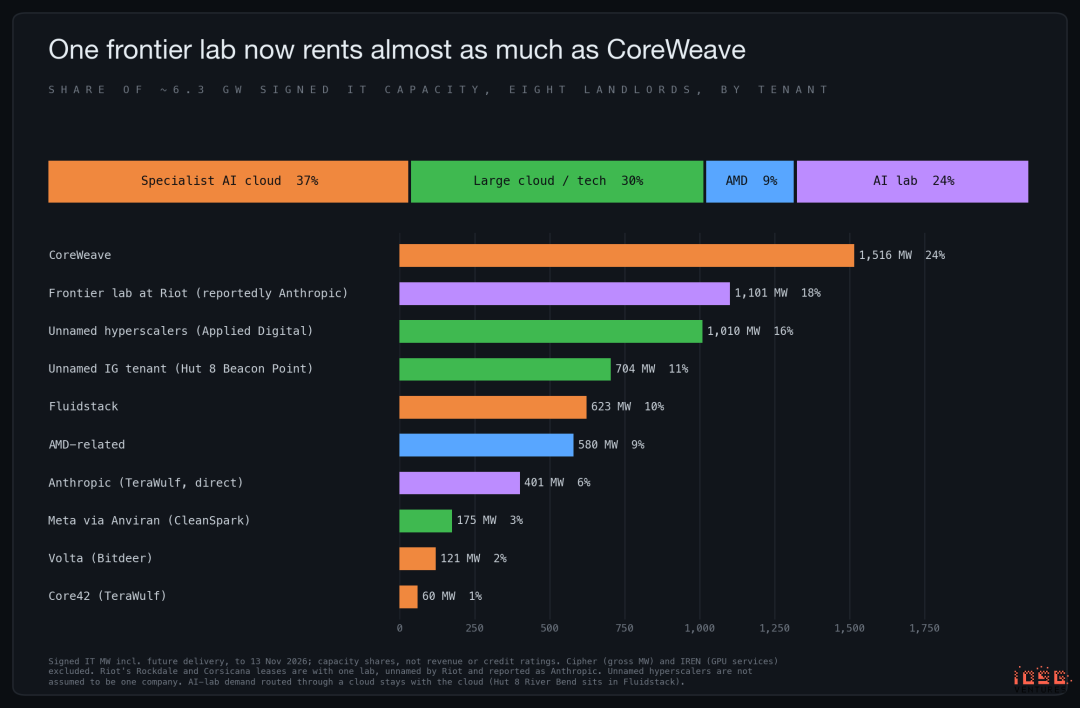
Specialized AI clouds remain the largest tenant cohort, ~37% of 6.3 GW. CoreWeave leased 1,516 MW via Applied Digital, Core Scientific, and Galaxy (24% total); Fluidstack adds another 10%.
Hyperscalers & tech firms account for ~30%, AMD-linked arrangements 9%, direct AI labs 24% (up from 11% pre-Corsicana).
If Riot's tenant is indeed Anthropic, direct leasing hits ~1.5 GW. Combined with 245 MW rented via Fluidstack at River Bend, terminal demand exceeds CoreWeave's.
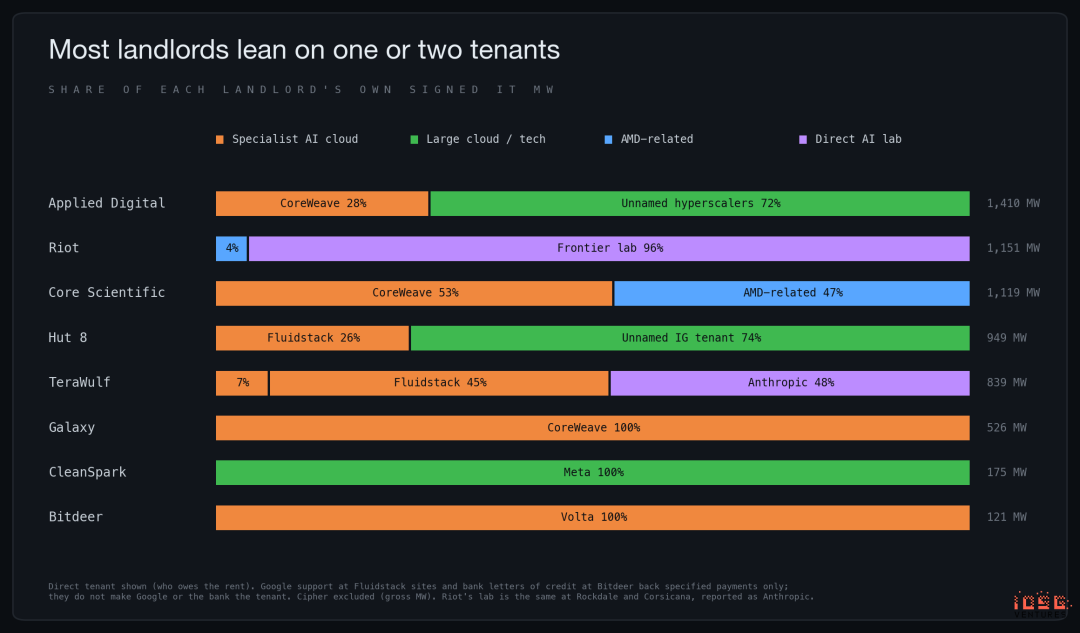
Tenant concentration is high across landlords. Galaxy, CleanSpark, and Bitdeer each have one tenant. Riot's capacity is now 96% concentrated in a single lab. The critical focus is CoreWeave's concentration, given the summer credit flip. Previously, the fear centered on unrated AI labs.
Since then, Anthropic raised $6.5B at a $965B valuation, reported $16.8B Q3 revenue to investors, filed for IPO on Oct 26, and is currently roadshowing at an estimated $1T valuation.
What genuinely spooked the market was CoreWeave: B+ rating, $41.6B recourse debt at late Sept (~$10B quarterly increase), October bond yields near 15%, 5Y CDS >1,000 bps through mid-Oct prior to earnings.
The highest risk in these leases isn't the labs themselves, but the intermediaries subleasing capacity to them.
The Few Still Mining
Only a handful mine at scale: Bitdeer 82 EH/s, MARA ~71, CleanSpark 50, Hut 8's American Bitcoin ~25. All are hedging bets.
MARA's 2 GW Matagorda TX campus is listed as "studied load" in ERCOT's Batch Zero process. MARA plans to sign two leases by year-end but may extend into next year. CleanSpark's Meta GA lease sits right next to its mining fleet.
Riot nominally sticks to mining: mining dominates revenue, but it has leased 1,151 MW and nearly liquidated its Bitcoin stack.
Revenue & Costs
How Much Rent Per MW?
Nominal rent is contract value divided by MW count and years. NOI is what the landlord retains after property operating expenses, excluding financing, depreciation, and taxes. Under triple net leases, operating costs fall to tenants, making the two metrics nearly identical. Service-inclusive leases require landlords to absorb 10%-20% of costs via higher base rent.
On an IT load basis, nominal rents range from ~$1.44M per MW annually (CoreWeave at Core Scientific) to ~$2.6M (CoreWeave at Galaxy's Helios Phase II). The same tenant appears at both extremes, proving nominal rent clearly isn't pricing credit risk.
At Core Scientific, most data hall fit-out was CoreWeave-funded; Core Scientific's economic input was ~$1.5M per MW, explaining why lower rent correlates with significantly lower build costs. Four leases in the chart below disclose both rent and NOI, clarifying the mechanics.
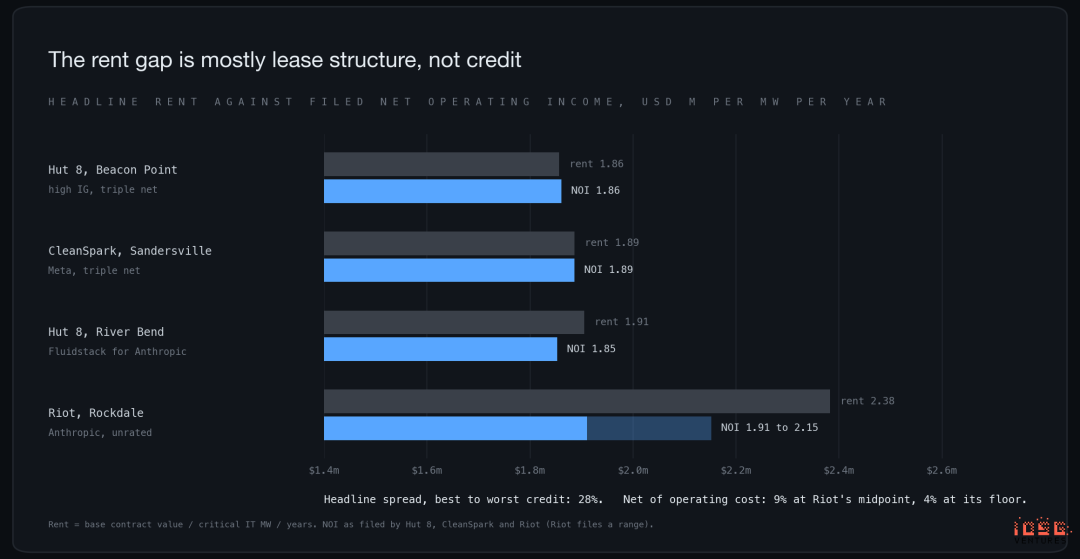
Riot's Rockdale lease with an AI lab (reported Anthropic) features nominal rent 28% higher than Hut 8's highly rated triple-net tenant. After opex deduction, the median differs by only 9%, the lower bound by 4%.
The premium primarily covers landlord-bearing costs, offering minimal incremental compensation for weak credit.
Riot's Corsicana lease is the latest and structurally distinct. 910 MW averages ~$1.8B annually in rent (~$2M per MW incl. escalators), with 99% NOI margins falling within the Rockdale band. The variable is cost.
Riot invests only ~$6M per MW vs. $8M-$15M for full builds, as tenants construct and own their halls. This is the first lease priced on "approved TX grid power" rather than construction. Signing coincided precisely with election-day morning, immediately after polls made approved TX power scarcer.
Timing may outweigh credit. Amazon signed with Cipher in late 2025 at ~$1.7M per MW; Meta signed with CleanSpark nine months later at $1.89M. Both are triple net, top-tier credit.
AI lab direct leases signed in 2026 (TeraWulf, Riot Rockdale, Bitdeer) command $2.37M-$2.43M per MW.
Corsicana's Nov signing at ~$2M breaks this trend; on a base-period basis it's even lower, as its $2M figure includes escalator averages while others exclude them. It also covers less building footprint. These are nominal figures under different structures; we treat the pattern as a clue, not a conclusion.
Return on Cost
Build costs inflate alongside rents, keeping building returns in a narrow band. The metric here is annual NOI divided by construction cost, excluding financing—distinct from equity returns.
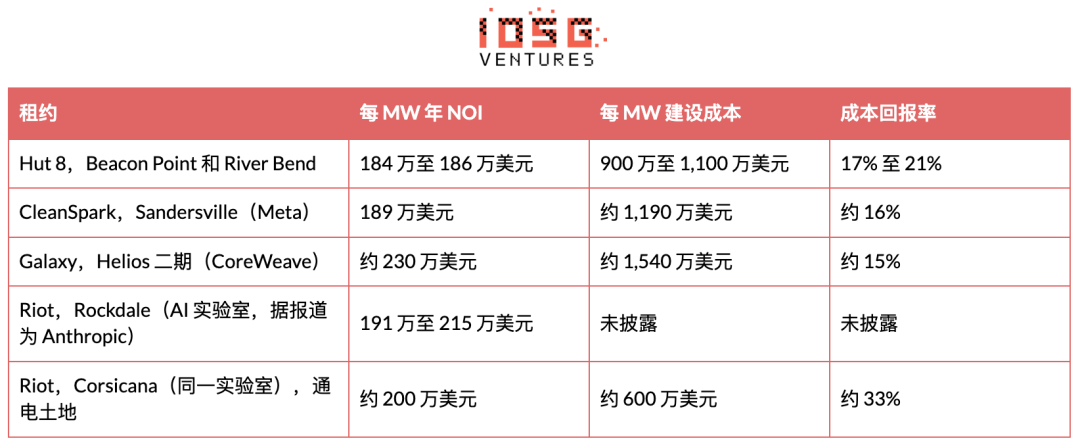
A 15-year tenanted building yielding 15%-20% annually represents prime real estate economics. Miners earn this by holding scarce inputs; Corsicana demonstrates how much that input commands when tenants fund construction. 33% is Riot's internal projection, contingent on successful project financing, which is still underway.
The weakest-credit tenant, Galaxy, lands at the interval floor: highest rent, most expensive build, thinnest return.
How Much Actually Generates Rent
Based on latest disclosures: Core Scientific had 485 MW billing as of Sept 30. Galaxy generated revenue from 133 MW as of Sept 30 (unchanged through the quarter); Phase II starts Q2 2027. TeraWulf had 102 MW online as of Sept 30, with 336 MW under construction.
Applied Digital reached 250 MW deliverable as of Oct 1, guiding to 300 MW by year-end. Cipher collected its first Black Pearl lease in Q3 but omitted MW figures; Amazon's six-phase delivery spans Sept 30, 2026 to Feb 28, 2027.
Riot's 25 MW AMD allocation has been billing since Q2.
The remainder is just the delivery pipeline.
Bitdeer's two 60.5 MW phases deliver Q4 2026 and Q1 2027; Hut 8 River Bend's first hall opens Q2 2027; Riot Rockdale lab capacity arrives Dec 2027;
Corsicana phases run Sept 2027 to July 2028; CleanSpark's first rent settles Q4 2027.
Dates and milestone definitions vary by company, so we avoid aggregating into a single industry percentage.
Impact
On Bitcoin: Dedicated Miners Are Selling
Address the bull's strongest bear argument. Blockware stats show public miner Bitcoin inventories dropping from ~127,000 at year-start to ~99,000 by mid-Aug, ~$1.8B net sold, directed toward DC construction.
MARA holds the largest stack and historically preached "HODL," changing policy in March to permit reserve sales. Six-month holdings plummeted from 53,822 to 35,577. Blockware argues this sell pressure partially explains undervalued Bitcoin weakness heading into 2026—an argument holds water. And it persists.
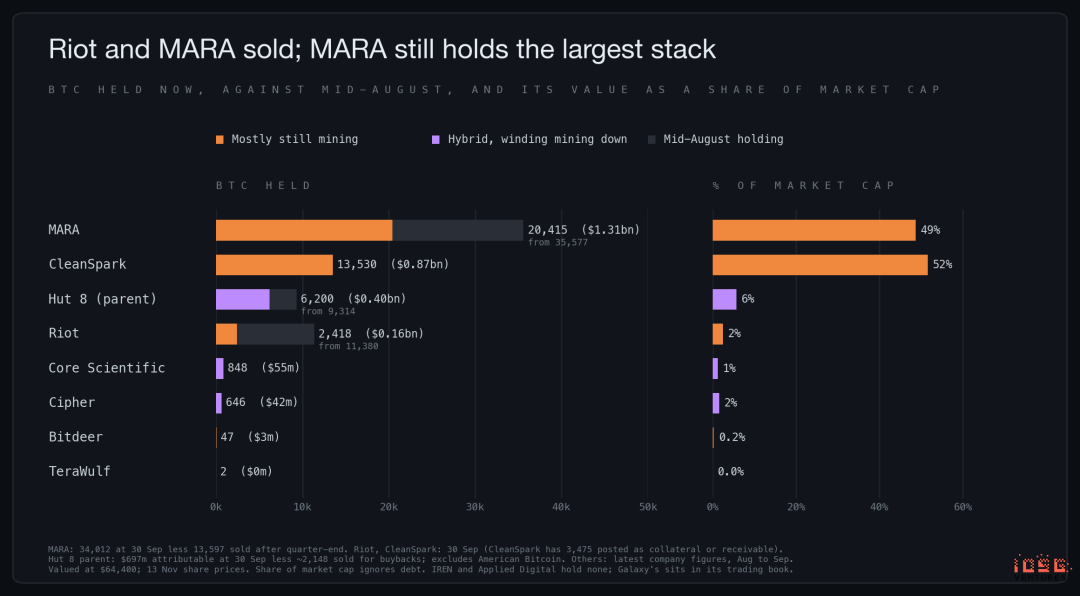
Transitioned landlords long exhausted sells: Core Scientific and Cipher hold <1,000 coins each (~1% market cap); TeraWulf, IREN, and Applied Digital are near zero. Sell pressure shifted to active miners initiating self-build AI projects.
Riot sold 20,264 coins in the first nine months (~$1.5B), primarily for DC build, down to 2,418 by late Sept. MARA sold 13,597 at ~$81K avg post-quarter, using $750M to retire Bitcoin margin debt, releasing collateral. Hut 8 sold ~3,100 for buybacks.
CleanSpark's 13,530 coins remain untouched among holders; it paused monthly production reports in Oct. MARA, CleanSpark, and Riot collectively hold ~36,000 coins (~$2.3B), down from 60,500 in Aug. That's a 40% drawdown, not a clearance.
MARA retains ~20,400 coins, pledging continued selling for AI fundraising; CleanSpark's construction relies on notes; Riot's residual 2,418 is negligible.
Inventory isn't the sole supply source. The network mints ~450 BTC daily; miner retention is discretionary. Transitioning pushes that discretion toward selling. MARA altered strategy in 2025 to permit mined coin sales, expanding to reserves in 2026. Riot sold more BTC this year than it mined.
CryptoQuant data shows miners transferred 21,140 BTC to Binance on Oct 26, the sixth single-day exceedance of 20K since Feb, pushing miner reserves near five-year lows. These flows include private miners/pools; exchange deposits don't guarantee sales: coins moved to sellable venues, not necessarily sold.
Thereafter, Bitcoin fell from ~$84K late Oct to $64.4K, an Aug low, amid spot ETF outflows, hawkish Fed commentary, and AI stock selloff following NVIDIA's Nov 12 announcement of Jensen Huang stepping down as CEO. Miner selling added supply to this decline but didn't trigger it.
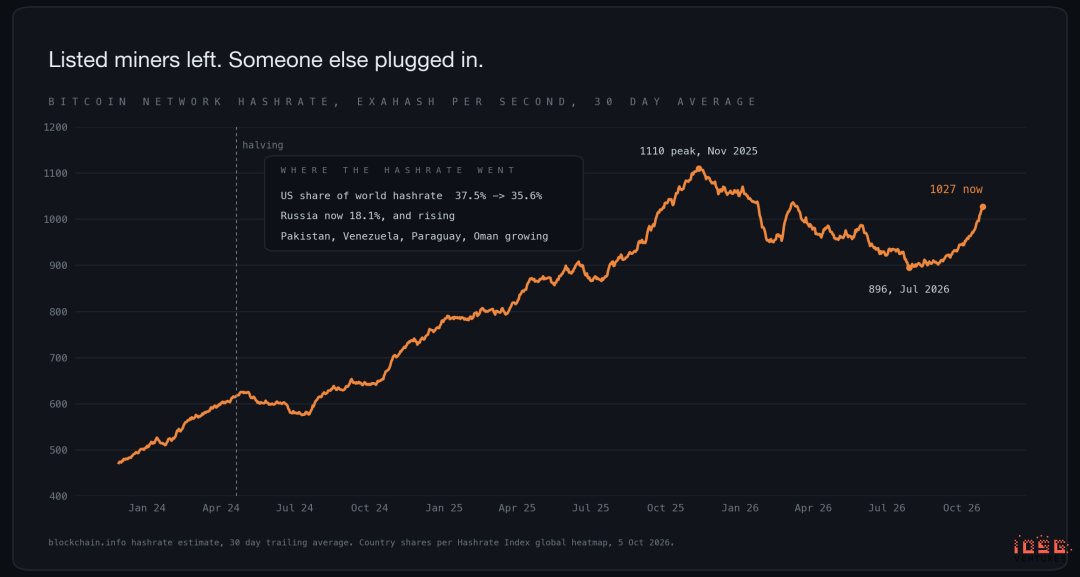
The network steadily absorbed the exit. Hashrate dropped 19% from last Nov peak to July, rebounded above 1,000 EH/s in Oct, implying ~965 EH/s at mid-Nov difficulty. Difficulty adjustments worked: post-public-miner shutdowns, remaining miners captured higher per-unit BTC yields, and new capacity elsewhere compensated.
Long-term security budget concerns persist. Fees contributed only 0.63% of miner revenue this year, trailing below 1% for 15 straight months. Revenue relies almost entirely on block subsidies, halving again in 2028. Adam Back posits mining/AI operates as an arbitrage mechanism balancing at equal marginal returns; this year's hashrate recovery validates his thesis.
2028 halving presents the true test: at current prices, post-subsidy cuts, even $0.04/kWh electricity won't cover OpEx for next-gen rigs, forcing more power redirection to AI. This year's experience proves networks adapt gracefully via replacement entry.
On Crypto Markets: Mining Stocks Are No Longer Bitcoin Plays
Since Aug 3, Bitcoin has risen while every mining stock has fallen.
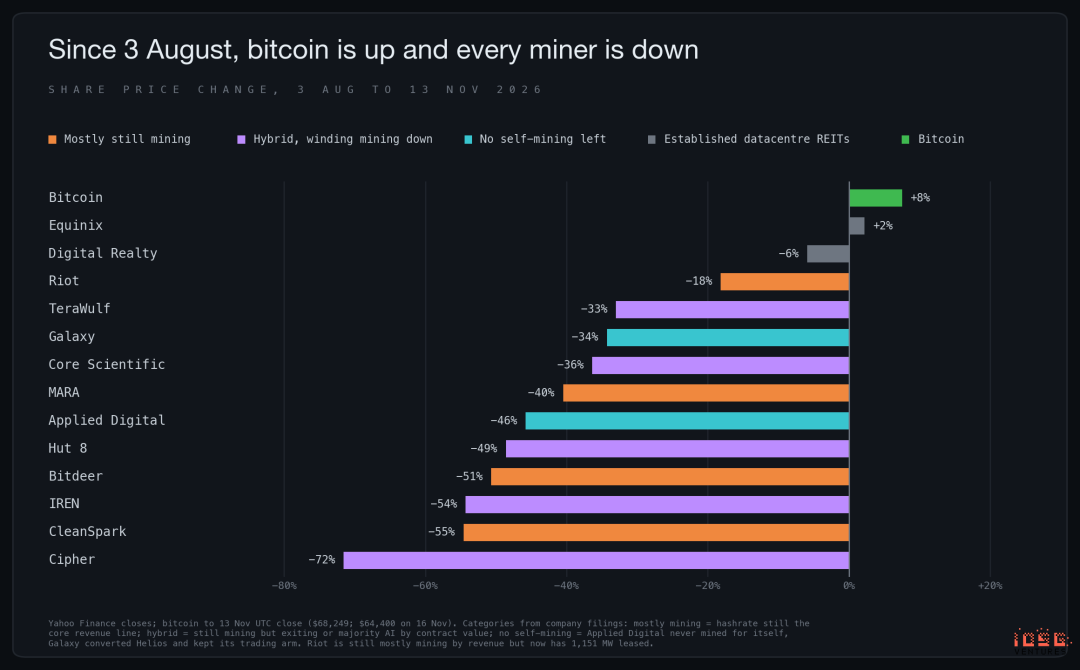
Aug 3 to Nov 13: BTC +8%, every miner −ve, ranges from Riot's -18% to Cipher's -72%. Dedicated miners and transitioned ones fell similarly, disproving market punishment for pivoting. Five drivers:
1. Temporal mismatch: mining stocks peaked June with AI infra rally; Bitcoin bottomed Aug at $63K.
2. Universal AI financing demands: every company, inclusive of holders, funds AI projects; equities price accordingly.
3. October CoreWeave credit event infected all AI data center debt-related credits.
4. BTC upside impact overstated: hashprice never materially exceeded $35.
5. Nov 3 election discounted all projects pending TX/GA approvals.
Meanwhile, Digital Realty and Equinix traded between -6% and +2%, isolating the issue to miner fundamentals: financing, permits, delivery, tenant credit.
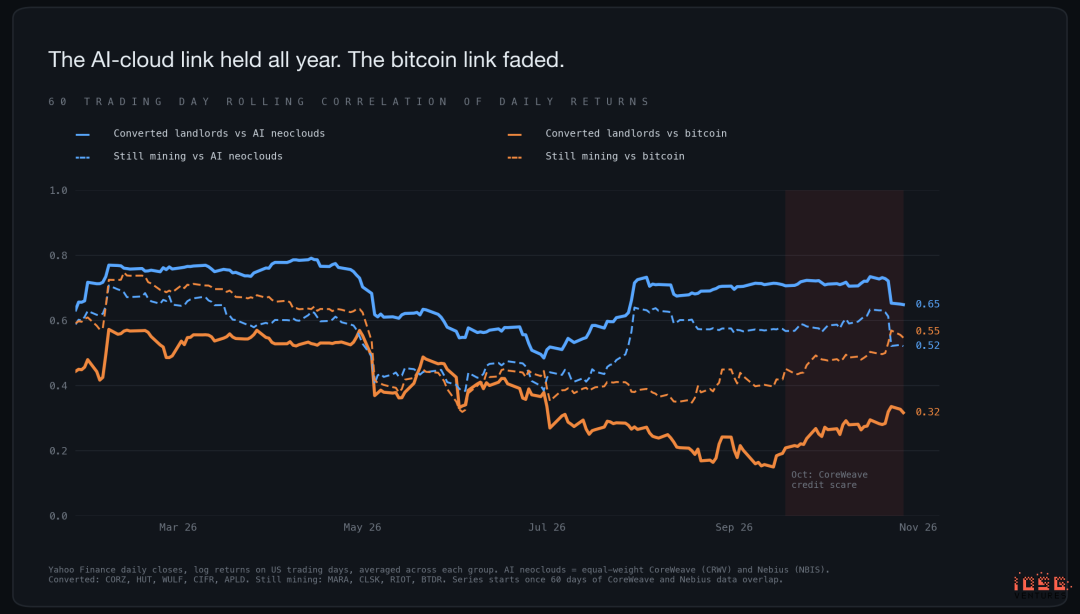
60-day rolling correlation: transitioned landlords track CoreWeave and Nebius (0.6-0.8) tighter than Digital Realty or Bitcoin. Linkage to BTC severed, dropping from ~0.55 in spring to 0.15 by mid-Sept.
Per CryptoSlate, Hut 8's BTC beta fell 1.18→0.53; Cipher 1.13→0.58.
Election bifurcated the sector again. Nov 3-13: BTC -12%, Riot +25%, Core Scientific +2%, TeraWulf +1%; Galaxy -15%, Cipher -16%, CleanSpark -18%.
Bernstein cut target prices 35%-54% across seven miners, now valuing AI managed-hosting businesses at 12x forward EBITDA citing tightened financing markets and TX uncertainty.
Morgan Stanley favors TeraWulf, Hut 8, Applied Digital, citing non-TX locations, though Hut 8's Beacon Point sits in TX.
Selloff originated in leveraged AI compute lessees, spreading sector-wide. Since Aug 3: CoreWeave -38%, Nebius -46%, NVIDIA -21% (most declines post-CEO announcement).
Oct 14 CoreWeave bond dump triggered same-day Cipher convertibles pricing; Cipher fell 12%, peers generally 5%-10%.
Flagship mining ETF WGMI now top-weights Cipher, Nebius, CoreWeave, Hut 8—two never mined a coin. For crypto investors, the public miner basket is no longer a BTC proxy, but AI infrastructure credit exposure with a fractional BTC overlay.
On AI: Genuine Capacity, Primarily for Training
JLL tallies ~66 GW North American DC pipeline; BNEF caps US grid annual addition at ~7.1 GW. Pre-2029 live capacity heavily features miner-held leases, as grid interconnections are already secured.
Mid-term elections amplified this: TX, GA, OH governors campaigned on halting new DC approvals, boosting existing lease values. Constraints follow.
Risks
Texas.
Riot, Galaxy, Cipher AI campuses sit in TX; Hut 8's Beacon Point and MARA's new campus too.
Just Riot, Hut 8 BP, and Galaxy represent 2.4 GW (38% of signed pipeline), excluding Core Scientific TX sites and Cipher. TX already paused under GOP gov.
Aug 3 Gov. Abbott ordered Big Load queue audits; ERCOT halted Batch Zero studies/large computing connections. Sept 21 he froze DC environmental permits. Markets anticipated post-election easing.
Nov 3 DP Gina Hinojosa won, pledging pause all DC approvals until new state legislation passes, eliminating sunset clauses. Takes office Jan 19, one week after legislature convenes.
Her authority is bounded: PUC commissioners appointees of Abbott, nominees require Senate supermajority (GOP holds 19-12). We expect pause through mid-2027, culminating in stricter conditions, not permanent bans.
Next catalysts: ERCOT Dec 10 audit report, PUC Dec 17 meeting. Approved-power signed volumes stabilize: Riot signed Corsicana with power already approved.
Exposure lies in pending interconnection/permitting: Galaxy's remaining 830 MW at Helios unleased; MARA's Matagorda payment contingent on grid approval; standby gen permits for contracted projects.
CleanSpark's Meta lease sits in GA; new DP seeks statewide interim pause; PUC shifts DP majority in 2027.
Demand Shift to Inference.
These campuses are intrinsically training-centric: miners prioritize cheap power, locating far from users. Gartner forecasts inference surpasses training in AI-optimized cloud spend this year ($23.3B vs $19B), reaching 59% share by 2027.
OpenAI scaled back autonomous builds: abandoned Aug 2025 Abilene 800 MW expansion, paused Stargate UK in Apr. Abilene/Norway capacity absorbed by Microsoft; demand migrated, not vanished. Counter-argument holds: batch inference, agents, RL exhibit latency tolerance; load segmentation remains fuzzy.
Yet a 15-20 year lease implicitly wagers perpetual overlap.
Intermediary Credit.
~37% capacity leased to specialized AI clouds, subleased to labs. CoreWeave holds 24%, rent lacks guarantors, $41.6B recourse debt, Oct distress pricing; management now pledges against unsecured issuance at current yields.
Fluidstack holds 10% (unrated private); Google backs only TeraWulf/Cipher specific obligations, not universal. Bitdeer's Volta reliance hinges on conditional bank LCs.
Intermediary failure leaves landlords half-built facilities with single tenants, unsolicited by terminal labs.
Financing.
Most leases unfunded; capital derives from equities down 33%+ since Aug, or debt priced on CoreWeave spreads. VanEck estimates ~$50B industry funding gap; Bernstein cites tightening.
Hut 8 unrestricted cash dropped to $157M intra-quarter; Bitdeer held $214M late Sept; Tydal retains hundreds millions in remaining CapEx. Riot's Dec 31 bridge maturation is the imminent hurdle.
Conclusion
Transition is real; decisions largely final. Grid interconnections held by miners represent AI construction's scarcest input. Built-and-leased campuses value ~$27M per MW; tenant-less < $3M. Post-deduction of builds, leased interfaces command 4x-6x multiples. Bitcoin would need to reach ~$250K to alter operating math,
prompting even holders to hedge.
Election elevated input pricing, bifurcating value. Adding 1 MW in the US is costlier and slower; approved/leased/funded MWs trade at premiums, awaiting TX/GA permits trade at discounts.
Riot Corsicana lease signed election-morning prices the former best: tenant-funded halls yield ~33% annual returns on cost.
Construction remains unfinished. ~6.3 GW committed, ~1 GW live, remainder requires funding over next two years. At 15%-20% cost returns, leases are solid businesses; rent spreads between strong/weak tenants stem from lease structuring. This provides comfort and highlights the flaw: highest CoreWeave-exposed landlords received no corresponding risk premium.
For Bitcoin, inventory sell-offs peaked but conclude. Transitions sold first, then Riot/MARA; three dedicated holders retain ~36,000 coins, MARA's ~20,400 most prone to market inflow. Hashrate recovered; networks so far absorbed exits cleanly.
For crypto investors, mining stocks no longer provide BTC exposure. They carry AI infrastructure credit risk and TX permit risk, with BTC as a minor component.
Methods & Notes
Capacity stats reflect disclosed AI leases through Nov 13, 2026, excluding IREN GPU cloud contracts. Committed capacity includes future deliveries. Deliverable/delivered/billable tracked per corporate disclosures; dates vary; industry billable percentages not calculated.
Capacity shares reflect committed IT MW weighting, not revenue or credit ratings. Anonymous hyperscaler vendors treated as distinct entities; cloud-subleased lab demand attributed to cloud providers.
Riot's dual lab leases omit tenant names; Bloomberg identifies Rockdale tenant as Anthropic; Riot confirms Corsicana houses same lab.
Cipher's disclosed 700 MW denotes gross power, not IT load, thus excluded from capacity shares.
Per Cipher's Feb 2026 investor materials, Black Pearl comprises 300 MW gross power, 216 MW critical IT load; thus Amazon's 15Yr/$5.5B contract translates to ~$1.7M/yr per IT MW ($1.22M/gross MW).
Cipher began Black Pearl billing in Aug but omitted billable MW figures.
Nominal rent = base-period contract value ÷ critical IT MW ÷ years, excluding escalators; Corsicana exception, Riot only discloses escalated averages. NOI sourced strictly from company disclosures (Hut 8, CleanSpark, Riot).
Galaxy Phase II NOI derived from disclosed >90% margin applied to reported revenue. Return-on-cost utilizes corporate CapEx guides; Corsicana applies Riot's $6M/MW, inclusive of $4M tenant reimbursements.
TX exposure tracks Riot (Rockdale, Corsicana), Hut 8 BP, Galaxy Helios; excludes Core Scientific TX sites (undisclosed by campus) and Cipher.
Mining economics assume 19 J/TH efficiency (52.6 PH/MW), $0.04/kWh power, 100% uptime, steady difficulty; calculates revenue minus electricity only.
Hashprice computes expected revenue based on 144 blocks/day, network difficulty-derived hashrate; current figures utilize mid-Nov 134.8T difficulty and $64.4K BTC price. Correlations employ daily log returns on US equity trading days. Bitcoin holdings reflect latest corporate disclosures through chart dates, valued at $64.4K.
Lease Detail
IG = Investment Grade, n/d = not disclosed. Base value = contract value within base period. "Not disclosed" indicates absent NOI figures in reviewed filings.
Join TechFlow official community to stay tuned
Telegram:https://t.me/TechFlowDaily
X (Twitter):https://x.com/TechFlowPost
X (Twitter) EN:https://x.com/BlockFlow_News
 IOSG Ventures