
When the Crypto Engine Enters Traditional Finance: A Conversation with Bitget’s CFD Head on Achieving a Billion-Scale Cross-Sector Benchmark in Ten Months
Author: jk, Odaily

The boundary between crypto and traditional finance is becoming increasingly blurred. Leading exchanges have been progressively adding gold, forex, equity indices, and US stocks to their platforms, making "all-asset class coverage" the key keyword for the new round of competition. From tokenized treasuries and tokenized stocks to perpetual contracts on traditional assets and CFDs, exchanges are taking increasingly diverse paths into traditional finance.
Crypto market users are also turning their attention to opportunities outside the crypto space, with precious metals, forex, and stock indices becoming the go-to destinations for hot money.
Bitget's CFD (Contract for Difference) product, launched this January, has already achieved significant scale within this trend. The daily trading volume peak for this business line reached approximately $10 billion, with overall volume growing roughly fourfold since its launch, putting its scale on par with a traditional mid-tier CFD broker.
CFD stands for Contract for Difference. Traders can use it to participate in the price movements of assets like gold, forex, and equity indices without actually purchasing or holding them. Based on market outlook, traders can choose to go long or short, ultimately calculating profit or loss based on the price difference between opening and closing positions.
For example, assume gold is currently trading at $4,000 per ounce. If you believe it will rise, you buy a 1-ounce gold CFD. If it later rises to $4,100 and you close the position, you earn a $100 price difference; if it falls to $3,900, you lose $100. Throughout this process, you never actually bought physical gold, nor do you need to store it or arrange for physical delivery.
Odaily Planet Daily recently spoke with JZ, Head of CFD at Bitget, about this new product direction. With a background in traditional finance where he worked across front, middle, and back offices, most of the team he now leads comes from the same circle. He claims he isn't skilled at grand narratives, but when discussing business, he is highly practical and grounded.
In his view, CFD's significance for Bitget lies in bringing together two previously disjointed groups of traders to form a larger market with greater liquidity and tighter spreads. From its original intent to its current state, JZ shared numerous details from the frontlines of operations.
Here is the original interview transcript:
Why Did Bitget Launch CFD?
As crypto exchanges venture into traditional assets like gold and forex, JZ believes there are two driving reasons behind this trend.
On one hand, changes in user demand: In earlier years, trading a few major cryptocurrencies was enough. During periods of quiet Bitcoin markets, many felt there was little to do in crypto, yet noticed that gold, silver, forex, and major equity indices were consistently active. They wanted to directly apply their familiar trading styles and macroeconomic insights to these markets.
On the other hand, the scope of competition among exchanges is expanding. Many peers are broadening into more asset categories, and Bitget is likewise seeking innovation. For exchanges, this represents new growth avenues while also accommodating older users' increasingly diverse trading needs.
When asked why CFD was chosen, JZ explained that the traditional financial market hosts a vast number of stock brokers and CFD brokers with a large client base, many of whom have never interacted with a crypto exchange. CFD itself is a mature product with broad appeal and clear demand, making it ideal for attracting this demographic. Its rules are also quite simple—similar to crypto futures but with more transparent pricing and a wider market.
Users hold a contract rather than having to physically purchase gold; they simply gauge price movements and settle profits or losses based on the price difference.
JZ noted that CFD primarily targets traditional CFD traders already accustomed to MT5. CFD and tokenized stocks are fundamentally different products, not mutually exclusive but rather complementary. CFD trading involves contracts that settle price differences without requiring asset ownership, whereas tokenized stock trading involves asset tokens backed by real-world asset custodianship.
The former has a lower barrier to entry, while the latter requires more considerations regarding custody, holding, and compliance. Bitget maintains a dedicated product line for equities.
He also gave a vivid example. Traditional CFD brokers typically focus only on gold and forex, limiting their offerings. If gold lacks volatility, capital sits idle. By placing both crypto and traditional assets on the same platform, Bitget achieves a "where one fails, the other succeeds" effect: when gold is flat, users can trade crypto; when crypto is quiet, they can trade gold, forex, or indices; and when both are sluggish, they can still allocate funds to wealth management products.
This is precisely what Bitget's UEX (Panoramic Exchange) strategy aims to achieve.
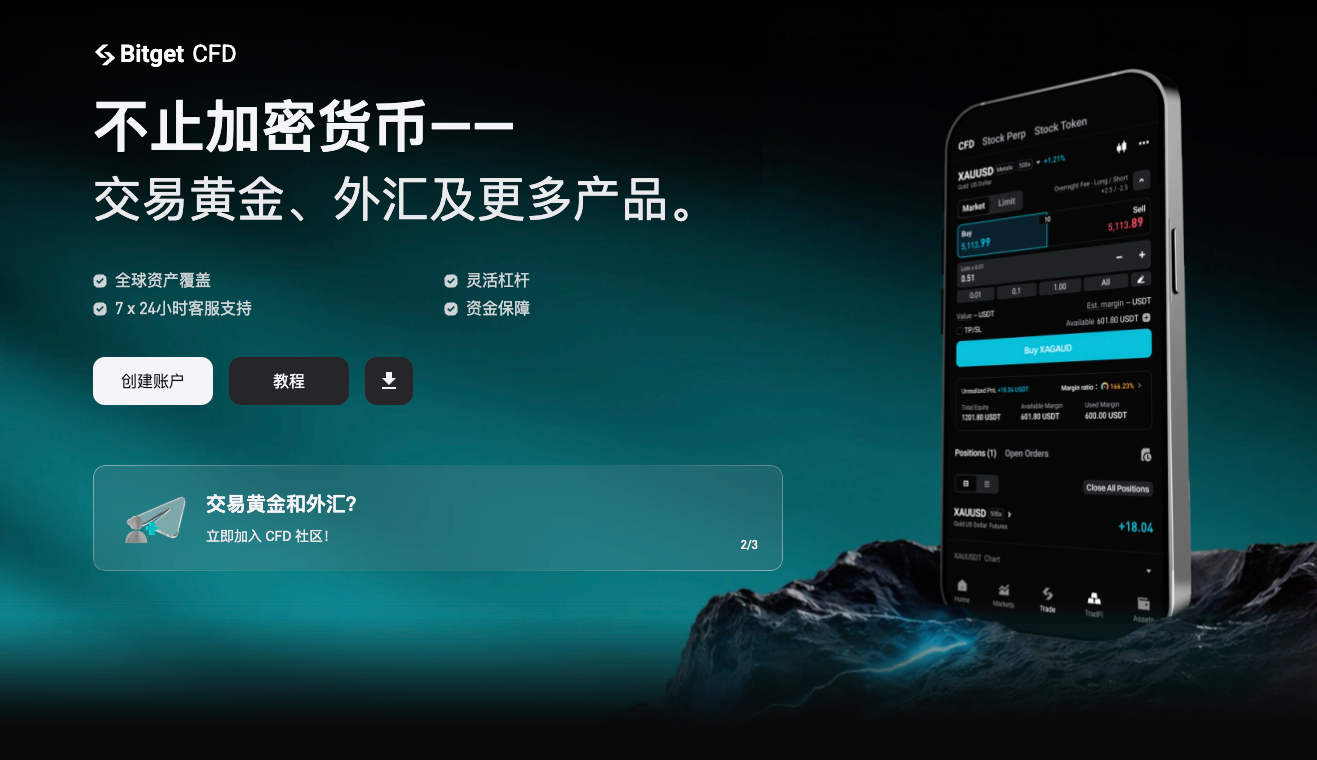
How Does It Compare to Traditional Brokers?
Bitget already has a solid foundation in products, technology, and global operations. However, traditional CFD brokers have spent years building deep accumulation in professional client relationships, channel networks, and market trust. JZ candidly admitted that these cannot be fully bridged in the short term simply by launching a product.
Within the traditional CFD circle, Bitget is still a relatively new name. It will take time for users to recognize and accept it, gradually earning market recognition through genuine trading experiences and long-term service.
However, from a crypto industry perspective, developing new products holds immense value. According to JZ, traditional CFD clients prioritize trading environment, fund security, and platform strength. Bitget excels in these areas, and combined with its technological capabilities, an ecosystem of 125 million users, and global influence, it possesses advantages that traditional MT4/MT5 brokers struggle to match.
In his view, traditional traders are constantly searching for trading platforms with stronger comprehensive capabilities, better trading experiences, and more professional, reliable services—and Bitget is that answer.
After Ten Months Online, What Has Been Achieved?
JZ revealed that the daily trading volume peak for Bitget's CFD product reached approximately $10 billion, placing it at the level of a mid-tier broker in the CFD industry, despite this business line only launching in January this year. Additionally, compared to its initial launch phase, trading volume has grown roughly fourfold. His next goal is to reach the trading volumes of top-tier traditional brokers.
Among the currently listed instruments on Bitget, gold has seen the fastest growth, accounting for roughly 80% to 90% of total trading volume, which aligns closely with broader CFD market trends. Following gold are global equity indices dominated by US stock indices, and further down come commodities primarily driven by crude oil.
JZ explained that these asset classes operate in global markets heavily influenced by politics, geopolitical conflicts, interest rates, and varying risk appetites across countries. A single tweet from Trump can trigger moves that amplify multiple times due to heightened sentiment and leverage effects.
"But we won't settle for the present; we will continue striving to reach the trading volumes typical of top-tier traditional brokers."
JZ mentioned that the bulk of the trading volume increment comes from crypto users, including existing Bitget customers and migrants from other exchanges. They need more asset categories to capture opportunities, and the gold, forex, silver, crude oil, and global indices launched on Bitget perfectly fulfill this demand.
Another segment comes from traditional CFD users. As Bitget penetrates this circle through business development and sales channels, an increasing number of traditional users are drawn by reputation, representing another crucial growth driver. After trial runs, these users generally found that crypto exchanges can execute CFDs with high professionalism.
JZ believes this is a key differentiator between Bitget and other crypto exchanges. Many crypto platforms lack professional teams familiar with CFDs. In contrast, Bitget's team is largely sourced from the traditional CFD industry while simultaneously possessing strong Web3 expertise. This allows product design to cater to both demographics, enabling channel expansion across both fronts simultaneously.
Is Gold Offered with up to 2000x Leverage?
Offering up to 2000x leverage on gold is one of Bitget CFD's most highlighted selling points.
JZ provided a detailed explanation of the platform's 2000x leverage design: First, it features a tiered leverage structure. The 2000x ratio applies only to small positions; leverage automatically scales down as position size increases. At smaller sizes, it peaks at 2000x, then steps down to 500x, 200x, 100x, and so on as exposure grows.
JZ stated that this design is primarily intended to protect users. It aims to meet diverse capital utilization needs while implementing stricter risk management for larger positions, simultaneously leaving ample operational room for traders.
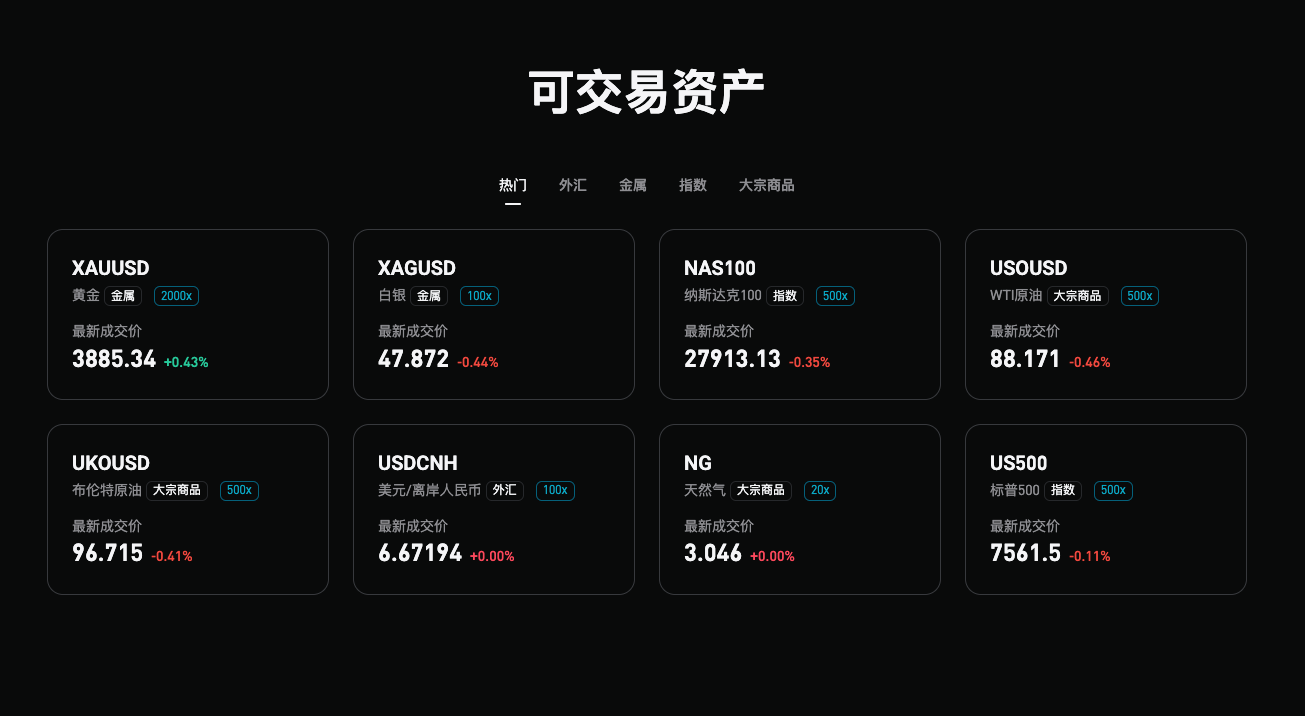
For seasoned CFD users familiar with the space, high leverage is nothing new. They understand how it functions, under what conditions margin calls or liquidations occur, and how to set take-profit and stop-loss orders, making 2000x seamless to use.
JZ disclosed that some users have even remarked, "They're wondering when Bitget will roll out 3000x or 5000x leverage." Nevertheless, Bitget will currently maintain its ceiling at 2000x.
Four Account Types Catering to Four Trader Profiles
Bitget CFD currently offers four account types: Zero Commission, ECN, Pro, and Standard+. JZ regards this account framework as a standout feature of Bitget's CFD offering within the crypto exchange space, designed with trader personas as the primary consideration.
He broadly categorizes market participants into three segments. The first group consists of high-frequency, cost-sensitive independent traders who favor intraday scalping strategies. The second comprises channel-acquired clients, often backed by KOLs or trading desks. The third is the most institutionalized, including physical gold companies and jewelers engaged in calendar spreads, cross-market hedging, and basis trading.
ECN accounts feature very low spreads with an additional small commission fee. Borrowed from the traditional forex market, this model has been adapted by Bitget. It suits users running automated, quantitative, and algorithmic strategies, who demand precise entry prices and are typically sophisticated individual traders.
Zero Commission accounts fold the commission directly into the spread, meaning all costs are reflected in the spread pricing. "Some users prefer not to see separate commission lines on their statements, finding it harder to track true costs. This account type is tailored for them."
Pro accounts target corporate entities and professional institutions. Regarding trading conditions and liquidity allocation, they focus more on meeting the needs of large-volume trades, institutional transactions, and advanced strategies. Bitget matches corresponding institutional liquidity resources based on client profiles and trading characteristics.
Standard+ accounts mainly serve clients acquired through Introducing Brokers (IBs), KOLs, and other partnership channels. Compared to other account models, it features a distinct cost structure and provides partners with corresponding service frameworks and commission incentives.
Bitget hopes that such a mechanism incentivizes channels to continuously invest in client education, market analysis, and customer support, thereby fostering a more sustainable collaborative relationship among the platform, partners, and traders.
Account Tiering Also Splits Order Flow, Routing Optimal Orders to Suitable Clients
Behind account tiering lies meticulous order flow management. The liquidity fed into Bitget CFD falls into two categories: one specifically handles retail order flow, while the other processes institutional and professional orders. Retail orders enter retail liquidity pools, whereas corporate clients needing gold hedging routing their orders into institutional liquidity.
JZ explained this design stems from lessons learned in the industry. Different Liquidity Providers (LPs) vary in asset coverage, quote depth, order sizing capacity, and risk absorption ability. Applying uniform liquidity configurations to all order types would likely fail to yield optimal execution results.
Therefore, Bitget matches specific liquidity resources according to different client types and order characteristics, ensuring both retail and institutional clients receive trading environments best suited to their needs.
To achieve this, Bitget segregates retail and institutional flows onto separate rails, with Pro accounts routed through the institutional rail. According to JZ, professional and enterprise clients rate this arrangement highly, generating substantial trading volumes.
Liquidity and Execution: Tested Through High Volatility
For professional traders, spreads, liquidity, and execution quality far outweigh UI design and marketing campaigns. JZ noted that this infrastructure has been operating smoothly in the industry for over two decades. Bitget draws upon mature industry experience, structuring its overall architecture to benchmark against leading traditional brokers.
Aggregated Quotes and Liquidity Design with LP Incentives & Penalties
Bitget CFD integrates over a dozen tier-one Liquidity Providers, encompassing banks, non-bank institutions, and high-frequency quantitative market makers. Aggregating their quotes and depths yields superior overall liquidity compared to relying on any single provider. JZ stated this elevates Bitget's spreads and transaction costs to industry-leading levels, achieving an order fill rate of 99.999%.
The team conducts long-term, real-time monitoring of each LP, tracking fill rates, execution latency, slippage, market depth, and spreads. Top performers receive higher order allocation, while underperformers are initially urged to improve; persistent failures result in termination of partnerships.
Routing orders to either the retail or institutional rail depends on client segmentation outcomes, factoring in KYC data gathered during onboarding and transaction behavior analysis. The entire process remains publicly transparent to clients. He believes openly informing clients "which account type best suits your trading style" actually fosters trust in platform transparency, encouraging greater capital deployment and higher trading volumes.
He argues that long-term ecosystem viability hinges on maintaining healthy states across the platform, LPs, and clients alike.
Non-Farm Payrolls Releases Trigger Hundreds of Thousands of Orders in Seconds
Those critical seconds when major economic data drops best test a platform's resilience. Under further questioning, JZ broke Bitget's response capabilities into two components.
One component is liquidity management, namely the aforementioned LP selection and real-time monitoring. The other involves technology and infrastructure: trading servers, bridging systems, and LP order execution systems are all deployed in dedicated financial data centers in Tokyo, London, and other hubs, equipped with multi-region disaster recovery protocols.
He cited an example: During each Non-Farm Payrolls release window spanning roughly ten to fifteen seconds, the platform absorbs approximately 100,000 orders, with virtually every execution completing within 40–150 milliseconds without congestion. Spreads naturally widen during these spikes, reflecting authentic market dynamics;
however, to date, during NFP and CPI releases, the platform has experienced no quoting anomalies or downtime, nor received any slippage-related complaints. Bitget guarantees system stability during these periods through optimized liquidity sourcing, trading server redundancy, bridging efficiency, and geographic distribution, continuously monitoring order processing, execution latency, and slippage metrics.
Maintaining consistently high availability, ultra-low latency, and premium execution standards throughout.
When asked whether execution metrics could surpass those of traditional brokers, JZ answered frankly: This represents the current industry ceiling, making further leaps extremely difficult. In essence, what Bitget communicates is that a crypto exchange's execution quality can now rival that of top-tier traditional firms.
Copy Trading and Automation: Catering to Different Trader Types
Accounts, leverage, and liquidity determine whether a platform can facilitate trading, whereas copy trading and automation tools dictate who trades and via what methodology. These two functional pillars respectively address Bitget's two primary user demographics.
Copy Trading: Connecting Skilled Traders with Capital Holders
Copy trading is highly prevalent in crypto circles, and Bitget ranks among the pioneering exchanges to launch it. The CFD business directly inherits this mechanism. Its role serves as a matchmaking conduit: connecting individuals with limited capital but exceptional trading acumen alongside those possessing capital but lacking expertise. Signal leaders share strategies for revenue sharing, while followers capture gains;
the platform drives overall volume, benefiting all three parties. "It essentially functions as a bridge between seasoned traders and novices," JZ explained.
In JZ's perspective, this represents a significant advantage for Bitget relative to traditional CFD brokers. Given Bitget's massive inherent user base, integrating an accomplished trader quickly attracts copiers.
Bitget initially rolled out public domain copy trading, where all signal leaders operate transparently for users to freely select, yielding excellent reception. Later, signal leaders voiced a new requirement to restrict strategy access to specific audiences, inviting their high-net-worth clients while delivering differentiated strategic portfolios. Consequently, Bitget subsequently introduced private domain copy trading.
EAs and Open API: Trading Multiple Asset Classes with a Single Codebase
Bitget selected MetaTrader 5 (MT5) as the foundational layer for CFD trading, largely due to its robust Expert Advisor (EA) ecosystem. According to JZ, there are currently over one million EAs available on MT5, allowing users to select algorithms aligned with their personal strategies and risk profiles, or develop custom solutions.
Numerous professional traditional CFD traders place high value on platform branding and capital strength, frequently migrating EAs used over years directly onto Bitget's MT5 environment.
JZ also observed that clients utilizing EAs for automated trading significantly outperform manual counterparts in trading volume, frequency, and account longevity, as delegating execution to algorithms eliminates human emotional biases like impulsivity and greed.
However, most of Bitget's crypto users have rarely interacted with EAs. To address this, Bitget extends its Open API, already integrated into equity operations, to cover CFDs. Users previously leveraging the Bitget API for crypto trading can now utilize identical codebases to simultaneously trade crypto assets, equities, and CFDs.
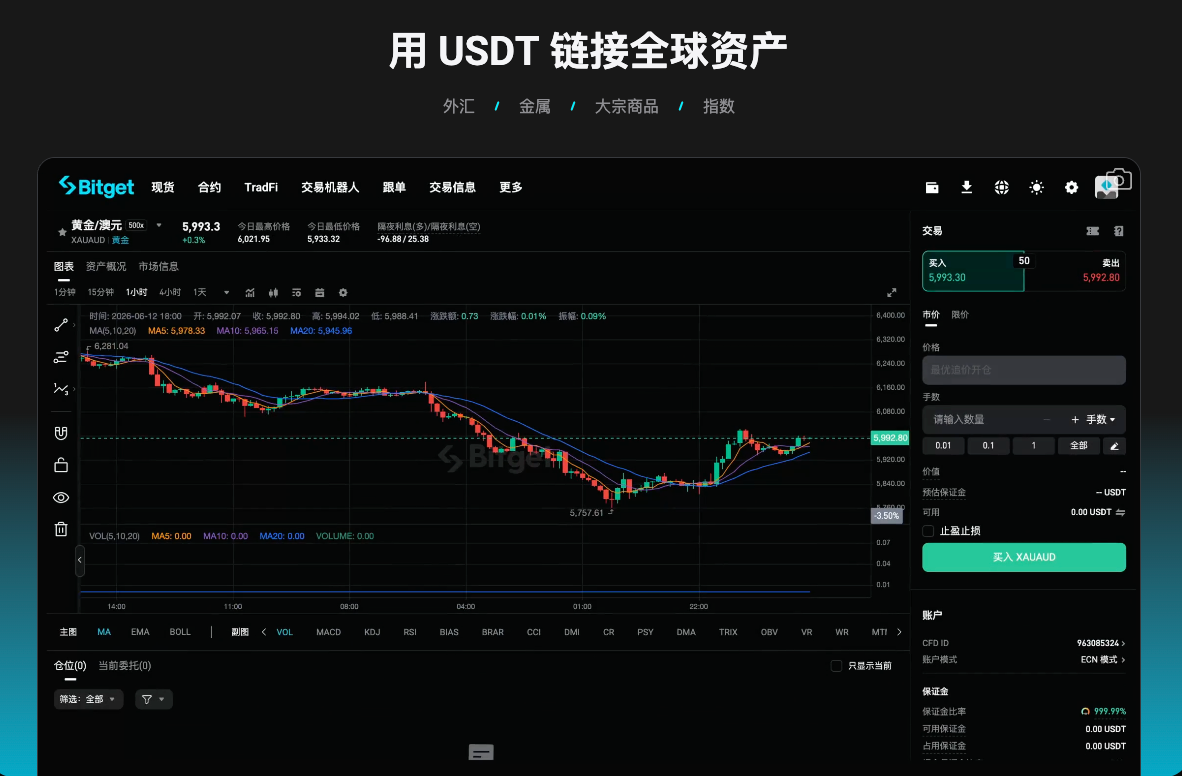
Simultaneously, JZ noted that traditional trading teams face near-zero migration costs when transitioning to Bitget. He cited examples of desks originally conducting directional and swing trading via perpetual swaps with solid performance records. Upon discovering that gold CFDs offered superior transaction costs and market depth compared to gold perpetuals, they simply adjusted their code snippets to integrate seamlessly.
The entire transition essentially involves modifying a handful of endpoints, verifying contract specifications and trading hours, followed by immediate order placement. He expresses strong confidence in this remarkably low adoption barrier.
Next Steps: Gaining Trust from Traditional CFD Users
Finally, when asked where Bitget's greatest gap lies compared to globally tier-one CFD brokers, ...
JZ's answer centered squarely on trust, noting minimal correlation with technical or product deficiencies.
He explained that while Bitget operates as a behemoth within the crypto sector, user trust within traditional CFD circles remains incomplete. Many still perceive it as a newcomer, preferring a wait-and-see approach. The immediate priority revolves around genuinely securing this demographic's endorsement.
Specifically, three initiatives will persistently continue: relentlessly refining products and trading infrastructure, executing sustained user education initiatives alongside channel network expansion, and strategically cultivating the Bitget CFD brand identity.
Before concluding the interview, JZ humorously acknowledged his background in middle/back office operations leaves him less articulate than market analysts or business developers. Precisely because of this, his responses remain highly grounded; discussions on products avoid exaggeration, data presentation maintains appropriate restraint, and objectives are sharply defined—solely targeting trading volumes equivalent to leading traditional brokers.
"This is the most critical objective, yet undoubtedly not the hardest." He affirmed confidently.
As the agility of the crypto realm converges with the depth of traditional finance on a unified order book, a novel era spanning all asset classes pushes open the door. For Bitget CFD, reaching the ten-billion-dollar scale marks merely the starting line; the true journey has just begun.
Join TechFlow official community to stay tuned
Telegram:https://t.me/TechFlowDaily
X (Twitter):https://x.com/TechFlowPost
X (Twitter) EN:https://x.com/BlockFlow_News
 Odaily