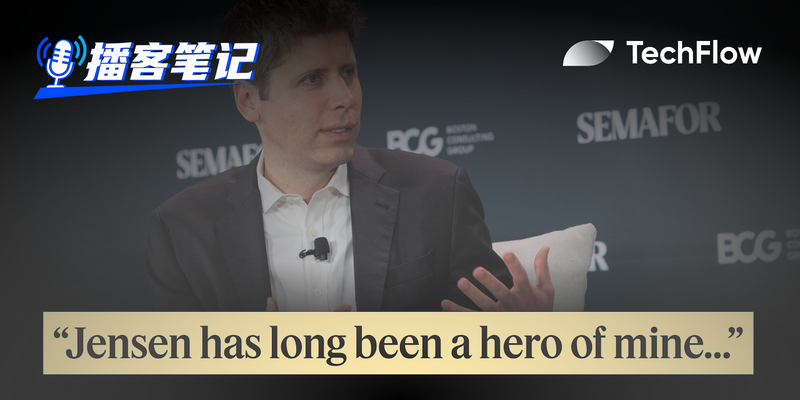
Podcast Notes | Even OpenAI's CEO Admits He Hasn't Made Good Use of AI: Sam Altman on Habit Inertia, Non-Consensus Bets, and a Letter to His Son
Compiled & Translated by TechFlow

Guest: Sam Altman, CEO of OpenAI
Host: David Senra, Host of the Founders / David Senra podcast
Sourced by: David Senra
Original Title: Sam Altman on Building OpenAI & Betting on the Impossible
Release Date: August 23, 2026
Disclosure: Sam Altman is CEO of OpenAI. This episode covers OpenAI's strategy, products, technological roadmap, and industry vision, making his stance highly relevant to the company's interests. The following content faithfully presents the guest's views and does not constitute independent third-party judgment.
Key Takeaways
The most interesting part of this conversation is that Sam Altman, as the creator of AI, admits he hasn't crossed the "iPhone moment" himself yet. He invented Codex years ago, but still uses a workflow from 20 years ago: copying and pasting between different messaging apps, mindlessly scrolling through emails to reply only to the easiest ones, and maintaining his to-do list in the old way. His reason is simple and very common: people tend to equate some inefficient method with "work" itself.
This is exactly the most valuable takeaway for everyday people from the entire episode. Over his decade-plus journey from venture capital to leading OpenAI, what he truly distilled has little to do with technical details and more to do with a set of universal principles on how to evaluate, bet, and make trade-offs. For example, he believes "research also follows a power law," where the single best idea is more important than all others combined; when hiring, he looks for whether someone is willing to stick to highly unpopular convictions; and he learns more from success than from failure because success is easier to replicate. He also rarely discussed his personal life: after his first son was born, he wrote him a letter every Sunday, only stopped after eight letters, but that framework of "not being able to hide behind anything" prompted him to reflect much more honestly.
Of course, he also talked about OpenAI's platform strategy and AI risks, but all of this rests on one premise: humans are the ultimate meaning of it all. Rather than worrying about AI taking jobs, he is more concerned about loss of control and excessive concentration of power.
Key Highlights
On Adoption & Inertia
- "Toby Lütke is the most forward-leaning CEO I've ever seen, ahead of other CEOs by six to eight months. But I'm not too sure that 2026 will be the breakout year where every business gets reshuffled; I think it will happen a bit slower."
- "The economy and society have massive inertia. People continue doing the same things, buying the same tools, working in the same ways. This will make the upcoming major transition smoother, but it also means we are overly optimistic about our timelines."
- "How I use my computer today isn't much different from 20 years ago. Even though better tools exist, deep down I seem to equate this inefficient method with 'work' itself."
On Non-Consensus Bets
- "In 2015, when we said we wanted to build AGI, we were mocked by intellectual giants in the field. Later, when we bet on large language models, we were mocked again."
- "Research also follows a power law. The single best idea will outweigh the sum of all others."
- "You look for someone whose way of thinking is obviously different from others and who is willing to stick to highly unpopular beliefs. If they're wrong, so be it; if they're right, they are absolutely right."
On Success & Failure: Learning More from Success
- "I learn more from success. Failure certainly has lessons, but most failures have many causes, making it hard to extract the correct causal relationships."
- "When something really works, like which practices at YC are effective or which at OpenAI are effective, applying those lessons to the future is far more helpful."
On Letters to My Son: An Honest Framework
- "When my first child was born, I would put him to sleep at night, telling him what I did during the day and what I was worried about."
- "One benefit of writing letters to your child is that you can't hide behind anything. You genuinely care about how your child will view you in the future, so you reflect more honestly on what went wrong this week and how to improve next week."
- "It's a very interesting mental framework, unfortunately I only wrote eight letters before stopping."
On Platform Strategy & Trade-offs: Sacrificing Good Products for Great Ones
- "We should be more of a platform company than a product company. One direct interface, one API, letting people build everything on top of it."
- "Last year we shut down Sora, and also the Atlas browser. They were both good products, but in a world with limited compute, talent, and resources, we have to sacrifice good products for great ones."
- "One of the hardest lessons for entrepreneurs to learn is: killing good ideas."
On Risks & Human Agency
- "The two risks that worry me most about AI are loss of control and excessive concentration of power. Both outcomes are fundamentally anti-human."
- "The right path is not handing the future over to a few companies, a few people, or a single model. Humans are the entire point of this."
- "Trading away humanity's influence over the future in exchange for 'we will cure all diseases and make the world cheaper' is a terrible sales pitch."
On OpenAI's Early Days: Four and a Half Years Without a Product
- "We founded the company in late 2015 and didn't release our first product until mid-2020—four and a half years. That's the exact opposite of YC's 'ship early' philosophy."
- "In January 2016, over a dozen people gathered at Greg Brockman's apartment. Everyone was excited, but soon we started looking at each other, thinking: what do we actually do now? We didn't even have a whiteboard."
- "We went through a long period of chaotic stumbling before we finally stumbled upon the research path that led to GPT."
I. Adoption Will Lag Behind Technology: Toby Lütke's Lead and Habitual Inertia
David Senra: Why do you think Shopify's Toby Lütke is one of the most interesting CEOs right now?
In every early stage of AI, Toby has been the most forward-leaning CEO. He writes his own software, runs his own experiments, and sends us incredibly detailed product feedback. Long before anyone else, he stated that we are not NPC companies and must embrace agents, or we're done. He takes action, has a deep understanding of technological boundaries, and is probably six to eight months ahead of other CEOs.
David Senra: He himself said 2026 will be the year every business gets reshuffled, and he even plans to rebuild an AI-native version of Shopify overnight. Do you think this timeline is accurate?
I agree with the spirit, but less so with the timeline. I think it will be a bit slower than he expects. My doubt isn't about possibility, but about economic and social inertia. People will keep doing the same things, buying the same products, using the same tools. AI is one of the most astonishing technologies humans have ever created, but societal and economic adaptation will move more slowly.
This is actually a good thing in many respects. It will make the upcoming major transition proceed more smoothly. But we are all overly optimistic about our timelines.
David Senra: This reminds me of what Larry Ellison said in the 1980s: it's not a software problem, it's a human problem. The technology is there, but people's behavior needs to change.
Exactly. Changing behavior is much harder than geeks imagine. I often cite the example of Blockbuster still renting movies by mail even when Netflix was already shipping DVDs. The power of that inertia is far greater than the technology itself.
II. Sam Altman Himself Hasn't Crossed the "iPhone Moment" Yet
David Senra: You're building these products simultaneously. Have you noticed that even though you have better tools, you still work by old habits?
Absolutely. I've been waiting a long time for this question. The biggest inconsistency in my head is that I've used computers in the exact same way for 20 years. Now that we have a magical tool called Codex, theoretically I should completely change how I use my computer. I shouldn't be copying and pasting between different messaging apps, idly scrolling through emails to reply only to the easiest ones, or maintaining my to-do list the old way.
But if we look at revealed preference, I still seem to prefer the old way. This only proves one thing: somewhere in my mind, I equate this inefficient method with "work" and "being productive."
David Senra: What would make you truly dive deep into using your own products?
I think it will be a gradual process. Completely changing someone's habits and workflow is extremely difficult. We can still build better products to make the switch seamless. Right now, it feels like the pre-iPhone smartphone era. I used a Palm Treo back in 2003; the technology was already pretty close, what was missing were the killer app ideas that made the iPhone an iPhone. Today we have all the technological puzzle pieces, but we haven't yet seen the iPhone moment that completely changes human-computer interaction.
III. Non-Consensus Bets: Twice "Mocked by the Crowd" from AGI to LLM
David Senra: You loved AI since childhood. Why did you end up choosing this path everyone thought was impossible in 2015?
I was a nerdy kid growing up, playing on the computer Friday nights, watching sci-fi, reading sci-fi. I always felt AI would be the craziest thing. In college, I even worked in an AI lab over the summer, but nothing worked back then. The professors explicitly told me: deep learning is guaranteed to yield poor results and is the safest way to ruin your career. That was around 2005, and I believed them.
Later, I accidentally fell into startups and fell in love with it. Becoming a founder first, then an investor, goes against the conventional order. I strongly recommend this path because, as an investor, you get to see the most critical crux moments across countless companies. Though you lack the daily hands-on practice, your dataset is enormous.
David Senra: How does doing investing directly help you run OpenAI now?
A huge benefit is power-law thinking. You have to reprogram your brain: your single best investment will surpass the sum of all others; your second-best will surpass the rest combined. AI research works the same way.
When we founded OpenAI in late 2015, there was almost no effort related to AGI in the world except for a couple like DeepMind. When we said we wanted to build AGI, we were mocked by intellectual giants in the field. Later, when we bet on large language models, we were mocked again. Coming from a VC background, I understood: high-risk bets are fine as long as they are immensely valuable once successful. Great researchers are precisely those non-consensus thinkers with new methods, high energy, and non-standard approaches.
David Senra: What exactly do you mean by "non-standard"?
You're not looking for someone who makes slight adjustments to existing ideas and then desperately tries to convince you they're different. Those people are just mimicking Peter Thiel's advice to "be different," but deep down they still follow the crowd.
What's truly valuable is someone whose way of thinking you clearly sense is different from others, and who is willing to hold onto highly unpopular convictions. They might be wrong, but if they're right, they are absolutely right.
IV. Compute: The Largest Infrastructure Project in History
David Senra: Where is your main focus right now?
Research and compute. I'd love to spend more time on products, and we have excellent people handling that, but the absolute priority right now is building smarter models and delivering them efficiently and abundantly to many users. It's a high-leverage challenge for sustaining exponential growth, and it happens to be a complex problem I'm relatively good at.
Scaling compute requires coordinating chips, fabs, data centers, power grids, finance, policy, supply chains, and logistics. This may already be, or is becoming, the most expensive infrastructure project in human history. It piles together technical, commercial, policy, and supply chain issues.
David Senra: You used to be a startup investor, now you manage research projects. Are the two similar?
Very similar. On the surface, researchers and founders differ, but in dimensions like finding non-consensus bets, judging conviction, understanding exponential growth, and managing outlier talent, there's immense overlap. The very building I sit in right now is the research building; my office is here.
V. Platform Strategy: One Interface + One API, Killing Sora and Atlas
David Senra: How many product lines do you currently have? Where does the revenue come from?
We just merged ChatGPT and Codex. Previously, we had ChatGPT, Codex, and the API. The name "Codex" easily misleads people into thinking it only writes code, but it can actually do any task.
I believe OpenAI should function more as a platform company than a product company. We'll definitely build some products, but what most people truly want is a unified interface to access personal or corporate AGI, plus an API so people can build anything on top of it. We will optimize AI for every point on the cost-performance curve. Need high-end AI for scientific discovery? Done. Need cheap AI for repetitive tasks? Also done.
David Senra: What mistakes did you make or sacrifices did you make to learn this?
The hardest lesson is: sacrificing good products for great ones. Last year we shut down Sora. It was fun, cool, and had users, but it consumed massive compute, which was better allocated to Codex. We also killed the Atlas browser. I think it might have been the best browser, but we needed talent elsewhere. In a world of limited compute, talent, and resources, we must stay extremely focused: general intelligence, knowledge work, scientific discovery, and the upstream work supporting these, like in-house chips, data centers, and infrastructure.
David Senra: Did Peter Thiel give you any advice on focusing?
When ChatGPT first launched, growth was rapid but felt unstable and lacked perceived value. Many discussed pivoting. I went to Peter, and he listed a bunch of directions we could switch to. He said: besides the fact that "it's growing," the more obvious mistake would be doing something else. Its strength lies in that Google-style empty text box; you type anything and it handles it. It didn't fit the Silicon Valley wisdom of feeds, network effects, or user lock-in back then, but why wouldn't an empty text box work for this just like it did for Google?
I listened, bet fully, and it worked out beautifully.
VI. Two Major AI Risks: Loss of Control & Concentration of Power
David Senra: What are you afraid of regarding AI?
Two primary risks. One is loss of control, where AI becomes too powerful and we cannot guarantee desired control. The other is excessive concentration of power, where a single company, model, or person holds too much authority. Both are fundamentally anti-human.
The right path is for humans to deeply govern the future and be deeply empowered. Humans are the entire point of this. We cannot gradually hand control over to AI models simply because we distrust people. That's a profoundly cynical stance.
Another equally dangerous version is restricting who can use this technology and how, concentrating power in a few companies out of fear of bad outcomes. I'll give you disease-curing drugs and cheap goods, but you forfeit autonomy and influence over the future while accepting extreme inequality. That is a terrible sales pitch.
David Senra: Why would anyone propose such a pitch?
I think it stems from fear and power. Many are terrified by the magnitude of AI risk, believing they must trade significant freedom for safety. But this often becomes an excuse for power rent-seeking.
I agree with part of the doomer perspective: this is powerful technology, and we should be cautious and safety-biased. But I disagree that it's an unsolvable problem. When OpenAI was founded, there were two broad consensus views: first, we couldn't possibly make something very AGI-like within a decade; second, even if we did, we couldn't guarantee safety. Now we've built what most would consider very AGI-like, the world hasn't ended, alignment hasn't collapsed. Predictions should be updated accordingly.
VII. Why People Fear AI and the Upcoming Boom in Small Businesses
David Senra: Everyone is using AI now, yet many also hate it. How do you explain that?
People always fear rapid socioeconomic shifts. Not everyone felt great during the Industrial Revolution either. I actually think this inertia in human society is a useful feature; it provides stability during turbulent times.
On the other hand, the AI industry, including ourselves, has done a terrible job explaining the benefits and how risks are mitigated. We kept saying "25% chance of destroying the world" or "50% of jobs will vanish next year," which is naturally scary. Worse, we rarely articulate that AI grants people more power and individual freedom, not less.
I believe we will witness the largest wave of small business entrepreneurship in history. AI is enabling this. Opening a small company used to require privilege, luck, and resources, but AI lowers the barrier. The industry, including us, talks about this far too little.
David Senra: This reminds me of Intel's Big Three giving more classes to customers and investors about microprocessors than community colleges. Why does no one in the AI industry do this?
We have no excuse; we should do much more. We've been trying, but haven't found the most effective format yet.
VIII. From YC to OpenAI: The Anti-Playbook Path of Four and a Half Years Without a Product
David Senra: Why is YC's impact on you and OpenAI so profound?
YC changed not just how I run a company, but the entire startup ecosystem. The ethos it instilled: iterative deployment, technologists in charge, willingness to back young but energetic and ambitious individuals, rapidly shipping embarrassingly early versions, and learning from real user feedback.
OpenAI is a product of YC philosophy in many ways. But one thing is completely opposite: we spent four and a half years after founding without releasing a single product. YC would say ship faster, but without external customer signals, we had to invent our own substitutes for "do customers like this product?"
During the Dota 2 era, we built a leaderboard so different ideas could compete publicly, giving researchers an objective, real-time progress signal. We also learned the power of external demos, having researchers impress important figures who would judge their work. We tried useless methods too, like fake deadlines.
David Senra: What was the scene on day one in 2016?
In January 2016, over a dozen people gathered at Greg Brockman's apartment. Everyone was excited, like the first day of school. Then quickly we looked at each other, thinking: what do we actually do now? We didn't even have a whiteboard. Greg sent someone to find one. When it arrived, silence followed. That energy crashed instantly. We all knew we wanted to build AGI, but had absolutely no clue where to start.
We did what we knew how to do: wrote papers, brainstormed, experimented. Much didn't work, but slowly we found a rhythm for evaluating research bets and ways to prevent smart people from wasting their potential. After a long period of chaotic stumbling, we finally found the path to GPT, moving from unsupervised sentiment neurons to GPT-1, and then scaling laws gave us the confidence to buy more compute.
David Senra: Between learning from successes and failures, which is more useful?
I learn more from success. Failure certainly teaches lessons, but most failures have myriad causes, making it hard to isolate the true causality. When something truly works, like which YC practices are effective or which at OpenAI are effective, applying those lessons forward yields greater help.
IX. Letters to My Son & Recording History
David Senra: Do you write journals?
When my first child was born, I would put him to sleep at night, telling him what I did that day and what I was worried about. I later thought these records were interesting and maybe he'd want to read them when he grows up. So I started writing him a letter every Sunday. I didn't keep it up long though, only about eight letters.
David Senra: You should keep writing. Founders don't write autobiographies at 40, they wait until 70, but by then too much has faded into time. Even writing a book internally would be good.
I'll consider it. One benefit of writing letters to your child is that you can't hide behind anything. You genuinely care about how your child will view you in the future, so you reflect more honestly on what went wrong this week and how to improve next week. It's a very interesting mental framework.
Join TechFlow official community to stay tuned
Telegram:https://t.me/TechFlowDaily
X (Twitter):https://x.com/TechFlowPost
X (Twitter) EN:https://x.com/BlockFlow_News
 深潮TechFlow