Solana Q2 Report: Tokenized Equity Quadruples to $4.8 Billion, Sustained Demand is Replacing Speculation
TechFlow Selected TechFlow Selected
Solana Q2 Report: Tokenized Equity Quadruples to $4.8 Billion, Sustained Demand is Replacing Speculation
Solana's demand foundation is shifting from speculation to settlement, from casino to bank.
 Navigating Web3 tides with focused insights
Author: Blockworks
Compiled by: TechFlow
TechFlow Editor's Note: Solana has just delivered the most compelling evidence to date: enduring, non-speculative demand is taking root on-chain. Q2 tokenized asset trading volume doubled to a new high of $5.8 billion, with tokenized equities accounting for $4.8 billion—June alone contributed $3.3 billion. However, simultaneously, the receding tide of meme coins dragged network REV down 43% to $51 million, and application revenue slid 31%. These two seemingly contradictory data sets are actually telling the same story: Solana's demand foundation is shifting from speculation to settlement, from casino to bank. And the Alpenglow upgrade, SIMD-553 burn proposal, and SIMD-550 inflation reform are laying the economic groundwork for this narrative switch.
Overview
Q2 2026 delivered the most compelling evidence to date that enduring, non-speculative demand is taking root on Solana, and its dominant position in spot trading has surpassed any single asset class.
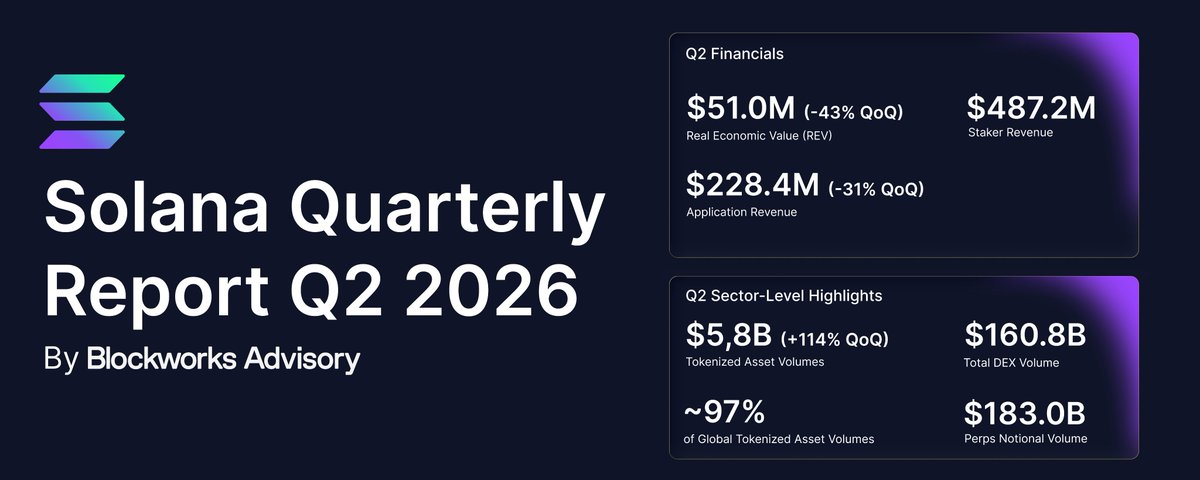
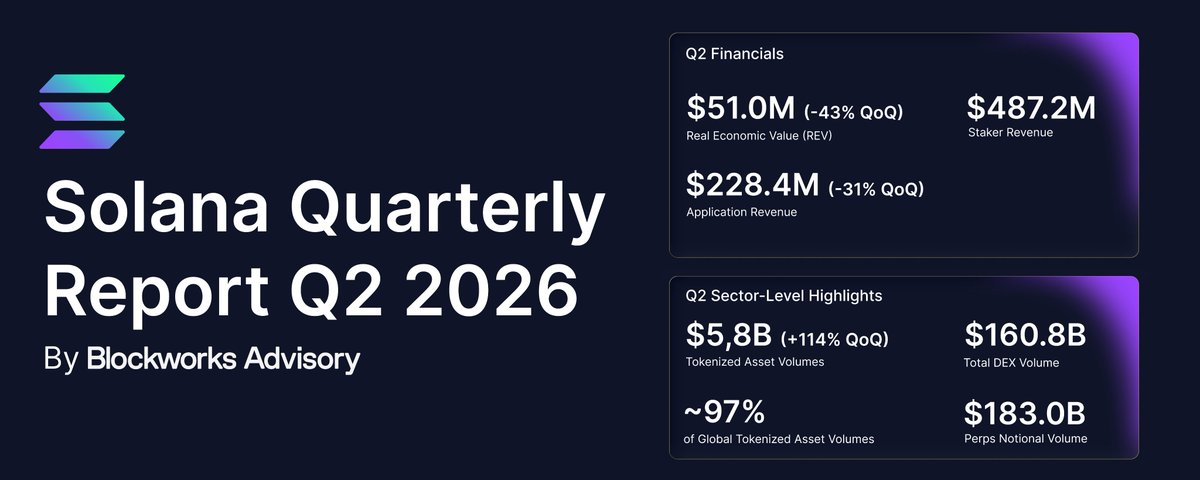
Tokenized asset trading volume hit a new high of $5.8 billion, up 114% quarter-over-quarter, driven primarily by tokenized equities—$4.8 billion, more than four times the Q1 record. June alone contributed $3.3 billion in equity trading volume, and Solana currently processes approximately 97% of tokenized equity transactions across chains.
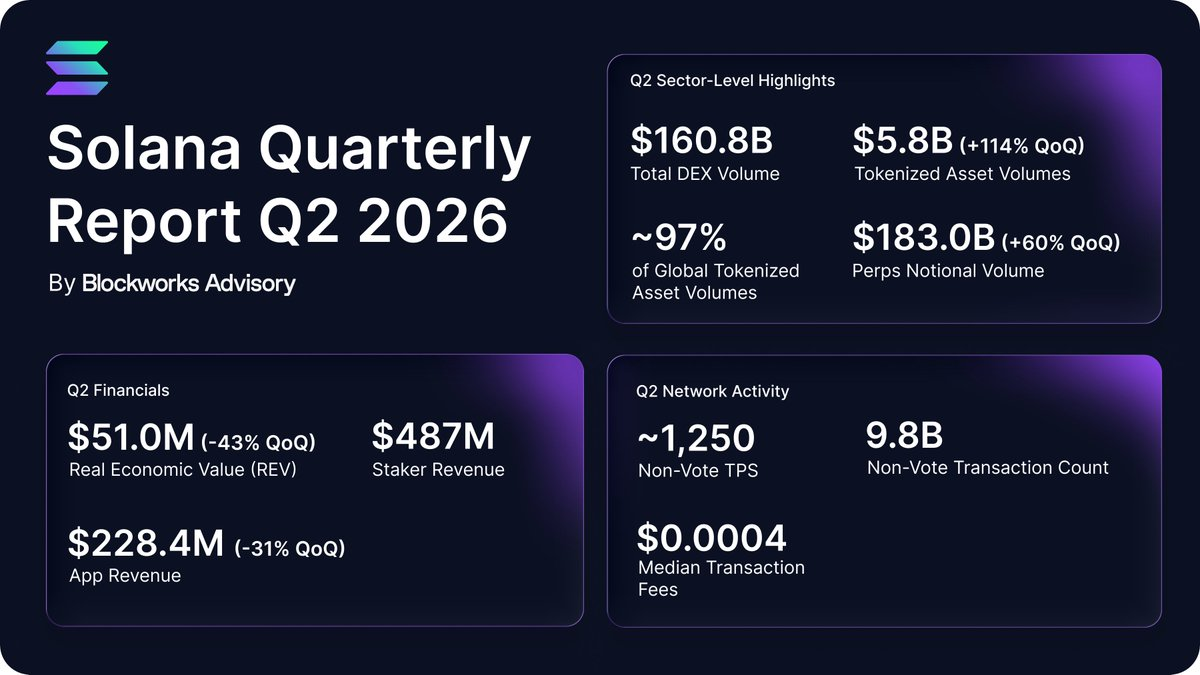
This growth occurred against a backdrop of overall industry slowdown and continuous reset of meme coin revenue: REV fell 43% quarter-over-quarter to $51 million, and application revenue declined 31% to $228.4 million. Even so, Q2 indicates that Solana's demand base has moved beyond pure speculative activity.
Despite BTC and ETH spot ETPs recording net outflows of $3.7 billion and $500 million respectively, SOL spot ETPs still recorded net inflows of $120 million, exceeding Q1's $113 million. Staked SOL reached a new high of 427 million tokens at the end of the quarter (approximately two-thirds of supply). Stablecoin supply remained basically flat at $16.3 billion, and while DEX volume fell 44% quarter-over-quarter to $160.8 billion, it rebounded 26% in June, suggesting the activity trough may have passed mid-quarter.
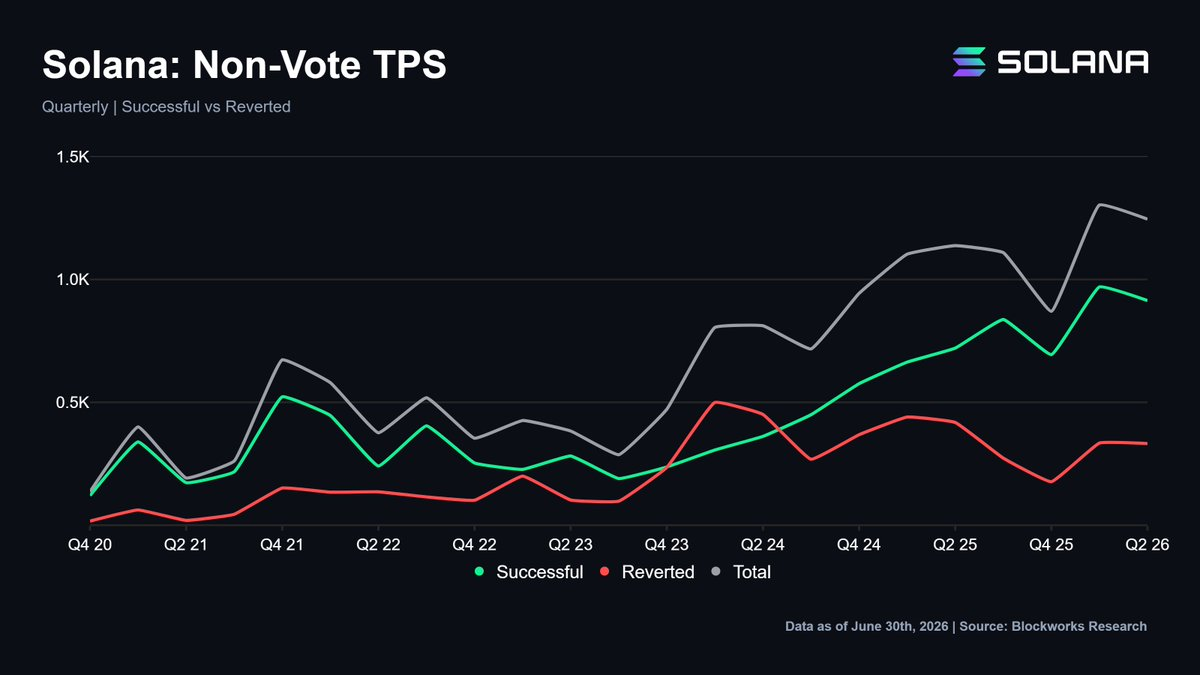
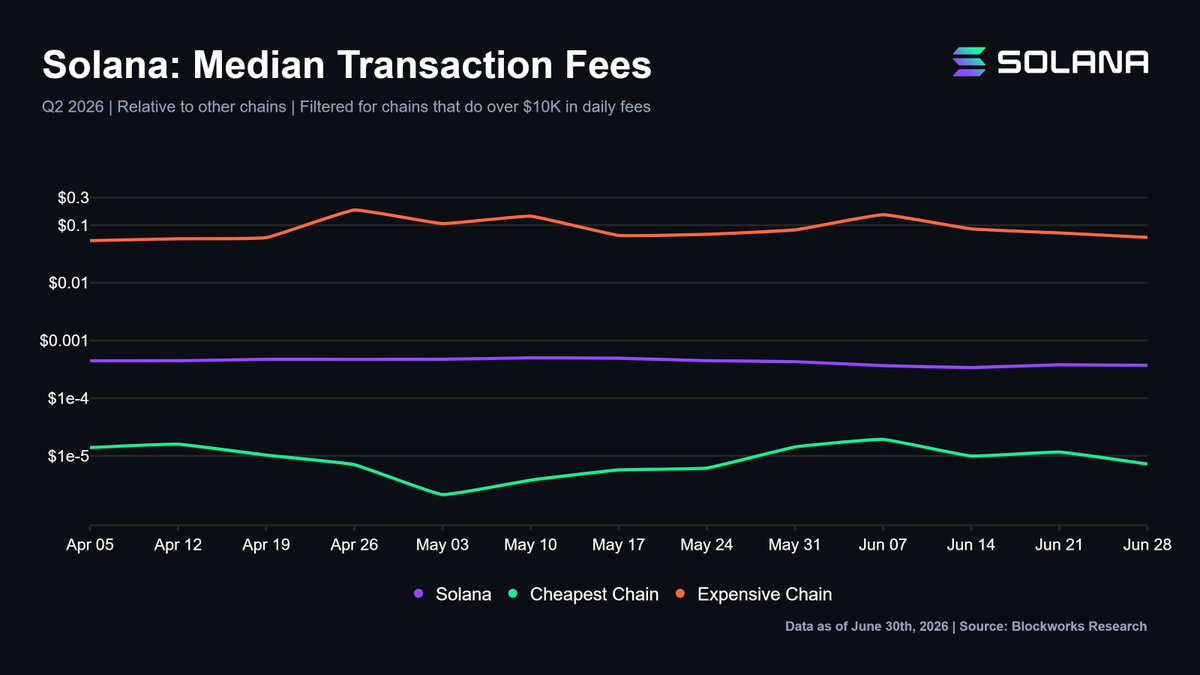
At the network level, Solana processed 9.8 billion non-vote transactions—the second highest quarterly volume after the Q1 record—with median fees stable at $0.0004. The story ahead now focuses on Alpenglow—Solana's largest protocol upgrade to date—bringing 150 ms confirmation times, coupled with progressive slot time reduction, larger blocks, and a standard mechanism for sharing block revenue with stakers.
Financial Metrics
Network Real Economic Value (REV)
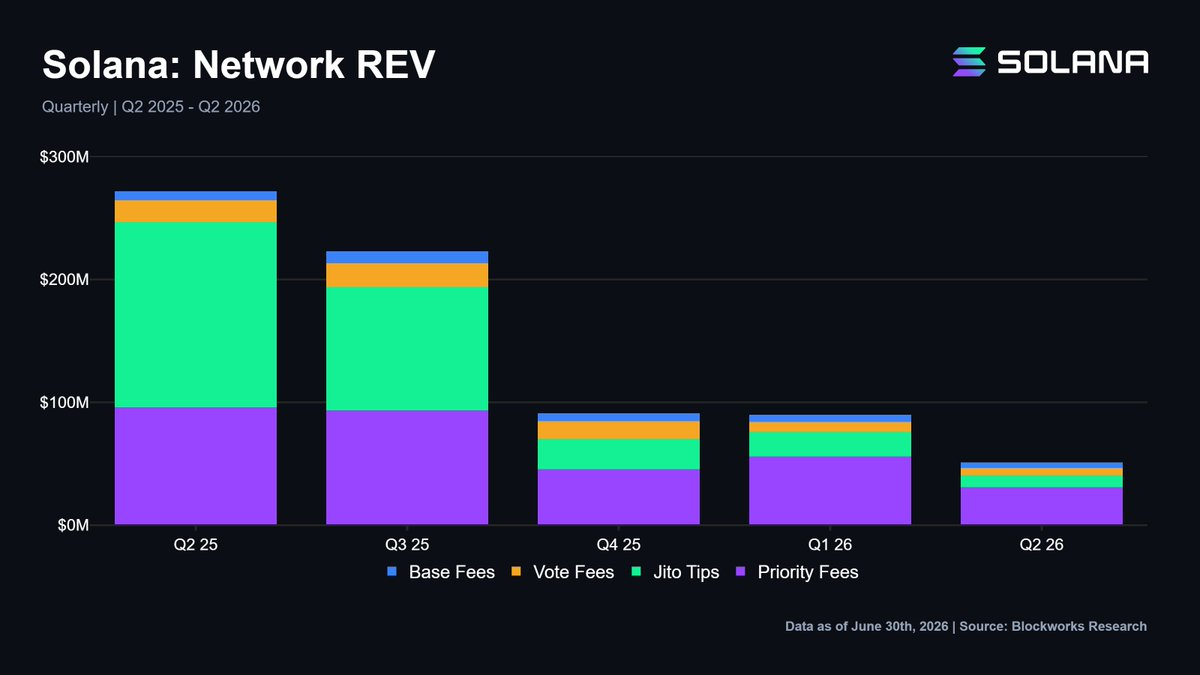
Solana's Real Economic Value (REV) totaled $51 million in Q2 2026, down 43% quarter-over-quarter. After stabilizing around $90 million for two consecutive quarters, REV dipped further as meme coin activity driving 2025 peaks continued to fade: monthly REV fell from $18.6 million in April to $18.1 million in May and $14.3 million in June. The decline was broadly distributed across components: priority fees fell 45% quarter-over-quarter to $30.8 million, Jito tips fell 50% to $9.9 million, and voting and base fees combined contributed $10.3 million.
Q2 introduced SIMD-553, a proposal from Solana lab company Temporal, which will substantially strengthen the SOL value accrual framework. The proposal will reintroduce a meaningful transaction fee burn mechanism—replacing a portion of Solana's existing fixed fees with a new resource-based fee that will be permanently removed from supply. Unlike the current burn which has become negligible relative to issuance, the new mechanism will scale with network usage and capacity.
At current activity levels, SIMD-553 is estimated to burn 7,500 to 9,000 SOL daily (approximately $600,000 to $720,000 at $80/SOL), about ten times the current rate, equivalent to approximately 12% to 15% of daily issuance.
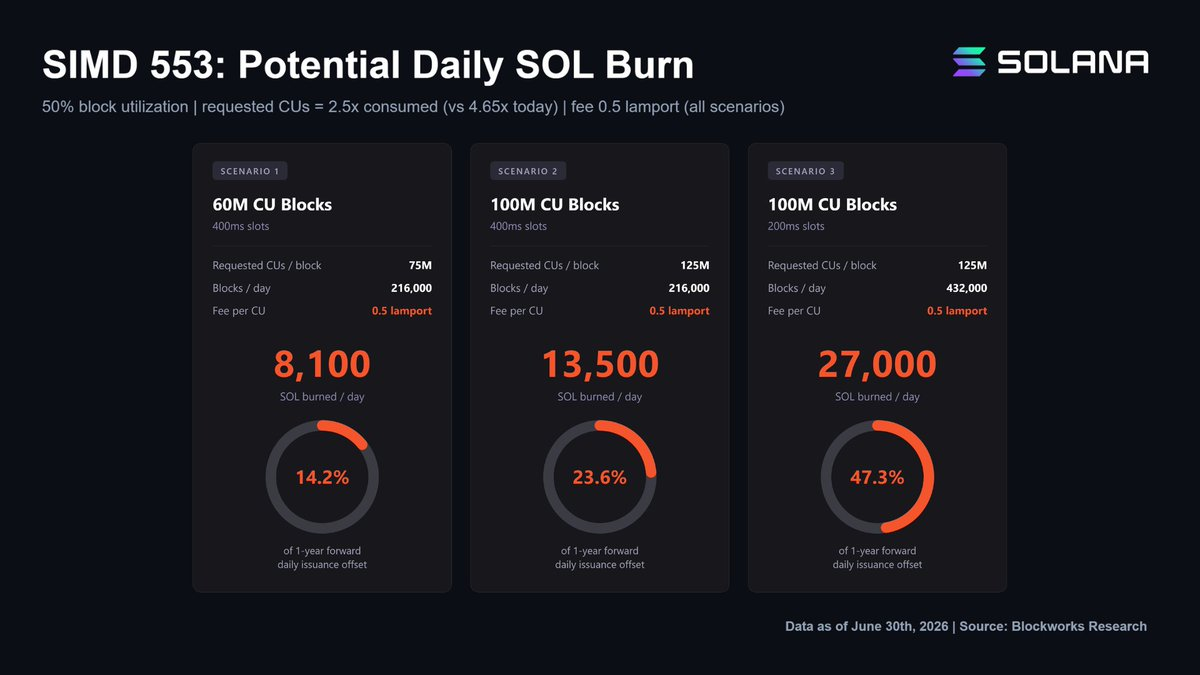
For SOL holders, the implication is straightforward: as network usage and block space demand grow, larger amounts of SOL will be removed from circulation. This will provide a second value accrual channel for REV—besides revenue allocated to validators and stakers—ensuring increased network activity benefits all token holders, not just block producers.
The distribution of REV among network stakeholders remained consistent with recent quarters: approximately 72% to validators, 26% to token holders, and about 2% captured by Jito.
By chain revenue, Solana ranked fourth with a 12% share ($51 million), behind Hyperliquid (33%, $141.4 million), Tron (21%, $89.8 million), and Ethereum (15%, $63.3 million). Solana's 12% network revenue share fell 33% quarter-over-quarter from Q1's 18%.
Staker Returns
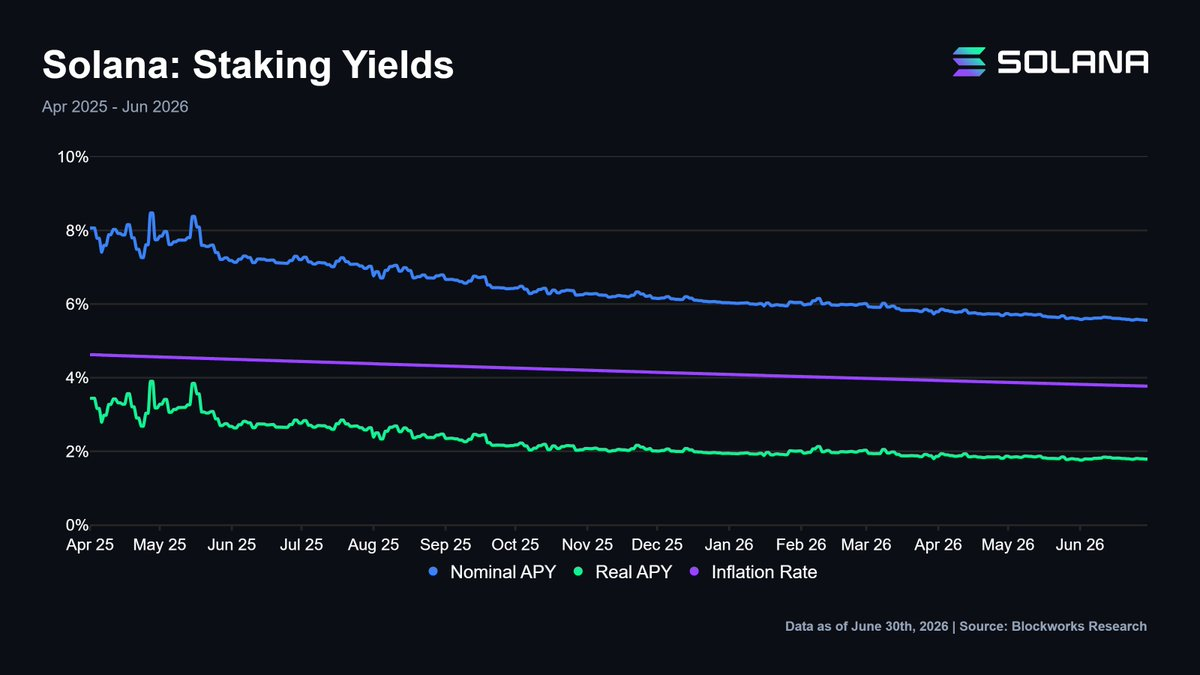
SOL's nominal staking yield was approximately 5.5% at the end of Q2, down from 5.8% at the end of Q1, as the fixed issuance schedule continues to decay: inflation is currently near 3.8%, with the 1.5% terminal rate reached in approximately six years under the current schedule. Real staking yield (nominal yield minus inflation) was approximately 1.7% at the end of the quarter.
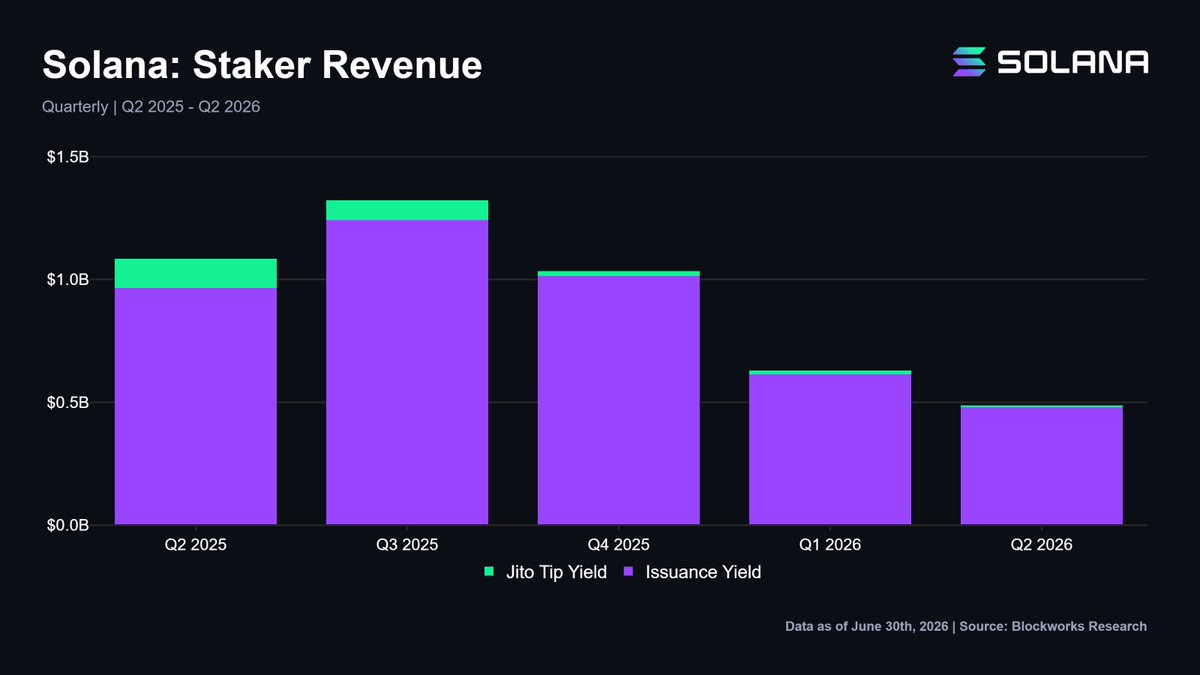
Solana stakers earned $487 million in Q2 2026, down 23% from Q1's $630 million. Issuance accounted for over 98% of staker income, with Jito tip yield contributing $8.2 million.
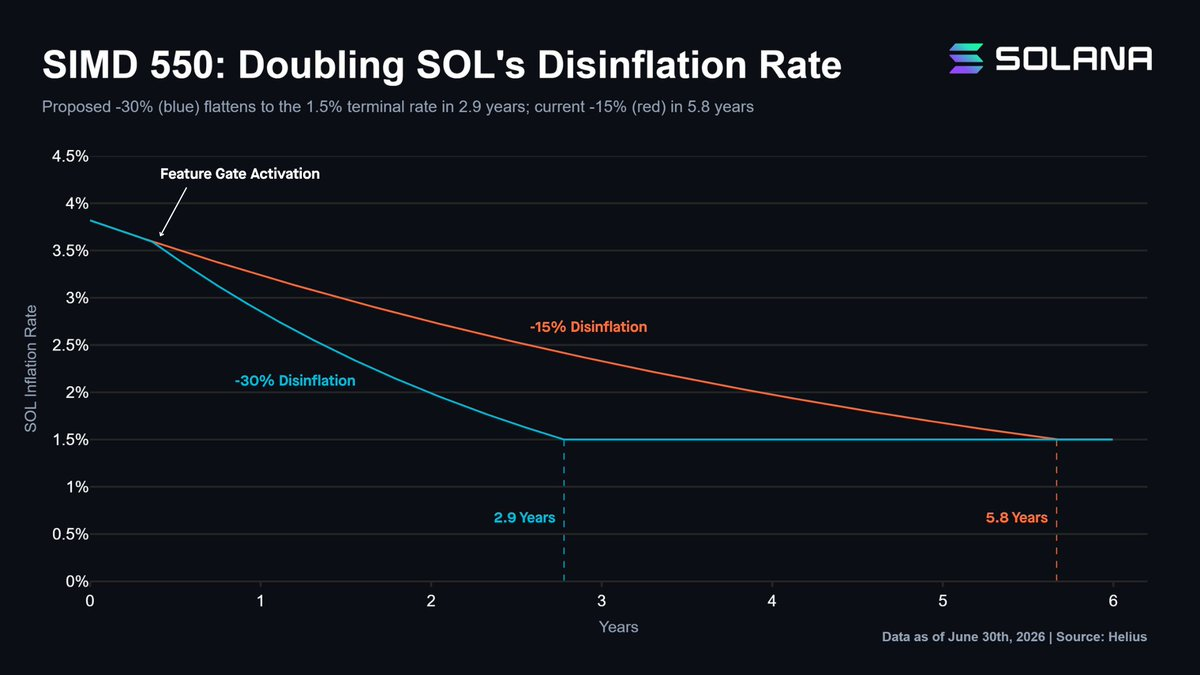
During Q2, issuance became the center of governance discussion. Solana infrastructure provider Helius proposed SIMD-550 within the quarter, targeting the supply side of the staker economy. This is an updated version of the company's November 2025 proposal; SIMD-550 would double Solana's disinflation rate from 15% to 30%/year, doubling the decay speed, while keeping the 1.5% terminal rate unchanged. This would shorten the time to reach terminal inflation from 5.8 years (first half of 2032) to 2.9 years (first half of 2029), and cut issuance by approximately 18.9 million SOL during the period. The cost to stakers is a faster decline in nominal yields: assuming a 68% staking rate, nominal staking yields would fall to 4.34%, 3.00%, and 2.25% in the first three years respectively. For token holders, the same math reduces dilution, narrowing the gap between nominal and real yields.
SIMD-550 and SIMD-553 address the same problem from two sides—the former cuts supply growth, the latter increases usage-linked burns.
The staker economy story is also closely linked to SIMD-123, a proposal that will introduce a standardized in-protocol mechanism for validators to share priority fees with stakers. Eighteen months after SIMD-96 redirected 100% of priority fees to block producers, this distribution mechanism remains inactive on mainnet, but is now expected to launch with Alpenglow. Priority fees account for 60% of REV, and in-protocol fee sharing is the largest pending improvement for staker value accrual.
Application Revenue
Application revenue is a metric for measuring the success of enterprises within the ecosystem. While REV is an important tracking metric, the true measure of ecosystem product-market fit is revenue generated by user-facing applications.
Solana applications generated $228.4 million in revenue in Q2 2026, down 31% from Q1's $329.3 million, the lowest quarterly total since Q1 2024. The decline tracked the overall cooling of retail trading activity, rather than share loss to other chains.
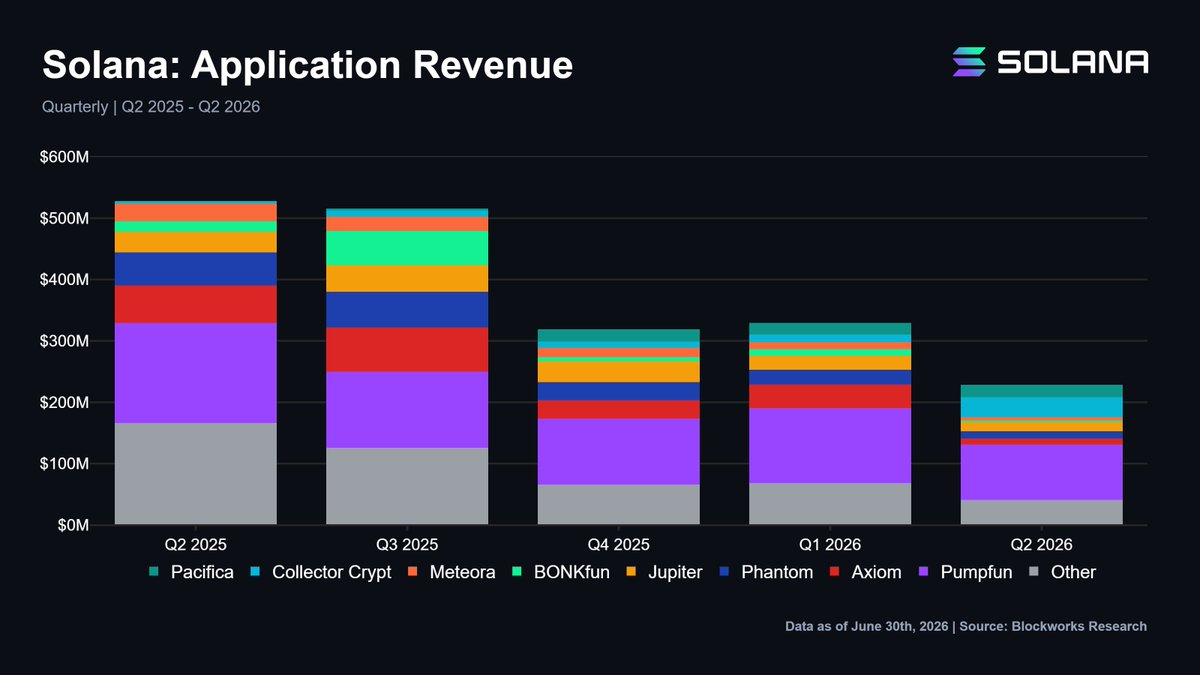
Leading applications by revenue in Q2 were: Pumpfun ($90.1 million, 39%), Collector Crypt ($32.2 million, 14%), Pacifica ($20 million, 9%), Jupiter ($15.3 million, 7%), and Phantom ($11.9 million, 5%).
Institutional Capital Flows
Global Systemically Important Banks (G-SIBs)
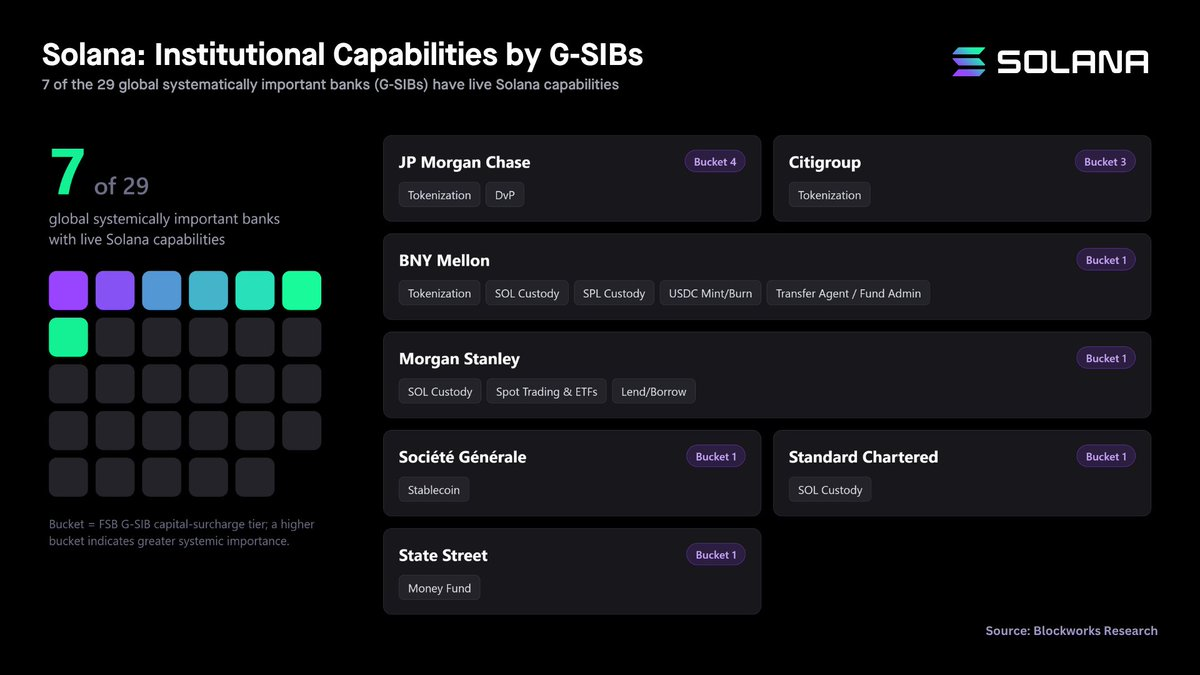
Q2 marked the beginning of Solana's institutional adoption touching the traditional banking system. 7 of the 29 Global Systemically Important Banks (G-SIBs) have gone live with Solana capabilities, led by JPMorgan Chase and Citigroup—these two are the most systemically important names by capital surcharge tier.
Deployments covered the full service stack rather than a single use case: JPMorgan's tokenization and delivery-versus-payment settlement, BNY Mellon's SOL and SPL custody and USDC minting/burning and fund management, Morgan Stanley's custody, spot trading, ETFs and lending, Société Générale's stablecoin issuance, State Street's money market funds. The breadth of these deployments in custody, issuance, settlement, and distribution is one of the clearest external validations of Solana as institutional settlement infrastructure.
Exchange Traded Products (ETP)
Institutional demand decoupled from price for the third consecutive quarter. SOL spot ETPs recorded net inflows of $120 million in Q2 2026, exceeding Q1's $113 million. During the same period, BTC spot ETPs had net outflows of $3.7 billion, and ETH ETPs had net outflows of $500 million. Looking at all SOL ETPs, the quarterly inflow figure was $148 million. Although distribution within the quarter was uneven, the entire quarter continued the pattern defining SOL institutional buying since US spot ETFs began trading in October 2025—maintaining net positive inflows during declines.
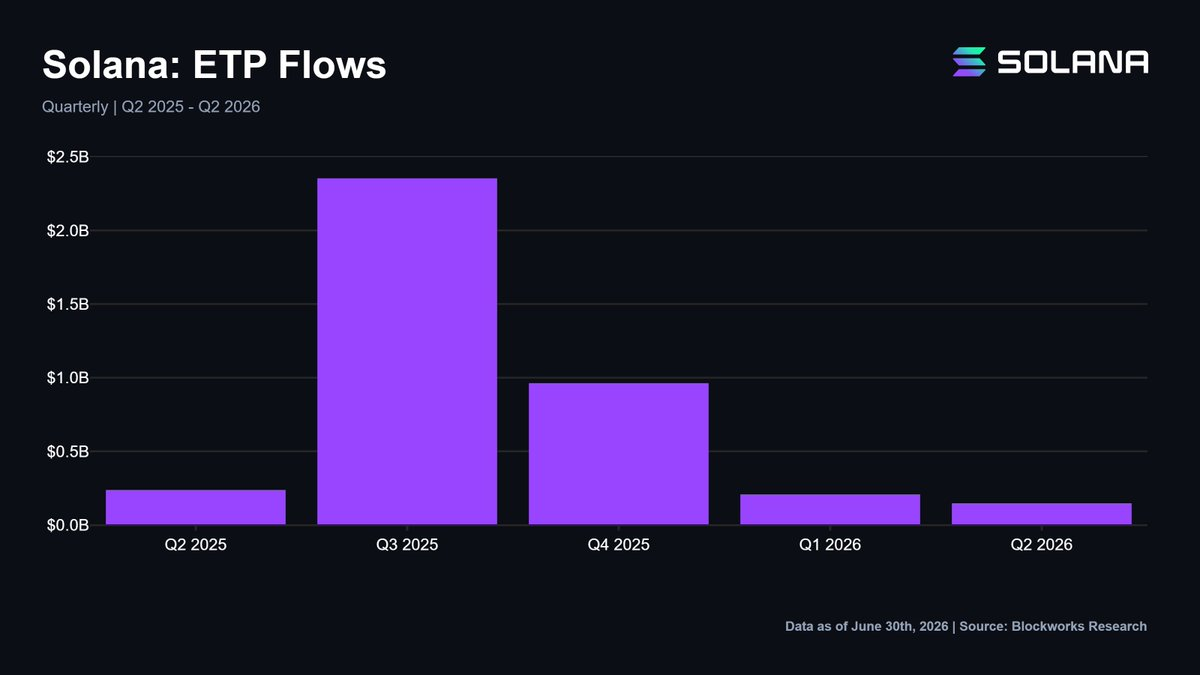
By region, the US remained the engine—SOL ETP net inflows of $185 million, Europe net outflows of $38 million, Asia Pacific flat. Spot ETP AUM was $1.9 billion at the end of the quarter, down 5% quarter-over-quarter, as price depreciation exceeded inflows.
Digital Asset Treasury Companies (DATCO)
SOL DATCO holdings remained basically unchanged for the ninth consecutive month, at 16.8 million SOL at the end of Q2, down 0.9% quarter-over-quarter. Approximately 150,000 SOL were reduced between April and May, as limited secondary liquidity and continued mNAV discounts continued to constrain this instrument category. DATCOs remain a stable passive holder base, rather than a source of incremental demand.
Sector Analysis
Solana's Q2 confirmed an argument: the network's trading infrastructure transcends any single asset class. As meme coin activity cooled, the same infrastructure (Prop AMM, aggregators, low fees, sub-second confirmation) absorbed tokenized equities at record scale. The "Exchange of Everything" is no longer a forward-looking statement—it was the network's primary growth engine in Q2.
Spot Trading
Solana DEX spot trading volume totaled $160.8 billion in Q2 2026, down 44% from Q1's $288.5 billion. Despite this, Solana processed the most spot trading volume in Q2, accounting for 32%, leading Ethereum (25%), Base (16%), and BNB Chain (12%). This is the eighth consecutive quarter Solana accounted for over 30% of spot DEX volume.
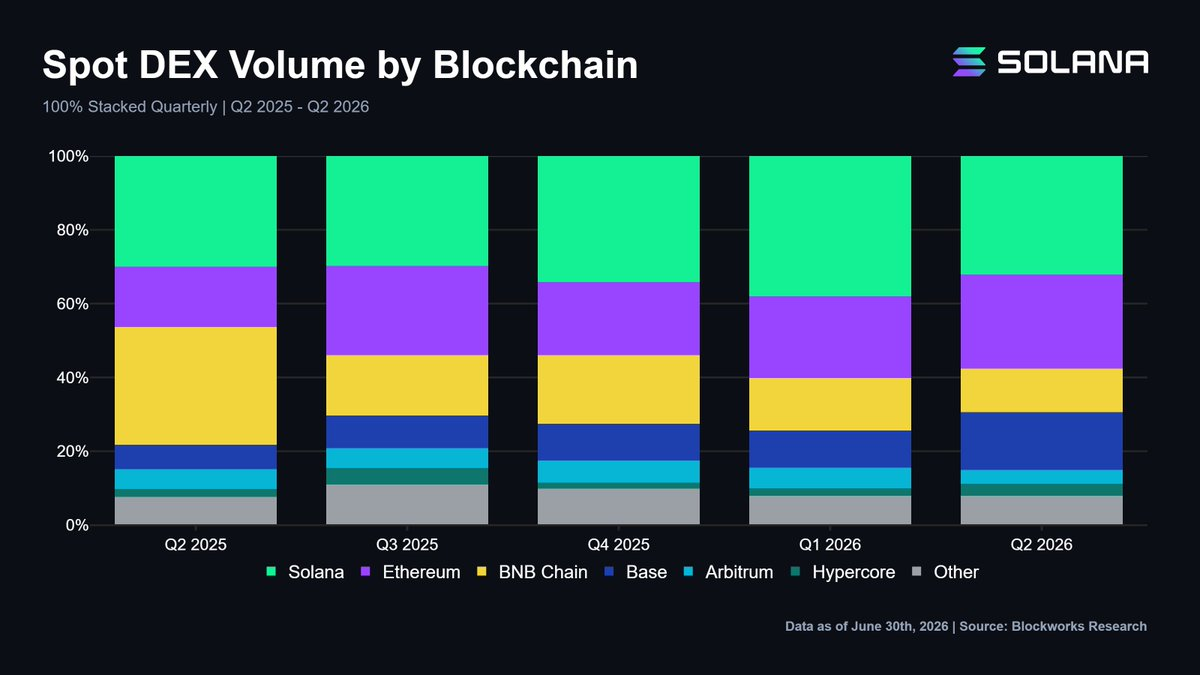
Monthly trends tell a more constructive story than quarterly totals: volume fell from $52.3 billion in April to $48 billion in May, then rebounded 26% in June to $60.5 billion—the strongest month of the quarter—as tokenized asset activity accelerated sharply.
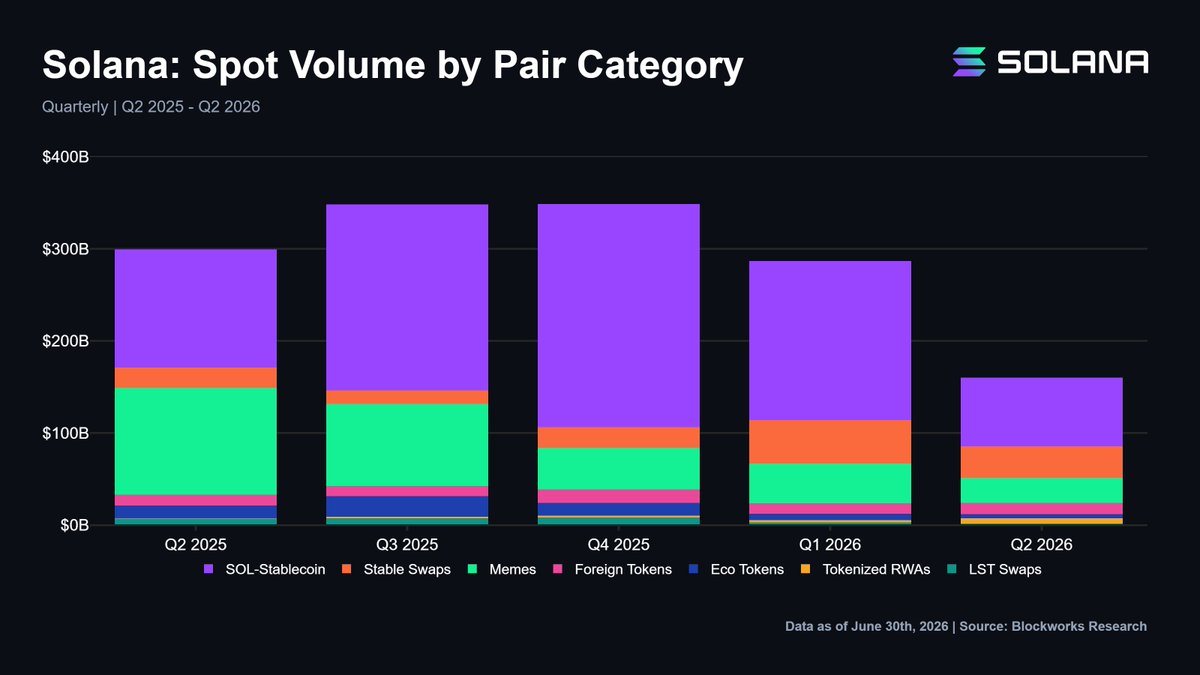
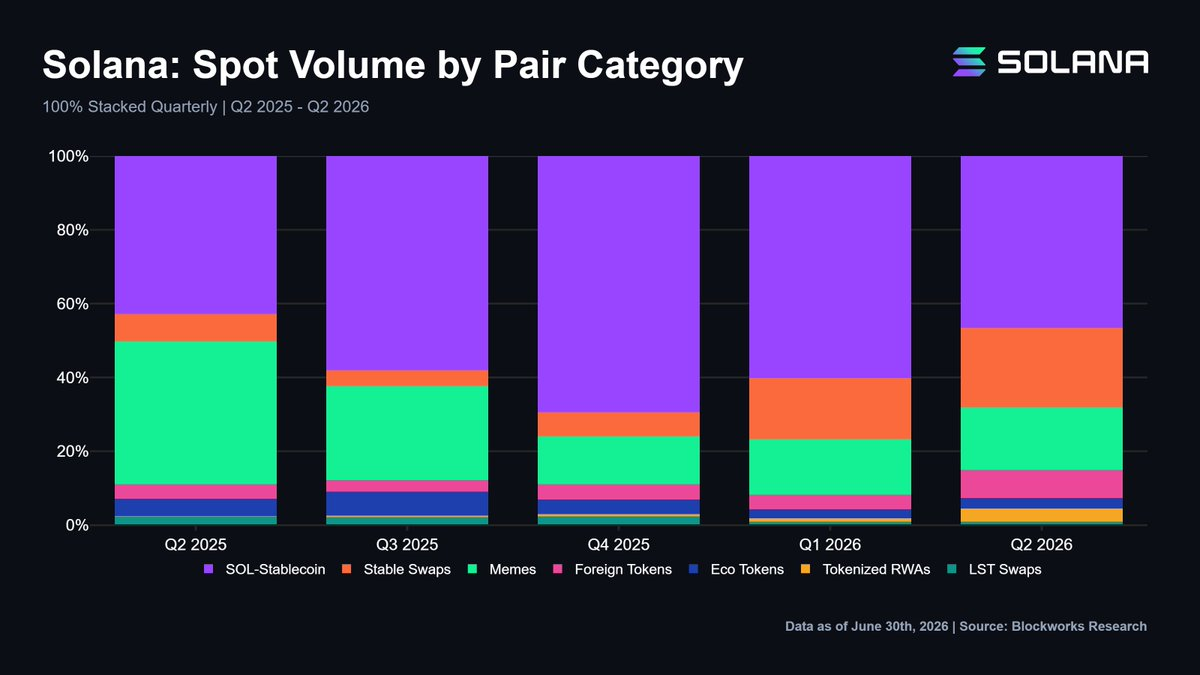
SOL-stablecoin pairs remained anchored at approximately 46%, while the fastest growth came from the newest category: stablecoin swaps climbed from approximately 17% in Q1 to 21% in Q2, external token share nearly doubled to 8%, and tokenized asset share quadrupled to nearly 4%. Meme coins remained at approximately 17%—a stable contributor in a market trading increasingly diverse assets.
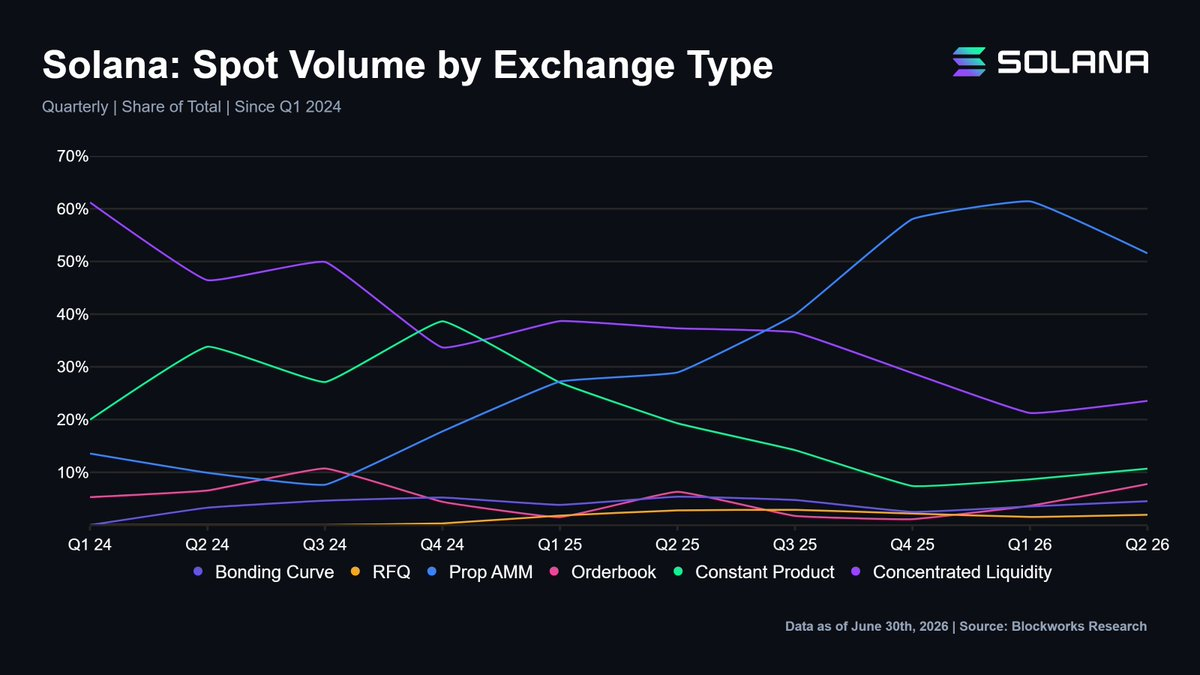
Venue structure also continues to evolve: BisonFi led Prop AMM with approximately 17% of Q2 volume, Pumpfun's integrated AMM continued to gain share, accounting for 13% of volume in Q2.
DEX on Solana remains a Prop AMM story. Prop AMMs are spot exchanges that actively manage liquidity via oracle updates. Each Prop AMM is operated by a single market maker (no external LPs), using highly optimized trading to update oracle prices, allowing quotes to be adjusted multiple times per second. Nearly twenty Prop AMMs are running on Solana, with their spot DEX volume share at 53% in Q2 2026, up from 30% in Q2 2025.
Tokenized Assets
Tokenized assets were the highlight of Q2 2026, and the highlight for Solana year-to-date. Tokenized asset DEX volume reached $5.8 billion, up 114% quarter-over-quarter, hitting new highs for the sixth consecutive quarter.
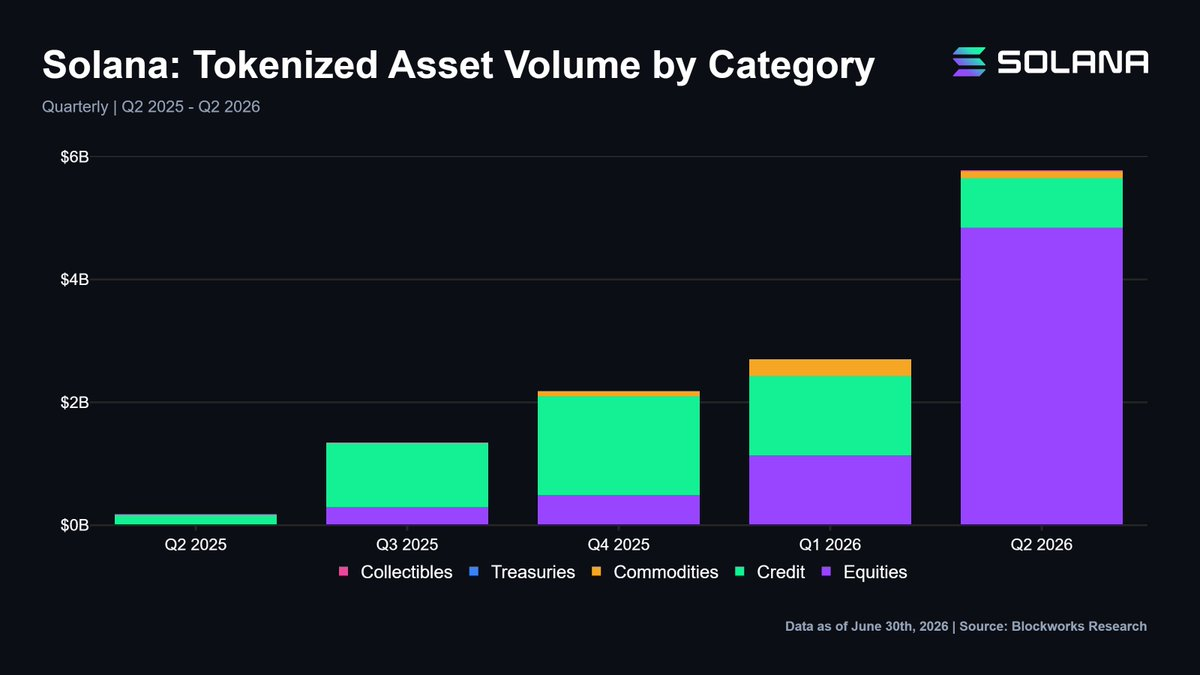
The vast majority of activity came from tokenized equities, accounting for 84% of volume. Solana currently processes approximately 97% of tokenized equity trading volume across chains, making this vertical the clearest expression of enduring, non-speculative demand on the network.
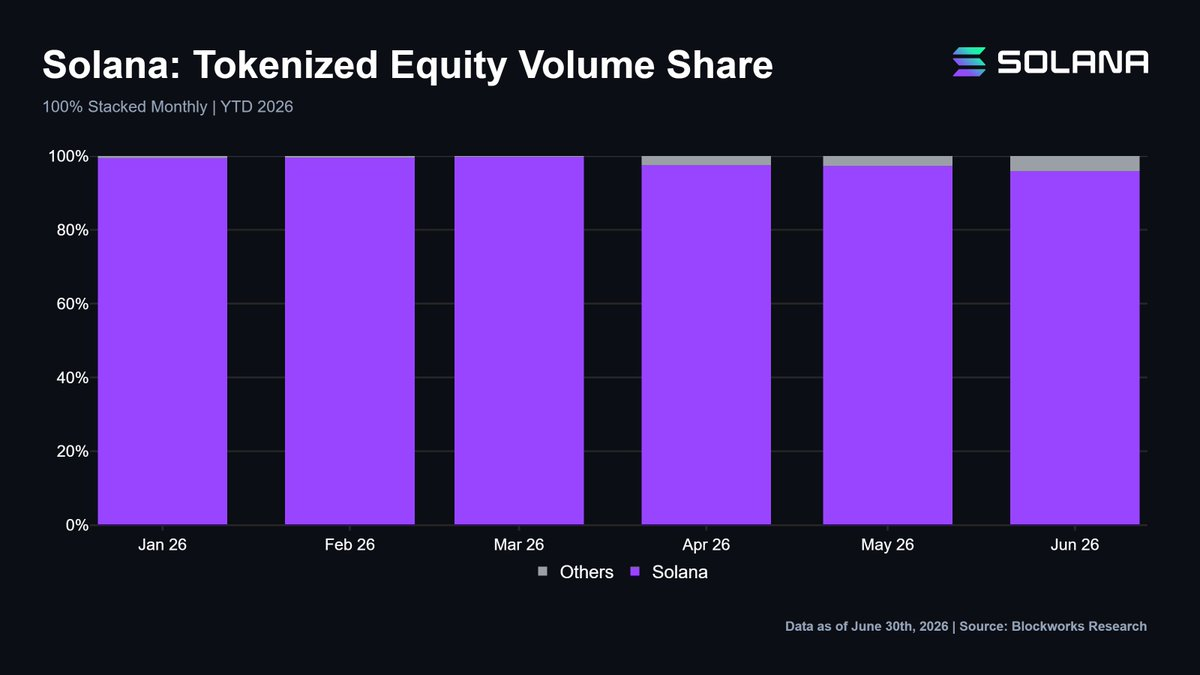
Tokenized equities recorded $4.8 billion in volume in Q2, approximately four times Q1's $1.1 billion. This growth was even more significant within the quarter: April $670 million, May $871 million, and June alone contributed $3.3 billion.
June's data marked a new high for the category, catalyzed by the SpaceX listing on June 12—the largest IPO in history. Calculated by the broader tokenized asset sector (including instruments beyond listed equities), monthly volume reached approximately $3.6 billion, up 222% quarter-over-quarter. Tokenized SPCX issued via Sunrise and distributed via Backpack accounted for approximately $770 million. Issuers have since expanded tokenized equity coverage to more targets, including Micron, SanDisk, and Roundhill Memory ETF (DRAM). Together with SPCX, these four instruments contributed over $1 billion in volume in June.
Prop AMMs began quoting tokenized assets during the quarter and now account for approximately 50% of tokenized asset trading volume. Since these tokenized equities can be redeemed one-to-one for underlying stocks, integrated venues may encounter lower operational friction when providing liquidity, which may support tighter arbitrage and greater quoting confidence.
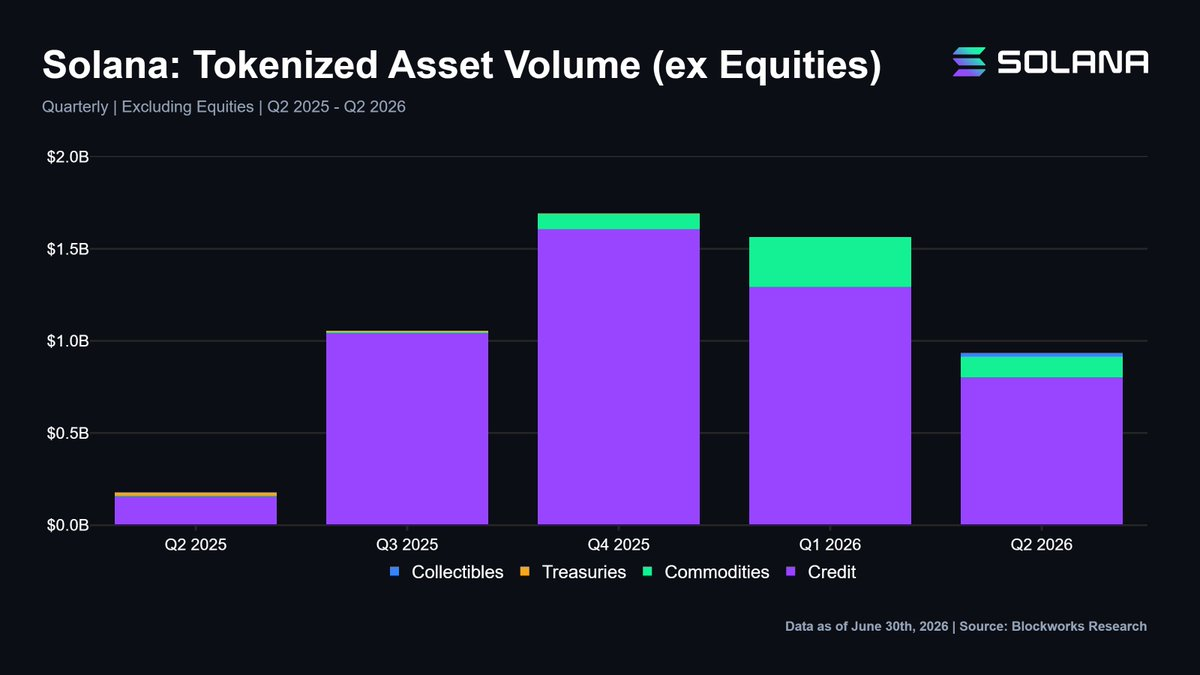
Besides equities, tokenized private credit contributed $803 million (14%), commodities $111 million, and collectibles—a new category led by the Collector Crypt trading card market—$20 million.
External L1 Tokens
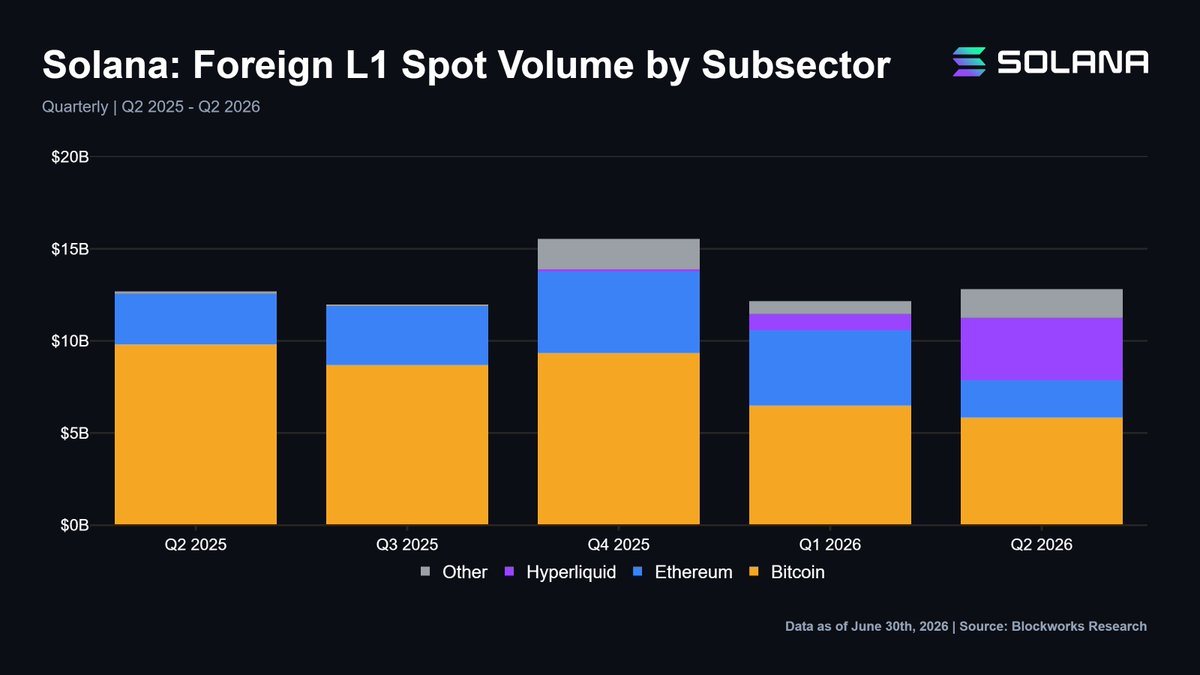
External L1 tokens as a category continued to expand, reaching a historical high of 8% of DEX volume in Q2, or $12.2 billion, with BTC and HYPE alone contributing over $9 billion. May also marked the first time HYPE volume exceeded ETH volume on Solana—a signal indicating that what determines network trading content is not legacy asset hierarchy, but listing speed.
Perpetual Contracts
Perpetual contracts remained Solana's most challenging vertical in Q2. Drift suffered an exploit on April 1—a social engineering attack on its multisig—affecting approximately half of the protocol's TVL—setting the tone for the quarter. The recovery response was substantial: Drift announced a relaunch backed by approximately $150 million in collaboration with Tether etc., equipped with a recovery pool and token mechanism directing protocol revenue to compensation, with USDT becoming the new quote asset.
Perpetual contract platforms on Solana processed approximately $183 billion in notional volume in Q2, up 60% quarter-over-quarter. GMTrade accounted for 50% of Q2 perpetual contract volume, Pacifica 39%, and Jupiter fell to 10%.
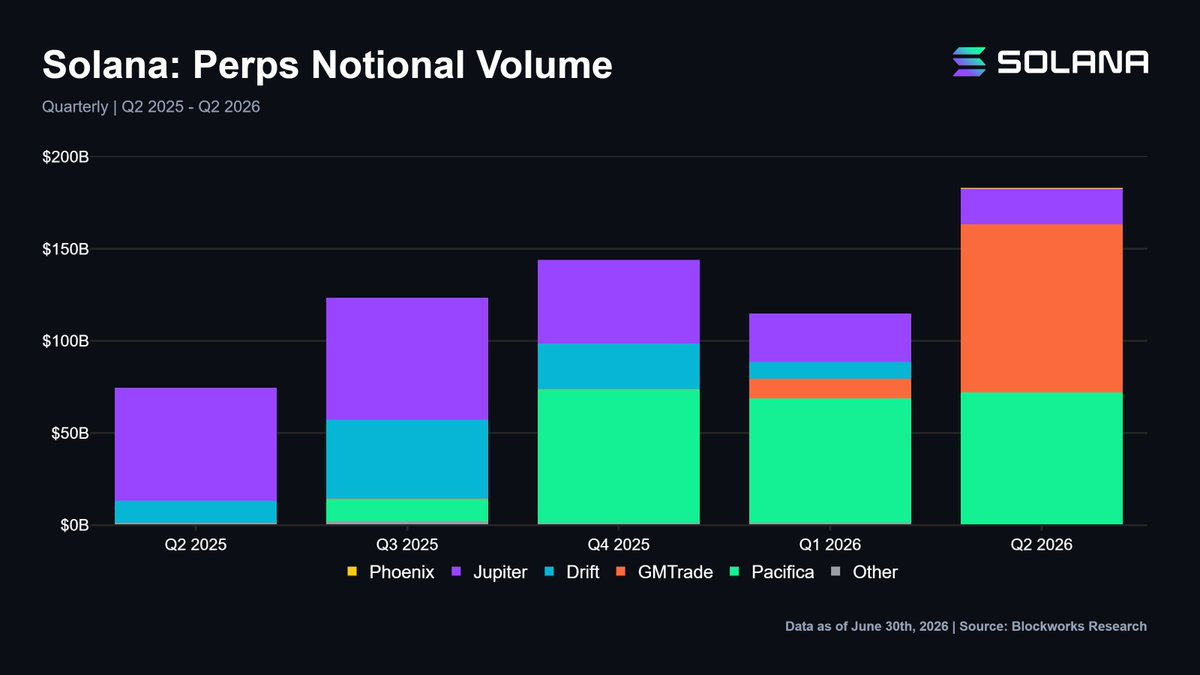
Phoenix (built by Ellipsis Labs) remains the strongest attempt on Solana to close the perpetual contract gap in fully on-chain form. Its design addresses toxic flow problems at the compute layer, allowing market makers to quote cheaper than taker orders. Although still early, Phoenix processed $777 million in notional volume in Q2.
Forward-looking progress comes from Jito: JTX announced on May 5 is a trading frontend for spot and eventual perpetual contracts based on Phoenix, with 80% of JTX fees directed to JTO value accrual. Between Phoenix's compute layer solution for toxic flow and JitoBAM's growing staking share, infrastructure investment targeting the perpetual contract gap is accumulating, but closing the gap remains an execution story for 2026 rather than a delivered result.
Lending
As of the end of Q2, total deposits and outstanding loans for Solana's two largest money markets, Kamino and Jup Lend, were $4.1 billion and $1.6 billion respectively. Deposits fell 8.3% quarter-over-quarter, and outstanding loans fell 7.9%, reflecting continued weakness in on-chain leverage demand in the crypto market.
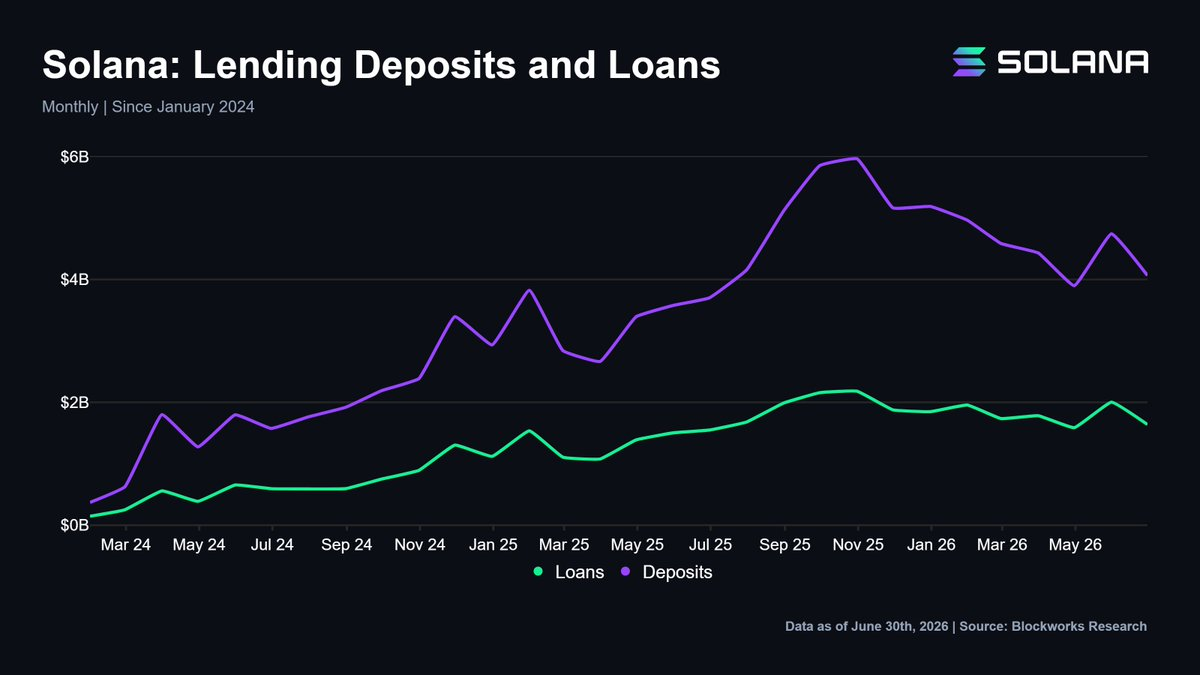
Although RWA lending became a key growth area in Q1 2026 (led by Kamino's Figure PRIME HELOC lending and OnRe reinsurance market), Q2 experienced a sharp pullback. RWA lending deposits on Solana fell from $1.23 billion in Q1 to $640 million in Q2, a 48% quarter-over-quarter pullback.
The structural highlight in lending was in the stablecoin adjacent sector: Jupiter Lend integrated Ethena's USDe in mid-May,配合 with the launch of a vault managed by Bitwise, pushing USDe supply on Solana from nearly zero to over $500 million within a month. Kamino launched its own Ethena market, which has grown to over $500 million in deposits and is currently the platform's second largest market. In a quarter of declining lending balances, yield-bearing stablecoin markets were the clearest source of new capital—brought onto the network rather than recycled from existing crypto collateral.
Consumer Side
Token Launch Platforms
Launch platform volume totaled $25.8 billion in Q2 2026, down 33% from Q1's $38.3 billion, while token creation performed better—2.6 million tokens went live, down 7% quarter-over-quarter. Launch platforms on Solana generated $63.9 million in revenue in Q2, down from Q1's $95.2 million, with Pumpfun accounting for 97% of the total.
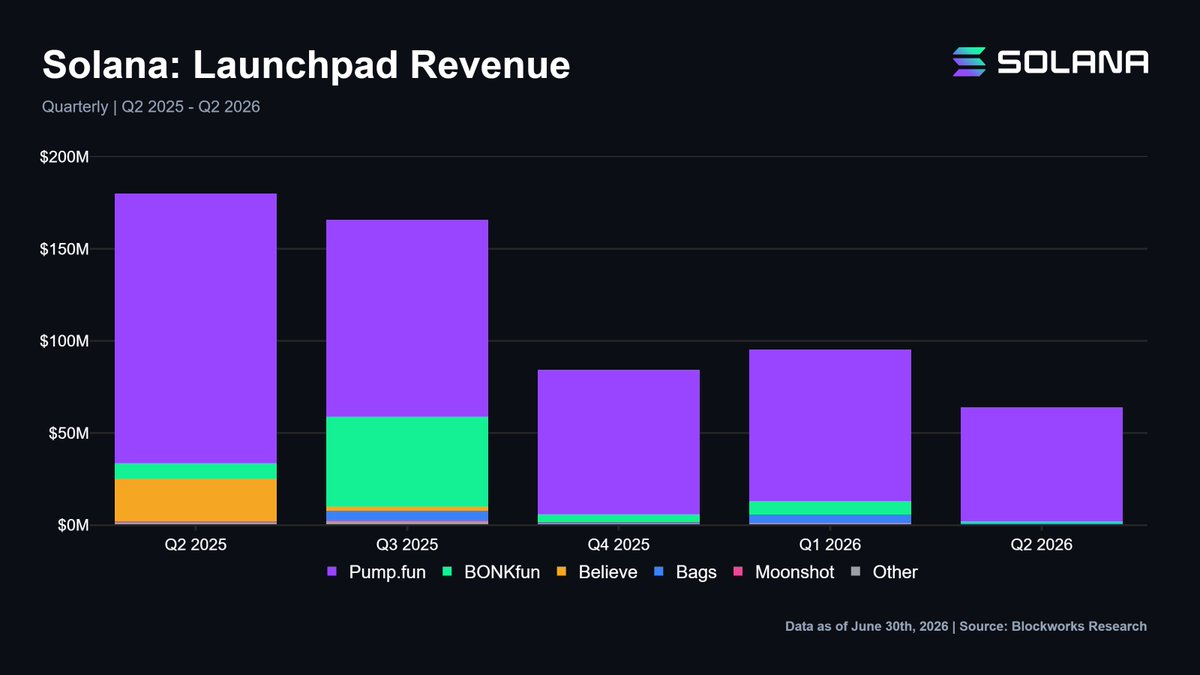
Although the category's product-market fit with retail users is unquestionable, its cyclicality and concentration are issues. Pumpfun's share of launch platform revenue and total application revenue reached a new high this quarter, precisely because the rest of the market contracted faster.
Stablecoins
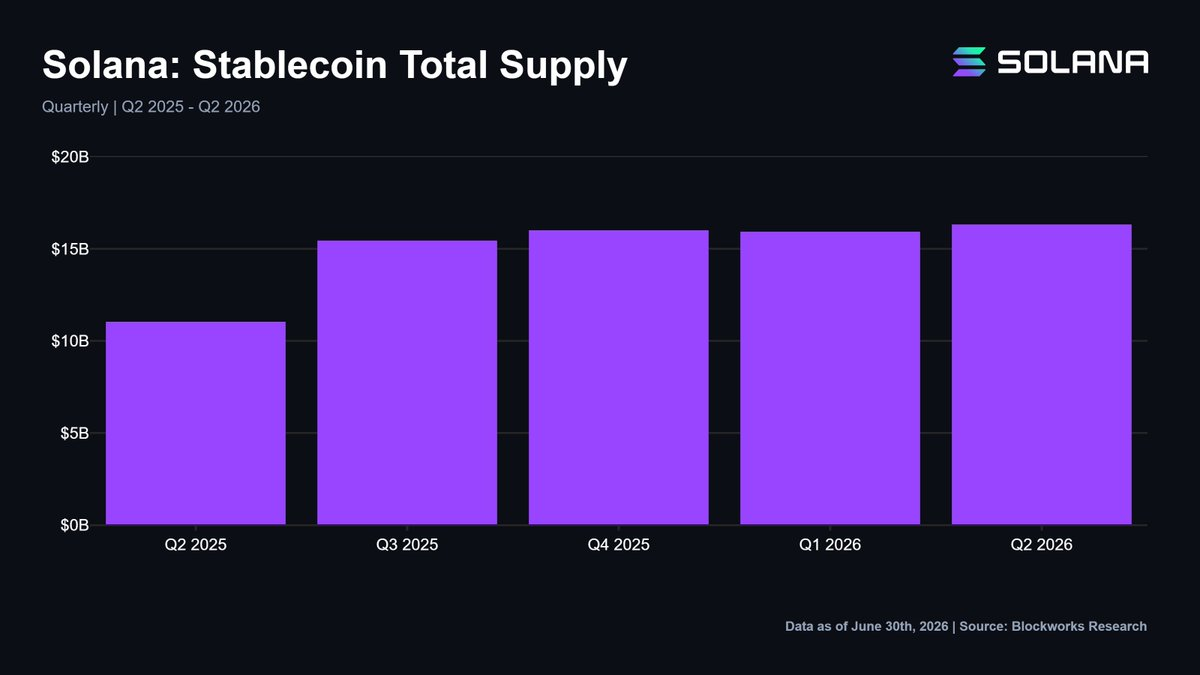
Total stablecoin supply on Solana was $16.3 billion at the end of Q2 2026, up 2% quarter-over-quarter. Supply remained basically flat across four consecutive quarters of declining activity. Stablecoin composition continued to diversify: USDC's share fell from 55% in Q1 to 47% in Q2, while USDT increased slightly from 22% to 24%.
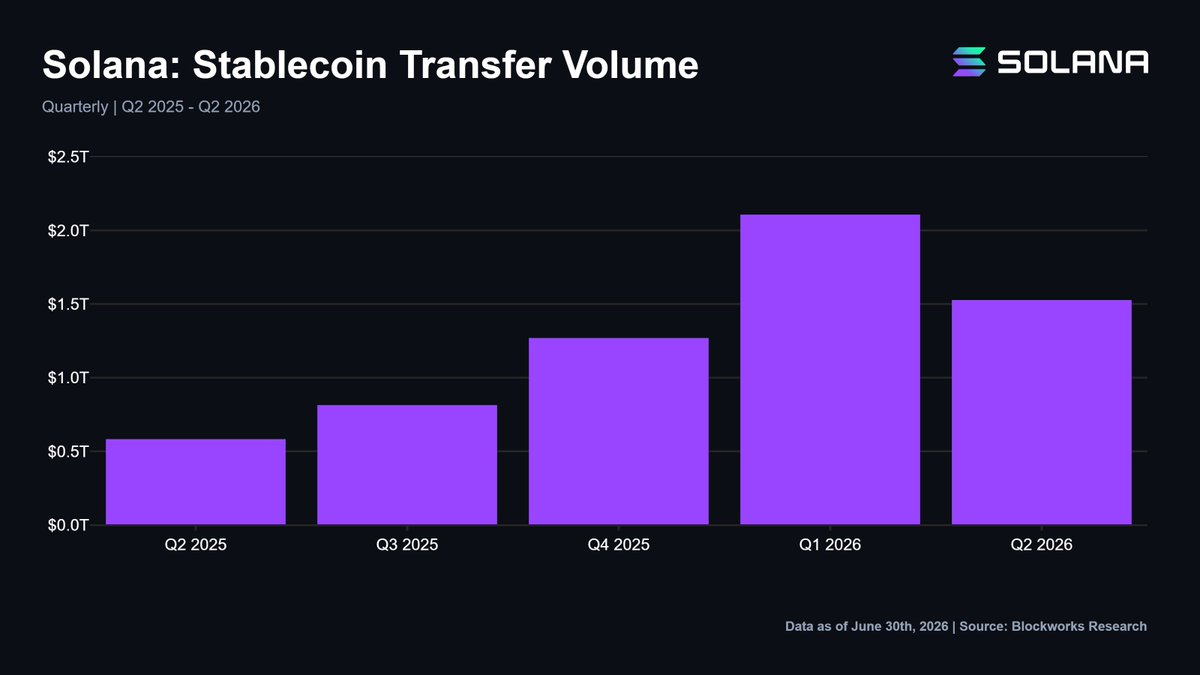
Stablecoin transfer volume on Solana reached $1.5 trillion in Q2 2026, down 29% quarter-over-quarter. Notably, this figure has been filtered to exclude flash loans and other forms of non-organic volume.
Payments
Q2 2026 was an explosive quarter for the Solana payments vertical, marked by a wave of traditional finance and enterprise adoption. Major banks and fintech companies flocked to Solana: SoFi announced its "Big Business Banking" product and issued stablecoins on-chain; SBI-backed B2C2, Singapore's Gulf Bank, Shinhan Card, and Korea's Toss Bank all migrated institutional stablecoins or settlement infrastructure to Solana.
Payment giants followed: Mastercard added Solana-based stablecoin settlement to its global card network and released a protocol for AI agents to conduct micropayments. Western Union issued the USDPT stablecoin on Solana, and Moneygram entered the validator space with its own validator. In cross-border and payroll, Deel launched stablecoin payroll payments, and Y Combinator completed the first fully stablecoin-funded round on Solana using USDC.
The biggest new frontier this quarter was Agentic Commerce: Google Cloud and Solana Foundation launched Pay.sh—a service providing on-demand pay stablecoin payment rails for AI agents; AWS launched a stablecoin system for AI traffic monetization; Meta began testing stablecoin payments for creators; Open Standard launched OUSD—a new stablecoin for the internet economy backed by BlackRock and Google, with Solana as part of its launch. Finally, the World Series of Poker added Solana-based tournament registration payments, highlighting the broad use cases stablecoin rails on Solana can cover.
Network Analysis
Volume and TPS
Solana processed 9.8 billion non-vote transactions in Q2 2026, down 3% from Q1's historical high of 10.1 billion, the second highest quarterly volume in history. Of the 9.8 billion transactions, 73% succeeded and 27% rolled back. Rolled back transactions are usually associated with automated strategies like arbitrage bots—they are often features not bugs, where transactions naturally rollback when slippage conditions deteriorate or exceed set limits.
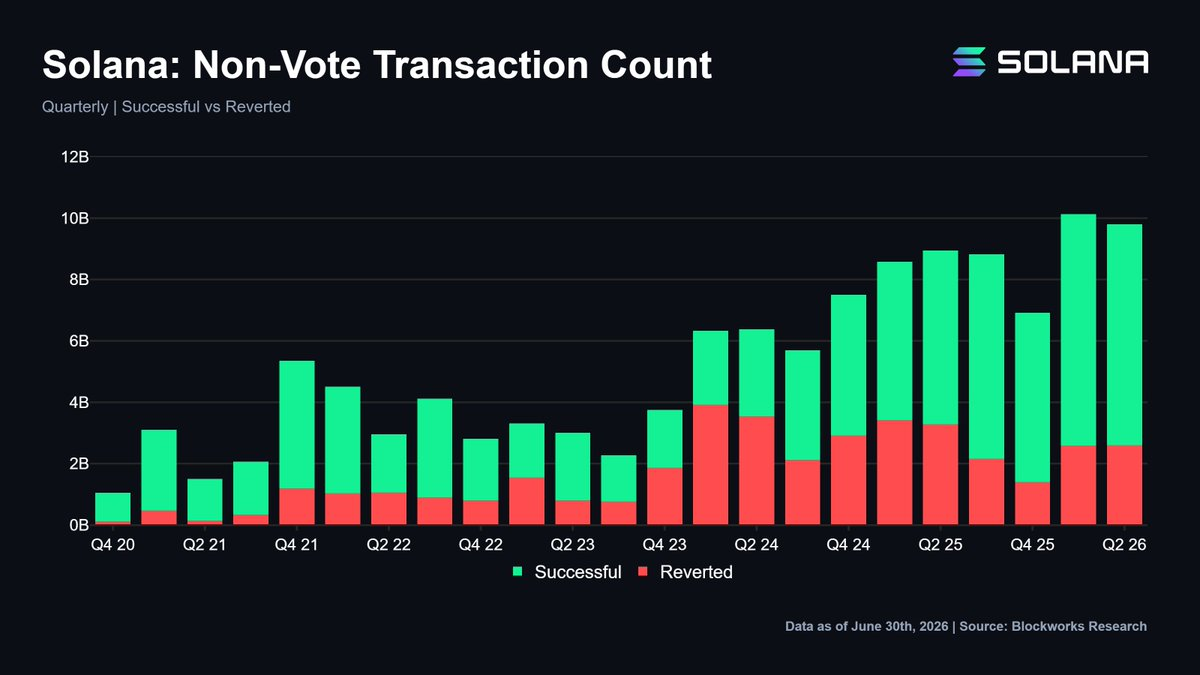
Non-vote TPS averaged approximately 1,250 in Q2. Daily active addresses averaged 2 million, down from Q1's 2.4 million, consistent with the retail cooling visible in application revenue. The network is processing nearly as many transactions from a smaller, more mature user base.
Median Transaction Fees
Median transaction fees averaged $0.0004 in Q2 2026, never exceeding $0.0005 on any day during the quarter, ensuring stability. This level of fee stability is not just a cost advantage; it is a property that makes high-frequency market making, Prop AMM quote updates, and consumer applications economically viable on shared infrastructure.
Validators and Decentralization
Solana's validator count declined this quarter as the Foundation phased out delegation subsidies, but node count is the least informative measure of decentralization. Network control is determined by who holds stake, who routes delegation, what software validators run, and where they operate. In these dimensions, Solana is comparable to Ethereum, and stronger in multiple aspects: significantly more independent entities need to coordinate to halt finality than Ethereum, approximately 80% of SOL is self-directed by holders rather than routed through intermediaries, stake is geographically well-distributed, and validators run truly diverse clients.
Resilience records support the same conclusion—Solana previously absorbed shocks without interruption after suddenly losing approximately one-fifth of stake. Alpenglow will increase the network's tolerance for offline stake to 40%, further hardening consensus against concentration risk.
Product and Ecosystem Updates
Q2's roadmap converged on one destination: Alpenglow. Core development during the quarter mainly revolved around pushing its prerequisites, while the economic layer moved to the center of governance debate.
Agave v4.0
Agave v4.0—the first major release since v3.1—was recommended for mainnet validators in May, with feature activation starting at the end of the month. This release carries prerequisites for multiple Alpenglow features and refactored block replay, cutting block replay thread usage per block by approximately 3x—from approximately 130 ms to approximately 50 ms.
P-Token (SIMD-266)
The P-Token standard went live in mid-May, replacing the SPL Token program with a compute-optimized implementation, providing approximately 95% CU consumption reduction for standard transfers, compressing the Token program's share of block global compute from approximately 25% to low single digits. The launch also demonstrated increasingly mature security processes: Asymmetric Research disclosed a critical bug in the implementation before impacting mainnet, and Anza patched it timely via dedicated ownership checks.
Slot Time Reduction (SIMD-525)
SIMD-525—the proposal to halve slot time from 400 ms to 200 ms—was merged at the end of May. The reduction is phased (400ms→350ms→300ms→250ms→200ms, with one epoch delay between each increment), with implementation targeted for Agave v4.2 around August, bundled with Alpenglow and rent reduction.
Alpenglow
Alpenglow—Solana's largest protocol upgrade to date—targets Agave v4.2 around August. This upgrade replaces Tower BFT and Proof of History with a new consensus design, bringing 150 ms confirmation times (approximately 100x finality improvement), removing on-chain vote transactions (eliminating validators' major recurring cost), introducing a 1.6 SOL validator entry ticket per epoch, and increasing tolerance for offline stake to 40%. For applications, sub-second finality narrows most remaining user experience gaps with centralized venues; for validators, removing voting costs重构 the economic model for running smaller operations.
Post-Quantum Readiness
On April 27, Anza and Firedancer teams each released independent reports on Solana's post-quantum migration path, prompted by research showing estimated resources required to crack 256-bit elliptic curve cryptography have decreased significantly. Anza believes the probability of cryptography-related quantum computers appearing within five years is 3% to 5%, and both teams have released preliminary implementations of compact post-quantum signatures.
Summary and Outlook
Solana's most important Q2 2026 result was delivered under market pressure. When asset prices fell across the board, tokenized asset volume doubled to a new high of $5.8 billion, tokenized equities quadrupled to $4.8 billion, and June alone contributed $3.3 billion. Spot ETPs absorbed $120 million in new net capital—exceeding Q1 totals during declines. DEX volume rebounded 26% in June, driven by tokenized assets rather than meme coins. Demand growing in a declining market is the enduring kind—Q2 produced more evidence of this than any previous quarter.
The cyclical half of the story continues to reset: REV fell 43%, application revenue fell 31%, quarterly DEX volume fell 44%—excess from the meme coin era continues to flow out of the system. The distinction between the two halves determines how the next few quarters should be interpreted. Revenue tied to speculative velocity is being repriced; demand tied to settlement (stablecoins, tokenized equities, institutional wrapping) is growing under the same conditions, and June's tokenized-led rebound is an early data point that the enduring leg can become the growth leg.
The catalyst path ahead is unusually specific, setting the stage for growth continuation. Alpenglow is expected to arrive as early as Q3, bringing 150 ms confirmation, voting cost removal, and higher offline stake tolerance, coupled with progressive slot time reduction and larger blocks. SIMD-123 will give stakers an in-protocol claim on priority fees—currently priority fees account for 60% of REV. Burn and issuance proposals under debate will tighten the link between network usage and token holder value.
Solana is no longer just the fastest on-chain casino. It is becoming the infrastructure for on-chain finance—and Q2's data is the hardest anchor for this narrative switch.
Join TechFlow official community to stay tuned
Telegram:https://t.me/TechFlowDaily
X (Twitter):https://x.com/TechFlowPost
X (Twitter) EN:https://x.com/BlockFlow_News
 Blockworks