Stanford Research Reveals: 5-Minute Bitcoin Prediction Markets Exhibit Settlement Manipulation, Retail Investors Are "Precisely Harvested"
TechFlow Selected TechFlow Selected
Stanford Research Reveals: 5-Minute Bitcoin Prediction Markets Exhibit Settlement Manipulation, Retail Investors Are "Precisely Harvested"
As prediction markets penetrate traditional exchanges such as Nasdaq and Cboe, contract design will become a key variable determining market fairness.
 Navigating Web3 tides with focused insights
Source: Cointelegraph
Compiled by: TechFlow
TechFlow Editor's Note: The latest research from Stanford University and Singapore Management University reveals systemic flaws in Polymarket's five-minute Bitcoin prediction market—ultra-short settlement windows create perfect incentives for manipulators to push spot prices instantly before settlement and harvest retail traders. Approximately $1.28 million shifted from ordinary traders to manipulators during the sample period, but researchers point out this is not an inherent problem with prediction markets, but a settlement design flaw: extending the window from 5 minutes to 15 minutes can significantly eliminate manipulation effects. As prediction markets penetrate traditional exchanges like Nasdaq and Cboe, contract design will become a key variable determining market fairness.

Researchers from Stanford University and Singapore Management University found that Polymarket's five-minute Bitcoin prediction market creates incentives for traders to manipulate settlement prices, enabling sophisticated participants to profit at the expense of retail traders.
Why the Five-Minute Window Became a "Sweet Spot" for Manipulators
The contract mechanism examined in this study is simple: traders bet on whether the Bitcoin price will be above or below a preset level after five minutes. Contract settlement relies on the Chainlink price oracle, using the Bitcoin price at the end of each trading window as the basis for determination.
The problem lies in the settlement logic—since the contract looks at only one instantaneous price point, traders have a clear motive to push the spot market price in their favor at the moment before settlement, letting the price fall back quickly after settlement is complete.
Researchers analyzed trading activity before and after Polymarket launched this contract in July 2024 and found a clear pattern: Bitcoin spot market order flow surged sharply before settlement, followed by a rapid price reversal—this behavior is highly consistent with settlement price manipulation.
$1.28 Million in Retail Losses
The study estimates that during the sample period, this manipulation behavior transferred approximately $1.28 million from ordinary traders to manipulators. This is not an isolated incident, but systematic price harvesting—manipulators exploited structural loopholes in the settlement mechanism to precisely influence price direction within the most critical five-minute window.
But the study also offers a direct fix: extending the contract duration from five minutes to fifteen minutes can largely eliminate manipulation effects. A longer time window means manipulators need to maintain price deviation for longer, significantly increasing costs and risks, making manipulation no longer economically viable.
This Is Not the "Original Sin" of Prediction Markets
Researchers particularly emphasized a key point: The findings do not mean prediction markets themselves are easily manipulated, but rather that the design of the settlement mechanism determines market fairness.
They proposed two potential solutions:
- Extend the settlement window: From 5 minutes to 15 minutes, the cost for manipulators to maintain price deviation skyrockets
- Adopt Time-Weighted Average Price (TWAP): Instead of taking a single instantaneous price point, weighted average the prices within the settlement window, making instantaneous manipulation almost impossible to effect
The core logic of both solutions is consistent—making settlement prices difficult for a single actor to control in an instant.
Impact Far Beyond the Crypto Sector
The significance of this finding is extending beyond the cryptocurrency sphere. The paper points out that traditional exchanges like Nasdaq and the Chicago Board Options Exchange (Cboe) have proposed event contracts linked to asset prices. As prediction markets move from a DeFi niche to regulated financial markets, contract design is no longer a technical detail, but a core issue determining the fairness of markets worth trillions of dollars.
A simple rule is emerging: The shorter the settlement window, the greater the manipulation space; the more the pricing method relies on instantaneous points, the more precise the harvesting. This is a structural constraint that any exchange designing event contracts—whether Polymarket or Nasdaq—must face.
World Cup Drives Record Growth in Prediction Markets
Prediction markets set trading volume records in June, with the expanded 2026 FIFA World Cup driving activity across the industry. According to DefiLlama data, Kalshi processed approximately $9.4 billion in trading volume that month, and Polymarket International processed about $4.3 billion.
The World Cup champion markets on the two platforms combined generated over $5.4 billion in trading volume, with Polymarket at about $4.25 billion and Kalshi at about $1.2 billion.
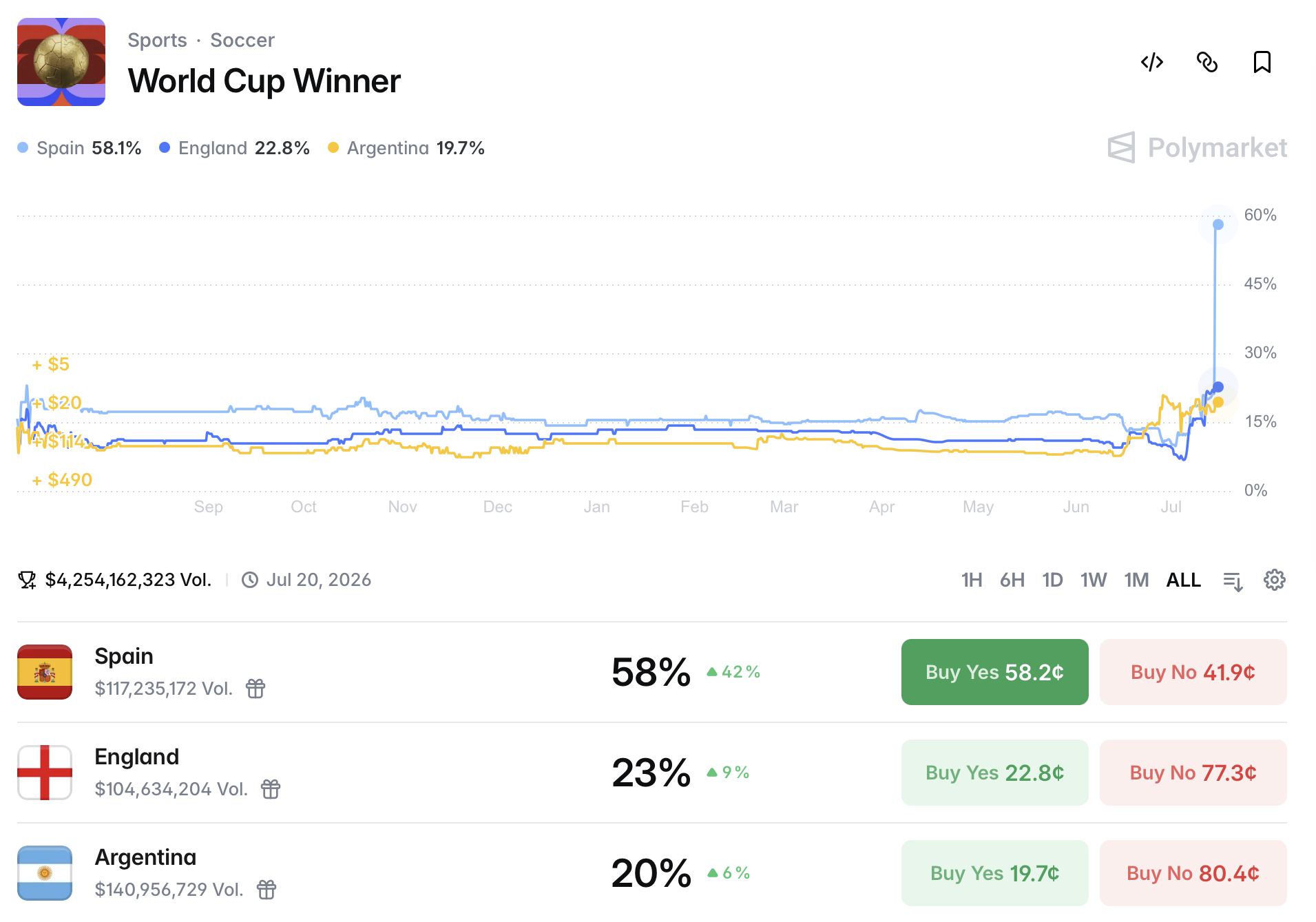
Figure: Market for World Cup Champion betting on Polymarket. Source: Polymarket
Alongside industry growth, regulatory pressure is also intensifying simultaneously.
Regulatory Tug-of-War: CFTC vs. States, Possibly Going All the Way to the Supreme Court
Multiple U.S. states have challenged Kalshi and Polymarket this year, while the CFTC argues that federally regulated event contracts fall within its "exclusive jurisdiction" scope and are not subject to state gambling laws.
The dispute has entered federal courts. Legal observers point out that conflicting rulings among appellate courts may ultimately prompt the U.S. Supreme Court to rule on "who has primary jurisdiction over prediction markets."
The outcome of this legal battle will determine whether prediction markets continue to expand as financial innovation in the U.S. or are defined as gambling by each state and restricted—and the fairness of contract design will become one of the most powerful arguments in this debate.
Join TechFlow official community to stay tuned
Telegram:https://t.me/TechFlowDaily
X (Twitter):https://x.com/TechFlowPost
X (Twitter) EN:https://x.com/BlockFlow_News
 @Cointelegraph