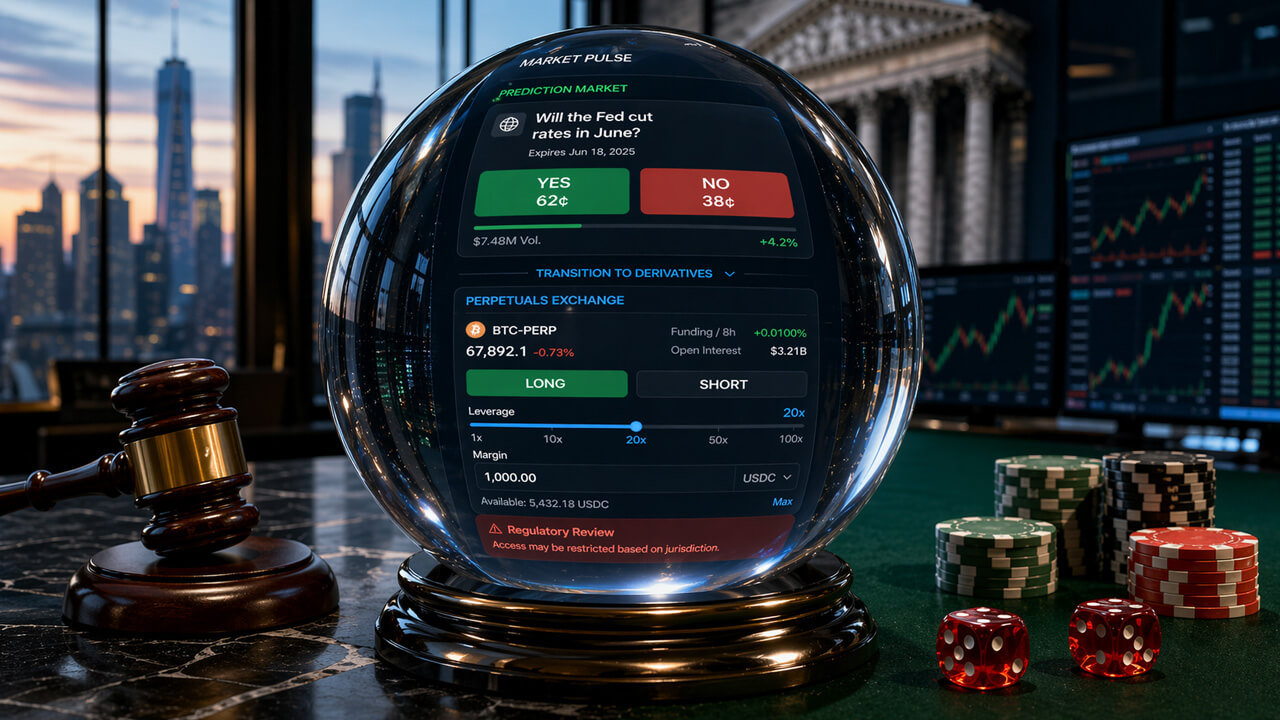
2026 World Cup Reignites Volatility in Prediction Markets
TechFlow Selected TechFlow Selected
2026 World Cup Reignites Volatility in Prediction Markets
Think the 2026 World Cup is just about which team wins or loses? Off-field prediction markets have already quietly come of age.
 Navigating Web3 tides with focused insights
Author: Fugui
The crypto world has recently been embroiled in one farce after another. The SpaceX IPO hype flared up briefly—only to fizzle out into chaos upon actual execution. Even the perennially hyped “DeFi Summer” has lost its luster. In May, VC deal volume hit a new low since before 2021, with only about 50 deals recorded for the entire month. Just as everyone assumed the industry had entered “sage mode,”
the World Cup arrived! In fact, prediction markets began heating up as early as May. It wasn’t just Polymarket—Kalshi’s volume surged nearly thirtyfold, and centralized exchanges (CEXs) rushed in too. Even traditional brokers like Robinhood jumped headfirst into the fray. This narrative seems unstoppable.
Money never makes noise when it’s being made—but noise rarely makes money. Prediction markets may be the exception.
From Trump to the World Cup: Two Breakouts for Prediction Markets
At its core, a prediction market is simply “voting with money.” Its history runs far deeper than most realize—from academic experiments at the University of Iowa in the 1990s, to Intrade in the 2000s, and PredictIt in 2014. For decades, it remained a niche toy for academics and tech enthusiasts.
The real turning point came in 2024. The U.S. presidential race between Donald Trump and Joe Biden (and later Kamala Harris) thrust prediction markets into the mainstream spotlight for the first time. Polymarket alone processed over $3.6 billion in trading volume—making the narrative of “aggregating information through money” irresistibly compelling. Media outlets began treating market probabilities as equals to polling data; The New York Times and CNBC vied to cite them. Markets reacted to debates and judicial rulings faster than polls—and were later validated as “truth machines” more accurate than traditional surveys. Prediction markets evolved from financial instruments into highly participatory political entertainment.
After the election, the sector didn’t cool down—it underwent financialization. By 2025, prediction markets emerged as a legitimate force in mainstream finance, drawing billions of dollars in bets on everything from NFL games to Federal Reserve interest rate decisions. Polymarket and Kalshi formed a duopoly that generated over $44 billion in total trading volume that year—roughly equivalent to the GDP of a small country.
According to Pew Research Center data, combined monthly trading volume across the two platforms surged from under $5 billion in September 2025 to approximately $24 billion by April 2026—a figure now exceeding the average monthly legal sports betting handle in the United States. Prediction markets began operating like traditional financial exchanges: probabilities were priced, events standardized, and real-world uncertainty transformed into a high-frequency tradable asset.
The 2026 World Cup merely cranked up an already high-speed engine—and swapped in a far more mainstream display screen.
The Duopoly Battle: Depth, Compliance, and Infrastructure as Three Moats
Post-2024, the industry landscape briefly clarified: Polymarket targeted global decentralized traffic, while Kalshi focused on compliant U.S. users. But under the World Cup spotlight, this simple binary collapsed—competition evolved into a three-dimensional war across liquidity, regulatory distribution, and trading infrastructure.
Polymarket: The Undisputed Liquidity King. Its moat is simple and brutal: ultra-deep liquidity concentrated in a single flagship contract. As of mid-June 2026, its “World Cup Champion” market had surpassed $2 billion in cumulative trading volume—with $118 million traded on opening day alone. Its liquidity pool for this single market exceeded $48 million, even reaching $100 million, enabling large trades with virtually no slippage. This “one-market-dominates-all” depth is impossible for competitors to replicate in the short term. Operating globally (albeit with restrictions on U.S. users) and settling in USDC, Polymarket became the primary battleground for crypto-native users and global speculators. In April 2026, its monthly trading volume reached $9 billion—28% of total market share.
Kalshi: The Compliance & Distribution King. Kalshi pursued a different path. As the first event derivatives exchange licensed by the U.S. Commodity Futures Trading Commission (CFTC), compliance is its hardest license. This allows lawful access to tens of millions of U.S. users—and positions Kalshi as the underlying contract provider for mass-market platforms like Robinhood and Coinbase. Leveraging Robinhood’s 27 million active accounts and Coinbase’s massive user base, Kalshi achieved exponential traffic amplification. In May 2026, Kalshi’s monthly trading volume soared to $17.9 billion—58% of global prediction market volume, nearly double Polymarket’s. Its strategy prioritizes breadth: launching over 424 World Cup-related markets to meet diverse retail demand with rich contract types.
Hyperliquid: The Perpetual Contract King’s Downward Strike. In May 2026, Hyperliquid—the DeFi derivatives giant with over $5.5 billion in total value locked (TVL)—officially entered the space. Its HIP-4 event contracts (“Outcomes”) weren’t mere copies. Instead, they implemented native binary options tightly integrated with perpetual futures—sharing the same account and margin pool. Traders could simultaneously run high-leverage perpetual trades and hedge event outcomes using a single USDC account, with risk automatically identified and margin dynamically released. This capital-efficiency revolution is something Polymarket and Kalshi simply cannot match. Armed with its inherently deep order book and near-zero fees, Hyperliquid didn’t come to slice the pie—it came to redefine the rules of the game.
The market has evolved beyond a two-horse race into a more complex, multi-layered structure: Kalshi dominates in volume via breadth (424 markets); Polymarket crushes competition in core arenas via depth (a single champion market at $2 billion); and Hyperliquid is reshaping the foundational settlement layer.
New Entrants: Official Partners, Dark Horses, and Long-Tail Competitors
Under the World Cup spotlight, alongside the giants, a cohort of newcomers also tried to grab a slice—each meeting dramatically different fates.
ADI PredictStreet (Official—but Cold Reception): As FIFA’s first-ever official prediction market partner, ADI PredictStreet boasted elite pedigree (Abu Dhabi royal backing) and solid tech (ADI Chain + Chainlink oracles). Yet it launched only three days before kickoff (June 8), and initial trading volume was dismal—nearly zero. This exposed the awkward reality of brand licensing in prediction markets: IP prestige doesn’t automatically convert into liquidity; execution is king.
Rain Protocol (Infrastructure Dark Horse): A decentralized prediction market infrastructure protocol deployed on Arbitrum, Rain avoids front-end traffic plays and focuses instead on foundational infrastructure. Ahead of the World Cup, its foundation injected $100 million in dedicated liquidity, propelling protocol TVL to $125.4 million—ranking it among the top three globally. Through “permissionless market creation” and “on-chain professional order books,” Rain attracted numerous Latin American and Southeast Asian local communities to rapidly build prediction applications atop its protocol—emerging as a key variable breaking the duopoly.
OmenX (Rapidly Rising Newcomer): A leveraged prediction market natively built on Base chain, OmenX saw new-user growth surge 210% on opening day. Its per-match trading volume (e.g., $1.78 million for South Korea vs. Czechia) already reaches 30–40% of Polymarket’s for the same match—making it one of the fastest-growing dark horses of this tournament.
Long-tail Competitors (Opinion, Predict.fun, Probable): During the January peak, these collectively held nearly 20% market share—but have seen their survival space sharply compressed under pressure from giants and the World Cup’s suction effect.
Traditional Players’ Bets: Brokers and CEXs Enter—and Real Incremental Growth Emerges
A deeply ironic paradox is unfolding: while crypto’s primary market VC funding has frozen (only ~50 deals in May 2026), secondary trading in prediction markets is exploding.
Traditional financial heavyweights are voting with their feet—and doubling down on this nascent sector:
Robinhood: Partnering with Susquehanna to launch Rothera—a CFTC-licensed clearinghouse—it officially rolled out event contracts on World Cup opening day. Its prediction market business generated $415 million in annualized revenue in Q1 2026; Bernstein projects $586 million for full-year 2026—17% of the company’s total trading revenue.
Coinbase: Collaborating with Kalshi, it launched prediction markets early in 2026—and within two months, annualized revenue breached $100 million, with sports-related contracts accounting for 39% of prediction market trading volume.
DraftKings: Its prediction business achieved $1.3 billion in annualized consumer trading volume in May, up 24% month-on-month. Leveraging media partnerships with Telemundo and a Spanish-language-native app, DraftKings precisely targets the U.S.’s 52%-share Hispanic population—a move Bernstein identifies as the tournament’s biggest fundamental significance: not zero-sum competition, but wholesale conversion of sports bettors and Robinhood retail traders into prediction market participants.
Institutional participation goes beyond traffic. In April 2026, Kalshi executed the platform’s first block trade—a California May electricity market settlement price contract between an environmental hedge fund and market maker Jump Trading. This signals institutions are beginning to use prediction markets as genuine event-risk hedging tools—a capability traditional gambling has never offered.
Where does real incremental growth lie?
Research estimates roughly 30% of Polymarket’s offshore trading volume (~$16.7 billion over the past year) actually originates from U.S. funds unable to access compliant channels. The World Cup—and the rise of compliant platforms—is driving this “gray demand” toward regulated venues like DraftKings, Robinhood, and Coinbase. This cold, hard capital logic is what truly fuels the sector’s explosive growth.
This Isn’t the End—It’s the Coming-of-Age Ceremony for a New Asset Class
The World Cup is a watershed moment. But what’s truly fascinating isn’t who wins the trophy—it’s the dual internal and external transformation underway in prediction markets.
Internally, Polymarket, Kalshi, and Hyperliquid are pursuing parallel technical paths—fortifying high walls across liquidity depth, regulatory distribution, and trading infrastructure. Meanwhile, newcomers like Rain and OmenX are carving niches from protocol layers and vertical user experiences.
Externally, the regulatory tug-of-war between the CFTC and state governments is clarifying (in June 2026, the CFTC issued proposed rules greenlighting sports-based predictions), traditional brokers are integrating distribution channels, and institutional capital is gradually entering—pushing prediction markets from crypto’s fringe narrative into mainstream finance’s toolkit.
Bernstein forecasts total prediction market trading volume will grow from ~$51 billion in 2025 to $1 trillion by 2030—a compound annual growth rate of ~80%. Full-year 2026 volume is projected at $240 billion.
An industry’s true maturity rarely arrives at the moment of breakout—it arrives when all participants—retail traders, institutions, platforms, and regulators alike—begin to recognize: this is no longer just a noisy game. It is a fundamentally new asset class, priced on global information and collective belief.
The ball is rolling. So is the money.
By the next hot cycle, there may be many more players seated at this table—and the rules of the game may look unrecognizable.
Join TechFlow official community to stay tuned
Telegram:https://t.me/TechFlowDaily
X (Twitter):https://x.com/TechFlowPost
X (Twitter) EN:https://x.com/BlockFlow_News