The Rise of Prediction Markets: Why a Trillion-Dollar Industry Has U.S. Regulators on Edge
TechFlow Selected TechFlow Selected
The Rise of Prediction Markets: Why a Trillion-Dollar Industry Has U.S. Regulators on Edge
Authors at the Mises Institute argue that the U.S. government’s regulatory crackdown on prediction markets is not genuinely motivated by protecting the public, but rather by “protecting itself.”
 Navigating Web3 tides with focused insights
By Long Yue
Source: WallStreetCN
When a decentralized crowd can predict wars, policy shifts, and market trends more accurately than U.S. federal agencies, regulators take notice.
Prediction markets are undergoing rapid expansion. The Mises Institute recently published a long-form article by Angelo Monaco that outlines how prediction markets operate, their explosive growth, and why the U.S. government is rushing to regulate them.
The article argues that U.S. regulators’ crackdown on prediction markets is ostensibly about “protecting the public,” but in reality it’s about “protecting themselves.” What regulators truly fear is not that these markets will malfunction—but that they work *too well*: so well, in fact, that they publicly expose the inadequacy of regulators’ own forecasting abilities.
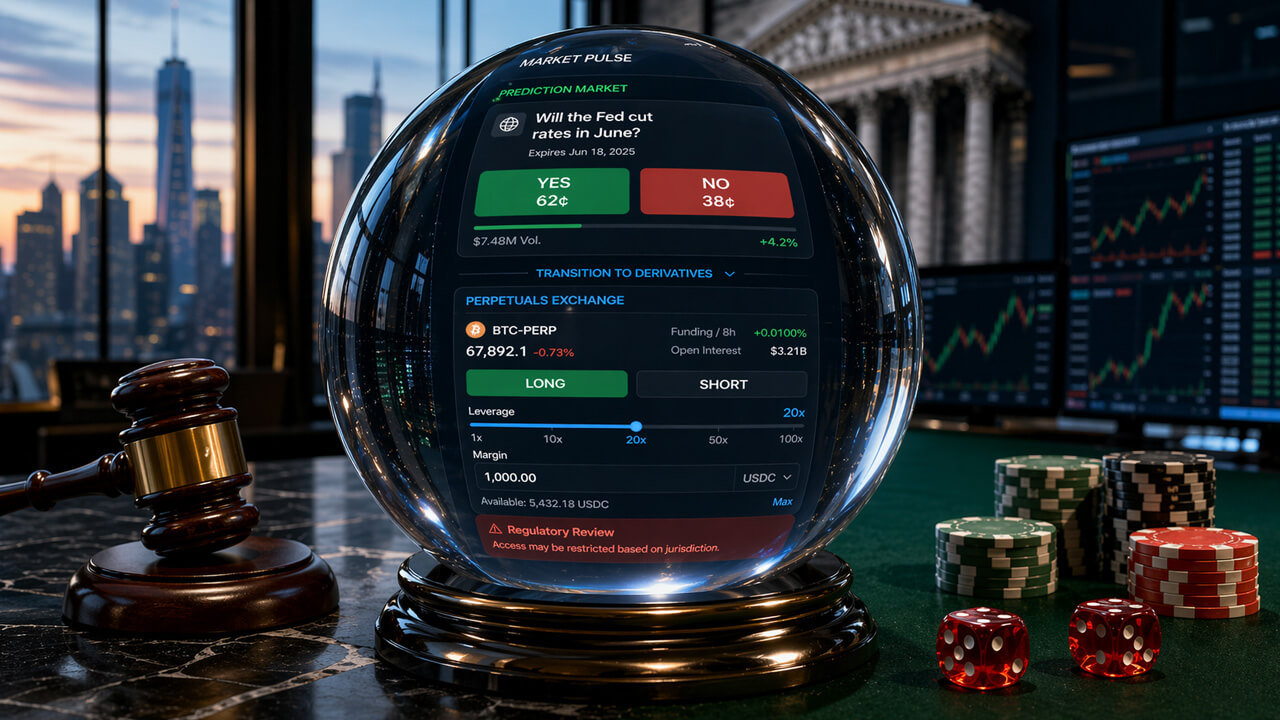
The logic behind prediction markets is straightforward. Platforms like Polymarket and Kalshi function essentially as financial exchanges: users buy and sell contracts tied to real-world outcomes. Contract prices fluctuate between $0.01 and $0.99, directly reflecting the crowd’s collective probability assessment of an event occurring. If the event occurs, the contract settles at $1.00; those who predicted correctly profit, while those who guessed wrong incur losses. This mechanism forces every participant to put real money behind their judgment.
Currently, monthly trading volume in prediction markets has surpassed $24 billion. Analysts project the overall market size will exceed $240 billion—and annual trading volume could surpass $1 trillion before 2030. Such growth is exceptionally rare in finance.
Iran War: Prediction Markets Outpaced the Pentagon’s Press Conference by Hours
The article uses the 2026 Iran conflict as its central case study to demonstrate the practical value of prediction markets.
From late 2025 through January 2026, as localized unrest began brewing in Iran, mainstream analysis firms and media outlets generally predicted stable energy markets, with Brent crude oil forecast to average $55–$60 per barrel for the year. Yet during the same period, clear divergence signals emerged in both crude oil options markets and decentralized geopolitical event contracts—while TV analysts told the public “there’s no need to panic,” traders risking real capital were already significantly raising the implied probability of “worst-case scenarios.”
Markets began pricing in the structural vulnerability of the Strait of Hormuz weeks before the U.S.-led coalition launched military strikes in February.
In March, when Iran blockaded the Strait of Hormuz—disrupting roughly 20% of global oil supply—prediction markets on Polymarket and IMF PortWatch had already delivered a clear, data-driven verdict hours before the Pentagon held its press briefing. Their assessment integrated satellite tracking data, surging insurance premiums, and regional shipping company reports.
The article points out: if you relied solely on traditional energy forecasts in January, you would have been told that a sharp oil price spike was a “low-probability event.”
Courts Have Already Ruled: The CFTC’s Concerns Are “Lacking Concrete Evidence”
Do regulators’ arguments hold water? The article says no.
The most representative legal case is Kalshi v. CFTC. The U.S. Commodity Futures Trading Commission (CFTC) attempted to ban congressional election-related contracts in federal court, but the D.C. Circuit Court of Appeals explicitly rejected the government’s motion to stay enforcement. The court’s language was blunt: the CFTC’s concerns about market manipulation and threats to electoral integrity were “speculative and lacking concrete evidentiary support.”
The court further ruled that the CFTC had exceeded its statutory authority and failed to demonstrate that trading political outcomes posed any imminent harm to the public interest. This ruling effectively cleared the path for the legalization of commercial election-event contracts in the United States.
The CFTC’s most heavily cited “national security threat” case involved a U.S. Army soldier who, in April 2026, used classified information about Venezuela operations to earn over $404,000 on prediction markets. The federal government widely publicized this incident. But the article notes this remains the *only* major national security case to date. Using a single isolated incident to argue systemic risk is logically unsound.
States’ Real Motive: Not Public Protection—But Tax Revenue
If federal-level suppression is largely about “narrative control,” state-level motives are far more direct: money.
Citing commercial gambling revenue tracking data from the American Gaming Association, the article states that since early 2025, prediction market platforms have cost U.S. state governments approximately $950 million in potential gambling tax revenue.
This stems from a regulatory arbitrage loophole: traditional sports betting operators must pay high gross gaming revenue (GGR) taxes to state gambling commissions, whereas prediction market platforms classify themselves as “financial instruments,” subject only to standard corporate income tax—and thus entirely bypass state-level gambling tax regimes.
Take Minnesota, for example: when the state enacted its prediction market ban, the core argument advanced during legislative debate was not “social harm,” but rather loss of market share and tax revenue. The article concludes that the “harms” states cite are often projected tax shortfalls and threats to traditional gambling monopolies—not empirically documented social problems.
Hayek Called It Decades Ago
When arguing for the informational value of prediction markets, the article invokes economist Friedrich Hayek’s classic insight.
Hayek observed that decentralized price mechanisms are the only tool capable of coordinating globally dispersed “local knowledge.” No single expert, federal agency, or algorithm can possibly aggregate fragmented information scattered across the globe. Prediction markets do precisely one thing: crowdsource global intelligence.
By contrast, opinion polls and regulatory reports are static snapshots—often outdated the moment they’re published. Prediction markets are dynamic and continuous. When a geopolitical event unfolds or economic data leaks, the instantaneous price movement of related contracts tells you—faster than any editor can file a story—how significant that information really is.
The article also cites an everyday scenario: if a cable TV host shouts that a piece of legislation is “certain to pass,” yet its corresponding prediction market contract trades at just $0.12, you instantly grasp the gap between rhetoric and reality. It’s a real-time “sobering check.”
Join TechFlow official community to stay tuned
Telegram:https://t.me/TechFlowDaily
X (Twitter):https://x.com/TechFlowPost
X (Twitter) EN:https://x.com/BlockFlow_News