Let PAXG earn passive income, Enhanced moves gold into the Options Vault
TechFlow Selected TechFlow Selected
Let PAXG earn passive income, Enhanced moves gold into the Options Vault
This is the first step for RWA from "moving on-chain" to "doing real work"—gold is just the beginning.
 Navigating Web3 tides with focused insights
Author: Castle Labs
Compiled by: TechFlow
TechFlow Editor's Note: The on-chain RWA scale has reached $32 billion, but 90% of gold tokens are sleeping in wallets. Enhanced turns PAXG into yield-bearing assets using covered call options, allowing users to earn premiums without understanding options. This is the first step for RWA from "moving on-chain" to "actually working," and gold is just the beginning.
The on-chain RWA scale has already exceeded $32 billion.
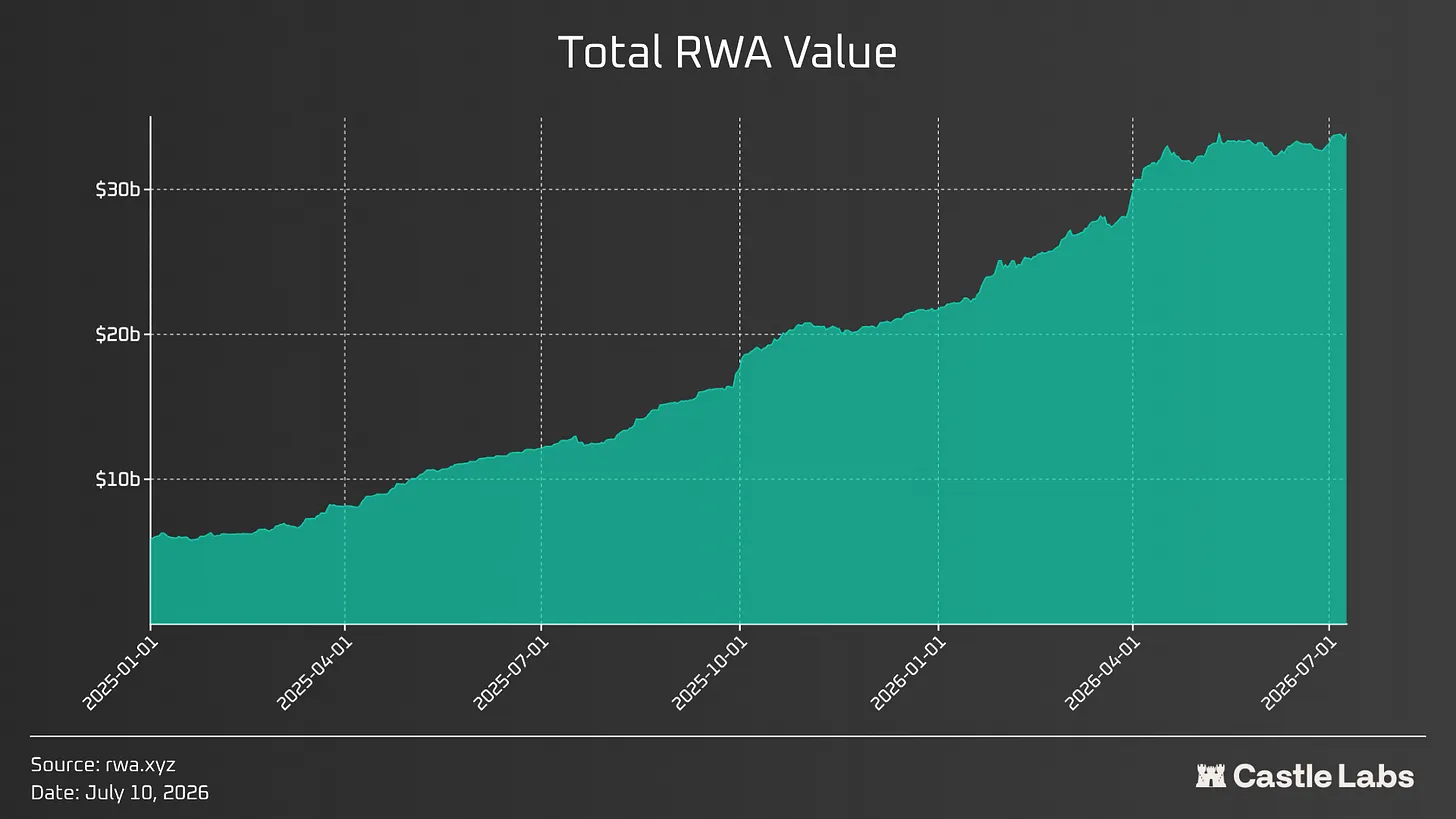
Most are low-risk assets, such as U.S. Treasury bonds, and the proportion of other asset classes like stocks is also growing.
Gold is the largest commodity on-chain. Tokenized value exceeds $4.9 billion, paving the path for tokenization as a store of value.
But most on-chain products have limited functionality: users can only buy spot gold, and no one cares about how to generate yield from this gold on-chain afterwards.
This causes on-chain products to be discounted in value and utility compared to traditional finance (TradFi) products.
This article focuses on what we believe is the next wave of RWA: enabling these assets to generate yield.
We take Enhanced as a case study, focusing on its upcoming Gold Volatility Yield Vault, which uses PAXG. This is Enhanced's first "View Vault," where users can express specific expectations and yield through options (with more binary instruments in the future). This vault uses a covered call option design, a strategy that has been undervalued but has unique advantages: it generates yield and hedges, making it the first step for RWA like gold, which usually does not yield, to start making money.
The on-chain RWA ecosystem is just getting started.
Will option vaults be the key to making RWA actually work?
Let's start by talking about how to generate yield from gold.
Making Gold Work
Gold is a $30 trillion asset class and the first commodity to pave the path for on-chain tokenization. But although there is over $4.9 billion of gold on-chain, the vast majority of funds remain idle, generating no yield.
Traditional financial products, such as covered call ETFs, allow many people to use options to earn premium income or hedge gold holdings.
But these products have the common shortcomings of traditional financial products: limited accessibility, high fees, high management fees, brokerage fees, KYC and custody requirements. For example, GLDI, the oldest gold covered call ETF (similar to the strategy used by Enhanced), charges a 0.65% fee, which is deducted before investors receive any yield.
This is why Enhanced decided to focus on gold. On-chain gold solutions exist, but are currently very limited: mostly spot, providing no yield.
Moreover, gold is the largest asset by market cap on-chain and is in a historic period:
Gold prices hit an all-time high in April 2026
More investors want to allocate to gold due to its store of value function
Geopolitical and macroeconomic volatility has been at historic highs in recent years
This makes gold a perfect underlying for covered calls: it can provide considerable premiums, while price trends are relatively mild and range-bound.
Making on-chain gold a yield-bearing asset is the natural evolution of on-chain RWA: the first wave of growth focused on popularizing and broadening accessibility to these assets. The next wave, perhaps more importantly, is to differentiate these assets from their off-chain counterparts, ensuring they are efficient and yield-generating.
Vaults are the perfect way to package all of this.
Boosting Yield
Enhanced's goal is to bridge the gap between RWA assets and their on-chain productivity.
The method is to identify the unique characteristics of each asset as well as retail and institutional investors, encapsulating these nuances into structured strategies that can provide yield for RWA.
For gold, they focus on View Vaults using covered call options.
Leveraging Options
Compared to other on-chain derivatives like perpetual contracts, options have been difficult to achieve wider adoption. This is usually attributed to the complexity of options trading, requiring learning and skills. Because not everyone is familiar with options, we ensure to explain clearly covered call options and how Enhanced uses them.
Covered calls allow for optional selling only if the stock reaches the strike price at expiration. In exchange, the seller can collect premiums while continuing to hold the stock (or in the case of Enhanced's first vault, commodities).
Users using covered calls hold a neutral/slightly bullish view on the underlying asset: they expect small fluctuations and collect yield during the holding period. But in some cases, covered calls can also be used as a hedge after the asset rises steadily. Both situations perfectly fit the characteristics of the gold asset.
Covered call users are essentially spot long, because they hold the asset while having an option short position that generates premiums.
Covered calls provide reliable premiums, buffer losses, but also limit potential upside. Therefore, they are more suitable for investors with weaker directionality (such as mildly bullish) and more passive.
RFQ System
The underlying mechanism of the PAXG vault utilizes a Request for Quote (RFQ) system.
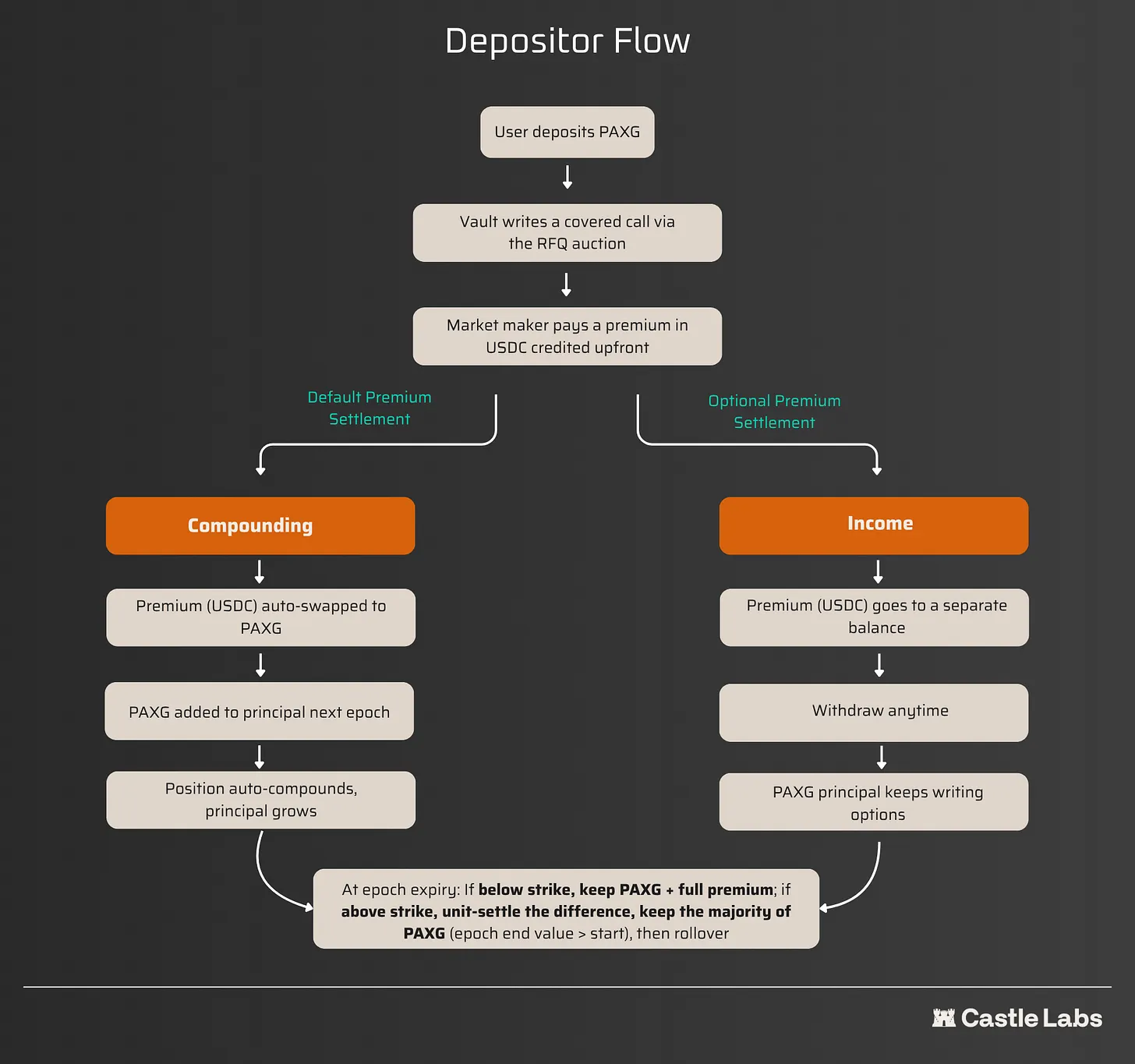
In the backend, deposited assets are batch auctioned to the best bid in the RFQ system (from top market makers), and options are signed on-chain. Users subsequently receive premiums in advance.
There is also a manual RFQ function open for access, expected to gradually attract more market makers, institutional and retail investors to ensure fair premiums for options.
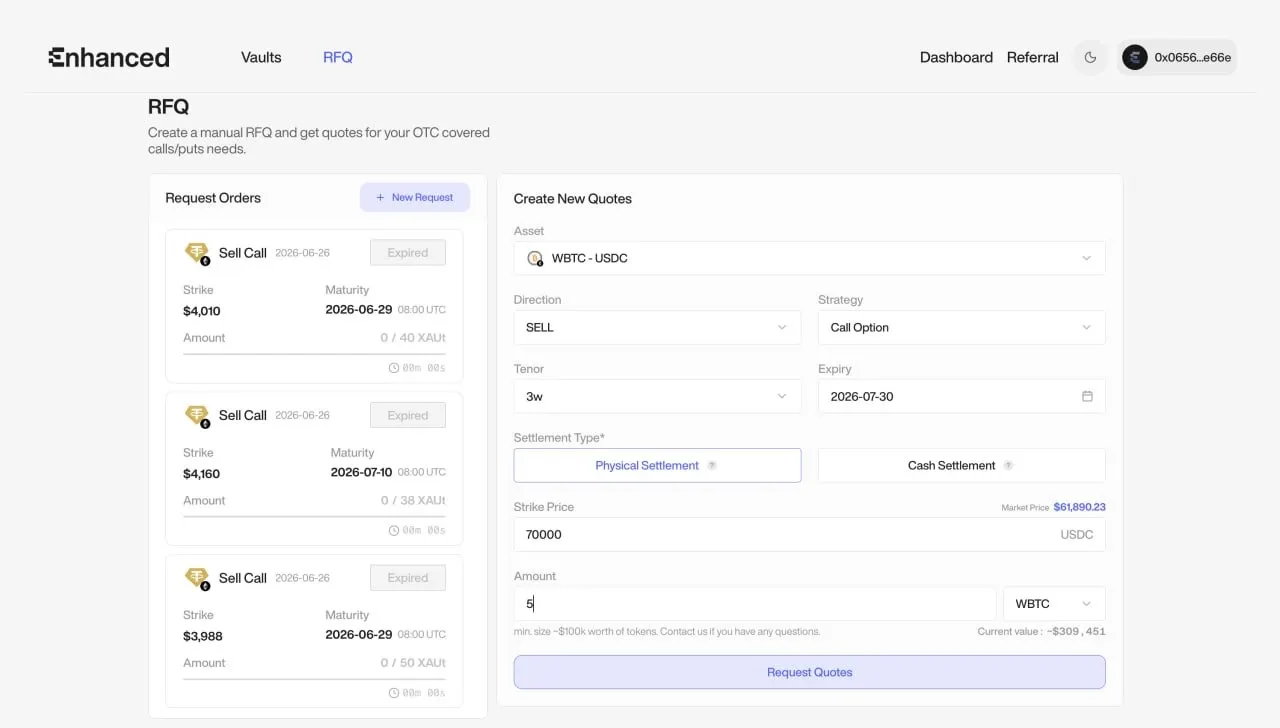
Any participant can directly sell covered calls against their holdings and define custom execution parameters (such as strike price, duration, direction). In the future, the range of available tools can be extended to options for buying and selling any asset other than gold, including any ERC-20 tokens.
Transactions are signed by both parties, executed atomically, and cannot be changed by operators, ensuring fair quotes.
The RFQ system is attractive to any large vault holding assets that need regular rebalancing or have specific sales terms, thereby helping asset liquidation.
Enhanced targets the broader structured products market, because the RFQ system can be used for asset classes other than gold, thereby ensuring future expansion.
PAXG Volatility Yield Vault
The first View Vault launched by Enhanced is the PAXG Volatility Yield Vault.
It will focus on leveraging PAXG's volatility to generate premiums for users.
The vault will use covered calls to let users earn option premiums on gold.
The vault operates as follows:
Subscribe to European options. Can only be exercised on the expiration date, meaning funds are locked during the period
Users can deposit PAXG and USDC (converted to PAXG)
Strike price is expected to be 103-107% Out-of-the-Money (OTM), meaning the strike price is usually 3-7% higher than the gold spot price, while dynamically adjusted to reflect market conditions
Option cycle is bi-weekly (14 days, 26 cycles per year)
Charge 0.019% fund protocol fee at the end of each cycle (0.5% annualized)
To be more practical, let's look at what it means for users to deposit gold in the vault, and what will happen at expiration under different scenarios.
Specifically, assume a user deposits gold in the vault (the vault sells covered calls on it). When the option expires:
If the gold price is higher than the strike price, the option is settled, and users receive the value of the option they subscribed to, plus USDC premiums. The cost of In-the-Money (ITM) options is the upside given up during the cycle. In this case, users give up potential upside above the strike price.
Let's use a practical example, initial gold price is $100, strike price is $105.
If at expiration, the price is $107, the option is exercised: users gain the rise to the strike price and premiums (from $100 to $105), but give up the extra $2 rise from $105 to $107.
If the gold price is lower than the strike price, the call option expires worthless and is not exercised, users retain their gold holdings and the generated premiums. According to current strategy configuration, this is the target situation, expected to be the most common. Covered calls cannot protect against downside risk, only provide a buffer through income. If the gold price falls, the vault holds the same quantity but lower USD value.
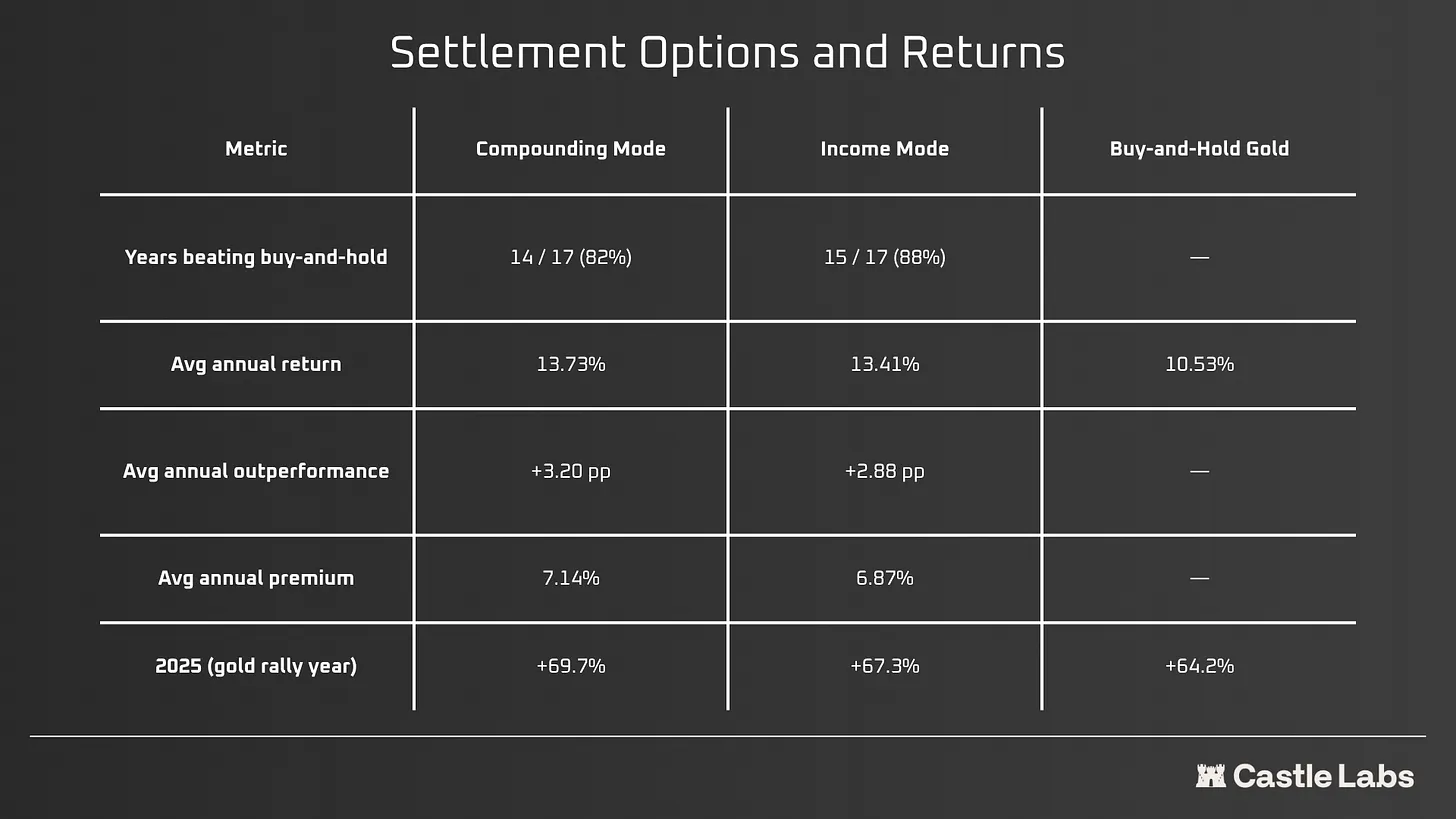
A feature of Enhanced vault configuration is allowing users to choose different settlement modes to decide how premiums are distributed.
The default settlement option is Compounding Mode, where each USDC premium earned is automatically compounded, converted to PAXG and added to the deposited funds in the next cycle. This is a classic automatic compounding position, more suitable for long-term gold investors.
The optional mode is Income Mode, where each USDC premium is deposited into a separate balance that can be withdrawn at any time. This strategy is more suitable for users who wish to accumulate and generate USDC income (similar to dividends) from their gold assets, very attractive to those with large idle asset vaults.
Users can simply switch modes before the start of any cycle.
Here is an example of the performance difference between the two settlement modes, using a strategy backtest of gold spot from January 2010 to April 2026:
The end-to-end operation of the vault is illustrated with a chart:
The focus of the PAXG vault is not to maximize premiums, but to focus on a more conservative strategy: retaining gold as much as possible by keeping out-of-the-money, while still generating premium income for users.
Food for Thought
Vaults are evolving from single strategies to a range of multi-strategies, covering the nuances of RWA asset classes and investor characteristics.
Making currently idle assets generate yield on-chain is the top priority for yield providers and users holding these assets.
The Enhanced Gold Vault is a suitable example of how options and covered calls can provide an additional income stream in the form of premiums for PAXG holders.
Since one of the main problems with options is complexity, in this scenario, option operations are abstracted in the backend, seamless for users.
Through these products, investors can now earn yield on gold, which is a significant step in making on-chain RWA yield-generating like off-chain alternatives, with advantages in accessibility, automation, and configuration. A obvious example is two different types of settlement, which can be easily switched via a toggle.
Other advantages include transparent pricing and fees, and flexibility in depositing and withdrawing in each cycle, without strict lock-up periods.
We expect this is just the starting point, because vaults have proven to be the most suitable primitives for making on-chain RWA generate yield. Enhanced itself can utilize RFQ for a wider range of assets, including stocks, etc.—gold is just the first proof of concept.
More strategies and asset coverage are crucial for ensuring large capital allocation. Once the CLARITY Act is fully passed, friendly regulation will make launching liquidity and managing asset scale easier.
We will closely follow these developments.
Join TechFlow official community to stay tuned
Telegram:https://t.me/TechFlowDaily
X (Twitter):https://x.com/TechFlowPost
X (Twitter) EN:https://x.com/BlockFlow_News
 @castle_labs