
Research Report Analysis: Goldman Sachs Deconstructs the Truth of Asian Stock Markets, Extreme Crowding Behind the Prosperity
TechFlow Selected TechFlow Selected
Research Report Analysis: Goldman Sachs Deconstructs the Truth of Asian Stock Markets, Extreme Crowding Behind the Prosperity
Goldman Sachs' logic is straightforward: earnings growth is the hard truth that determines stock prices, and the North Asia market's leading advantage in this regard will not change in the short term.
 Navigating Web3 tides with focused insights
Author: Rita
TechFlow Guide
In the second-half handbook released at the end of June by the Goldman Sachs Asia Equity Strategy team, a seemingly contradictory view was raised: continue to stick with the winners and avoid lagging sectors.
Report data shows that the MXAPJ index rose 21% in the first half of the year, but almost all of it was supported by South Korean and Taiwanese tech stocks. Removing these two markets, the rest of Asia actually fell 9%. Goldman Sachs' logic is straightforward: earnings growth is the hard truth determining stock prices, and North Asian markets' leading advantage in this regard will not change in the short term. Therefore, the key in the second half is to see whether these hardware and chip companies that have already risen can continue to deliver earnings.
How High is the Concentration of Winners in the First Half
Looking at the data, the MXAPJ index rose 21% in the first half, but 96% of this gain came from 8 stocks. If South Korea and Taiwan are excluded, the rest of Asia is negative, down 9%. Japan has the same structure; the Nikkei 225, concentrated in tech stocks, rose 38%, while the broader TOPIX only rose 16%.
Behind this extreme concentration is a huge gap in earnings growth rates. Goldman Sachs expects MXAPJ earnings per share to grow 60% in 2026, with South Korea contributing 320% and Taiwan contributing 48%. ASEAN and Australia are only in the mid-single digits. This is why South Korea rose 119% this year and Taiwan rose 56%. Goldman Sachs conducted a historical backtest; in the past 30 years, only 5 years simultaneously met the two conditions of rising over 10% in the first half and upward revisions to earnings expectations. The average return in the second half of these 5 years was 13%, while at other times it was only 2%. Currently, the Asian market falls exactly within this "good signal" range.
Earnings Growth Determines Everything
The core logic of Goldman Sachs strategists comes down to one sentence: 80% of the return in the Asian market relies on earnings growth or upward revisions to earnings expectations. Asia's earnings growth rate is expected to drop to 22% in 2027, but it is still higher than other regions globally. South Korea and Taiwan are the core of the chip industry, and their earnings growth rate depends on one thing: the supply-demand gap for memory chips.
Goldman Sachs' semiconductor analysts calculate that global computing demand will rise 24 times by 2030, mainly driven by AI. But the supply of memory chips cannot keep up. In 2025, DRAM and NAND have already seen record supply gaps, expected to expand in 2027, and may not ease until 2028 or even 2029-2030. Supply-demand imbalance has pushed up chip prices, plus the high leverage in the memory industry, profits are rising even more fiercely than prices. This is the direct source of high earnings growth in South Korea and Taiwan.
Macro Environment Shifts to Reflation
The macro background in the second half is also improving. The war risk in Iran has eased, and oil prices have dropped significantly. The Goldman Sachs Commodities team adjusted the Brent oil price forecast for Q4 2026 from $90 to $80. For energy importing countries, lower oil prices mean improved growth prospects and reduced inflationary pressure. Goldman Sachs expects global GDP quarter-on-quarter annualized growth rate to return to 2.6% in the second half, with China reaching 4.7%.
In terms of monetary policy, the Fed has released hawkish signals, and the market expects possibly one rate hike in the second half. The US dollar will be stronger in the short term, but looking over 12 months, most Asian currencies are currently undervalued and have room for appreciation.
Six Overweight Themes
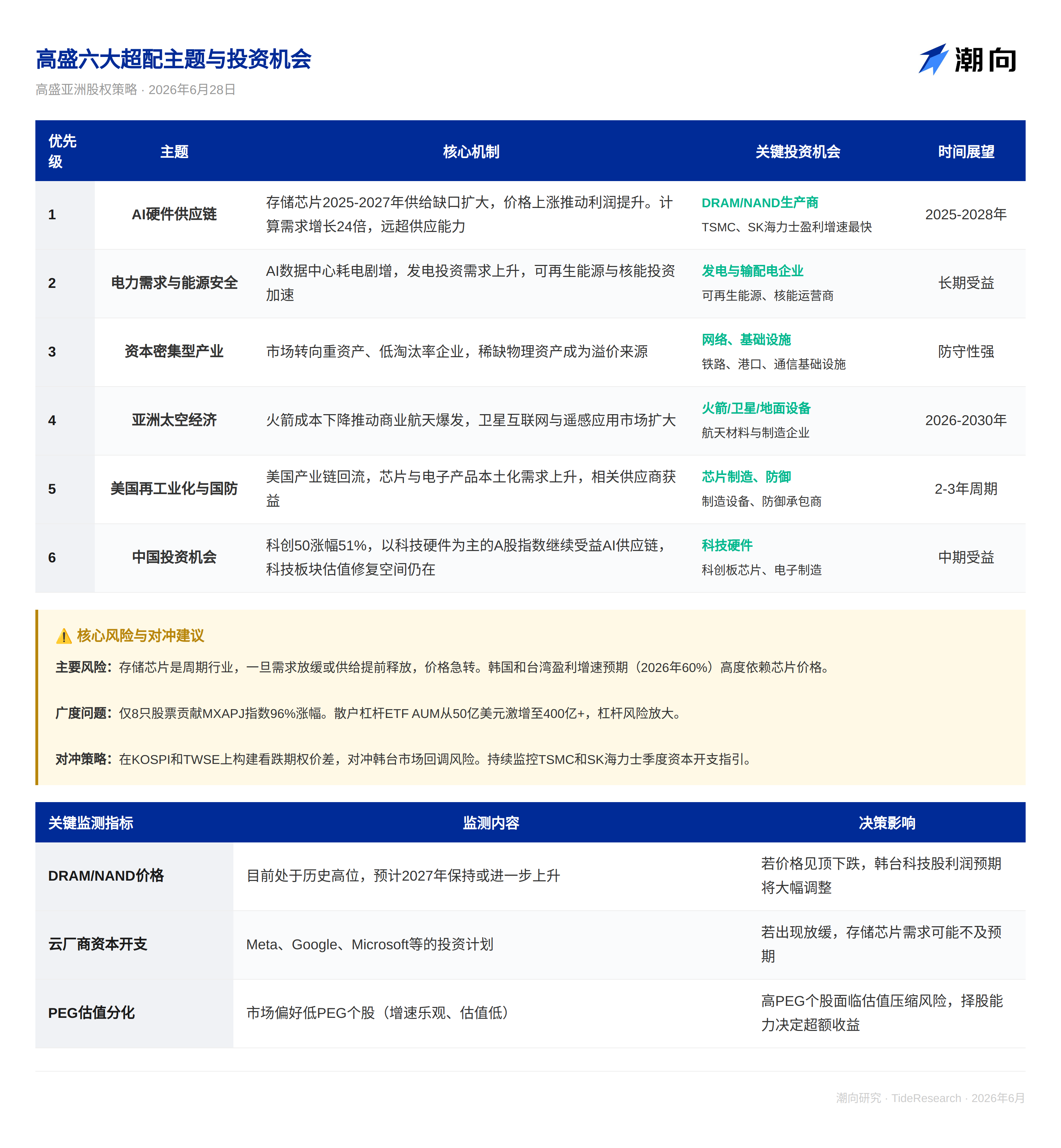
Goldman Sachs remains bullish on six directions in the second half.
Ranking first is still the AI infrastructure supply chain. Global computing demand will rise 24 times by 2030, memory chip supply cannot keep up, a record gap has already appeared in 2025, and the gap will expand in 2027. Chip prices are rising, and producers' profits are rising along with them.
Other themes include: Power Demand and Energy Security, Capital-Intensive Industries, US Reindustrialization and Defense, China Investment Opportunities, and a newly added Space Economy. As AI computing power increases, power generation investment must keep up. The space economy covers rockets, satellites, ground equipment, and aerospace materials, with policy support and rising demand. On the A-share side, the STAR 50 has risen 51% this year, and indices dominated by tech hardware will continue to follow the AI supply chain.
Specific Market Allocation
Goldman Sachs' weight adjustments are as follows: South Korea and Taiwan maintain Overweight, with 12-month targets of KOSPI 12000 points (corresponding to 46% USD return) and TWSE 51000 points (18% return) respectively. China A-shares Overweight, CSI 300 target 5500 points (18% return). Japan Overweight, TOPIX target 4400 points (17% return). China Offshore, Hong Kong, Singapore Neutral, Australia, Thailand, Philippines Underweight. MXAPJ's 12-month target is 1080 points, corresponding to 25% total return. In terms of industries, Overweight Tech Hardware, Capital Goods, and Banks.
Four Major Risks
The report also listed four things to watch.
First, market breadth is too narrow. 8 stocks contributed 96% of MXAPJ's gain this year. Once these stocks start to adjust, the entire Asian index will be pressed down.
Second, retail investors are adding leverage. The size of South Korean leveraged ETFs has risen from $5 billion at the beginning of the year to over $40 billion, and index volatility will be amplified.
Third, the issue of valuation. Goldman Sachs looked at 11 sub-sectors of the tech hardware supply chain, concluding that valuation and growth are basically matched, but there are large differences between individual stocks. Recently, the market prefers stocks with low PEG, and these stocks have more optimistic revenue growth expectations (26% vs 21%).
Fourth, IPOs are increasing. However, compared to market capitalization, the proportion is only 1% to 1.5%, which is still reasonable.
TechFlow Perspective
The core assumption of this Goldman Sachs report is "earnings growth can support stock prices", but the most fragile link here is: the 60% and 22% earnings growth rates for 2026-2027 largely depend on memory chip prices continuing to hold up. Memory is a strong cyclical industry; as long as the demand side slows down slightly (e.g., cloud vendors stop spending heavily), or the supply side comes out early, prices can turn sour instantly.
The report mentioned the issues of retail speculation and concentration in the risk section, but did not fully discuss the tail risk of the memory cycle peaking. Goldman Sachs' overweight recommendation for South Korean and Taiwanese tech stocks itself carries the natural bullish bias of sell-side research reports.
For investors, the AI narrative is moving from "storytelling" to "looking at performance" stage. But once the turning point of the hardware cycle comes, the destructive power is more fierce than software clearing, because hardware has inventory, capacity, and capital expenditure discipline. This is a key variable that needs to be judged by watching TSMC and SK Hynix quarterly capital expenditure guidance.

Disclaimer
This article is a compilation and interpretation of third-party broker research reports by TechFlow Research. The ratings, target prices, earnings forecasts, and related judgments cited in the text are the views of the broker's analysts, represent only the position of their affiliated institution, do not represent the views of TechFlow Research, and do not constitute any investment advice.
The market has risks, decisions need to be independent. This article should not be used as a basis for buying or selling any securities.
Data Source: Goldman Sachs Asia Equity Strategy Report (Timothy Moe Team, June 28, 2026)
Join TechFlow official community to stay tuned
Telegram:https://t.me/TechFlowDaily
X (Twitter):https://x.com/TechFlowPost
X (Twitter) EN:https://x.com/BlockFlow_News
 @chaoxiangooo