Luxury Cars Targeted, Family Members Used as Leverage: Encryption “Wrench Attacks” Sweep Across Europe and the U.S.
TechFlow Selected TechFlow Selected
Luxury Cars Targeted, Family Members Used as Leverage: Encryption “Wrench Attacks” Sweep Across Europe and the U.S.
Crypto holders need to heighten their vigilance—luxury cars, home addresses, and family members have all become prime targets for criminals.
 Navigating Web3 tides with focused insights
By Liam 'Akiba' Wright
Translated by Saoirse, Foresight News
Key Takeaways
- A Missouri man pleaded guilty in U.S. District Court for the District of Connecticut to conspiring to commit robbery affecting interstate commerce, involving an attempted Bitcoin theft and the kidnapping of two individuals in Danbury, Connecticut.
- Prosecutors emphasized that holding cryptocurrency can render a person’s family members and vehicles targets for physical coercion.
- Saif Faiq is scheduled for sentencing on August 28; meanwhile, this “wrench attack” crime pattern continues spreading from Europe into U.S. federal courts nationwide.
Saif Faiq, a 22-year-old resident of St. Louis, Missouri, pleaded guilty on June 8 in U.S. District Court for the District of Connecticut to conspiracy to commit robbery affecting interstate commerce. Prosecutors stated the case originated from a plot hatched in August 2024, wherein a group planned to steal Bitcoin from a household linked to another multi-million-dollar Bitcoin theft case.
The charge carries a statutory maximum sentence of 20 years’ imprisonment. Saif Faiq’s sentencing hearing is set for August 28.
According to prosecutors, the two kidnapping victims were the parents of an individual involved in the Bitcoin-related case. Within the criminal group, Saif Faiq was responsible for recruiting accomplices, coordinating with Adam Iza, and conducting ongoing surveillance of the victims’ residence.
The Danbury case serves as yet another stark illustration of escalating physical violence threats triggered by cryptocurrency wealth. Prosecutors connected key elements of this guilty plea: targeting relatives, prolonged surveillance, luxury vehicles, and the perpetrators’ logic—using hostages to coerce Bitcoin owners into surrendering their assets.
As previously reported by CryptoSlate, incidents involving leaked identity information of cryptocurrency holders in France—and subsequent violent attacks against their family members—have surged dramatically. The Danbury case’s court records now confirm that similar security threats have surfaced within the U.S. federal judicial system.
U.S. Court Records: Real-World Physical Violence Linked to Cryptocurrency Assets
In September 2024, Danbury police responded to a report of a Lamborghini Urus carjacking and kidnapping. Prosecutors subsequently charged six Florida residents. Official statements indicate the two victims were forcibly removed from their vehicle, bound, and confined inside a cargo van—before law enforcement intercepted the suspects and arrested them.
The U.S. Department of Justice announced in June 2026 that six additional individuals involved in the carjacking and kidnapping had all pleaded guilty.
Saif Faiq is not the only defendant entering guilty pleas. The Department of Justice identified his brother, Adam Iza, as one of the central organizers of the scheme. Adam Iza pleaded guilty on June 1 to the same Hobbs Act conspiracy-to-commit-robbery charge—also tied to the failed Bitcoin robbery and the Danbury kidnapping.
Prosecutors stated that Adam Iza coordinated multiple kidnappers via mobile phones and encrypted messaging apps, arranged logistical supplies for the operation, and provided financial backing for the entire scheme.
This federal criminal case includes multiple standard violent offense charges: recruiting accomplices, providing funding, stalking and surveillance, carjacking, kidnapping, and conspiracy to commit robbery. Its connection to cryptocurrency lies in the perpetrators’ plan to seize the target’s relatives and use physical coercion to compel Bitcoin holders to surrender their assets.
This guilty plea marks the formal inclusion of physical coercion crimes targeting cryptocurrency holders within the scope of U.S. federal violent crime adjudication.
For cryptocurrency holders, this case delivers a blunt security warning: once criminals identify someone as a Bitcoin holder, their family members, vehicles, home addresses—or any publicly visible sign of wealth—become potential targets.
All “wrench attack” cases follow this coercive logic.
The presence of a Lamborghini in this case is far from incidental—the prosecution explicitly cited the luxury vehicle as a visible, tangible indicator that signaled to the perpetrators the target likely held substantial Bitcoin worth stealing.
Thus, conspicuous luxury vehicles serve as safety red flags—alerting holders to risks stemming from exposed wealth, vulnerable loved ones, and potential leaks of digital asset access credentials.
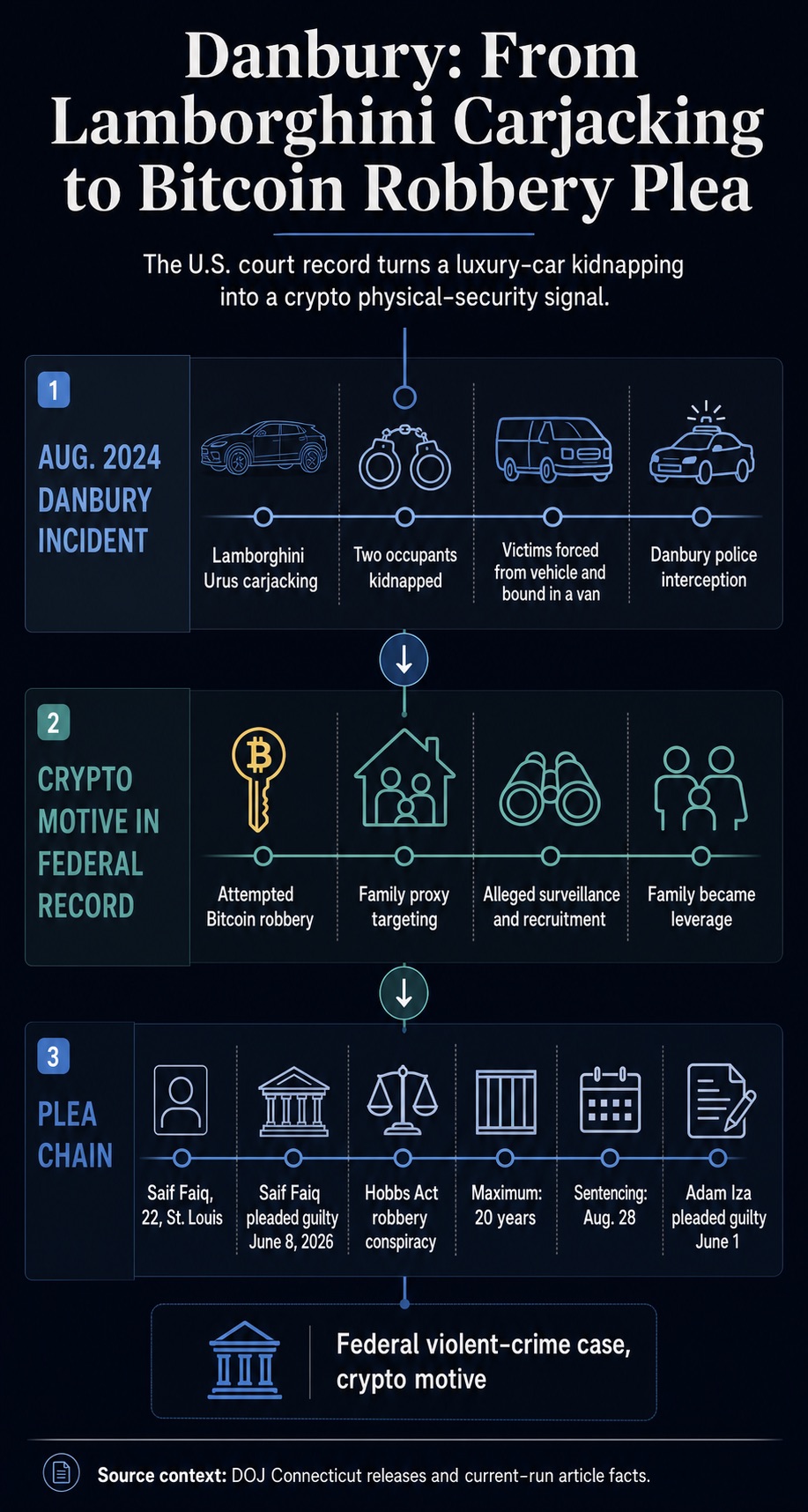
This infographic outlines the 2024 Danbury, Connecticut violent incident—targeting Bitcoin through a Lamborghini carjacking and owner kidnapping—including operational planning details and the judicial progress of two suspects who pleaded guilty in 2026 and await sentencing.
The Real Vulnerability Is Always Human
In cybersecurity research, a “wrench attack” is defined as a crime involving physical violence or coercion used to force victims to disclose passwords, private keys, or access credentials to digital assets.
CertiK’s 2025 SkyNet Wrench Attack Report classifies such crimes as attacks targeting the “human endpoint.” The report documents 72 verified cases in 2025—a 75% year-on-year increase.
This is critically important for Bitcoin holders: blockchain protocol security and personal physical safety constitute two entirely separate defense layers. Even if blockchain code is virtually impregnable and Bitcoin cannot be remotely stolen, the human custodian of those assets remains highly vulnerable to coercion.
Once criminals determine that hardware wallets, mnemonic phrases, exchange accounts, mobile devices—or even the victim’s relatives—can be exchanged for transferable cryptocurrency, all become viable pressure points.
In the Danbury case, the perpetrators selected the victims’ relatives as their leverage channel. The U.S. Department of Justice explicitly noted that the two kidnapped parents had no involvement whatsoever in the Bitcoin theft.
They were targeted solely because their child was implicated in the multi-million-dollar Bitcoin theft case—making this a textbook case of “indirect-target kidnapping” for robbery purposes.
Parallel incidents in France demonstrate this is now a widespread physical security threat. As reported by this publication in March, violent assaults against cryptocurrency holders in France are no longer limited to industry insiders or corporate executives; the perpetrator’s target pool has expanded significantly—to include ordinary individuals and private residences.
The Danbury case has fully imported this mature modus operandi into U.S. court records. A flashy luxury vehicle signals wealth, family members serve as coercion leverage, and Bitcoin remains the ultimate objective.
The perpetrators’ core strategy: identify someone susceptible to physical coercion—and use that person to extract cryptocurrency.
The Danbury case clearly demonstrates how relatives become indirect hostage targets in cryptocurrency crime; meanwhile, France’s series of incidents shows that when such attacks recur, local public safety guidance, executive travel and protection protocols, and self-defense practices among ordinary holders must all undergo comprehensive recalibration.

Europe Remains the Epicenter of Wrench Attacks
Setting aside the Danbury guilty plea, all available case data confirms Europe remains the current epicenter of wrench attack crimes.
CertiK’s 2026 Wrench Attack Overview Report documents 34 verified attacks between January and April 2026, with estimated total losses of approximately $101 million.
Of those 34 cases, 28 occurred in Europe—82% of all recorded incidents—with France reporting the highest number of cases.
CryptoSlate’s May special analysis on wrench attacks reached the same conclusion: offline violent extortion targeting cryptocurrency holders continues accelerating, with Europe—especially France—as the primary hotspot.
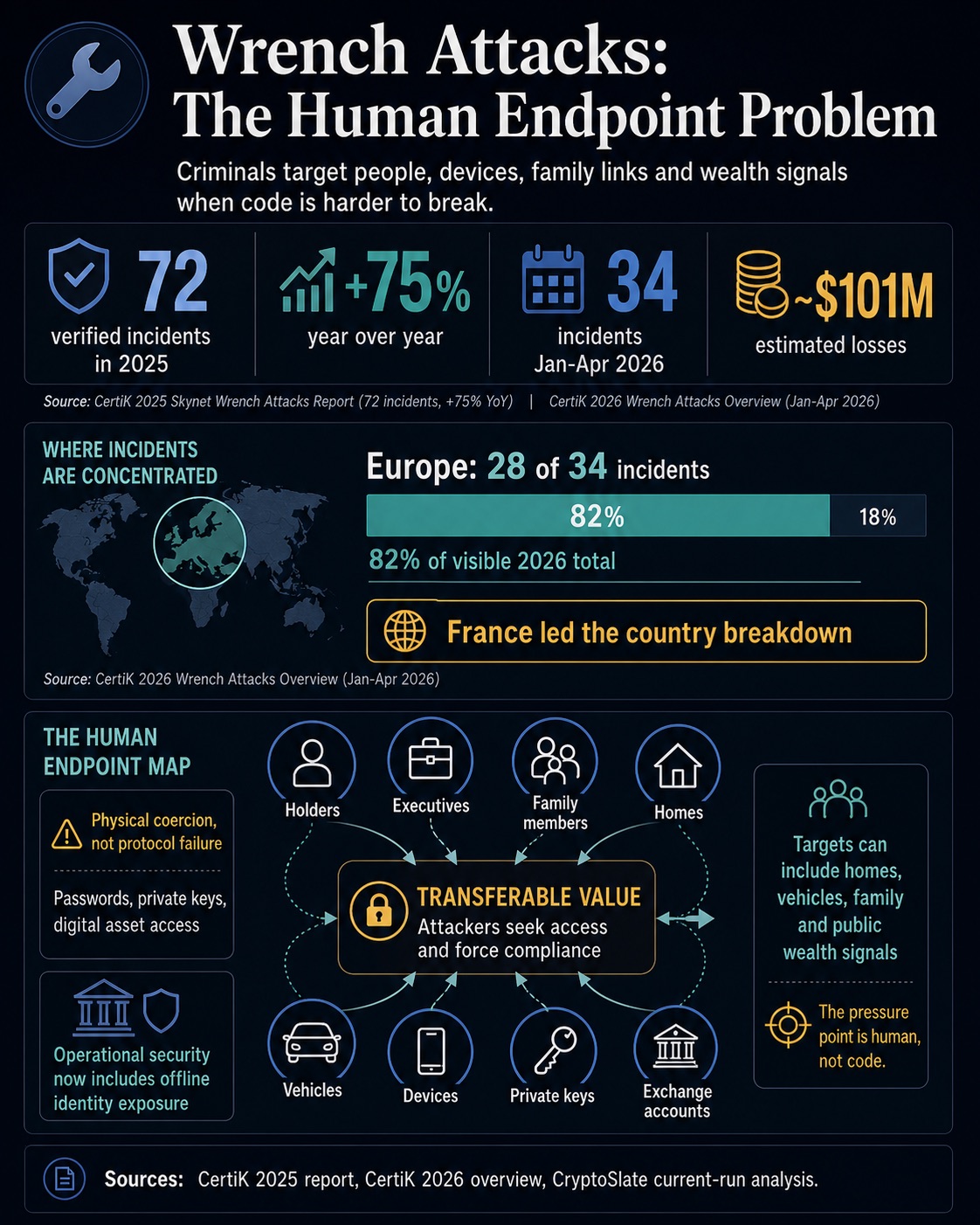
CertiK data shows wrench attacks in the crypto space target physical entities—including holders, their families, and devices. In 2025, 72 confirmed incidents rose 75% YoY; in the first four months of 2026, 34 incidents included 82% in Europe, with estimated total losses of ~$101 million. The core risk lies in human, physical endpoints—not code vulnerabilities.
The Danbury case confirms this attack pattern targeting cryptocurrency holders has now become a judicial challenge for U.S. prosecutors and federal courts.
Court records comprehensively reconstruct how offline security crises arising from cryptocurrency assets integrate into conventional violent crime enforcement workflows: gang recruitment, cross-regional operations, surveillance, family-member abduction, luxury-vehicle-based targeting, and hostage-for-Bitcoin coercion—all forming a clear, complete criminal chain.
For cryptocurrency holders and industry enterprises alike, operational security frameworks must now expand significantly: beyond online threats like phishing, wallet theft, exchange account breaches, and smart contract vulnerabilities, they must also address offline exposure risks—including identity information, home addresses, electronic devices, and family-member vulnerability.
The next critical judicial signal will be the sentencing outcome. Saif Faiq’s August 28 hearing will directly reveal how federal courts assess and penalize his culpability in this conspiracy-to-commit-robbery case.
Longer term, all high-priority cases share one commonality: criminals use offline clues—including family members, residences, vehicles, and publicly available social media profiles—to identify cryptocurrency holders. It is precisely such cases that have transformed what began as a localized security crisis in France into a nationwide societal issue demanding responses from law enforcement agencies across the United States—a single court filing serving as a risk alert.
Join TechFlow official community to stay tuned
Telegram:https://t.me/TechFlowDaily
X (Twitter):https://x.com/TechFlowPost
X (Twitter) EN:https://x.com/BlockFlow_News
 @CryptoSlate