Why Does Crypto Keep Building “Casinos” Instead of “Indispensable Products”?
TechFlow Selected TechFlow Selected
Why Does Crypto Keep Building “Casinos” Instead of “Indispensable Products”?
Too few people understand it; cryptocurrencies are still far from the general public.
 Navigating Web3 tides with focused insights
By: Thejaswini MA
Translated by: Baihua Blockchain
“Sofalarity.” This is my favorite word this month—or this year, depending on what I read next.
I only recently realized—belatedly—that my own exhaustion isn’t a personal failing; it’s precisely the state the system requires of me to keep running. I slump onto a bamboo sofa in a posture guaranteed to cause back pain and ask Alexa to brighten the lights—because what I just read began to feel deeply uncomfortable, even eerily personal.
We all know “singularity”: the theoretical inflection point where AI surpasses human intelligence and everything changes forever. We haven’t reached that yet—but “sofalarity” is already in the room with us.
At this inflection point, convenience itself has become so absolute that leaving a platform feels nearly as impractical as relocating to a country where you might not find a bamboo sofa.
The ecosystem you choose to stay in appears frictionless and drama-free—delivering tangible improvements to your life. But friction is visible everywhere else—and that’s why we keep making the same choice. Yet is it truly *your* choice—or was the choice made for you long ago?
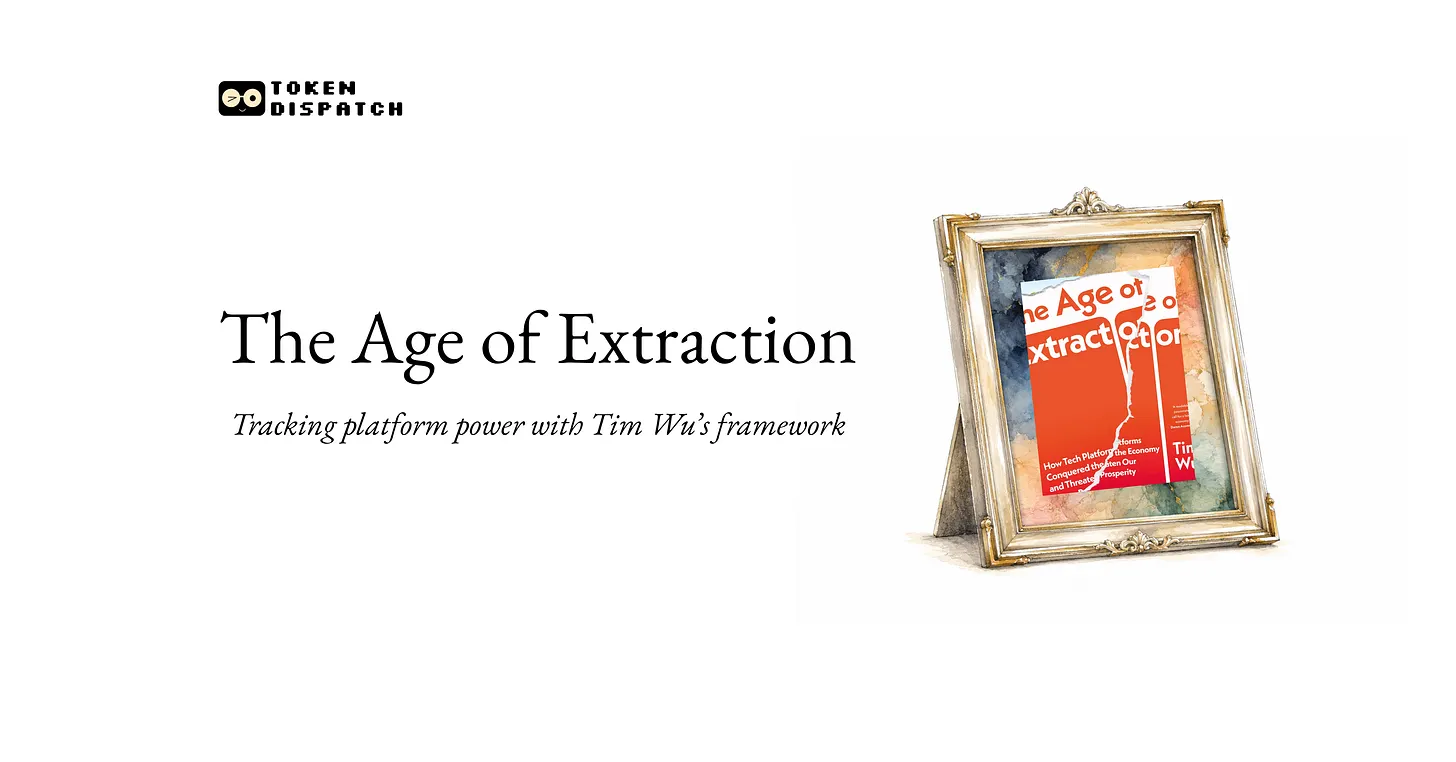
This book describes a phenomenon most of us recognize but lack words to name: the (comfortable) heaviness of staying on a platform you’re not even sure you like. Switching platforms doesn’t feel impossible—but somehow, before you’ve even begun, it leaves you utterly drained. The author borrows a term from stoner culture to describe it: “couch lock.” Its meaning is self-evident.
As always, my mind immediately jumps to crypto. Can we actually build a product smooth enough to induce “couch lock”? Or have we already promised exactly that—tried, and failed spectacularly? Are we entirely outside the cozy consumer harbor—or merely trapped at its lowest level?
Consider how apps exploit what psychologists call “variable reward schedules” to hook us. It’s the slot-machine effect that makes gambling addictive—and it’s everywhere in crypto. Price volatility acts as one of the most powerful slot machines ever invented. Most positions barely budge. Occasionally, an asset surges tenfold. That unpredictability triggers intense compulsive checking behavior—just like refreshing Instagram notifications or scrolling TikTok videos.
Crypto’s variable reward system bypasses platforms entirely, pulling people straight to price charts—where traders’ dopamine floods. It lacks the habitual, system-level dependency that Big Tech monetizes. That likely explains why, after fifteen years, speculation remains crypto’s only sustainable consumer-grade product.
Wu explains why platforms spend billions on things seemingly unrelated to their core business: Google paying $17 billion for NFL broadcast rights, or Amazon spending $11 billion on Thursday Night Football. Their target is time. They want control over enough of your Sundays that your entire week naturally orbits around one company’s interface.
Every hour you spend inside a platform’s ecosystem is an hour you’re not thinking about whether better alternatives exist elsewhere.
For Indians, watching *The Office* offers two options: Netflix and Amazon Prime. Amazon’s bundled perks make it an attractive choice—and Prime members enjoy numerous privileges.
“If it’s simple, it wins,” Wu says.
Borderless money, self-custody, transparent systems—all excellent. But this pitch demands you first convince others that something they don’t think is broken *is*, in fact, broken. Most people walking down the street aren’t pondering how to fix correspondent banking.
The internet’s “convenience gap” is obvious to everyone: “You no longer need to drive to the post office.” Okay—we’re convinced.
That before-and-after contrast is immediate and visceral. Crypto’s gap is equally real—but for ordinary people living within it, it’s almost entirely invisible. That inefficiency lives inside institutions, inside settlement layers, inside correspondent banking systems most people never need to understand. To the average user, “replacing all that with blockchain” sounds like alien gibberish.
The internet replaced things that plagued everyone: driving to a travel agency to book flights was annoying; renting movies from a video store was annoying—if you arrived late, someone else had already taken the copy. When the internet removed those barriers, people instantly felt the difference because it made their lives more comfortable. People accepted explanations of these solutions readily.
Crypto is replacing things most people have never thought about. An ordinary person sending money to family abroad knows only that it takes days and costs money. They likely don’t know what correspondent banking is. They don’t care that their $200 transfer passes through three or four intermediary banks—each charging fees. They only know the money arrives, more or less, and they’ll do it again next month.
If you swap the entire system for blockchain, the sender’s experience remains largely unchanged. It may be faster. Fees may be lower. But nothing visibly transforms their life. There’s no “aha—I’ll never have to do *that* again!” moment. That’s the problem.
Adoption has always been the industry’s challenge—not the user’s. As long as crypto requires explanation to be understood, no matter how brilliant the technology, it will remain firmly in “nerd” territory.
What’s missing from crypto? The chapter on data demands a completely fresh perspective.
Google and Meta generated $360 billion in ad revenue in 2024—because they spent two decades tracking your every move. Every scroll, every prolonged pause on a post, helped them build a machine predicting your next action. Brands pay billions for that predictive power. And we built that engine for them—free—from the moment we opened our first account.
Wu compares it to a poker game where your opponent has watched every hand you’ve ever played. They remember your bluffs and your worst calls. They play strictly by the rules—but they see right through you. That advantage compounds across billions of independent hands, ultimately building vast corporate empires.
I pause and ask: Does crypto have anything like this? No—I’m not talking about prediction markets.
Bitcoin’s entire blockchain—including every transaction since 2009—is roughly 611 GB. Meta processes more data than that every few hours. Ethereum’s on-chain data is richer, but it captures only financial behavior: wallet addresses, transaction amounts, protocol interactions. It shows *what* someone did with money—not *why*. It misses the countless tiny, everyday choices that make behavioral prediction commercially valuable.
Ninety million people use ChatGPT weekly—and share work documents, medical questions, anxieties, and business strategies. It helps them. When they use it, they don’t see the privacy trade-off.
People routinely hand over private search histories and location data to Big Tech for daily convenience. Then, turning around and asking that same audience to suddenly care deeply about financial sovereignty and transparent ledgers is wildly unrealistic. Some people *do* care. Others care but are too busy. This pitch only resonates with those already convinced. If you want mass adoption and “everything apps,” this growth strategy fails.
Wu challenges Shoshana Zuboff’s concept of “surveillance capitalism.” She claims platforms create Skinner boxes—mini-games that trick our brains into checking them repeatedly with surprise rewards. He counters that large-scale attention manipulation existed long before internet-scale data. On this point, I agree with him.
Goebbels didn’t need recommendation algorithms. Yes—the “totalitarian control” framing is overstated.
Return to variable reward schedules. As discussed at the outset, crypto has them too. The way prices surge and crash resembles a massive, thrilling game of surprises. Yet that excitement never locks you into a practical, everyday application.
The more you rely on a tool, the worse your ability becomes to do that thing without it. When the tool is a calculator, it’s no big deal. But when the tool is infrastructure owned and controlled by others, things get complicated.
Crypto keeps reproducing this problem. Developers build on sequencers they can’t control. Protocols depend on liquidity providers who can leave anytime. Apps cling to chains run by a handful of validators. Each layer feels like progress—but isn’t quite. You’ve built something on someone else’s foundation, and now you can’t move without their permission. Web2 operates the same way. When AWS goes down, half the internet goes with it.
Now we can revisit IBM’s analogy. IBM dominated its era by building elite enterprise-grade infrastructure—and letting the application layer run atop it—completely sidestepping the battle for consumer “sofalarity.”
Crypto’s best realistic outcome may look more like this—a realization we’ve only recently had: settlement rails, institutional clearing, cross-border infrastructure—nobody wants to rebuild these from scratch.
That’s a major achievement—even if it bears little resemblance to the dream of consumer-facing superapps.
In the book’s second half, the focus shifts from technology to exposing how the same corporate playbook dominates healthcare and housing. Mentioning this feels critical.
Welsh, Carson, Anderson & Stowe acquired anesthesia practices across cities—because patients under anesthesia can’t shop around. Prices rose 26% between 2012 and 2017. One patient received a bill for $108,951.
Invitation Homes has spent $150 million weekly buying foreclosed homes since 2012. Today it owns over 110,000 properties—and in 2024 paid $48 million to settle with the FTC, mailing $106 refund checks to 444,131 tenants. Yet rents rose 4.5% the quarter after the settlement.
We tout tokenized real-world assets (RWAs) as the ultimate tool for financial inclusion—arguing fractionalized real estate democratizes wealth. But does splitting a house into digital tokens really help local buyers compete against a corporation spending $150 million weekly on acquisitions?
All it does is digitize inventory for giants. Large corporations own just 1% of U.S. housing—but control 25% of Atlanta’s and 21% of Jacksonville’s housing stock.
A more liquid crypto layer simply lets Wall Street buy up these markets more easily. Tokenization won’t stop corporate landlords—it just builds them a faster ledger for collecting rent. Crypto here is a double-edged sword: entirely neutral—not an automatic savior.
The platform model merely accelerates extraction—making it hyper-efficient and inescapable. A private equity firm owning a single anesthesia clinic runs an isolated business. But when a single entity acquires *all* clinics in major metro centers, the rules change entirely. Coordinated via shared software, corporate owners raise fees uniformly across hundreds of medical facilities. Individual doctors operate blindly—unable to see the full trap. It’s old greed running on new infrastructure.
Wu draws boundaries carefully. I do not. The deep mechanics of these industries reveal a slow, primitive accumulation process unfolding within America’s middle class. This corporate transformation effectively forces doctors back into standardized labor—and traps homeowners in lifelong rental debt.
The platform model depends entirely on captive audiences and centralized gatekeepers. Yet we possess a technology fundamentally designed to smash those gates. It gives sovereign individuals tools to build their own systems—entirely beyond the reach of extractive elites. *That* is the moat.
Join TechFlow official community to stay tuned
Telegram:https://t.me/TechFlowDaily
X (Twitter):https://x.com/TechFlowPost
X (Twitter) EN:https://x.com/BlockFlow_News