UBS: Crowdedness in A-share tech stocks is far from its historical peak
TechFlow Selected TechFlow Selected
UBS: Crowdedness in A-share tech stocks is far from its historical peak
Historical patterns show that each style rotation typically lasts three years.
 Navigating Web3 tides with focused insights
By Xu Chao
Source: Wallstreetcn
The A-share technology sector has rebounded strongly, with trading volume hitting record highs—prompting rising market concerns over overcrowding. However, UBS Securities’ latest research report offers a more reassuring assessment: although the large-tech sector’s trading volume and market capitalization share have both surpassed historical highs, core indicators measuring institutional positioning concentration suggest current overcrowding remains far below historical peaks—and the duration of this technology-growth style cycle has yet to reach two years.
According to UBS Securities’ latest report, as of Q1 2026, mutual funds’ overweight position in the large-tech sector (including electronics, telecommunications, computer science, and defense) stood at 9.9%, down from 11.6% in Q3 2025 and significantly below the historical peak of 14.1% in Q4 2015; it also pales in comparison to the consumer sector’s historical peak overweight of 18.7%.
UBS notes that mutual funds’ overweight positions typically take about three years to rise from cyclical lows to peaks—yet this technology-growth style cycle, initiated by the policy pivot in September 2024, has lasted less than two years so far.
Meanwhile, A-share earnings recovery is accelerating, providing stronger fundamental support for the market’s upward momentum.
UBS forecasts that aggregate A-share earnings growth will rise from 3.9% in 2025 to 11% in 2026. In Q1 2026, non-financial A-share earnings grew 11.8% year-on-year, while gross and net profit margins both hit their highest levels since 2023. Sustained inflows across multiple funding channels, continuous expansion of thematic ETF assets under management (AUM), and a rebound in private fund issuance collectively constitute key micro-liquidity support for the current market.
Tactically, under UBS’s baseline “slow bull” scenario, the firm favors growth and cyclical styles. At the sector level, UBS highlights electronics, telecommunications, electrical equipment, machinery, non-ferrous metals, and chemicals as top picks—and maintains “Buy” ratings on multiple related stocks.
Room Remains for Tech Overweighting; Current Style Cycle Still Short-Lived
Trading activity and fund concentration in the technology sector have surged notably recently.
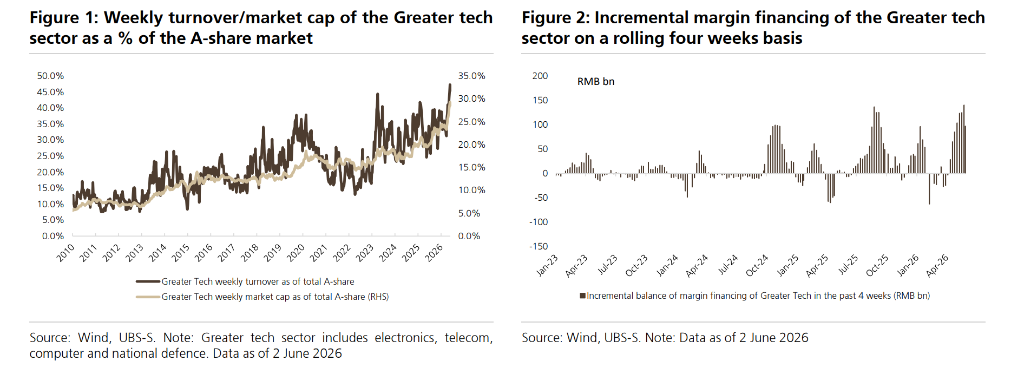
Per UBS data, as of June 2, 2026, the large-tech sector’s weekly trading volume accounted for 45.5% of total A-share volume, while its market cap represented 28.6% of the entire market—both metrics at historical highs. Since the U.S.-Iran ceasefire and subsequent risk sentiment recovery on April 8, the STAR 50 and ChiNext indices have risen 35.5% and 30.4%, respectively—significantly outperforming the Wind Full A Index (+11.0%) and the CSI 300 Index (+9.8%) over the same period.
However, UBS cautions that judging overcrowding solely by trading activity or short-term gains is misleading; mutual funds’ overweight ratio remains the more critical indicator of institutional positioning concentration. From this perspective, the current large-tech sector overweight ratio not only falls short of its own historical peak but also lags far behind the consumer sector’s historical highs—including 22.8% in Q3 2010 and 21.0% in Q3 2012.
UBS reviewed historical patterns of five major A-share style rotations since 2014:
- 2014–2015: Leveraged funding drove sharp market swings;
- 2017–2019: Foreign capital inflows propelled the “white horse stock” rally;
- 2019–2021: Mutual funds chased compounding-earnings companies, creating positive feedback;
- 2022–2024 (pre-policy pivot): Insurance funds and “national team” players drove defensive sectors ahead;
- Post-policy pivot in 2024: Margin financing, ETFs, and private fund flows pushed small-cap and growth styles into favor.
The analysis found that each style rotation—from emergence to reversal—typically lasts about three years: high-earnings visibility for any single sector rarely persists beyond three years, and fund positioning concentration faces natural ceilings; once excess returns narrow, redemption pressure transmits to stock prices and triggers trend reversals.
That said, certain sub-sector allocation signals warrant attention. The electronics sector’s overweight ratio has reached 6.6%, surpassing its prior high of 5.4% in Q3 2020; the telecommunications sector’s overweight ratio has hit a new 2010–2026 high for three consecutive quarters, reaching 4.0%. UBS says it will continue monitoring these indicators closely.
Accelerating Earnings Recovery Solidifies Market Upside
UBS forecasts aggregate A-share earnings growth will rise to 11% in 2026 and notes that both top-down and bottom-up indicators confirm an accelerating earnings improvement trend.
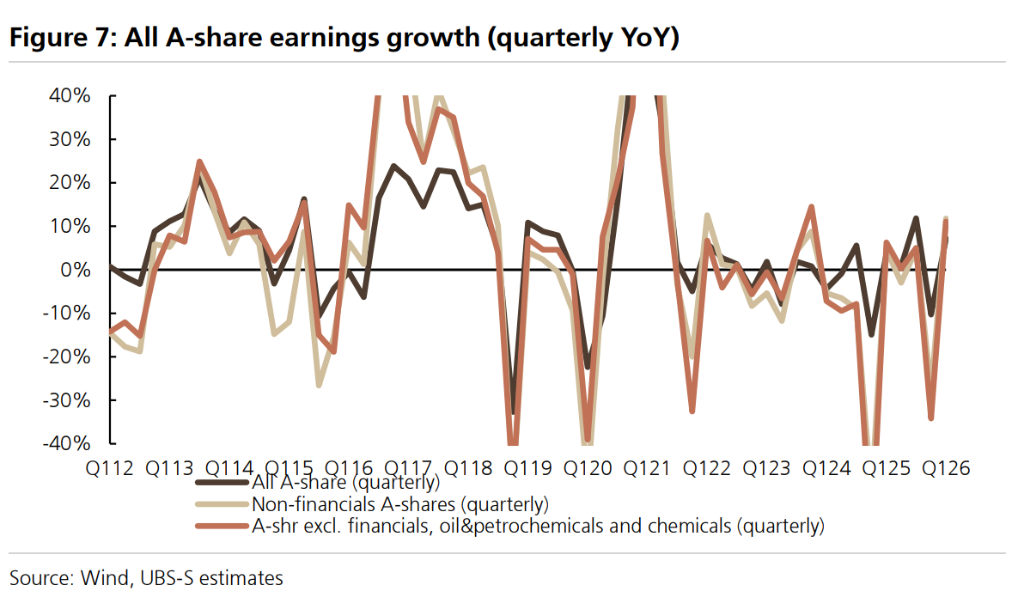
Q1 2026 financial results show non-financial A-share earnings growth jumped sharply to 11.8% year-on-year, up from just 0.8% in 2025; excluding oil, petrochemicals, and basic chemicals, growth reached 12.3%. STAR Market earnings surged 204.7% year-on-year, while ChiNext rose 22.7%—both vastly outpacing the Main Board’s 5.5%. Gross and net profit margins rose 0.6 and 0.3 percentage points year-on-year, respectively—the highest since 2023—indicating downstream firms’ profitability pressures remain manageable despite elevated oil prices.
At the macro level, April’s PPI rose 2.8% year-on-year and CPI rose 1.2%; UBS expects inflation to rise further over the coming months. As non-financial A-share revenue growth correlates strongly with nominal GDP and PPI trends, rising inflation will directly accelerate top-line expansion.
Bottom-up data similarly confirm the earnings upswing.
In the first four months of this year, profits of designated large-scale industrial enterprises rose 18.2% year-on-year, with profits in the computer, communications, and electronic equipment manufacturing sector surging 107.7%. Profits in non-ferrous metal mining, coal mining, and coal washing rose 94.9%, 26.0%, and 21.0%, respectively. On earnings expectations, IT, raw materials, real estate, and energy sectors all saw their six-month forward earnings growth forecasts revised upward by over 20 percentage points—a trajectory highly reminiscent of prior earnings upcycles in 2017, 2019, and 2021.
Looking at the medium term, rising overseas business exposure provides another key margin-support pillar. Non-financial A-share overseas revenue share has steadily increased from 9.5% in 2010 to 18.7% in 2025, and overseas gross margins have consistently exceeded domestic ones—with the gap widening further in 2025. UBS believes continued implementation of “anti-intra-competition” policies and supportive measures will further boost industry-level profitability over the medium term.
Tactical Allocation: Growth & Cyclical Sectors in Focus; Six Sectors Overweighted
At the style-allocation level, UBS favors growth under its baseline “slow bull” scenario; rising PPI and industrial profit growth support cyclical styles; and sustained liquidity abundance and high market turnover favor small-cap styles.
However, the ongoing expansion of thematic ETF AUM is providing additional funding support to leading companies. UBS expects relative performance between large- and small-cap styles in H2 2026 to be more balanced than in 2025.
At the sector level, UBS overweights six areas: electronics (benefiting from semiconductor inventory cycle recovery and AI-driven innovation); telecommunications (AI compute demand and broad rollout of industrial internet driving earnings growth among sub-sector leaders); machinery (automation equipment and industrial robots gaining from domestic capital expenditure recovery and import substitution); non-ferrous metals (rising copper and aluminum prices, lithium demand recovery); chemicals (accelerated bottom formation amid anti-intra-competition progress and overseas capacity exits); and electrical equipment (policy support and AI data center power demand boosting energy storage development).
Join TechFlow official community to stay tuned
Telegram:https://t.me/TechFlowDaily
X (Twitter):https://x.com/TechFlowPost
X (Twitter) EN:https://x.com/BlockFlow_News