SaaS Battle Royale: The Surviving Winners Share One Common Trait
TechFlow Selected TechFlow Selected
SaaS Battle Royale: The Surviving Winners Share One Common Trait
SaaS Death Match: Who Will Win?
 Navigating Web3 tides with focused insights
Author: Consult Daoist Zhao for K-line analysis; TideFlow Research
Today, Microsoft’s annual developer conference, Build, opened in San Francisco’s Fort Mason Center. Nadella’s keynote delivered a single, clear message: AI is no longer just an assistant that answers questions—it is now an employee that does the work for you.
This conference arrives at a telling moment. Over the past five months, the U.S. software sector has undergone a brutal shakeout.
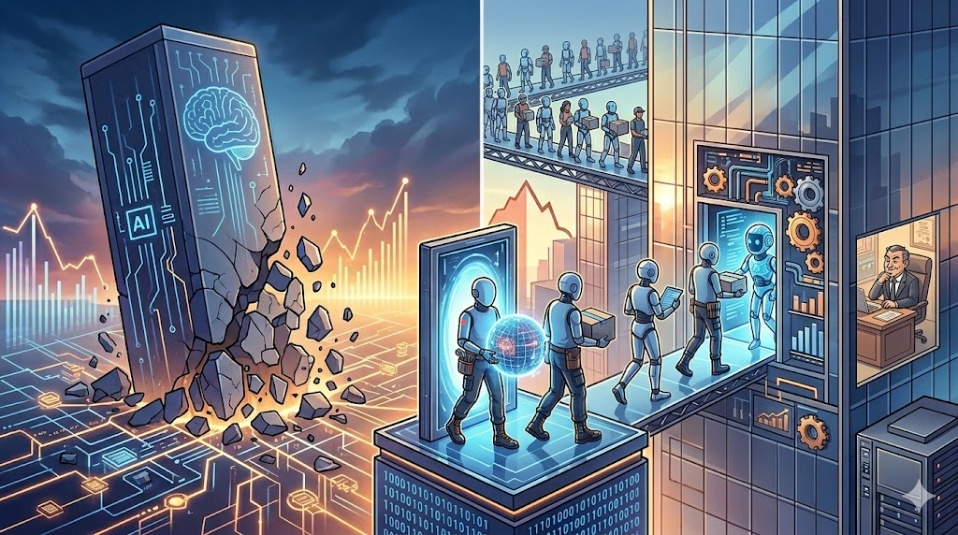
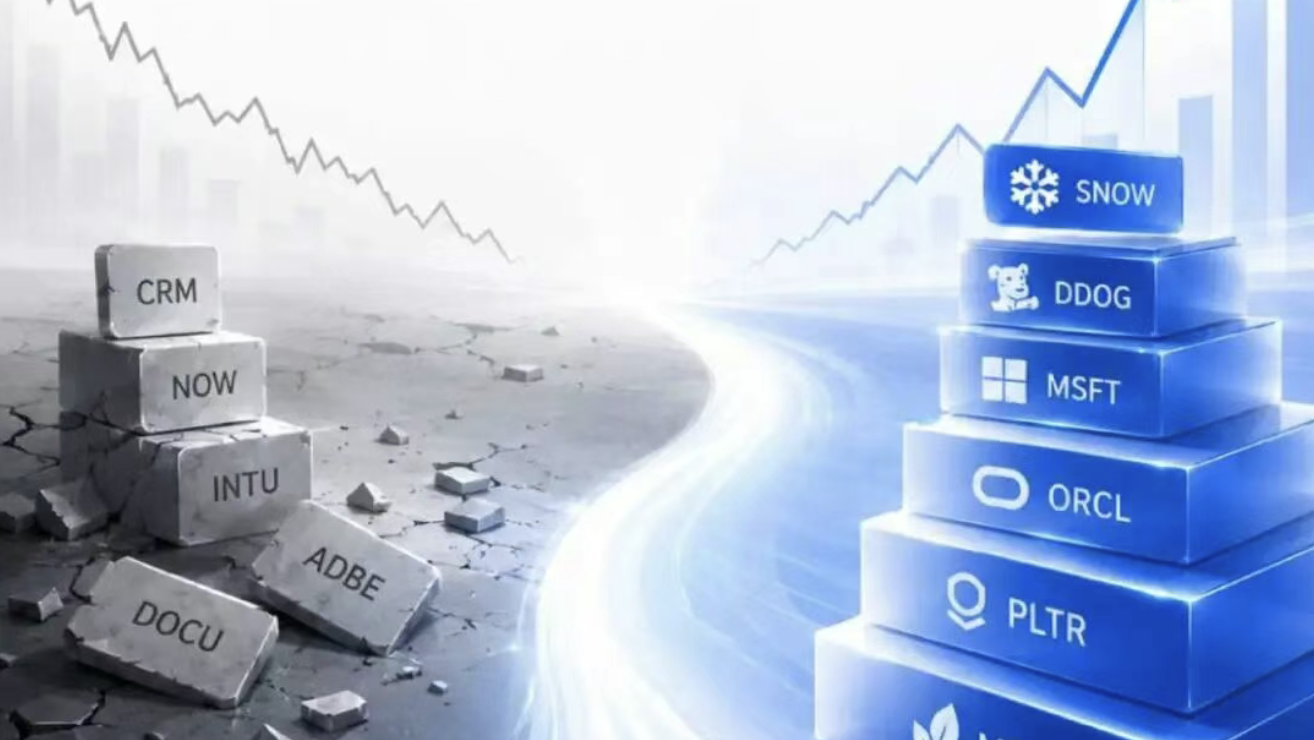
Markets have dubbed this carnage the “SaaSpocalypse”—a SaaS apocalypse. From the start of the year through mid-May, Salesforce fell 33%, Intuit dropped nearly 30%, and even Workday and Adobe failed to escape unscathed. The panic logic is straightforward: AI agents can perform the work of ten people—so enterprises no longer need to buy ten software seats. The per-seat pricing model, which has underpinned the entire SaaS industry for two decades, has had its foundation pulled out from under it.
Yet last week, a group of companies suddenly rose up from the slaughterhouse floor.
On May 28, Snowflake surged 36.5% in a single day—the largest one-day gain since its IPO. Datadog’s stock doubled year-to-date, hitting an all-time high on May 29. On the same day, MongoDB rose 10%, Palantir climbed 8%, and all three indices reached new highs.
Meanwhile, another group remains flat on the ground. Intuit plunged as much as 19% following its earnings report. Though Salesforce beat EPS expectations by 24%, its stock still declined after earnings—and remains down 28% year-to-date.
In the same broad selloff, some stocks doubled while others were cut in half. What explains the difference?
Snowflake Lit the Spark
What gives Snowflake the power to ignite this rally? Its pricing model.
Over the past five months, market panic has centered on one concrete thing: per-seat pricing. The logic is simple—if AI agents can do the work of ten people, enterprises won’t need ten software seats. Atlassian reported its first-ever decline in enterprise seat count this year—a fear grounded in real data.
Snowflake stands precisely opposite this fear. It doesn’t charge per seat; it charges based on compute usage and data processing volume. Far from reducing demand, AI is exploding it: AI accounts on its platform jumped from 9,100 to 13,600 in a single quarter; product revenue rose 34% year-on-year; the company raised its full-year guidance—and announced a $6 billion procurement deal with AWS for AI compute capacity.
Datadog tells the flip side of the same story. While Snowflake proves “AI is feeding data platforms,” Datadog proves “AI is feeding monitoring platforms.” Its Q1 revenue crossed $1 billion for the first time, growing 32% year-on-year—accelerating for three consecutive quarters (from 25% to 29% to 32%). Full-year guidance was raised to $4.3–$4.34 billion. The logic is straightforward: the more AI workloads enterprises deploy, the more they need to monitor and debug—and the faster Datadog’s usage-based billing meter spins. Its RPO (Remaining Performance Obligations) grew 51% year-on-year to $3.48 billion, indicating not only active usage but also longer-term contract commitments. Its stock doubled year-to-date and hit an all-time high on May 29.
One sentence captures the rally’s core thesis: AI is generating more workload for certain platforms—not replacing them. Snowflake and Datadog are the two cleanest examples.
The Other Face of the Market—Same Week
If you declare “software stocks are saved” after seeing Snowflake alone, you’ll fall into another trap.
Salesforce’s Q1 earnings report—released the same week—tells a far more complex story than “weak guidance.”
First, the good news: Q1 revenue hit $11.13 billion, up 13% year-on-year and above expectations; adjusted EPS was $3.88—24% higher than Wall Street’s $3.12 forecast; and most critically, Agentforce (its AI agent platform) achieved $1.2 billion in annualized recurring revenue (ARR), up over 200% year-on-year. The company processed 380 million agent work units and 286 trillion AI tokens in the quarter—real AI monetization, not just PowerPoint.
Salesforce is even proactively shifting toward consumption-based pricing. It launched “Flex Credits,” moving beyond pure per-seat billing to charge based on the volume of work completed by AI agents. Six of its top-ten deals in Q1 were tied to Flex Credits from inception. This company is straining hard to cross the dividing line between “per-seat” and “per-usage” models.
Yet the market’s reaction? Its stock fell in after-hours trading following the report. As of last Friday, Salesforce remained down ~28% year-to-date. Why? Because Q2 guidance slightly missed the most bullish forecasts—and Tableau and Commerce Cloud posted weak results.
What does this mean? That dividing line is very real—but crossing it takes time. The market rewards companies already on the consumption side (e.g., Snowflake) with a 36% single-day surge, yet refuses to grant credit to those still striving across (e.g., Salesforce). Intent to transform ≠ successful transformation.
Intuit serves as another counterexample. Its TurboTax—a task-based, consumer-facing tax filing tool—is the most direct target of the “AI displacing human labor” fear. Its stock opened ~19% lower post-earnings.
Build Conference: Three Signals Worth Watching
The Build conference is underway—and revealing more than expected.
Signal One: Microsoft Is Decoupling from OpenAI.
Project Polaris—the AI coding model unveiled at Build—will replace GPT-4 as GitHub Copilot’s default engine this August. Running on Microsoft’s proprietary Maia AI accelerators, Polaris signals Microsoft’s full-stack reclamation—from model to chip to developer tools. The commercial tension between OpenAI and Microsoft has long been evident: two overlapping-interest companies sharing the same user base. Polaris is Microsoft’s formal answer to that tension.
Signal Two: Agents Are No Longer Demos—They’re Becoming Part of the OS.
Agent Mode is now the default for Office 365 Copilot: open Word, Excel, or PowerPoint, and AI runs as an “agent” capable of planning and executing multi-step tasks. The Windows Agent Framework has been open-sourced (MIT license); the Windows Agent Store offers developers an 85% revenue share; Adobe and Zoom are already launch partners. Nadella put it plainly: AI has evolved from a “synchronous assistant” into an “asynchronous colleague capable of independently executing long-term, cross-domain tasks.”
Signal Three: A $9.7 Billion Pentagon Contract.
One day before Build opened, the Pentagon announced a five-year, $9.7 billion software consolidation contract—to unify scattered Microsoft 365 subscriptions across military departments, intelligence agencies, and the Coast Guard under a single agreement. This isn’t new spending; it’s a re-negotiation of existing, fragmented procurement. But the signal is unmistakable: for the world’s largest single software buyer, Microsoft’s seat-based model isn’t being weakened by AI—it’s being further locked in.
Where Exactly Does That Dividing Line Lie?
Returning to the central question: who did this rally reward—and who did it leave behind?
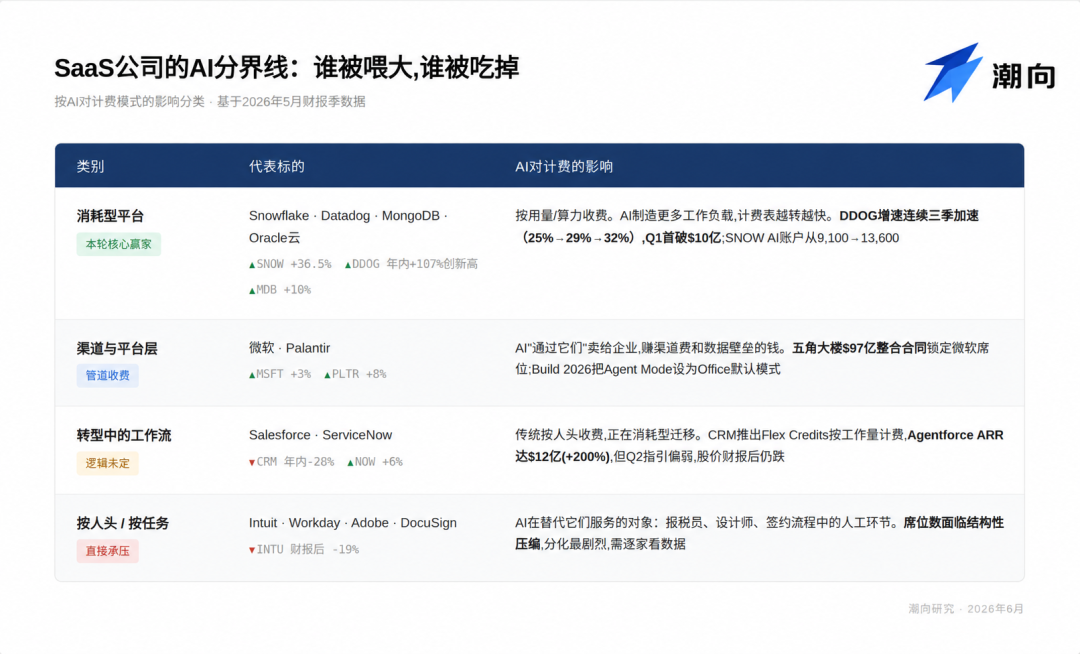
We can categorize software companies into four groups:
Group One: Consumption-Based Platforms. Examples include Snowflake, Datadog, MongoDB, and Oracle’s cloud business. AI drives greater demand for data processing, monitoring, and compute—spinning their usage-based meters ever faster. Datadog deserves special attention: its growth rate accelerated from 25% → 29% → 32%—an extremely rare feat among large-cap SaaS firms—and makes it the rally’s central winner.
Group Two: Distribution & Platform Layers. Examples include Microsoft and Palantir. AI sells *through* them—and they profit from distribution fees and data moats. Microsoft’s $9.7 billion Pentagon contract, Copilot Studio, and Azure AI Foundry all reinforce this position.
Group Three: Workflow Companies in Transition. Examples include ServiceNow and Salesforce. Their legacy model is per-seat; they’re migrating toward value- or consumption-based pricing. Salesforce’s Flex Credits exemplify this effort. These companies have rebounded partially—but markets await proof that their transition pace is fast enough.
Group Four: Directly Pressured Per-Seat / Per-Task Companies. Examples include Intuit, Workday, Adobe, and DocuSign. AI directly replaces the humans these companies serve—tax preparers, designers, manual signing steps—exposing them to the most acute pressure and sharpest divergence. Seat-level metrics must be assessed individually.
What to Watch Next?
The peak of panic has passed—but this isn’t a green light to buy blindly. Three things warrant close tracking:
First, Will the Dividing Line Expand—or Contract? Will the rally broaden beyond consumption-based platforms to include companies that can deliver hard evidence of “AI lifting per-seat value”? If it expands, the sector is healing broadly; if it stays confined to Snowflake and peers, the market has simply adopted a stricter filter.
Second, Can Salesforce’s Flex Credits and Agentforce Sustain Acceleration? This is the largest single test case for whether “per-seat companies can successfully cross over.” $1.2 billion ARR validates the direction—but Tableau and Commerce Cloud’s drag shows legacy businesses still sap transformation momentum. In the next earnings report (September 2), watch whether Agentforce ARR reaches $1.5 billion—and what share of new contracts ties to Flex Credits.
Third, Post-Build Enterprise Adoption Data for Microsoft Copilot. Now that Agent Mode is default, changes in paid seat counts and token consumption will directly test the core hypothesis: “Do agents feed platform revenue—or displace human seats?”
Markets have moved past the question “Will AI kill software?” and entered the discernment phase: “Who gets fed—and who gets eaten?” Seeing where that dividing line lies matters far more than chasing any single rally.
This article is an independent analysis by TideFlow Research based on publicly available information. Mentioned stocks and views are for research reference only and do not constitute investment advice. Markets carry risk; decisions must be made independently.
Sources: Snowflake FY2027 Q1 Earnings · Salesforce FY2027 Q1 Earnings & SEC Filings · Microsoft Build 2026 Official Announcements · ChatForest Build 2026 Recap · CNBC · Reuters · Seeking Alpha
Join TechFlow official community to stay tuned
Telegram:https://t.me/TechFlowDaily
X (Twitter):https://x.com/TechFlowPost
X (Twitter) EN:https://x.com/BlockFlow_News
 @BlockFlow_News





![[Beginner’s Anti-Scam Guide] Breaking Free from TradFi Yield-Mindset: The Right Approach to Web3 Wealth Management and Asset Allocation Logic](https://upload.techflowpost.com//upload/images/20260514/20260514121206644491.png)