








The Next Phase of Cryptocurrency Lies Not in the U.S., But in Emerging Markets
TechFlow Selected TechFlow Selected
The Next Phase of Cryptocurrency Lies Not in the U.S., But in Emerging Markets
The next real competition will not be about market热度 but about actual adoption and usage rates.
 Navigating Web3 tides with focused insights
By Liam Akiba Wright
Translated by Chopper, Foresight News
Compared to the bustling U.S. crypto market, Israel and Pakistan staged a far quieter—but profoundly consequential—test this month. The industry’s truly pivotal transformation in 2026 may well be unfolding where digital assets deeply integrate with local currencies and banking systems.
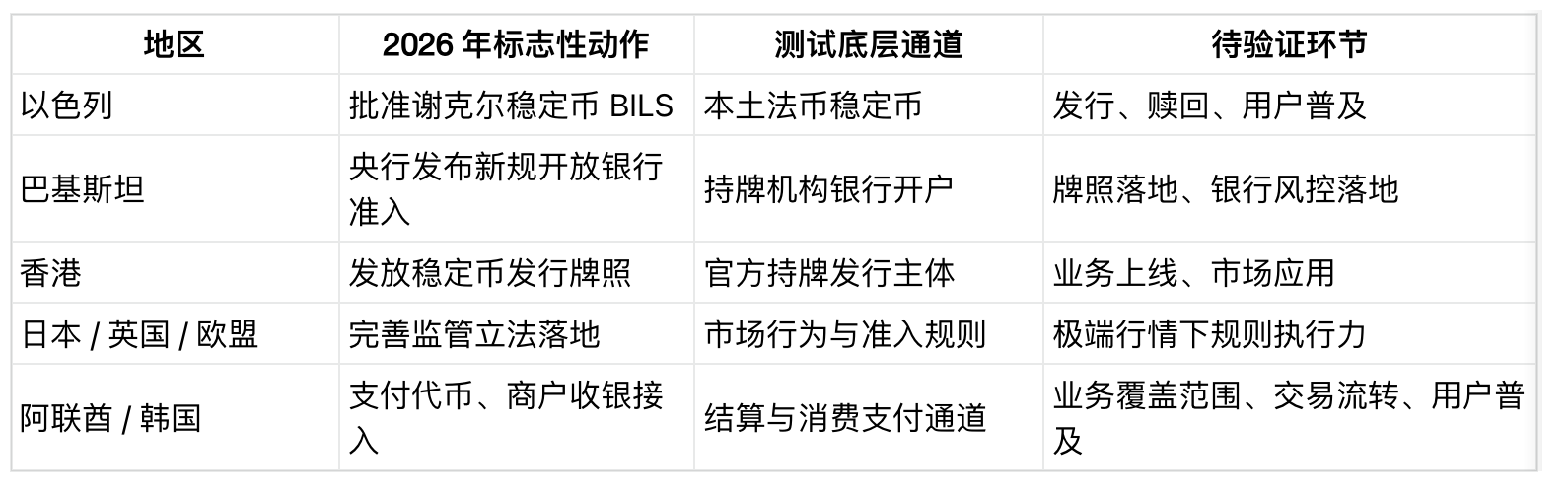
Israeli crypto firm Bits of Gold announced that, after two years of piloting, the Israel Securities Authority has approved the issuance and circulation of BILS—a stablecoin pegged to the Israeli shekel. Just days earlier, the State Bank of Pakistan issued Notice No. 10 of 2026, formally repealing its 2018 ban on virtual currencies.
Pakistan’s new regulation explicitly permits licensed Virtual Asset Service Providers (VASPs) and other authorized entities to open bank accounts—provided they operate within a compliant regulatory framework.
These developments exist on an entirely different plane from the U.S. spot ETF boom, yet they point toward the foundational logic shaping crypto’s future: Can cryptocurrencies transcend their role as mere investment instruments and become fully embedded in mainstream financial infrastructure?
The U.S. has delivered regulatory legitimacy and liquidity to the crypto industry—and ignited a contest over digital dollar governance. Meanwhile, other countries and regions are testing an alternative foundational capability: Can crypto seamlessly interoperate with local fiat currencies, bank accounts, merchant payment and settlement systems—and establish practical, enforceable regulatory rules?
We may need to redefine how we measure global crypto adoption. Bitcoin ETFs merely offer investors another asset allocation channel; compliant local-fiat stablecoins let users hold their national currency directly on-chain.
When central banks permit licensed crypto firms to open compliant bank accounts, they build the critical bridge connecting the industry to formal banking systems. ETFs only affirm crypto’s status as an asset class; local stablecoins and bank access truly test whether crypto can evolve into usable, inclusive financial infrastructure for everyone.
Everything remains in early pilot stages. BILS still needs formal issuance and real-world deployment; Pakistan must cultivate licensed service providers and forge stable banking partnerships. Other jurisdictions are advancing similar initiatives: Hong Kong’s newly licensed stablecoin issuers await official business launch; the UAE, South Korea, Japan, the UK, and the EU are each rolling out distinct components of comprehensive crypto adoption frameworks—including payment tokens, merchant point-of-sale settlement, market conduct supervision, licensing regimes, and risk-control compliance standards.
The UAE still needs to clarify the relationship between dirham token issuance and central bank registration. Yet the trend is increasingly clear: In 2026, the industry’s real-world implementation focus is shifting decisively toward deep integration between digital assets and fiat currencies, banking systems, merchants, and clearing & settlement infrastructures.
Local Fiat Currencies and Banking Services
Bits of Gold stated that the approved BILS will initially be issued on Solana, with pilot partners including Fireblocks, QEDIT, EY, and the Solana Foundation.
The policy’s greatest significance lies in on-chain fiat digitization. BILS introduces the shekel into an on-chain ecosystem still dominated by dollar-pegged stablecoins—and poses a critical question: Can a national currency obtain a programmable version without ceding its entire payments layer to dollar tokens?
This reflects a struggle over monetary sovereignty. Dollar-pegged stablecoins have become the dominant settlement medium in crypto markets; once the shekel stablecoin launches successfully and gains traction, Israel could build its own domestic currency payment rails atop the same on-chain infrastructure. Its value lies not in market hype, but in whether wallets, exchanges, payment processors, and regulated institutions voluntarily integrate and sustain long-term usage.
Pakistan, meanwhile, has completed the crucial banking-linkage piece. The State Bank of Pakistan’s new regulation replaces the 2018 ban, permitting regulated banks to open accounts for VASPs and their users—provided those entities are duly licensed and compliant. It also mandates that all such banking relationships meet rigorous requirements: risk-control reviews, documentation filing, fund monitoring, user risk screening, and strict adherence to Pakistan’s virtual asset regulatory framework.
This fundamentally transforms the operating environment for licensed crypto firms. Bank accounts constitute the most basic infrastructure of any financial system—and directly determine whether compliant firms can custody client funds, reconcile balances, fulfill due diligence obligations, and bring transactions under regulatory oversight.
In Pakistan—where on-chain crypto adoption has ranked among the world’s highest for years—banking access will decide whether the industry remains confined to informal, peer-to-peer circulation or advances into a traceable, institutionalized, formal development phase.
Hong Kong is likewise following a “license-first, then launch” path. On April 10, the Hong Kong Monetary Authority granted stablecoin issuer licenses to two institutions: Anto Financial and The Hongkong and Shanghai Banking Corporation Limited (HSBC). The licenses took effect immediately—marking Hong Kong’s transition from policy planning to licensed-entity implementation. Next steps include actual business launch and broad market-user adoption.
Global crypto foundational infrastructure deployment in 2026 is clearly visible:
Brazil, Singapore, Thailand, and the Philippines are similarly advancing crypto compliance across multiple fronts—from virtual asset licensing and stablecoin regulation to tokenized clearing, cross-border tourism payments, and bank custody services.
Regulatory Frameworks Are Becoming New Financial Infrastructure
Regulatory frameworks themselves are evolving into foundational industry infrastructure.
Japan’s Financial Services Agency (FSA) plans to upgrade cryptocurrency oversight from the Payment Services Act to the stricter Financial Instruments and Exchange Act—strengthening disclosure requirements, institutional risk controls, market manipulation surveillance, insider trading restrictions, supervisory authority, and investor protection mechanisms. This means crypto assets will enter a rigorous financial regulatory regime, where licensing eligibility hinges on behavioral compliance, ongoing supervision, and accountability.
It confirms that regulatory design itself constitutes foundational infrastructure. Markets rely on laws to define entry permissions, custody qualifications, marketing boundaries, and legal liabilities for trading behavior.
The UK is also steadily constructing its regulatory architecture. A new crypto business license application window opens from September 30, 2026, to February 28, 2027; the new rules take full effect on October 25, 2027, concurrently implementing detailed provisions on licensing, ongoing supervision, consumer rights, asset custody, prudent operations, and market anti-manipulation measures.
The EU’s MiCA regulation is now fully implemented, establishing a unified crypto rulebook covering transparency, mandatory disclosures, entity licensing, day-to-day supervision, consumer protection, market fairness, and financial stability.
Global regulation is no longer a unilateral national endeavor—it’s a multi-jurisdictional, coordinated effort. The biggest shift in 2026 is that regulatory rules now directly determine whether crypto products can access mainstream, formal financial channels.
The UAE has introduced a regulatory framework for payment tokens and published a list of licensed entities on its central bank’s website. Several financial institutions have also received approval to issue the dirham-pegged stablecoin DDSC—for institutional payments, clearing, liquidity pool management, and cross-border trade settlement. Currently limited to institutional use cases, large-scale retail adoption remains unproven.
South Korea has completed the merchant payment linkage. In March, Crypto.com partnered with KG Inicis to integrate crypto payments into a vast merchant network, serving both foreign tourists and domestic e-commerce users—merchants may choose to receive settlements in fiat or digital assets. Korea’s K Bank is also collaborating with Ripple to pilot cross-border payments, exploring integration models between traditional banking systems and crypto payment rails. The core value of such initiatives lies in extending crypto applications beyond pure investment into real-world scenarios: point-of-sale settlement, cross-border remittances, and everyday consumption.
Real-World Implementation Is the Ultimate Test
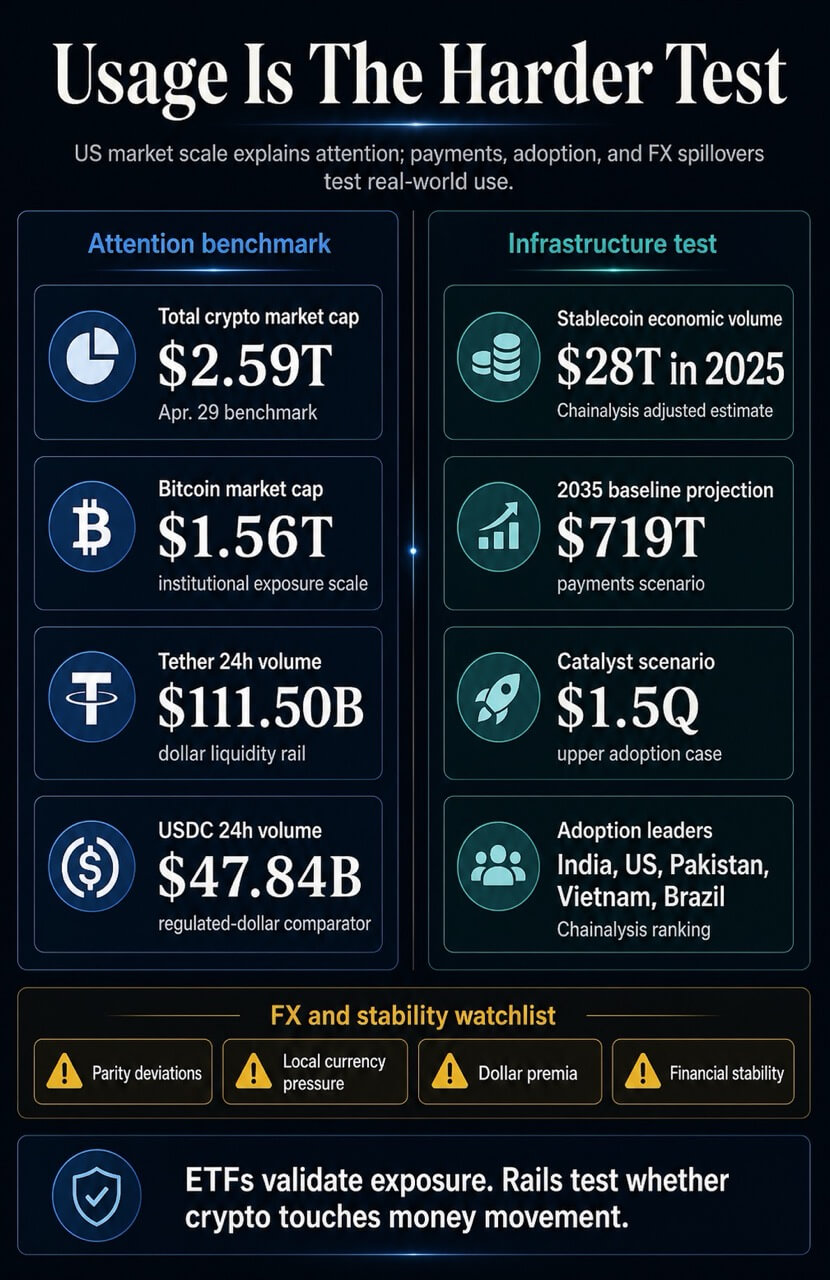
The U.S.-centric narrative remains dominant—thanks to sheer scale. As of April 29, total crypto market capitalization approached $2.59 trillion, with Bitcoin at roughly $1.56 trillion. Dollar-pegged stablecoins still monopolize market liquidity: USDT’s 24-hour trading volume stood at ~$111.5 billion, and USDC’s at ~$47.84 billion.
This massive scale ensures U.S. policy and the dollar settlement system remain the global focal point. The stablecoin debate underpinning the CLARITY Act is, at heart, a contest for economic dominance of the digital dollar. Dollar liquidity remains the irreplaceable cornerstone of global crypto infrastructure.
Yet real-world usage metrics are reshaping evaluation criteria. Chainalysis data shows global stablecoin economic transaction volume reached $28 trillion in 2025—and is projected to surge to $719 trillion by 2035, potentially nearing $1.5 quadrillion under optimistic scenarios. While these forecasts stem from modeling, they signal a clear trend: stablecoins’ value has expanded beyond trading collateral into three core domains—payment infrastructure, corporate treasury management, and cross-border clearing.
Emerging markets sit squarely at the center of this transformation. Chainalysis’ Global Crypto Adoption Index ranks India first, followed by the U.S., Pakistan, Vietnam, and Brazil—with adoption spanning all income levels. Sustained, real-world adoption hinges on on-ramp accessibility, regulatory clarity, and maturity of financial and digital infrastructure—the very challenges now being tested by Pakistan’s banking access and Israel’s local stablecoin pilots.
The International Monetary Fund (IMF) has also flagged risks: cross-border stablecoin flows could distort exchange rates, depreciate local currencies, inflate dollar premiums, and threaten overall financial stability. Put simply, when stablecoins become deeply embedded in foreign exchange markets, their influence surges—and so does the complexity of associated policy negotiations.
A tension thus emerges: Local fiat stablecoins preserve national currency relevance in on-chain finance; banking access brings crypto firms under regulatory purview; merchant payment integration moves crypto beyond investment into daily settlement. Yet each new channel raises the bar for reserve oversight, redemption mechanisms, anti-money laundering (AML), market manipulation prevention, and foreign exchange risk management.
The current landscape is already sharply bifurcated: U.S. ETFs and Wall Street’s entry have achieved crypto’s financialization—lowering barriers to mainstream asset allocation. But the far more difficult—and fundamentally more important—adoption challenge is now unfolding under regulators worldwide: Can crypto truly interface with local fiat, bank accounts, merchant payments, and foreign exchange markets?
All initiatives remain in early stages. BILS awaits formal issuance and user adoption; Pakistan awaits licensed entities’ actual integration into banking systems; Hong Kong’s newly licensed firms await operational launch; Japan, the UK, and the EU await real-world stress-testing of their regulations amid extreme market conditions; the UAE needs to finalize issuance-registration alignment rules; South Korea needs merchant payment volumes to demonstrate genuine transaction scale.
If all these pilots succeed, the global crypto landscape will no longer revolve around U.S.-driven investment cycles—but instead evolve into regionally distinct financial ecosystems, each absorbing and integrating crypto assets within its own sovereign regulatory framework. If pilots fall short, the dollar and U.S. capital markets will continue to steer the industry’s trajectory.
The next true competition won’t hinge on market热度—but on real-world usage rates.
Join TechFlow official community to stay tuned
Telegram:https://t.me/TechFlowDaily
X (Twitter):https://x.com/TechFlowPost
X (Twitter) EN:https://x.com/BlockFlow_News
 @CryptoSlate









