Bitget UEX Daily Report | Crude Oil Surges Short-Term, Volatility Intensifies; Nasdaq and S&P 500 Hit New Highs; Tesla’s Earnings Beat Expectations
TechFlow Selected TechFlow Selected
Bitget UEX Daily Report | Crude Oil Surges Short-Term, Volatility Intensifies; Nasdaq and S&P 500 Hit New Highs; Tesla’s Earnings Beat Expectations
Overall, short-term risk assets are boosted by easing geopolitical tensions; medium-term, close attention should be paid to Fed policy signals and the sustainability of Q2 earnings season. A balanced allocation between technology growth and value-defensive assets is recommended.
 Navigating Web3 tides with focused insights
Author: Bitget
I. Key News Highlights
Federal Reserve Updates
Trump Sets No Final Deadline for Iran Ceasefire Extension
- Trump indicated U.S.-Iran negotiations could resume as early as Friday but set no final deadline for extending the ceasefire; Israeli media reported the truce expires on the 26th, while Iran denied altering its “no negotiations” stance but acknowledged receiving U.S. signals to lift maritime restrictions; with Pakistan mediating, the probability of talks resuming within the next 36–72 hours has increased.
- Trump’s approval rating has fallen to 33% (down 5 percentage points since March); 73% of respondents rated the U.S. economy as “poor,” and 72% believe the country is headed in the “wrong direction.”
- Market impact: Short-term geopolitical easing boosted risk appetite, lifting both U.S. equities and cryptocurrencies; however, unresolved multi-front tensions across the Middle East continue to support oil price volatility, and the Fed’s policy path may face dual tests from inflation and growth dynamics.
Macroeconomic Policy
Goldman Sachs and Howard Marks Warn “Easy Money” Is Over
- Goldman Sachs’ trading desk noted that systematic buying—previously driving the S&P 500 rally—is entering its “final phase”; erratic movements among low-quality stocks signal disordered positioning, and market participants are shifting from passive momentum-chasing to active fundamental analysis.
- Howard Marks observed the S&P 500’s P/E ratio remains around 22x—still above its historical average—and thus “not cheap”; amid geopolitical uncertainty and AI-driven disruption, sentiment has turned more pessimistic, prompting investors to focus on “whether it’s still worth buying at today’s price” rather than waiting for a bottom.
- Market impact: Though robust corporate earnings continue supporting the equity rally, mounting pressures have led institutions toward greater caution. Supply shortages of power, water, copper, aluminum, and other metals—driven by AI data center expansion (Bank of America forecasts data center electricity demand will exceed Japan’s by 2030)—remain underpriced; medium- to long-term fundamental valuation will increasingly dictate market direction.
II. Market Recap
Commodities & FX Performance
- Spot Gold: Up 0.13%, rebounding to $4,745 after falling to $4,694.
- Spot Silver: Up 0.56% to $78, broadly tracking gold.
- WTI Crude Oil: Up 0.6% to $93.45.
- Brent Crude Oil: Up 0.68% to $102.61.
- U.S. Dollar Index: Rebounded for two consecutive days to 98.55.
Cryptocurrency Performance
- BTC: Up ~2.5% over 24 hours to ~$78,274; intraday high breached $79,000—the highest since February 2—fueled by geopolitical easing and a tech-led U.S. equity rally.
- ETH: Up ~1.77% over 24 hours to ~$2,366, posting a modest rebound aligned with broader markets; altcoin sentiment improved.
- Total Crypto Market Cap: Up ~1.9% over 24 hours to ~$2.7 trillion.
- Liquidations: Total 24-hour liquidations amounted to ~$462 million, including ~$352 million in short positions (indicating clear short squeezes).
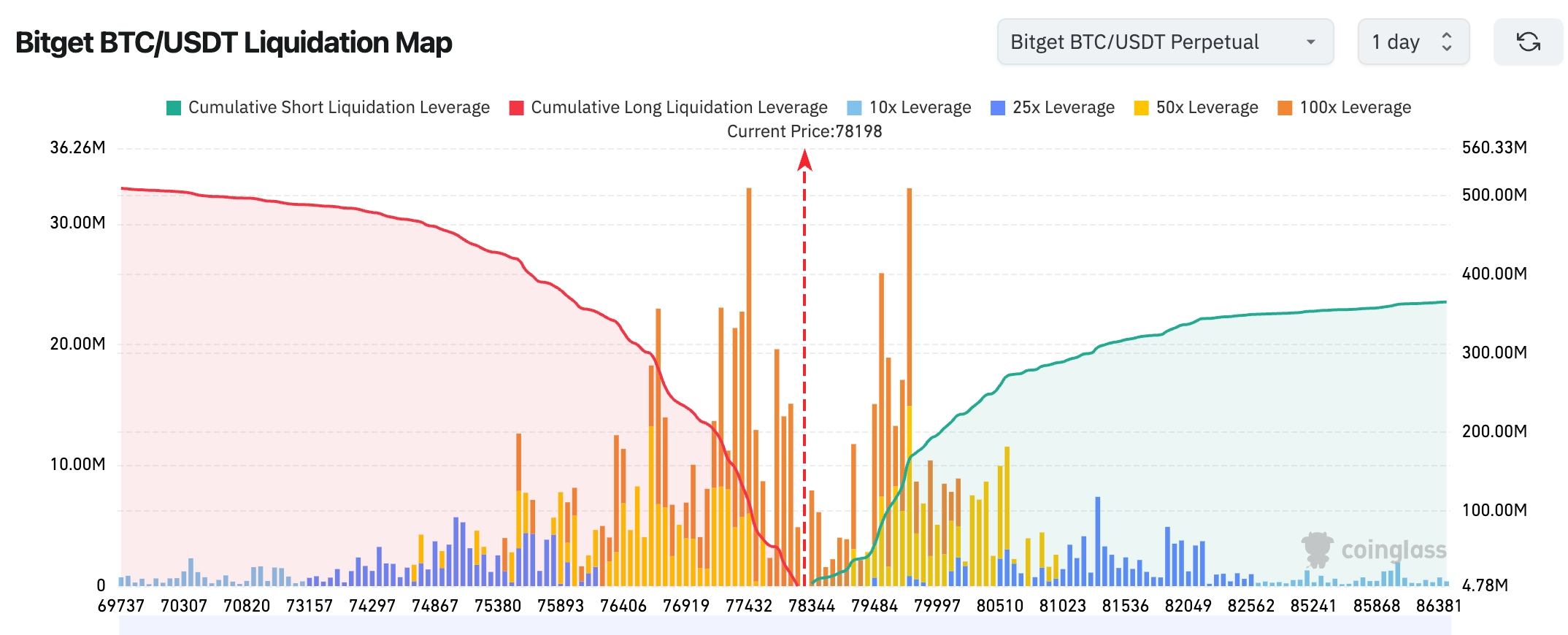
- Bitget BTC/USDT Liquidation Map: Current price ~$78,200 sits near the edge of a dense long liquidation zone, making sharp bid-ask sweeps likely in the short term. Cumulative short liquidation volume above this level continues rising, implying a relatively high probability of a short squeeze upon breakout—favoring further upside.
- Spot ETF Net Flows: BTC spot ETFs saw ~$85 million net inflow yesterday; ETH spot ETFs recorded ~$42.8 million net inflow (primarily driven by BlackRock and others).
- BTC Spot Flows: $2.783 billion inflow vs. $2.568 billion outflow yesterday, yielding a net inflow of ~$214 million—clear evidence of ongoing institutional accumulation.
U.S. Equity Indices Performance
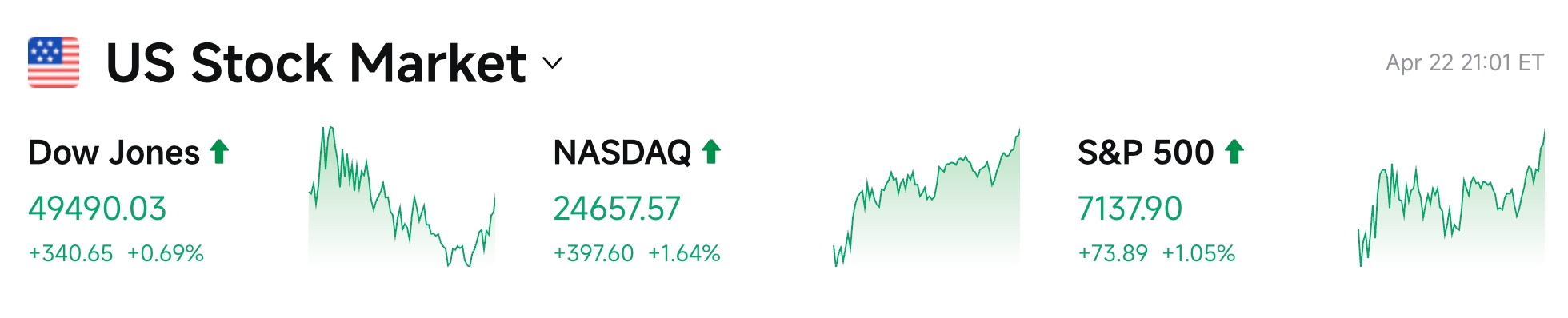
- Dow Jones Industrial Average: Up 0.69% to 49,490.03—rising for consecutive sessions but with relatively muted gains.
- S&P 500: Up 1.05% to 7,137.90—setting another record closing high, driven by strong earnings and geopolitical easing.
- Nasdaq Composite: Up 1.64% to 24,657.57—also hitting a new record close, led by technology stocks.
Tech Giants’ Updates
- NVIDIA (NVDA): Up ~1.2% to $200.50, sustained by robust AI demand.
- Microsoft (MSFT): Up 1.5% to $424.22, supported by steady cloud + AI business performance.
- Apple (AAPL): Up 0.8% to $268.00, backed by resilience in services and hardware.
- Amazon (AMZN): Up 0.6% to $249.84, reflecting continued cloud growth.
- Google (GOOGL): Up 2.2% to $330.47, buoyed by AI agent announcements and new TPU releases at Cloud Next.
- Meta (META): Up 0.9% to $668.53, as ad revenue and AI investment ROI become evident.
- Tesla (TSLA): Fell >2% post-market after briefly surging >4%; closed ~$386.42—Q1 results were strong, but elevated capex guidance triggered volatility.
Core Drivers Summary: Robust AI and semiconductor demand, combined with geopolitical easing, lifted all seven tech giants. Software stocks posted their eighth consecutive day of gains—up nearly 20% from April lows.
Sector Rotation Observations
Semiconductor Sector: Up ~2.7%
- Key names: Micron (MU) +8.48%, AMD +6.67%, Broadcom (AVGO) +5.09%.
- Catalysts: Surging demand for AI high-performance memory and compute; the Philadelphia Semiconductor Index extended its winning streak to 16 days—the longest in history; optical communication stocks POET and IPWR surged >20% intraday.
SaaS & Software Sector: Partial pullback
- Key name: ServiceNow fell >13.55% post-market.
- Catalysts: Middle East conflict delayed large contract deliveries; M&A activity temporarily compressed margins; and Wall Street’s skepticism about enterprise software’s prospects in the AI era intensified.
III. In-Depth Stock Analysis
1. Tesla — Q1 Earnings Show Highest Growth in Three Years, But Capex Guidance Sparks Volatility
Event Summary: Tesla’s Q1 total and automotive revenues rose 16% YoY, driven by rebounding demand in Europe and North America; energy revenue declined 12% YoY; service revenue accelerated 42% YoY, with paid Robotaxi miles nearly doubling QoQ; gross margin rose to 21%—a three-year high; capex came in below expectations, and the company invested $2 billion in SpaceX. Cortex 2 is now live; Dojo 3 development is underway; Optimus factory prep begins in Q2 (Phase I target: 1M units/year; Phase II: 10M units/year). Shares jumped ~4% post-earnings before reversing to fall >2% after Musk signaled sharply higher capex and CFO confirmed >$25 billion for the year. Market Interpretation: Institutions see resilient auto demand and long-term Robotaxi/Optimus narratives supporting valuation, yet elevated capex and slowing energy segment triggered short-term profit-taking; some analysts maintain “Buy” ratings but lowered near-term price targets, closely watching Q2 deliveries and production ramp. Investment Implications: Near-term volatility will intensify; monitor progress on Robotaxi and Optimus commercialization. The AI + robotics theme retains long-term potential—but position sizing must be disciplined.
2. SK Hynix — Q1 Net Profit Soars 500%, Setting a New Record
Event Summary: SK Hynix reported FY2026 Q1 revenue of ₩52.58 trillion (up 60% QoQ, up 198% YoY), operating profit of ₩37.61 trillion (up 96% QoQ, up 405% YoY), and net profit of ₩40.35 trillion; operating margin hit 72% and net margin 77%—both quarterly records. Core drivers include substantial DRAM/NAND price increases and higher shares of premium products; the company emphasized AI computing’s surging demand for high-performance memory, constrained supply, and a favorable pricing environment expected to persist. Market Interpretation: Wall Street broadly expects the memory cycle to extend, with AI data centers boosting demand for HBM and high-end DRAM; as a leading supplier, SK Hynix’s pricing power has strengthened. Some institutions raised price targets, expecting tight supply-demand balance through 2026 to sustain profitability. Investment Implications: A core beneficiary of AI infrastructure, with current earnings validating an upward cycle—suitable for medium- to long-term allocation. Monitor future pricing and inventory data closely.
3. ServiceNow — Results Meet Expectations, Yet Post-Earnings Drop of 13.55% Drags Down Sector
Event Summary: ServiceNow’s Q1 revenue reached $3.77 billion (+22% YoY), matching consensus; Q2 guidance slightly exceeded expectations. However, Middle East conflict delayed large deal deployments; M&A exerted temporary margin pressure; and persistent Wall Street concerns about AI disrupting traditional enterprise software intensified. Shares plunged 13.55% post-earnings, dragging down the broader SaaS sector. Market Interpretation: Analysts cite execution headwinds and macro uncertainty alongside growing fears of AI displacing legacy SaaS models; despite solid guidance, elevated valuations accelerated profit-taking, prompting some institutions to downgrade ratings or lower price targets. Investment Implications: High-valuation growth stocks require heightened vigilance regarding macro and structural risks. Consider re-evaluating fundamentals after a meaningful pullback.
4. Boeing — Q1 Revenue Up 14%, Backlog Hits Record $69.5 Billion
Event Summary: Boeing’s Q1 revenue totaled $22.2 billion (+14% YoY), exceeding expectations; net loss narrowed to $7 million; commercial aircraft deliveries rose 10%; backlog across all three segments reached $69.5 billion—a new high; operating cash flow remained negative, but debt repayment for the quarter totaled $7 billion; capex doubled to $1.275 billion. Market Interpretation: Institutions view this as a sign of aviation recovery, with production ramp-up and deleveraging progressing in tandem; the massive backlog provides long-term visibility; although cash flow pressure persists, accelerating 787 and 777X deliveries could restore confidence. Investment Implications: A long-cycle aviation beneficiary—ideal for patient, long-term holders. Monitor delivery progress and supply chain improvements.
5. IBM — Q1 Results Beat Estimates, Yet AI Disruption Concerns Persist
Event Summary: IBM’s Q1 total revenue rose 9% to $15.9 billion (beating estimates); software revenue grew 11% to $7.05 billion; adjusted EPS of $1.91 also beat expectations; full-year guidance remains unchanged. However, both overall and software revenue growth rates decelerated, failing to fully alleviate investor concerns about AI eroding traditional businesses. Market Interpretation: Wall Street acknowledges ongoing cloud and AI transformation but judges pace insufficient; hybrid cloud and consulting resilience provide valuation support. Some analysts maintain “Neutral” ratings, noting that growth premiums require clearer validation of AI’s contribution. Investment Implications: A value-oriented tech stock with strong dividend appeal—well-suited for defensive portfolios—but its growth ceiling hinges on tangible AI adoption outcomes.
IV. Cryptocurrency Project Updates
1. On-chain analysts report that the KelpDAO hacker has converted nearly all 75,700 ETH (~$175 million) into BTC. The primary cross-chain protocol used was THORChain—whose platform recorded $800 million in transaction volume and $910,000 in fee revenue directly attributable to the hacker’s activity.
2. Token Terminal data shows total on-chain TVL of tokenized U.S. Treasuries has surpassed $14 billion—a new all-time high. Franklin Templeton’s Benji Fund saw on-chain assets grow >381% over the past month, becoming the fastest-growing tokenized debt issuer.
3. Thailand’s Securities and Exchange Commission announced it is revising licensing rules for digital asset derivatives trading, allowing digital asset operators to offer derivative contracts referencing digital assets without establishing new legal entities—aiming to recognize digital assets as a formal asset class and provide investors with additional hedging tools.
4. Investment bank TD Cowen identified five major hurdles facing the Clarity Act beyond stablecoin yield concerns: (i) The Commodity Futures Trading Commission (CFTC) currently has only one sitting commissioner; filling vacancies and confirming nominees may take months, yet the legislative deadline falls in late July. (ii) Regulatory clarity for prediction markets—if included, could alienate Democratic lawmakers. (iii) Ongoing scrutiny of World Liberty Financial, a crypto project linked to the Trump family, may hinder bipartisan support. (iv) Reports that Iran is considering requiring cryptocurrency payments for Strait of Hormuz transit fees could increase pressure on anti-money laundering provisions. (v) The Credit Card Competition Act may be bundled into the crypto bill. Senator Tillis stated the Senate Banking Committee won’t vote on the bill until May at the earliest, and stablecoin yield compromise language may not surface until just before deliberations begin.
5. Tesla made no adjustments to its Bitcoin holdings in Q1 2026, retaining 11,509 BTC. At the current ~$78,000 price, this represents ~$880 million. Due to Bitcoin’s decline from ~$90,000 at year-start to ~$68,000 by end-March, Tesla reported a $173 million after-tax impairment loss on its digital assets.
6. BlackRock has continued accumulating Bitcoin, raising its current BTC holdings to ~806,700 coins—valued at ~$63.73 billion, a new all-time high.
V. Today’s Market Calendar
Data Release Schedule

Key Event Preview
Thursday (April 23)
- U.S. Initial Jobless Claims for week ending April 18: Watch labor market data for implications on Fed policy expectations.
- Intel (INTC) reports Q1 earnings after market close ★★★★ (Focus on chip demand trends and AI-related developments, which may materially impact the semiconductor sector.)
Institutional Views:
Goldman Sachs’ trading desk explicitly warned that the “final stage of systemic support” has arrived—now that “easy money” is exhausted, markets are pivoting to fundamental valuation. Rising energy costs are eroding both corporate profits and consumer purchasing power. Howard Marks bluntly noted the S&P 500’s 22x P/E remains “not cheap,” and with geopolitical tensions and AI disruptions weighing, sentiment has turned pessimistic: investors should disregard cost basis and ask only, “Is it still worth buying at today’s price?” Meanwhile, Bank of America highlighted that AI data center expansion will trigger a full-chain crisis in power, water, and critical metals—projecting that data center electricity consumption may surpass Japan’s by 2030, with the true bottleneck being “deliverability,” not cost. While earnings beats from Tesla and SK Hynix validate AI demand resilience, Middle East uncertainty and stretched valuations may constrain near-term upside. Overall, short-term risk assets benefit from geopolitical easing; medium-term direction hinges on Fed policy signals and sustainability of Q2 earnings season. A balanced portfolio allocating across tech growth and value-defensive assets is advised.
Disclaimer: The above content was compiled via AI search and verified manually prior to publication. It does not constitute any investment advice.
Join TechFlow official community to stay tuned
Telegram:https://t.me/TechFlowDaily
X (Twitter):https://x.com/TechFlowPost
X (Twitter) EN:https://x.com/BlockFlow_News