MYX Case Breakdown: The Complete “Reaping” Scheme Behind the Fake Surge in Cryptocurrency Token Prices
TechFlow Selected TechFlow Selected
MYX Case Breakdown: The Complete “Reaping” Scheme Behind the Fake Surge in Cryptocurrency Token Prices
Why Do You Still Get Liquidated When Shorting, Even Though You’ve Seen Through the Bubble?
 Navigating Web3 tides with focused insights
By Vaidik Mandloi
Translated by Saoirse, Foresight News
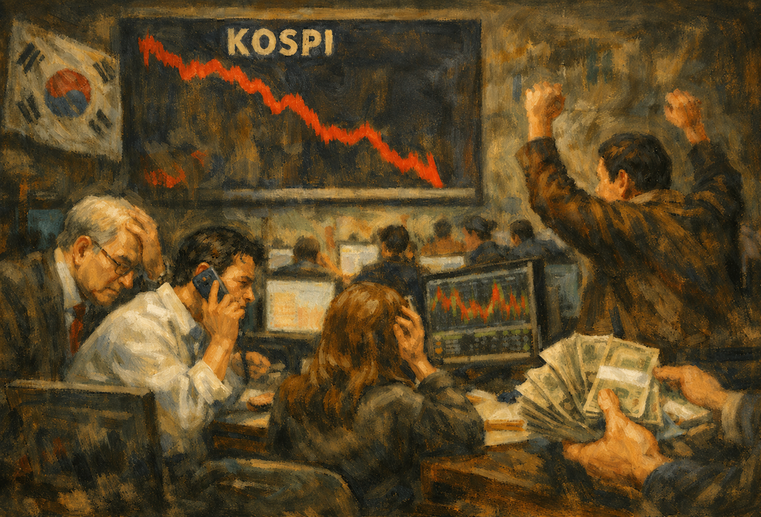
Right now, on crypto social platforms, there’s always a trader watching a token that surged 1,400% in one week. It’s the classic pump-and-dump scheme—but this project has virtually no real users, and the vast majority of its tokens are held in just a handful of dormant wallets. Having seen this pattern countless times, he knows exactly how it will end.
So he does what any rational trader would: he opens a short position. He’s convinced the token is about to collapse—then logs off and goes to sleep. When he wakes up the next day, his short has already been liquidated.
The most counterintuitive point here is that his judgment wasn’t wrong. The rally itself was indeed a false bubble. He simply didn’t understand who—or rather, what—he was actually betting against.
This isn’t fiction. It’s exactly what happened with the MYX token in September 2025. In just one week, MYX’s price soared from $1.30 to $18.42—despite zero major announcements, no product updates, no new users, and no genuine on-chain transaction activity. Traders who saw through the artificial pump and shorted the token collectively lost $89.51 million.
Tokens like this are known in the industry as “crime coins.” The issuing team locks up the overwhelming majority of circulating supply and colludes with market makers to manipulate price movements—trapping retail traders on both long and short sides alike. This article dissects the full operational supply chain, identifies who controls the tokens, and explains why the entire crypto industry continues to tolerate such abuses.
Foundational Setup
Every crime coin originates from a formal written agreement between two parties.
One party is the token-issuing project; the other is the market maker—the institution responsible for placing bid/ask orders on exchanges to ensure the token remains tradable. While this arrangement is standard across crypto, what makes crime coins unique lies in the contract’s fine print.
A typical profit-sharing model is 7:3—$0.70 of every $1.00 in trading profits goes to the market maker, $0.30 to the project. But the contract doesn’t just divide revenue—it explicitly stipulates that, post-launch, the market maker must “manage and guide” the token’s price.
The industry euphemistically calls this “price guidance,” but in practice, it means the market maker is hired to arbitrarily inflate or suppress the token’s price according to the joint needs of both parties each month. Data from MYX—and dozens of other tokens built using the same template—shows this single-cycle model can generate over $30 million in profit.
Even more critical is how the market maker obtains its tokens: it never buys them outright—it borrows them.
This is known as the “lending-options model,” the de facto standard paper process for project–market-maker collaboration. At launch, the project lends a massive quantity of tokens—often worth tens of millions of dollars—to the market maker. The loan carries a 12-month term: at maturity, the market maker must either return the tokens unchanged or repurchase them at a pre-agreed premium price.
But theory and reality diverge sharply: on the day it receives the tokens, the market maker dumps them all at once, flooding the market and crashing the price. Once the price hits a low, it quietly buys back the same number of tokens cheaply and returns them to the project—profiting from the spread.
Crime coins adopt this lending model—and add a second extraction layer: in addition to profiting from dumping borrowed tokens, the operators also specifically target and harvest retail traders who spot the manipulation and short the token anticipating a crash. The precise mechanics are detailed below.
For this scheme to work smoothly, the project and market maker must collectively monopolize nearly the entire token supply—and most crime coins achieve exactly that.
Over 90% of the total supply ends up concentrated in wallets controlled by a single operator. On blockchain explorers, these appear as dozens of seemingly unrelated addresses—creating the illusion of decentralized, retail-style distribution. Yet on-chain forensic analysis confirms they’re all controlled by one entity, deliberately fragmented to simulate dispersion.
Take MYX as an example: concentration reaches extreme levels. At peak price, only ~20% of tokens circulated outside the project and its affiliates. The remaining 80% splits into two buckets: one portion locked in vesting contracts (completely untradeable), and another held by core team members and early investors—who technically hold sellable tokens but voluntarily lock them up. In either case, none of these tokens enter the open market.
In conventional crypto tokens, fully diluted valuation (FDV) and circulating market cap are distinct metrics: FDV counts total supply; circulating market cap counts only tokens actively trading. Crime coins erase this distinction entirely—even tokens nominally classified as “circulating” cannot be freely traded in practice.
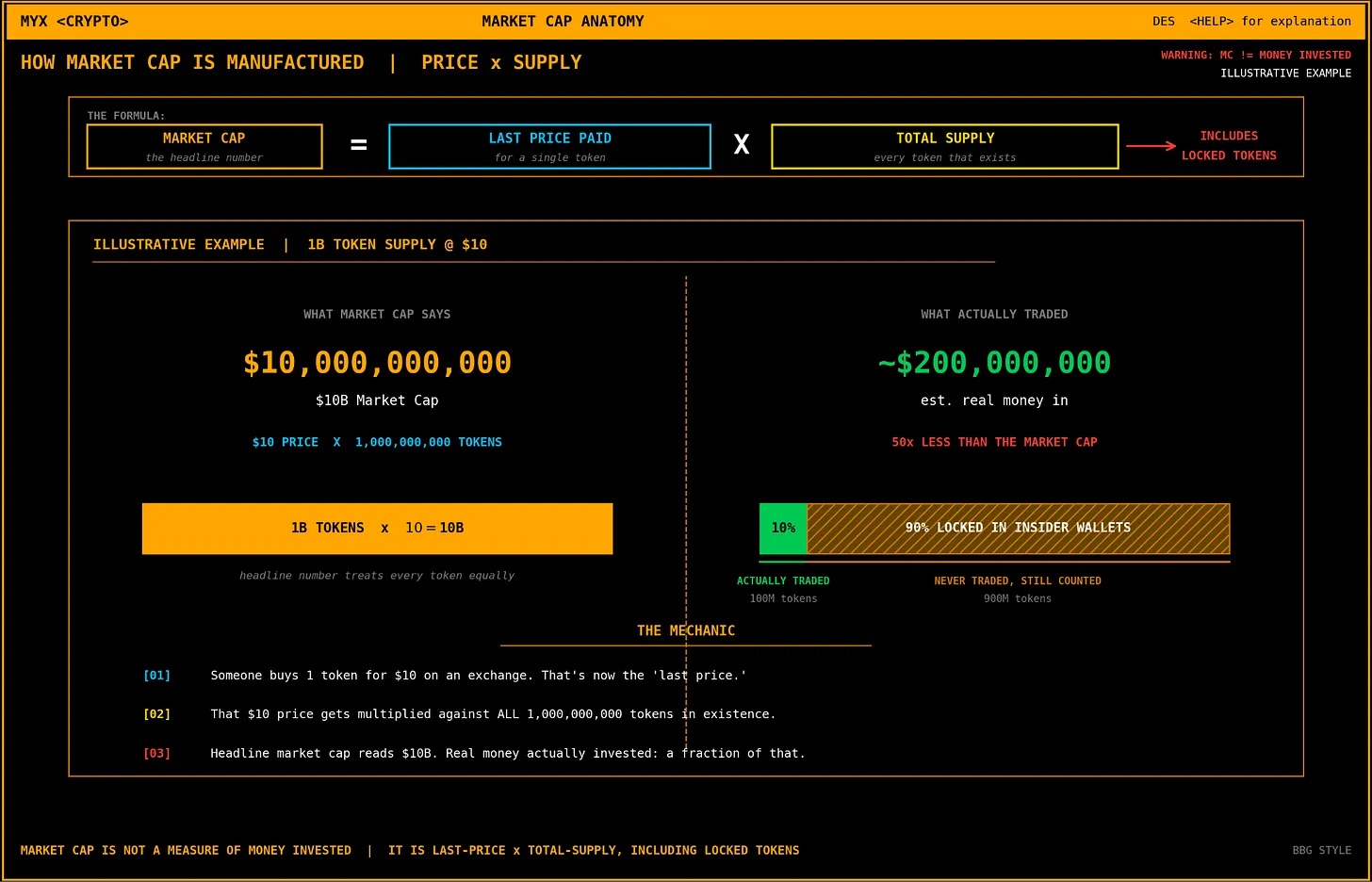
MYX Token | Market Cap Breakdown: How Market Cap Is Artificially Manufactured
This explains how MYX’s market cap ballooned from $200 million to $3.35 billion in one week—despite zero new users and zero external capital inflows into its protocol. A tiny fraction of genuinely traded tokens on exchanges sets the price for the vast majority of illiquid supply.
Any basic data check immediately reveals the grotesque disconnect between price and fundamentals. Total Value Locked (TVL)—a standard DeFi metric representing funds users deposit into protocols to access services—remained flat at $25–32 million throughout MYX’s $3.35 billion market cap surge. Its market cap / TVL ratio hit 100—versus 1–4 for top-tier DeFi protocols like Uniswap and Aave. From a revenue perspective, MYX generated only ~$5 million annually, yet commanded a $1.77 billion market valuation—implying a P/E ratio of ~3,500x.
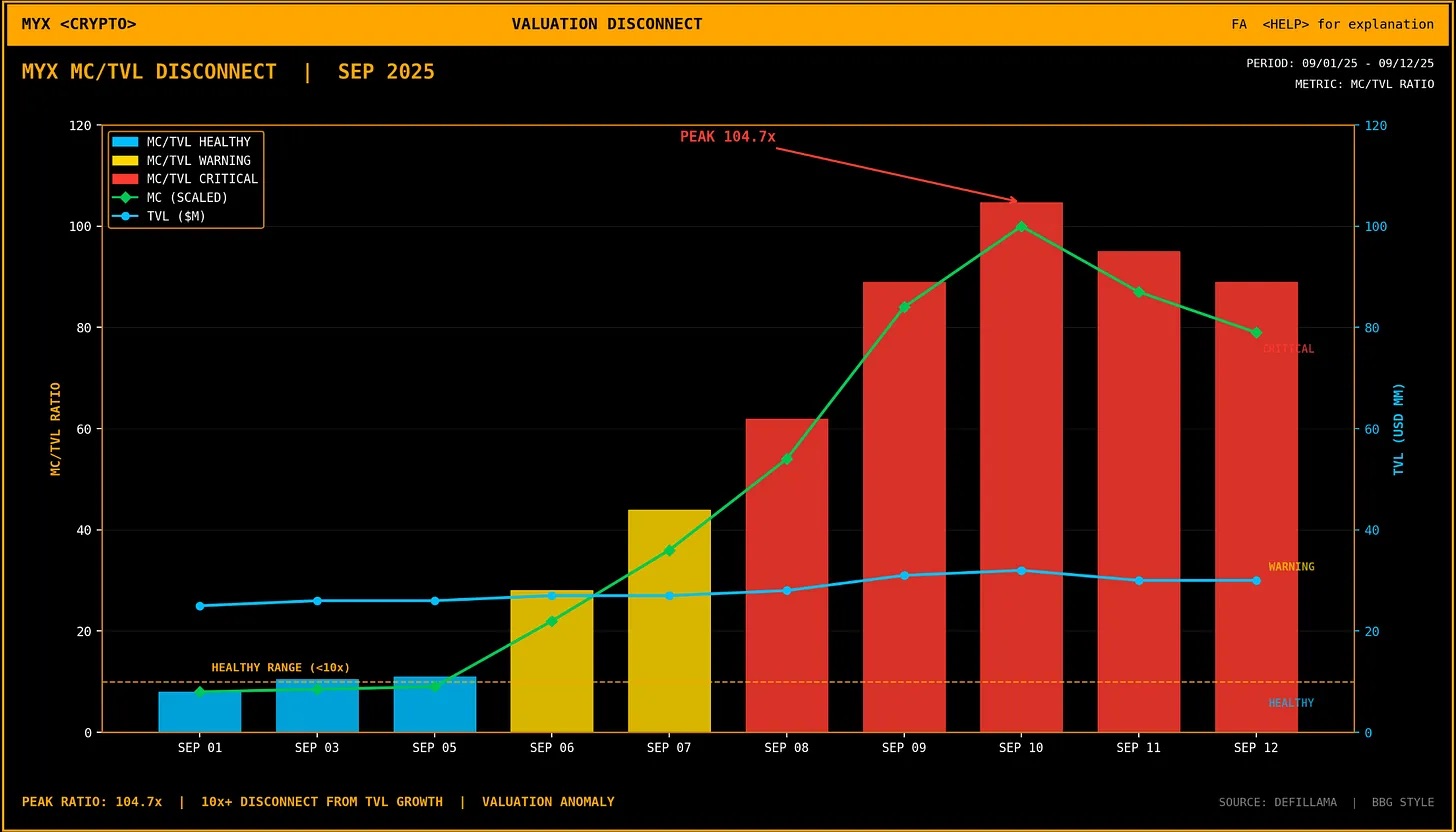
Market Cap / TVL Ratio Severely Distorted
Long before the public noticed MYX’s surging hype, the entire setup had been in motion for months. Several months prior to the rally, operators conducted wash trading across multiple exchanges—including PancakeSwap, Bitget, and Binance.
Wash trading occurs when a single entity acts as both buyer and seller, artificially inflating volume. Exchange listings and promotional support heavily rely on reported trading volume; fabricating volume on one platform often triggers listings on others. Tracing MYX’s order flow reveals that thousands of small buy orders across platforms all ultimately converge into one central wallet. A single operator creates the illusion of organic demand via self-trading.
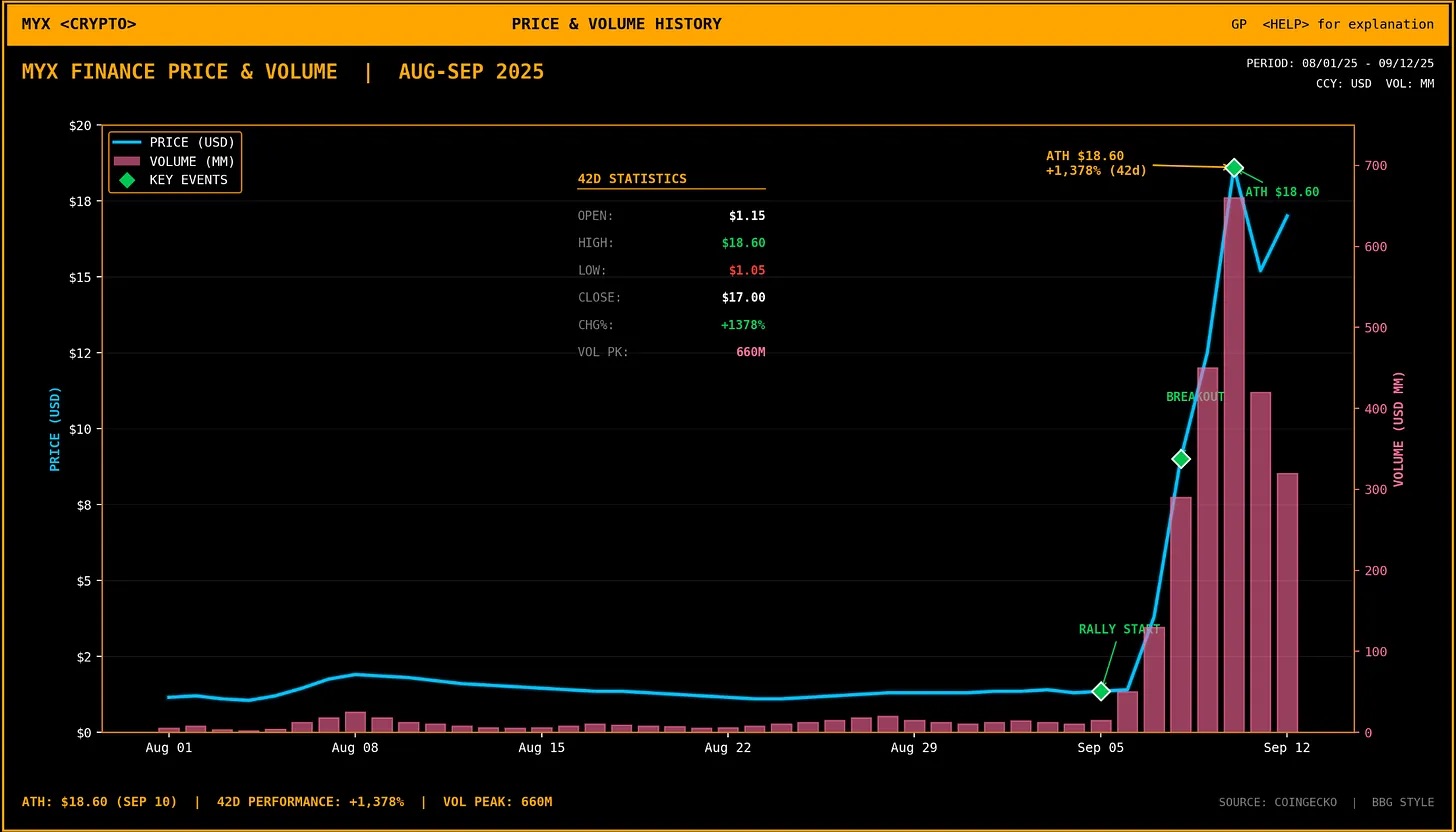
Price and Volume Historical Chart
Four-Stage Extraction Cycle
The entire scam operates as a tightly choreographed four-step loop—each step precisely engineered to exploit common retail trading behaviors.
Step 1: Luring Shorts
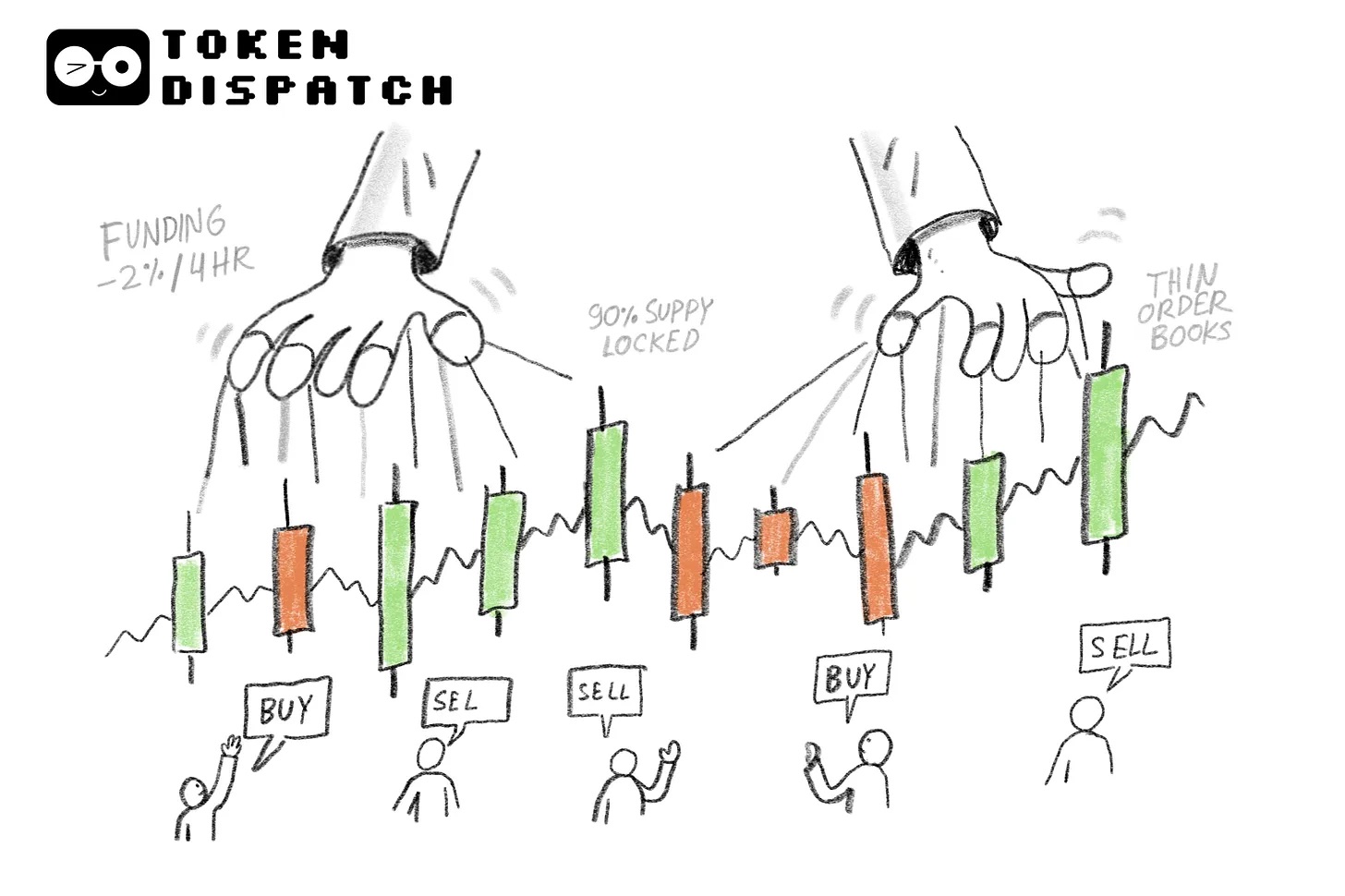
The market maker uses minimal capital to pump the price—a trivial task, given that most tokens are locked and order book depth on mid-tier exchanges like Bitget and Gate is inherently shallow. The shallower the order book, the easier it is for small sums to trigger 5–10% price moves.
RAVE—a different crime coin—is a textbook case: even with daily trading volumes reaching billions of dollars, just $172,000 in one-directional capital on Bitget could move the price ±1%; less than $2 million was needed to drive a 10% swing.

This initial pump isn’t aimed at long-side profits. The operators’ true profit engine lies entirely in the shorts who follow. The sole purpose of this phase is to make the uptrend look dangerously inflated and unsustainable—enticing cautious traders to short.
This counterintuitive logic is the scam’s core brilliance: the more artificial the move, the better it serves the operators. Conventional market makers engineer natural-looking rallies; crime coin operators deliberately expose manipulation signals—just to lure shorts into surrendering their capital.
Step 2: Setting the Trap
Once enough short positions accumulate, operators begin unwinding some of the long positions used to fuel the pump—reducing overall exposure while triggering a deliberate price pullback.
Falling price + shrinking open interest perfectly mimics a technical “topping out” pattern on candlestick charts. Observers on the sidelines interpret this as definitive confirmation of a reversal—and rush in to short.
Step 3: Short Squeeze Execution
Short-sellers begin losing money rapidly. Most trading in crime coins isn’t spot-based—it’s perpetual futures.
To balance long/short positions, exchanges charge funding rates: every few hours, one side pays the other. When perpetual prices trade above spot, longs pay shorts; when below spot, shorts pay longs. In normal markets, this rate is just fractions of a percent per day.
But during the squeeze phase, crime coin short funding rates spike to -2% every 4 hours—meaning holding a short position idle costs 12% of principal per day. Over one week, without any price movement, 84% of the initial margin vanishes.
Compounding this is extreme leverage: short positions commonly use 20x, 50x, or even 125x leverage. At 50x, a mere 2% adverse price move triggers immediate liquidation.
Massive short liquidations ignite cascading margin calls: each liquidated short forces a market buy to close, pushing price higher—which then triggers more liquidations above, generating more forced buys.
Traders who correctly identified the bubble and shorted it become the very fuel sustaining the rally.
MYX executed this squeeze to perfection: on September 8, 2025, $16.53 million in liquidations occurred in one day—$13.68 million of which came from forced short closures. With total MYX perpetual open interest at ~$262 million that day, over 6% of leveraged positions were wiped out within 24 hours—and nearly all were shorts.
Across the entire cycle, shorts lost $89.51 million; longs lost only $23.45 million—meaning for every 1 long liquidated, 4 shorts were harvested.
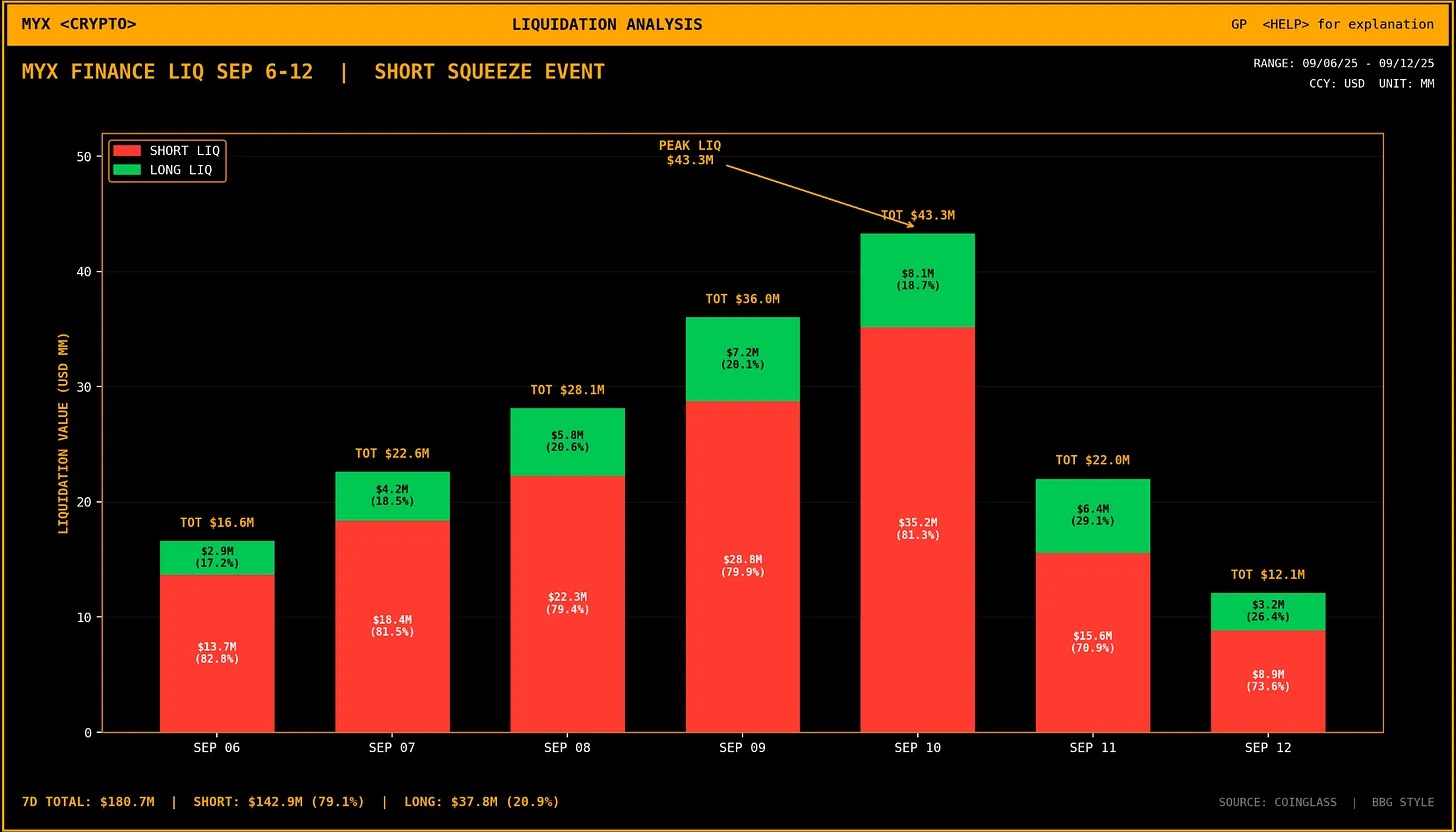
Perpetual Liquidation Analysis | Short Squeeze Dynamics
Step 4: Dumping at the Peak
After all shorts are cleared and price hits its apex, operators flip their positions: they open shorts themselves, close their original longs, and simultaneously transfer locked tokens to centralized exchanges.
Many experienced on-chain traders fall for this: seeing operator wallets send tokens to exchanges, they instinctively assume imminent dumping—and short again. But these transfers are pure bait—designed to harvest a fresh wave of shorts before actual selling begins.
The fundamental prerequisite for this entire scam: an overwhelmingly singular counterparty.
In real markets, participants hold diverse views, time horizons, and information advantages. In crime coin markets, every long and short trade faces the same operator—executing the same scripted extraction sequence.
Who Controls the Tokens Controls the Market
Every maneuver in a crime coin ecosystem boils down to one irrefutable fact: the project and its affiliates monopolize nearly the entire token supply.
This monopoly empowers a single actor to control both spot and derivatives markets simultaneously—to dictate timing, pace, and the precise moment to execute short squeezes. No other holder possesses sufficient supply to disrupt this manipulation.
In the MYX case, perpetual open interest exceeded circulating market cap; two-thirds of trading volume clustered on Bitget; and short funding rates remained persistently elevated. Traders who performed flawless technical analysis still failed to recognize they were operating inside a wholly synthetic market.
All evidence is publicly visible: clustered wallet addresses, exchange volume shares, and market maker disclosures all appear in official project fundraising documents. The industry looks away because the entire value chain profits: market makers earn trading fees, projects inflate treasury valuations using their own tokens, and exchanges collect fees regardless of whether volume is real or fabricated.
Only retail traders lose—every single time.
Join TechFlow official community to stay tuned
Telegram:https://t.me/TechFlowDaily
X (Twitter):https://x.com/TechFlowPost
X (Twitter) EN:https://x.com/BlockFlow_News