Amazon’s $10 Billion Acquisition of Globalstar: “Buying Spectrum” to Directly Compete with Starlink
TechFlow Selected TechFlow Selected
Amazon’s $10 Billion Acquisition of Globalstar: “Buying Spectrum” to Directly Compete with Starlink
Amazon’s acquisition comes on the heels of SpaceX’s push for an IPO.
 Navigating Web3 tides with focused insights
Author: Claude, TechFlow
TechFlow Introduction: On Tuesday, Amazon announced its acquisition of satellite operator Globalstar for $11.57 billion—securing scarce mobile satellite spectrum, approximately 24 operational satellites in orbit, and a long-term service agreement with Apple. Amazon plans to deploy its direct-to-device (D2D) satellite system by 2028, positioning itself as a direct challenger to Elon Musk’s Starlink constellation of 10,000 satellites. Following the announcement, Globalstar’s stock rose over 9%, while Amazon’s stock gained 3%.

Amazon has officially dropped a blockbuster into the satellite internet market.
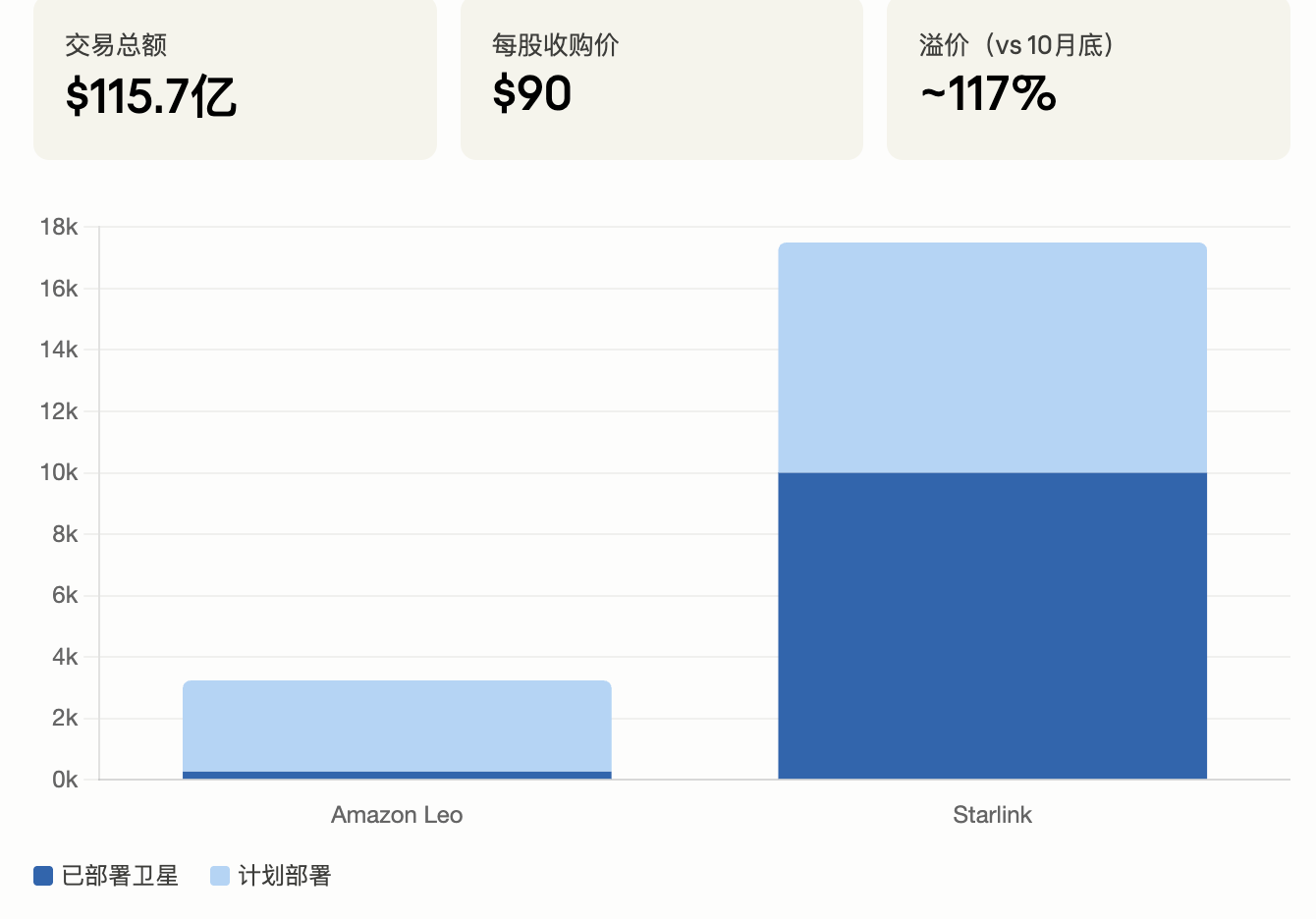
According to a Reuters report on April 14, Amazon announced on Tuesday its plan to acquire satellite operator Globalstar for $11.57 billion to accelerate its catch-up with Musk’s Starlink. Globalstar shareholders may elect to receive either $90 per share in cash or 0.3210 shares of Amazon common stock. Per Bloomberg data, this price represents a nearly 117% premium over Globalstar’s share price at the end of October last year—just before Bloomberg first reported that Globalstar was exploring a sale.
The deal was not entirely unexpected. Less than two weeks ago, the Financial Times reported that Amazon was negotiating the acquisition of Globalstar, with an estimated transaction value of around $9 billion at the time. The final price tag significantly exceeded those earlier rumors, underscoring Amazon’s determination to close the deal.
Buying Spectrum, Buying Time, Buying Apple: One Deal Solves Three Problems
As Armand Musey, Founder and President of Summit Ridge Group, put it, the core logic behind this acquisition is clear: Amazon has consistently lagged behind Starlink in satellite broadband—and acquiring Globalstar enables Amazon to rapidly close the gap in D2D spectrum allocation and leapfrog in D2D deployment.
Globalstar is a veteran operator in the global mobile satellite services (MSS) sector, holding globally licensed L-band spectrum licenses. Such spectrum is a scarce resource; obtaining it through application and auction could take years. Amazon bypassed lengthy regulatory approval processes with a single transaction.
Even more crucially, there’s Apple’s binding partnership. In 2024, Apple invested approximately $1.5 billion in Globalstar, acquiring a 20% equity stake to expand satellite-based emergency communication capabilities for iPhones. As part of the acquisition agreement, Amazon’s Project Kuiper will support future iPhones and Apple Watches with satellite functionality—including Emergency SOS, text messaging, Find My location services, and roadside assistance.
In a statement, Greg Joswiak, Apple’s Senior Vice President of Worldwide Marketing, confirmed the collaboration and expressed anticipation for deepening cooperation with Amazon on the expanded Amazon Kuiper network.
In other words, through the acquisition of Globalstar, Amazon instantly secured spectrum assets, in-orbit satellite infrastructure, and a long-term service commitment from the world’s largest consumer electronics brand.
243 vs. 10,000 Satellites: The Satellite Count Gap Remains a Structural Weakness
Despite its strategic clarity, Amazon faces enormous execution challenges.
Amazon has deployed only 243 satellites so far, whereas it pledged in 2019 to launch 3,236 satellites into low Earth orbit (LEO). By contrast, Starlink operates a network of roughly 9,500 satellites, serving over 9 million users.
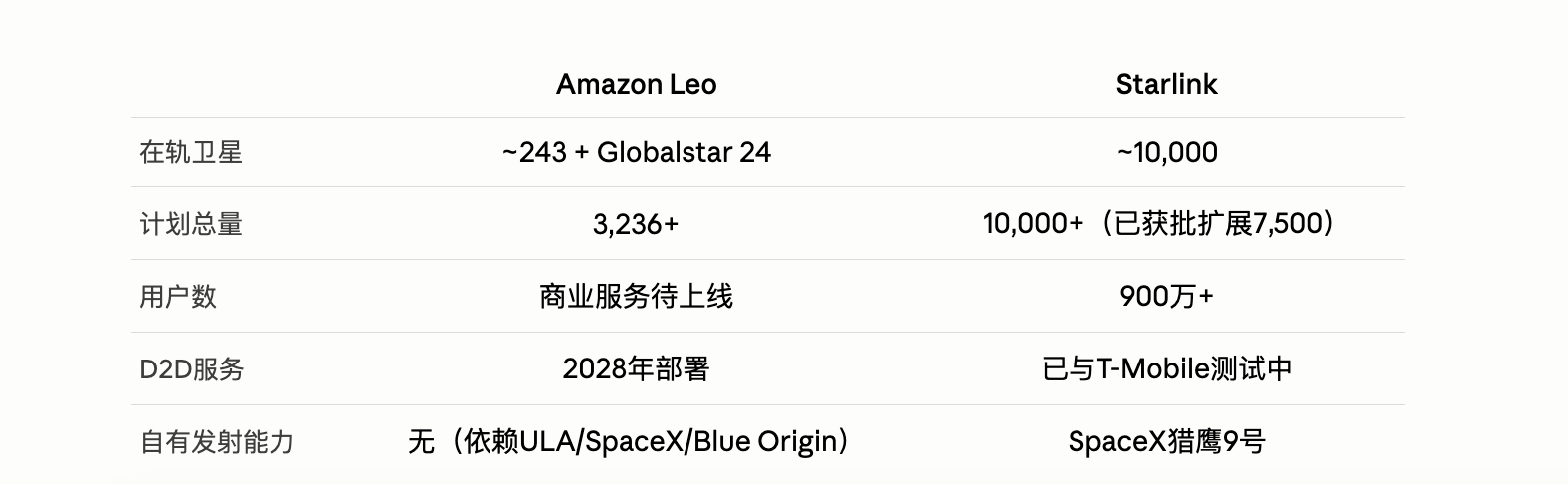
The approximately 24 additional satellites acquired via Globalstar (currently expanding to 54) offer only limited help in narrowing this gap. The real bottleneck lies in launch vehicles.
According to Reuters analysis, rocket shortages, manufacturing disruptions, and launch delays have severely constrained Amazon’s deployment pace—even forcing it to rely on competitor SpaceX’s Falcon 9 rockets for launches. Gregory Radisic, Senior Lecturer at Bond University, stated bluntly: “Unless Amazon resolves its deployment speed and launch capacity issues, the gap remains structurally unbridgeable.”
Earlier this year, Amazon applied to the U.S. Federal Communications Commission (FCC) to extend the deadline for deploying roughly 1,600 satellites by two years (originally due in July this year); the FCC has yet to rule. This means Amazon hasn’t even completed deployment of its already-approved constellation size.
Amazon’s long-term solution may lie with Jeff Bezos’s Blue Origin and its under-development New Glenn heavy-lift launch vehicle—but New Glenn has yet to demonstrate whether its launch cadence can meet the demands of large-scale constellation deployment.
Direct-to-Device Satellite Services: From Emergency Comms to Everyday Connectivity
The strategic significance of this acquisition extends beyond broadband internet.
Amazon plans to launch its own direct-to-device (D2D) satellite service by 2028, enabling smartphones to connect directly to satellites for voice, text, and data communications—without relying on terrestrial base stations.
D2D is the next battleground in satellite internet. SpaceX has already completed testing of Starlink Mobile’s text messaging capability through its partnership with T-Mobile, giving it a first-mover advantage. Amazon, by acquiring Globalstar, gains immediate operational capability and sidesteps the lengthy spectrum licensing process.
Panos Panay, Amazon’s Senior Vice President of Devices and Services, stated in a press release that the company intends to partner with mobile network operators to extend reliable, high-speed connectivity to every corner of the globe.
However, Amazon has not yet disclosed target throughput, latency benchmarks, or specific performance comparisons between its L-band architecture and SpaceX’s approach.
Market Reaction and the SpaceX IPO Context
Following the announcement, Globalstar’s stock rose 9.6%, closing at approximately $79.68—a roughly 13% arbitrage gap below the $90 acquisition price, reflecting uncertainty around deal completion and timing costs. Amazon’s stock rose 3%, while MDA Space—the prime contractor for Globalstar’s next-generation satellites—jumped 9%.
The timing is telling. Amazon’s acquisition closely follows SpaceX’s push toward an initial public offering (IPO). Starlink is estimated to contribute 50%–80% of SpaceX’s revenue, and its upcoming IPO is expected to rank among the largest in history. Amazon’s move to lock in Globalstar at this juncture signals both strategic foresight and a competitive message to capital markets.
The deal has already received written consent from Thermo Funding II, a Globalstar shareholder holding over 57% of voting power. Closing is expected in 2027.
Join TechFlow official community to stay tuned
Telegram:https://t.me/TechFlowDaily
X (Twitter):https://x.com/TechFlowPost
X (Twitter) EN:https://x.com/BlockFlow_News
 深潮TechFlow