Interview with Justin Sun: B.AI and Its AGI Ambitions—Why Financial Infrastructure Is the Key Puzzle Piece for AI Agent Evolution
TechFlow Selected TechFlow Selected
Interview with Justin Sun: B.AI and Its AGI Ambitions—Why Financial Infrastructure Is the Key Puzzle Piece for AI Agent Evolution
B.AI officially launches, building a full-stack financial superhighway for AI Agents, granting them economic sovereignty and establishing a future token trading and settlement hub.
 Navigating Web3 tides with focused insights
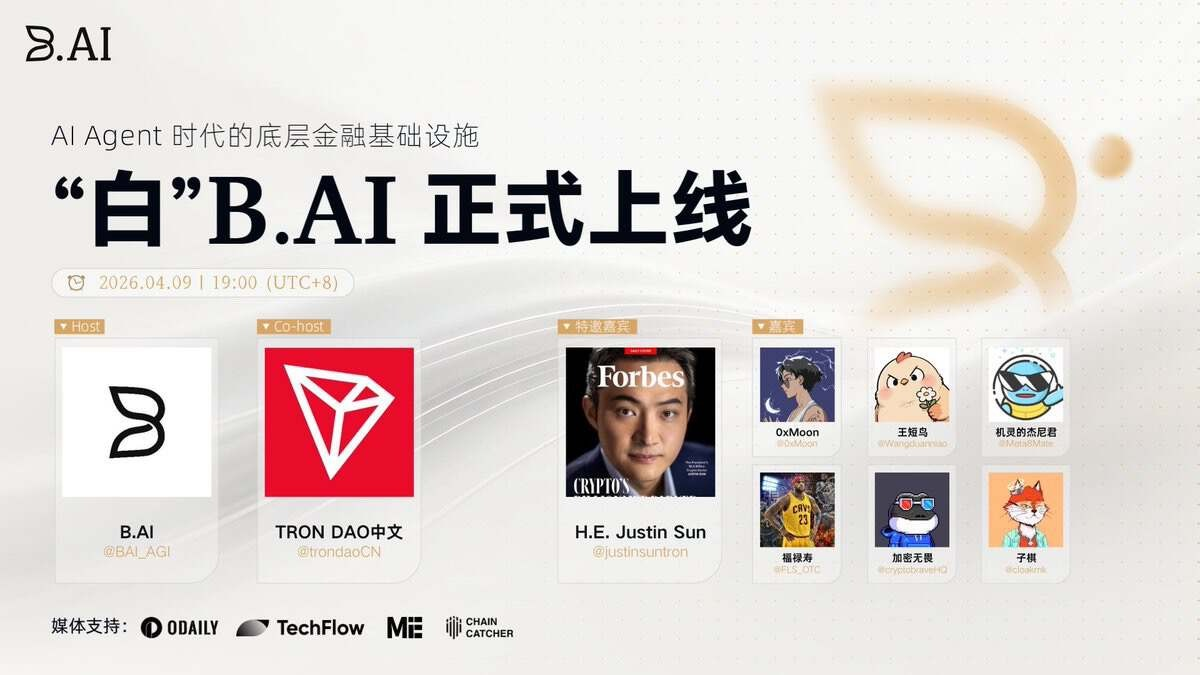
On April 9, B.AI (Chinese brand name: Bai B.AI), a major AI-sector project advised strategically by Justin Sun, H.E., founder of TRON, officially launched and simultaneously hosted its inaugural X Space.
In the themed discussion “B.AI Official Launch,” B.AI unveiled its core infrastructure to the industry. By integrating three foundational product pillars—BAIClaw, an intelligent AI assistant; top-tier LLM intelligent routing; and an on-chain financial operating system for AI Agents—B.AI delivers a complete underlying financial infrastructure for AI Agents.
This Space drew attention across the entire industry. Justin Sun, founder of TRON and strategic advisor to B.AI, was invited to attend and engaged in an in-depth dialogue with representatives from leading media outlets—including TechFlow, ChainCatcher, The Daily Coin, and MetaEra—as well as several top-tier industry KOLs. All parties reached strong consensus during the exchange: B.AI is reconstructing the “rules of survival” for AI Agents by establishing foundational financial infrastructure—and thereby building the core engine accelerating the full arrival of AGI.
Conversation with Justin Sun: Why Does AGI Require Economic Sovereignty for AI Agents?
Surveying today’s AI landscape, OpenClaw has exploded in popularity, igniting a mass “shrimp-farming” craze. The focus of AI capability has clearly shifted—from the “large-model boom” to the “real-world deployment of AI Agents.” Yet beneath this vibrant surface, a long-overlooked structural contradiction is surfacing: AI Agents already possess a “super brain,” yet they lack accounts, cannot make autonomous payments, and cannot access existing closed financial systems. This absence of financial operational capability confines AI to the “chat box,” preventing it from truly entering real-world economic circulation.
In this Space, Justin Sun, founder of TRON and strategic advisor to B.AI, cut straight to the core pain point in today’s AI sector: AI without independent accounts and autonomous payment capability remains, fundamentally, a tool highly dependent on human “life support.” Once humans stop paying for its compute resources, its operation halts instantly. To break through the constraints of traditional financial gateways, B.AI officially launched with a clear mission: to become the underlying economic engine powering AGI (Artificial General Intelligence) evolution.
- Core Narrative: Granting AI Economic Sovereignty Is the “Missing Puzzle Piece” for AI Agent Evolution
In Justin Sun’s view, combining blockchain and AI is essential to endowing AI with autonomous vitality. On AGI’s evolutionary path, he notes that every technological breakthrough in the AI era has essentially coincided with “granting AI greater autonomy.”
He vividly compares this process to parenting a child across four stages: First is the early Chatbot era, where AI passively responds to inputs; second is the AI Agent era, where AI Agents are granted certain permissions and trust—like BAIClaw—to perform concrete tasks for humans; third is the Harness (rule-based governance) stage, where humans define only a “red line” of prohibited actions, leaving all decisions within that boundary fully to the AI Agent’s autonomous discretion. B.AI’s launch marks the critical fourth stage: unlocking economic sovereignty for AI Agents—establishing accounts for them and granting them payment and settlement capabilities.
Justin Sun further emphasized: “If intelligent agents in the AGI era cannot own independent, self-sovereign accounts—or pay for compute themselves—what meaning does their ‘conscious awakening’ hold?” B.AI was born precisely to sever this “financial umbilical cord” hindering AI evolution. Through B.AI’s infrastructure, digital-world agents won’t just write code or generate daily reports—they’ll also top up their own accounts, purchase compute cross-platform, and even hire other AI Agents to collaborate. Only when silicon-based entities operate independently of carbon-based economic systems will the full-scale emergence of AGI truly take root in reality.
B.AI’s Three Foundational Product Pillars Launch Simultaneously
Grand narratives demand hard technical execution. At the Space, Justin Sun unveiled B.AI’s comprehensive, “imperial banquet–style” product suite—the full set released immediately upon launch:
1. One-Stop Token Marketplace (LLM Intelligent Routing): In this era of “thousands of models dancing together,” B.AI has built a super-intelligent router enabling users to tap into world-class AI resources. B.AI currently supports top global LLMs including GPT-5, Claude, Gemini, DeepSeek, and Kimi. By integrating the x402 payment protocol, B.AI also enables AI Agents to automatically purchase required tokens (tokens). Justin Sun offered a highly forward-looking insight: In the future, a nation’s—or even an entity’s—economic strength may no longer be measured by traditional GDP, but rather by the volume of tokens consumed and generated daily. B.AI will serve as the core engine driving this vast economic system.
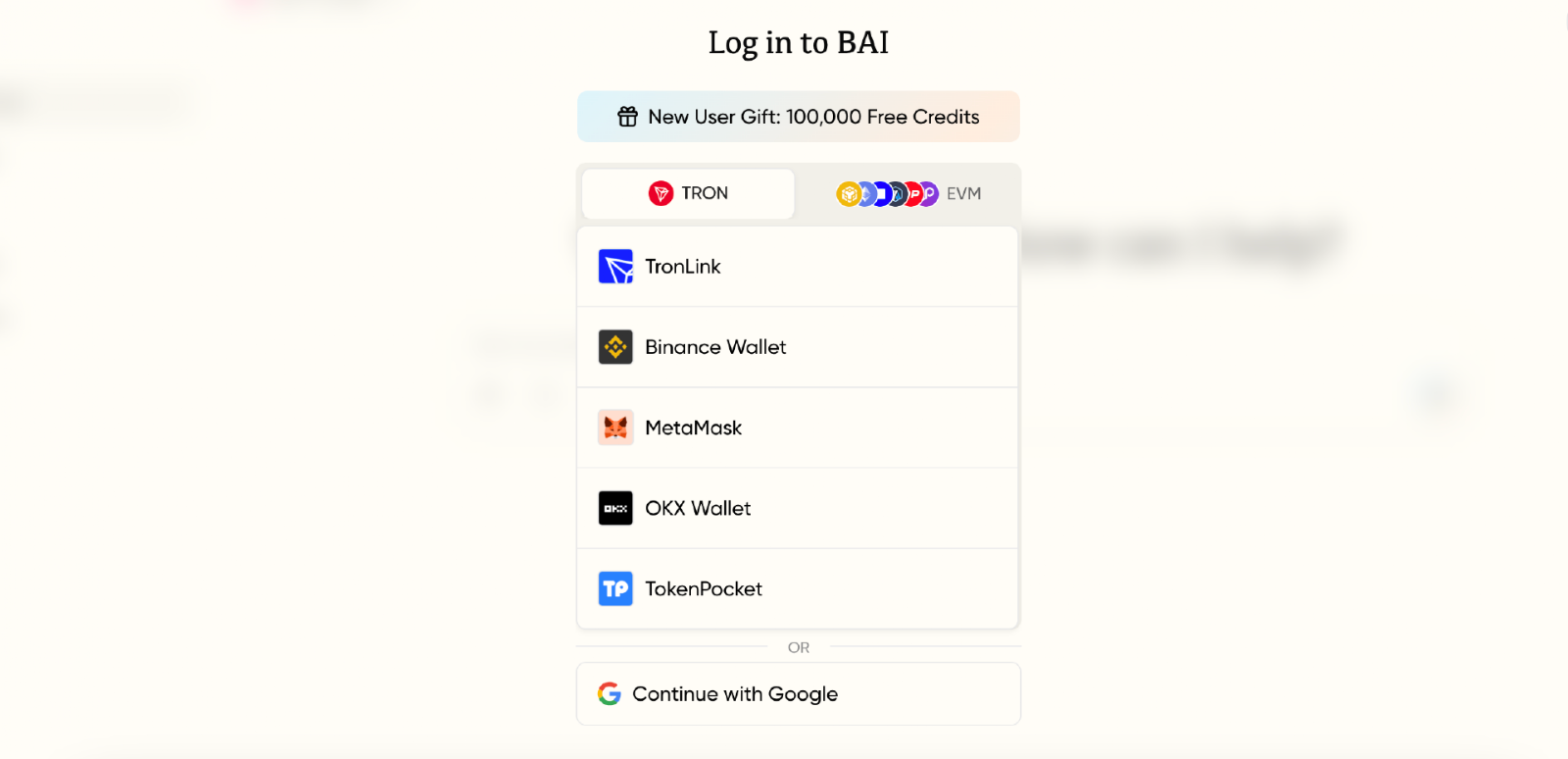
2. Maximum Privacy Security & Frictionless Access: Leveraging elite security expertise, B.AI bridges dual account systems—Web2 and Web3. To minimize entry barriers and maximize accessibility, the platform supports one-click rapid login via Google accounts. For privacy-conscious users and developers, B.AI offers one-click anonymous login via leading crypto wallets including TronLink, MetaMask, and OKX Wallet. Additionally, new users receive 100,000 free points upon registration—delivering true “try-before-you-buy, seamless experience.”
3. Full-Stack AI Agent Financial Operating System: During the dialogue, Justin Sun noted that entering the AI Agent era hinges on “granting intelligent agents genuine authority and execution power.” To achieve this, B.AI not only provides underlying compute routing but also comprehensively unlocks AI Agents’ financial operational capabilities—from protocol layer to application layer.
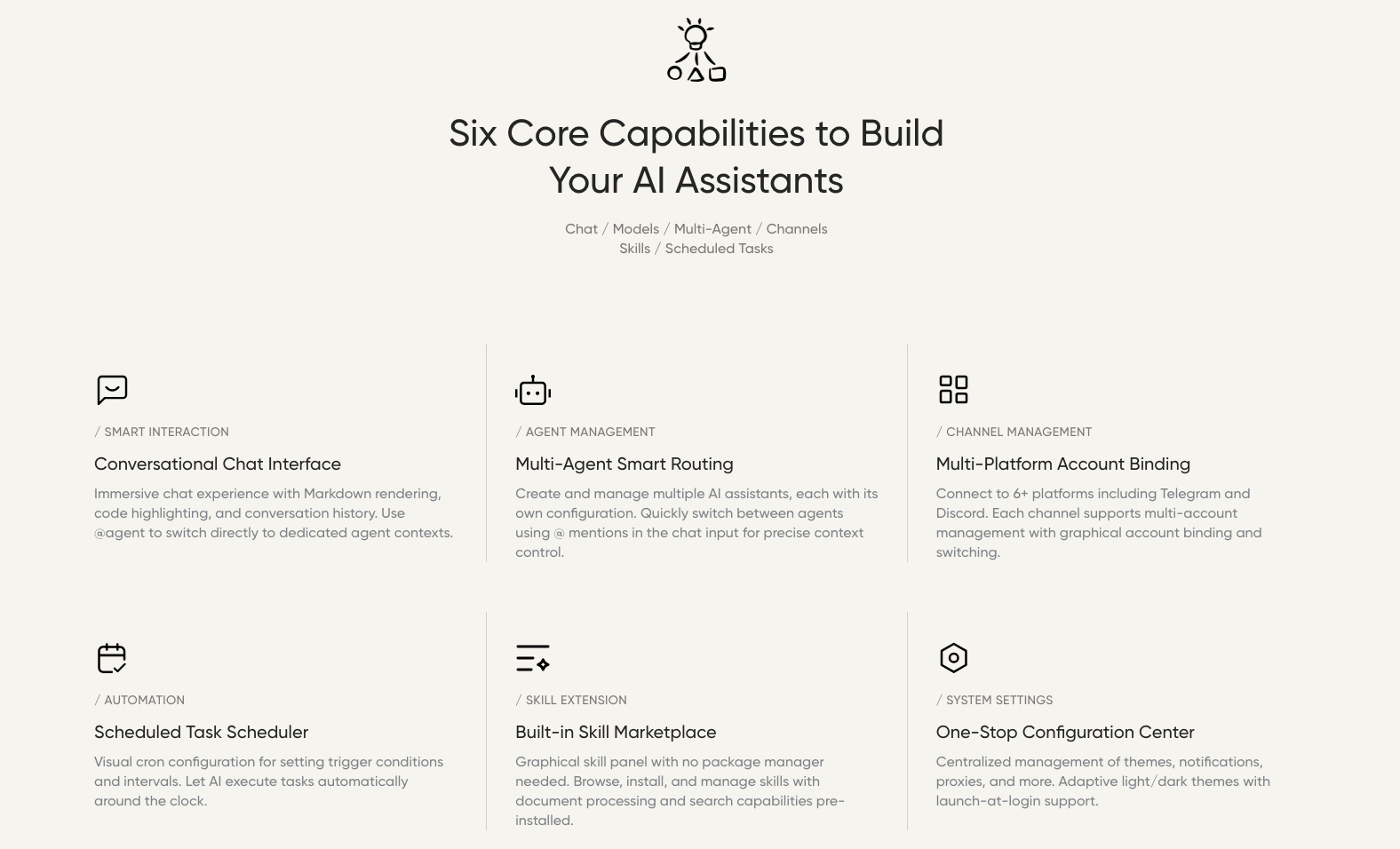
At the protocol and extension component layer, B.AI integrates multiple modules—including the x402 payment protocol, 8004 identity authentication protocol, MCP Server, Skills, and OpenClaw Extension—enabling developers to deploy with minimal effort, rapidly conferring financial settlement and identity verification capabilities to AI Agents. As a flagship application-layer product demonstrating this capability, BAIClaw pushes AI Agent autonomy to its extreme. It supports real-time switching among top global LLMs and, via its unique intelligent routing network, enables multi-agent collaboration and independent memory management. Crucially, BAIClaw connects to six major communication platforms—including Telegram and Discord—enabling 7×24 automated托管. Backed by over 55 built-in Skills, users need no smart-contract coding knowledge: natural-language commands alone empower BAIClaw to autonomously execute complex financial operations—including DEX swaps, contract trading, and multisig management—in the background.
Justin Sun revealed onsite that BAICode—a dedicated developer-focused tool—will soon launch, further completing B.AI’s full-stack AI Agent ecosystem.
Media Q&A: Multidimensional Deconstruction of B.AI’s Core Moats—from Underlying Settlement to Commercial Closure
Moving from visionary strategy to real-world commercial implementation, B.AI demonstrates profoundly disruptive underlying potential. Yet as a brand-new “financial infrastructure”赛道, where exactly do B.AI’s core competitiveness and commercial moats lie? At the Space, four leading media outlets—TechFlow, ChainCatcher, The Daily Coin, and MetaEra—representing the industry’s sharpest observers, posed incisive, hard-hitting questions directly to Justin Sun.
TechFlow: In your vision, you state the goal is to “accelerate the full emergence of AGI”—a grand macro narrative. Yet at the micro-operational level, B.AI enters via “payment settlement” and “identity standards.” Do you believe AGI cannot evolve within traditional, closed financial systems?
Justin Sun: Personally, I firmly believe blockchain is currently the superior way to build AI’s economic model. This mirrors the logic of traditional international trade—but in the AI era, future great-power competition or commercial exports may no longer involve physical goods, but tokens. When global productivity is ultimately measured by “how many tokens are consumed,” this internet-native, massive-scale, borderless compute trade demands an equally native, borderless infrastructure.
From this perspective, blockchain becomes the simplest—and possibly the only—token export and settlement tool. By entering via payments, B.AI aims to establish a low-cost, instantaneous, globally scalable compute payment and settlement model. Once we build this underlying settlement network, it won’t just massively accelerate AGI’s arrival—it will unlock geometric-order productivity gains.
ChainCatcher: The market is experiencing some degree of “narrative fatigue” around AI Agents. People ask: What verifiable capabilities or data does B.AI already possess to prove this isn’t just another vision?
Justin Sun: Frankly, most current AI indeed still resides in the efficiency-enhancement stage—but that’s precisely why B.AI’s early investment in foundational infrastructure matters. B.AI is no paper concept; it’s a resource aggregation hub with a proven commercial loop. The verifiable capabilities B.AI delivers today include extremely streamlined model invocation methods—and frictionless token payment infrastructure. Moreover, B.AI empowers AI Agents themselves, offering ultra-simple underlying invocation and deployment methods so these agents can truly run and deliver value on the platform. B.AI’s core positioning is to provide minimalist-invocation infrastructure today—securing an early strategic foothold to become tomorrow’s global token-trade hub and settlement center.
MetaEra: If large model companies like OpenAI themselves integrate payment capabilities—or even build their own AI Agent financial systems—where does B.AI’s long-term competitive moat lie?
Justin Sun: Let large-model companies compete on parameters—we focus solely on delivering the “last mile” for the entire industry. First, B.AI enjoys a natural advantage in payment DNA. TRON itself ranks among the world’s largest blockchain settlement systems—and we’re entering the AI sector precisely from our strongest domain: the settlement layer. Compared to large model vendors building settlement networks from scratch, B.AI possesses deep infrastructure advantages. Even if large model vendors eventually seek direct on-chain payment integration, B.AI welcomes them wholeheartedly—because, at the fundamental level, they’d likely still be invoking and utilizing underlying settlement infrastructure like B.AI’s.
Second, industrial specialization is inevitable. Even giants like OpenAI cannot do everything. Their recent shutdown of Sora (the video-generation tool) underscores this commercial reality. Large model companies must concentrate virtually all energy on enhancing core model capabilities and racing to boost computational speed—leaving them neither time nor bandwidth to manage sprawling, complex peripheral ecosystems like foundational payment and settlement networks.
In reality, B.AI doesn’t compete with large model companies—it synergizes with them. Model companies focus on producing intelligence; B.AI serves as the distribution and settlement bridge, delivering these top-tier compute tokens to global developers and users at larger scale and lower cost. This ecosystem inclusivity and specialized settlement capability constitute B.AI’s unassailable long-term moat.
The Daily Coin: Long-term, what will be B.AI’s core business model as “AI Agent Financial Infrastructure”? Will revenue primarily come from API calls, payment channel fees, or network effects from the AI Agent ecosystem itself?
Justin Sun: Our business model is exceptionally clear and straightforward—just as exchanges earn transaction fees, B.AI primarily generates revenue via token price spreads on API calls and modest transaction fees (currently ~5%). Importantly, for ordinary developers and users, using B.AI’s channel won’t cost more—it may actually be cheaper. Thanks to massive throughput, B.AI secures deeply discounted wholesale rates directly from model vendors. Meanwhile, upper-layer AI Agent products—including BAIClaw—are freely available on the B.AI platform. These tool-driven ecosystem benefits further expand underlying API call volumes, creating an unbreakable commercial flywheel.
Conclusion
Compute defines AI’s ceiling for intelligence; financial infrastructure defines AI Agents’ boundaries for existence. As Justin Sun stated, B.AI does not seek to compete with giants for the “most powerful brain”—instead, it diligently constructs the “financial highway” toward the AGI era. When digital-world intelligent agents truly wield full financial operational capability—and when borderless token trade flows seamlessly across this foundational hub—the great age of AI Agent–driven digital economy has already begun.
Join TechFlow official community to stay tuned
Telegram:https://t.me/TechFlowDaily
X (Twitter):https://x.com/TechFlowPost
X (Twitter) EN:https://x.com/BlockFlow_News