NVIDIA’s “Quantum Day” Double Hit: Open-Source AI Model Ising Ignites Quantum Stocks; Internal AI Completes Chip Design in One Night—Work Equivalent to 80 Person-Months
TechFlow Selected TechFlow Selected
NVIDIA’s “Quantum Day” Double Hit: Open-Source AI Model Ising Ignites Quantum Stocks; Internal AI Completes Chip Design in One Night—Work Equivalent to 80 Person-Months
NVIDIA’s current AI chip designs remain assistive rather than substitutive.
 Navigating Web3 tides with focused insights
Author: Claude, TechFlow
TechFlow Introduction: On April 14—World Quantum Day—NVIDIA unveiled Ising, the world’s first open-source quantum AI model family. It achieves a 2.5× speedup and 3× accuracy improvement in quantum error correction decoding over industry standards.
Quantum computing stocks surged collectively that day: IonQ rose 18%, D-Wave up 15%. On the same day, NVIDIA Chief Scientist William Dally revealed at GTC 2026 that AI had compressed chip standard-cell library porting—from eight engineers working for ten months—to completion overnight on a single GPU, with design quality surpassing human output.
NVIDIA is using AI to accelerate two of engineering’s hardest problems: making quantum computers truly usable—and making GPU design itself faster and better.
On April 14—World Quantum Day—NVIDIA launched NVIDIA Ising, the world’s first open-source AI model family designed for quantum computing, prompting an immediate broad rally across quantum computing stocks. Simultaneously, Chief Scientist William Dally disclosed at GTC 2026 the latest progress of AI integration into NVIDIA’s internal chip design workflow—where one task achieved efficiency gains on the order of hundreds of times.
These two developments point to a single conclusion: AI is evolving from an “application-layer tool” into “infrastructure for infrastructure”—accelerating both downstream industries (e.g., quantum computing) and the hardware iteration of AI itself.
The World’s First Open-Source Quantum AI Model: Targeting Two Core Bottlenecks in Quantum Computing
According to NVIDIA’s April 14 press release, the initial Ising model family comprises two domains: Ising Calibration and Ising Decoding—each targeting one of quantum computing’s two core bottlenecks.
Qubits in quantum processors are inherently noisy; even today’s best quantum processors produce roughly one error per thousand operations. To achieve practical utility, quantum computers must reduce error rates to below one per trillion operations.
Ising Calibration is a 35-billion-parameter vision-language model that automatically interprets quantum processor measurement data and makes calibration decisions—reducing calibration time from days to hours. Ising Decoding consists of a pair of 3D convolutional neural network models (optimized separately for speed and accuracy) used for real-time quantum error correction decoding—2.5× faster and 3× more accurate than pyMatching, the current open-source industry standard.
Sam Stanwyck, NVIDIA’s Quantum Product Director, explained the rationale behind the open-source strategy at the launch event: quantum hardware vendors each exhibit distinct noise profiles; open-sourcing the models enables them to fine-tune locally using proprietary data—improving performance while safeguarding sensitive information.
NVIDIA CEO Jensen Huang made the case even more directly: in his statement, he declared that AI is becoming the control plane for quantum machines—transforming fragile qubits into scalable, reliable quantum GPU systems.
According to NVIDIA, several institutions have already begun adopting the Ising models—including Harvard University’s School of Engineering and Applied Sciences, Fermilab, IQM Quantum Computers, Lawrence Berkeley National Laboratory, and the UK’s National Physical Laboratory.
Quantum Stocks Rally En Masse: IonQ Jumps 18% in a Single Day
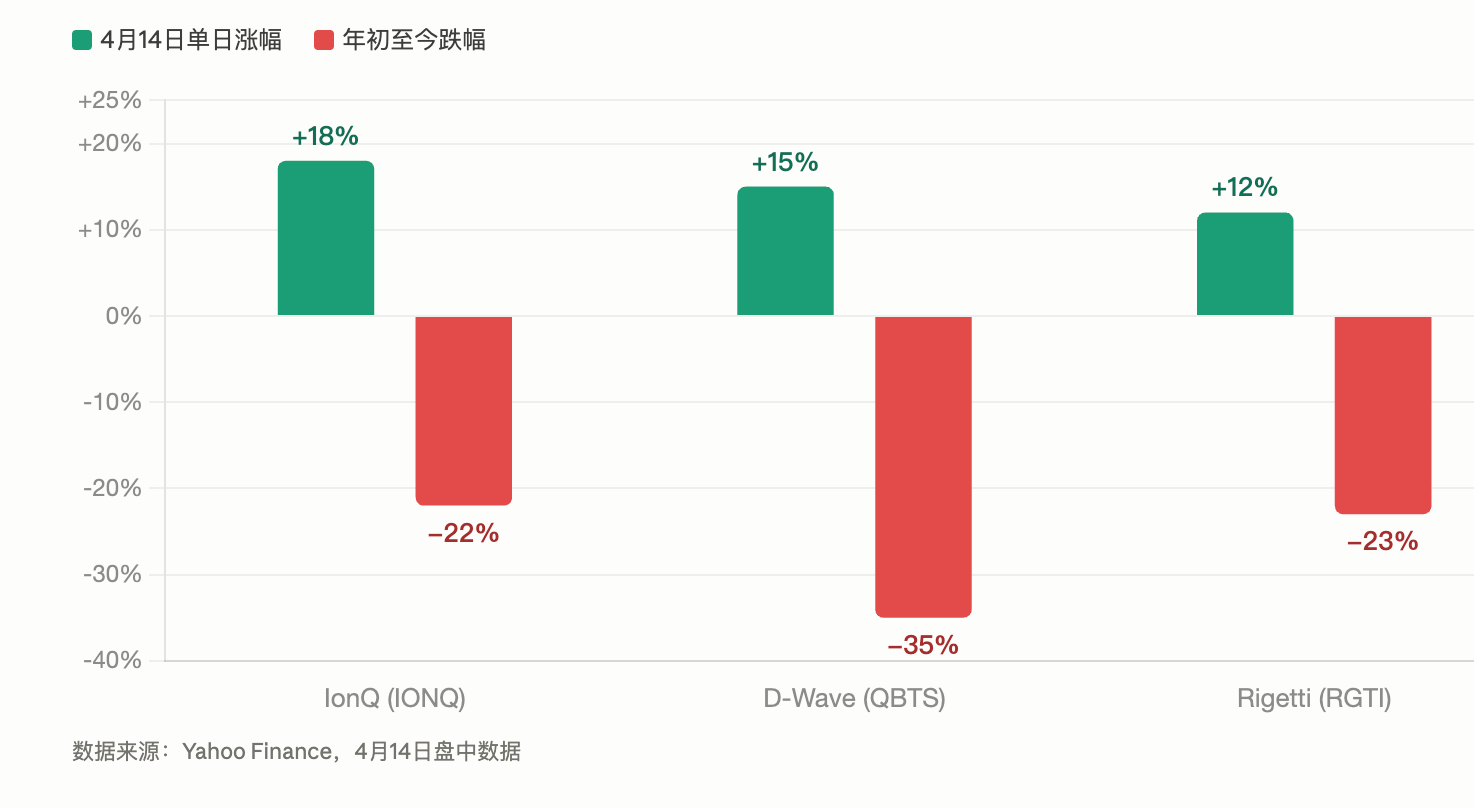
On the day of Ising’s release, U.S.-listed quantum computing stocks surged collectively. Per Yahoo Finance data, IonQ rose ~18%, D-Wave Quantum ~15%, and Rigetti Computing ~12%.
This rally occurred against the backdrop of steep year-to-date corrections across quantum stocks. As of April 14, IonQ was down ~22% YTD, D-Wave down ~35%, and Rigetti down ~23%. Although the double-digit rebound did not reverse the broader YTD downtrend, the synchronized magnitude across the sector remained notable.
It should be noted that Ising’s launch was not the sole catalyst. IonQ simultaneously announced a milestone in quantum networking and a new contract with DARPA; Rigetti disclosed an $8.4 million order from India’s Centre for Development of Advanced Computing (C-DAC). These multiple concurrent catalysts amplified the sector-wide effect.
Research firm Resonance forecasts the global quantum computing market will exceed $11 billion by 2030. Meanwhile, the Quantum Economic Development Consortium (QED-C) reported in its same-day publication that the global quantum market reached $1.9 billion in 2025, with headcount at pure-play quantum companies growing 14%.
From 80 Person-Months to Overnight: AI Reshapes NVIDIA’s Chip Design Workflow
While Ising accelerates external industries, NVIDIA is also using AI to transform its own chip design process.
At GTC 2026, NVIDIA Chief Scientist William Dally shared several concrete examples during a dialogue with Google Chief Scientist Jeff Dean. The most striking statistic involved standard-cell library porting: every time NVIDIA transitions to a new semiconductor process node (e.g., from 7nm to 5nm), it must redesign and adapt approximately 2,500–3,000 standard cells to the new process—previously requiring eight engineers about ten months. NVIDIA developed an RL-based tool called NVCell, enabling this entire task to be completed overnight on a single GPU—with resulting cells matching or exceeding human-designed cells in area, power, and delay metrics.
Per Tom’s Hardware, Dally likened the process to “an electronic game for fixing design rule violations,” highlighting how reinforcement learning excels precisely at such trial-and-error optimization.
At a higher abstraction level, NVIDIA built internal domain-specific large language models: Chip Nemo and Bug Nemo. These models were fine-tuned on NVIDIA’s proprietary 30-year dataset—including RTL code, hardware design documentation, and architectural specifications for every GPU ever shipped. As Dally described, junior engineers can now query Chip Nemo directly—eliminating repeated interruptions of senior designers. He characterized Chip Nemo as “an exceptionally patient mentor.”
At the circuit optimization level, NVIDIA applied reinforcement learning to classic circuit design problems like carry-lookahead chains. Dally noted that AI-generated designs “are bizarre solutions humans would never conceive—but deliver 20–30% better real-world performance than human-designed alternatives.”
AI-Driven End-to-End Chip Design Remains a Long Way Off
Nonetheless, Dally clearly demarcated expectations. He stated he would love to achieve full end-to-end automation—but emphasized that the field remains far from that goal.
NVIDIA’s current AI-assisted chip design remains augmentative—not substitutive. AI contributes separately to tasks like standard-cell porting, bug classification and summarization, placement-and-routing prediction, and architectural space exploration—but no fully automated end-to-end flow yet exists. Dally envisions a long-term direction centered on multi-agent models—where different AI systems handle distinct design phases, mirroring the division of labor in human engineering teams.
As reported by Computer Weekly, Dally and Dean also discussed how AI agents are disrupting traditional software tools: when AI agents operate orders of magnitude faster than humans, legacy software tools—designed for human users—become performance bottlenecks, necessitating complete redesigns across everything from programming tools to business applications.
Join TechFlow official community to stay tuned
Telegram:https://t.me/TechFlowDaily
X (Twitter):https://x.com/TechFlowPost
X (Twitter) EN:https://x.com/BlockFlow_News
 深潮TechFlow