“The Musk Version of WeChat” Has Really Arrived
TechFlow Selected TechFlow Selected
“The Musk Version of WeChat” Has Really Arrived
Every design decision points toward the same goal: enabling Western users to integrate social networking, messaging, AI assistants, and even payments into a single entry point.
 Navigating Web3 tides with focused insights
By: Zhao Ying
Source: WallStreetCN
Elon Musk’s three-year ambition to build a “super app” has finally moved from concept to product.
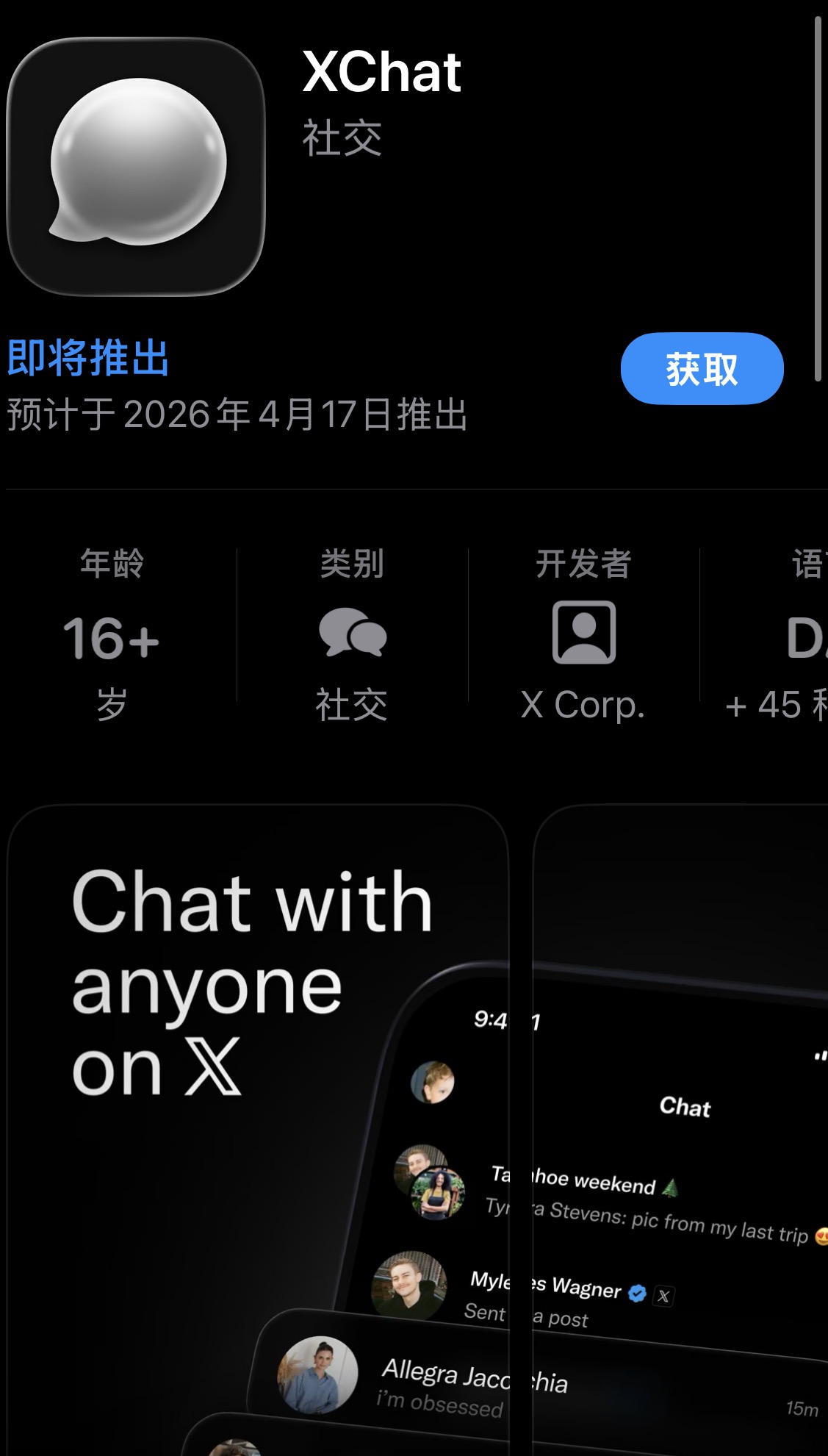
On April 11, Musk’s X platform officially announced that its standalone encrypted messaging app, XChat, will launch on the Apple App Store on April 17 and become available for download globally.
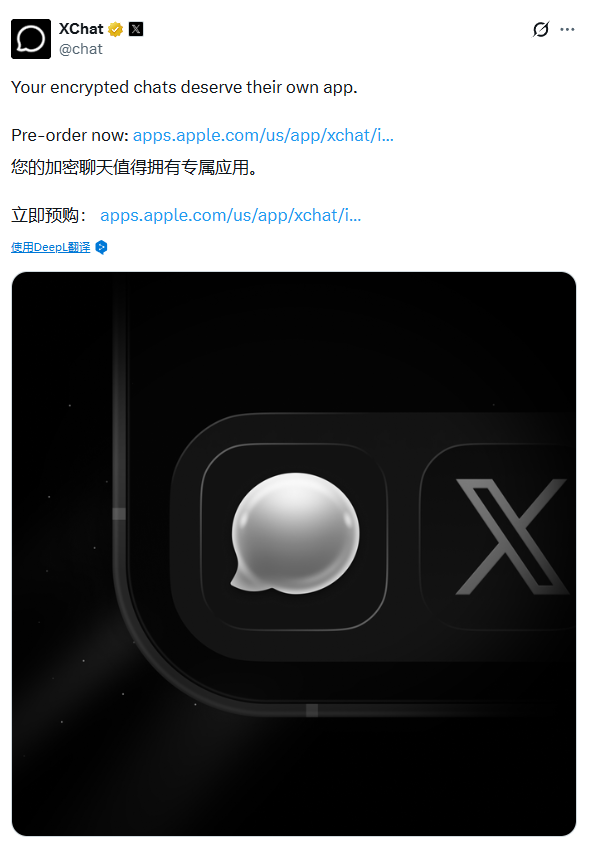
Built on an end-to-end encryption architecture and deeply integrated with xAI’s Grok large language model, XChat requires no phone number registration—users simply log in via their existing X account. Widely viewed as a critical step toward Musk’s vision of a “Western WeChat,” the app supports Simplified Chinese and is available for pre-order on the mainland China App Store via a direct link. It requires iOS/iPadOS 16.0 or later; an Android version is expected to follow.
Four Years of Obsession: From a Single Tweet to a Product
Musk’s public fascination with the “super app” model dates back to his $44 billion acquisition of Twitter in 2022. In multiple public appearances, he has expressed strong admiration for WeChat’s ecosystem—where Chinese users can fulfill all daily needs—including socializing, payments, shopping, and ride-hailing—within a single app, while Western users must constantly juggle over a dozen fragmented applications.
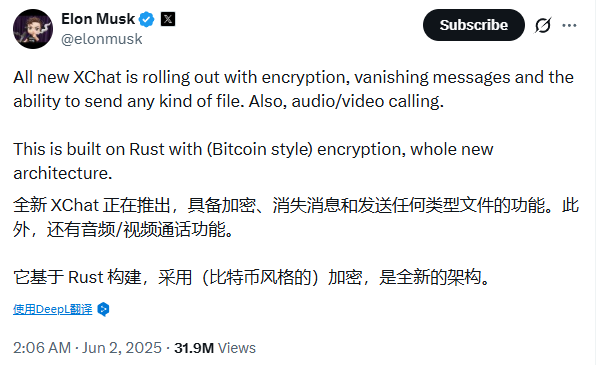
Last June, Musk announced the XChat development plan on X, explicitly citing core features such as encryption, disappearing messages, file transfers in any format, and voice/video calls. He also revealed that the app is built using the Rust programming language and employs a “Bitcoin-style encryption” architecture.
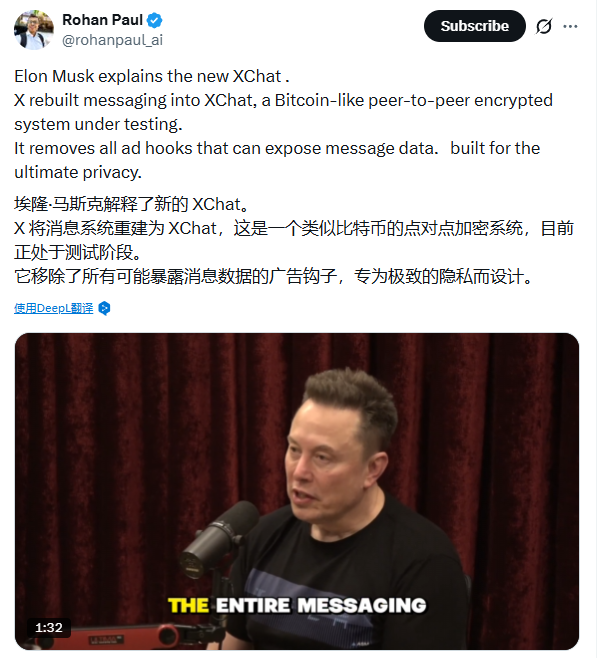
In a prior podcast appearance, he criticized mainstream messaging tools like WhatsApp for embedding advertising “hooks,” arguing that collecting enough user data to serve targeted ads inherently means collecting enough data to monitor users.
Technical Foundation: Can the Encryption Architecture Deliver on Privacy Promises?
XChat’s core technical selling point lies in its encryption architecture design. Developed in Rust—a language renowned for memory safety—XChat benefits from industry-wide adoption by tech giants including Microsoft and Google, who have migrated parts of their core systems to Rust to reduce security risks stemming from memory vulnerabilities.
At the encryption layer, Musk’s “Bitcoin-style encryption” refers to an end-to-end asymmetric encryption system. Under this architecture, message encryption keys reside exclusively on users’ local devices; servers cannot decipher any chat content. This means that even if X’s servers were compromised—or legally compelled to hand over user data—the only information they could provide would be indecipherable encrypted gibberish.
The company also pledges zero ads and no user data tracking. XChat includes additional privacy features such as disappearing messages, two-way message deletion, anti-screenshot capabilities, and screenshot alerts—offering a finer-grained level of privacy protection than most mainstream messaging apps.
Feature Set: A Messaging Hub Attempting to Consolidate Everything
Functionally, XChat supports one-on-one chats and group chats of up to 481 participants. It allows text, image, and file transfers in any format. Premium users can send files up to 4 GB in size and enjoy high-definition voice and video calls.
Deep integration with the X platform ecosystem represents another key design: users can drag and drop tweets or videos directly from X into chat windows, minimizing friction during content sharing. Here, Musk’s logic behind building a “super app moat” becomes clear—if social content, messaging history, and media consumption all converge within a single ecosystem, users’ switching costs rise significantly.
Moreover, XChat is deeply integrated with xAI’s Grok large language model. Users can summon Grok directly within the chat interface to process files, organize documents, plan itineraries, and answer questions. The chat box thus evolves from a simple text input tool into a context-aware personal AI assistant.
However, this feature also constitutes the focal point of the most concentrated privacy concerns surrounding XChat—the boundaries of AI involvement in private conversations and how related data is handled remain largely undisclosed to the public.
Competitive Landscape: Finding Space Between Three Giants
XChat enters a fiercely competitive market. Signal enjoys near-religious trust among privacy-conscious users thanks to its open-source code, nonprofit status, and absence of commercial monetization pressure. WhatsApp commands over 2 billion monthly active users, its network effects forming an almost insurmountable barrier. Telegram overlaps heavily with XChat in terms of feature richness and already boasts a massive, established community base.
XChat currently bets on two key differentiators: deep integration with Grok AI, and synergies with the X platform ecosystem. Whether the former can truly reshape user communication habits depends on Grok’s actual capabilities and users’ willingness to accept AI participation in private conversations. The latter hinges critically on the scale and engagement level of the X platform itself—a variable that has drawn sustained external scrutiny since Musk took over Twitter.
Musk’s longer-term vision is to gradually layer payment and service functionalities atop XChat’s messaging foundation, ultimately realizing his conception of a Western “Everything App.” Yet at present, XChat remains far from that goal—functionally, it more closely resembles a “clean-slate Telegram enhanced with Grok AI.” Its ability to sustain smooth performance amid continuous feature expansion—and avoid falling into the trap of becoming a bloated super app—will be the decisive test of whether XChat can retain users over the long term.
Join TechFlow official community to stay tuned
Telegram:https://t.me/TechFlowDaily
X (Twitter):https://x.com/TechFlowPost
X (Twitter) EN:https://x.com/BlockFlow_News