Crypto xAI Weekly Highlights: TAO Surges 40% in One Week; Decentralized Compute Trains First Competitive-Scale LLM
TechFlow Selected TechFlow Selected
Crypto xAI Weekly Highlights: TAO Surges 40% in One Week; Decentralized Compute Trains First Competitive-Scale LLM
The AI sector as a whole benefits from Bittensor’s catalytic effect and the ongoing institutional narrative momentum surrounding agent infrastructure.
 Navigating Web3 tides with focused insights
Author: 0xSammy
Compiled by: TechFlow
TechFlow Intro: The Bittensor subnet Templar has completed the largest decentralized LLM pretraining in history—Covenant-72B, a 72-billion-parameter model reportedly matching the performance of LLaMA-2-70B, trained entirely on consumer-grade internet hardware.
This is not a proof-of-concept—it is a delivered product, elevating Bittensor’s narrative from “subnets can exist” to “subnets can produce outputs competitive with centralized alternatives.”
Meanwhile, AWS released the x402 full technical reference architecture; together, these two developments propelled the DeAI sector up 12% over the week.
Full Text Below:
Top Story This Week: TAO and Covenant-72B
On March 10, Templar (Bittensor Subnet #3) completed the largest decentralized LLM pretraining in history: Covenant-72B. 72 billion parameters. Approximately 1.1 trillion tokens. Trained entirely on consumer-grade internet hardware across Bittensor’s permissionless network—anyone with a GPU can freely join or exit. Performance is reportedly competitive with LLaMA-2-70B.
This upgrades Bittensor’s core thesis from “subnets can exist” to “subnets can produce outputs competitive with centralized alternatives.”
A permissionless network composed of consumer GPUs achieving coordination at a scale previously associated only with hyperscale cloud providers. Before Covenant-72B, decentralized training was merely a promise on the roadmap; now it is a delivered product.
Within 24 hours of the announcement, TAO rose 19%; weekly gain reached +39.8%. A Templar post on X garnered 1.7 million views:
Three ecosystem subnets (SN3 Templar, SN4 Targon, SN39 Basilica) ranked among CoinGecko’s top eight gainers for the day. The structural dynamic between TAO and subnets amplified buying pressure: investors need TAO to acquire subnet tokens, so concentrated demand for any single subnet cascades into accumulation of the underlying asset.
Price action is now anchored to a verifiable technical milestone. Covenant-72B is a fully trained model. Grayscale’s SEC filing for its Bittensor Trust (December 2025) remains pending; xTAO, as the largest corporate holder, continues accumulating. Institutional access infrastructure is under active development.
A) DeAI Total Market Cap Analysis
This week, DeAI total market cap increased by $1.9 billion (+12%) to $16.2 billion:
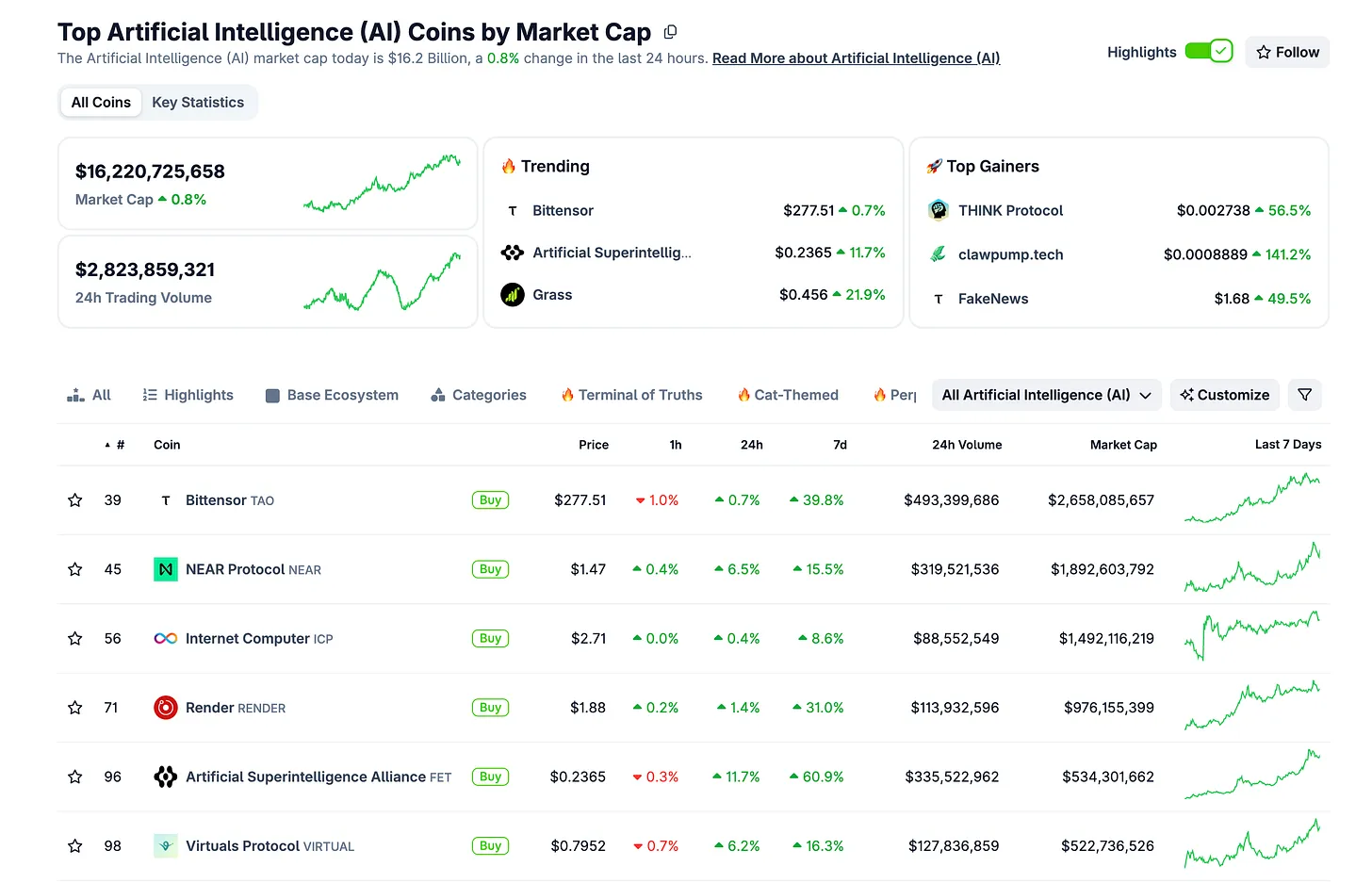
The headline news this week was Templar’s Covenant-72B (see above). The broader AI sector benefited from Bittensor’s catalyst effect and ongoing institutional narrative momentum around Agent infrastructure.
TAO (7-day +40%): $277.51, market cap $2.66 billion. Catalyst: Covenant-72B; structural dynamics from subnets to TAO amplified gains.
FET (7-day +61%): $0.2365, market cap $534 million. Strongest weekly performer among top DeAI assets. The Artificial Superintelligence Alliance benefited from sector-wide capital rotation triggered by the TAO catalyst, with broad inflows into AI tokens.
RENDER (7-day +31%): $1.88, market cap $976 million. Covenant-72B demonstrated that distributed GPU networks can train competitive models, providing tailwinds for the decentralized compute narrative.
NEAR (7-day +16%): $1.47, market cap $1.89 billion. Continued catalysts include IronClaw (a security-hardened Rust rewrite of OpenClaw deployed in TEE) and NEARCON 2026. NEAR’s positioning as enterprise-grade OpenClaw infrastructure keeps it in the AI buy-side flow.
ICP (7-day +9%): $2.71, market cap $1.49 billion. Caffeine AI—an in-house application platform on DFINITY’s ICP—continues attracting developers (per Dominic Williams, monthly unique visitors number in the hundreds of thousands). Version 3, featuring Claude Code integration, is imminent. The “Mission 70” tokenomics proposal targets a 70% reduction in annual inflation by end-2026, with Caffeine-driven compute burn as a key mechanism. Over the past 30 days, ICP ranked first in code development activity among AI/big-data crypto projects.
VIRTUAL (7-day -16%): $0.7952, market cap $523 million. Pullback following AGDP-driven rallies. However, VIRTUAL’s more compelling story this week lies in x402 facilitator data: Virtuals has entered the x402 top three facilitators by transaction value, powered by ACP.
B) Robotics Total Market Cap Analysis
This week, the robotics sector’s total market cap increased by $44 million (+6%) to $811 million:
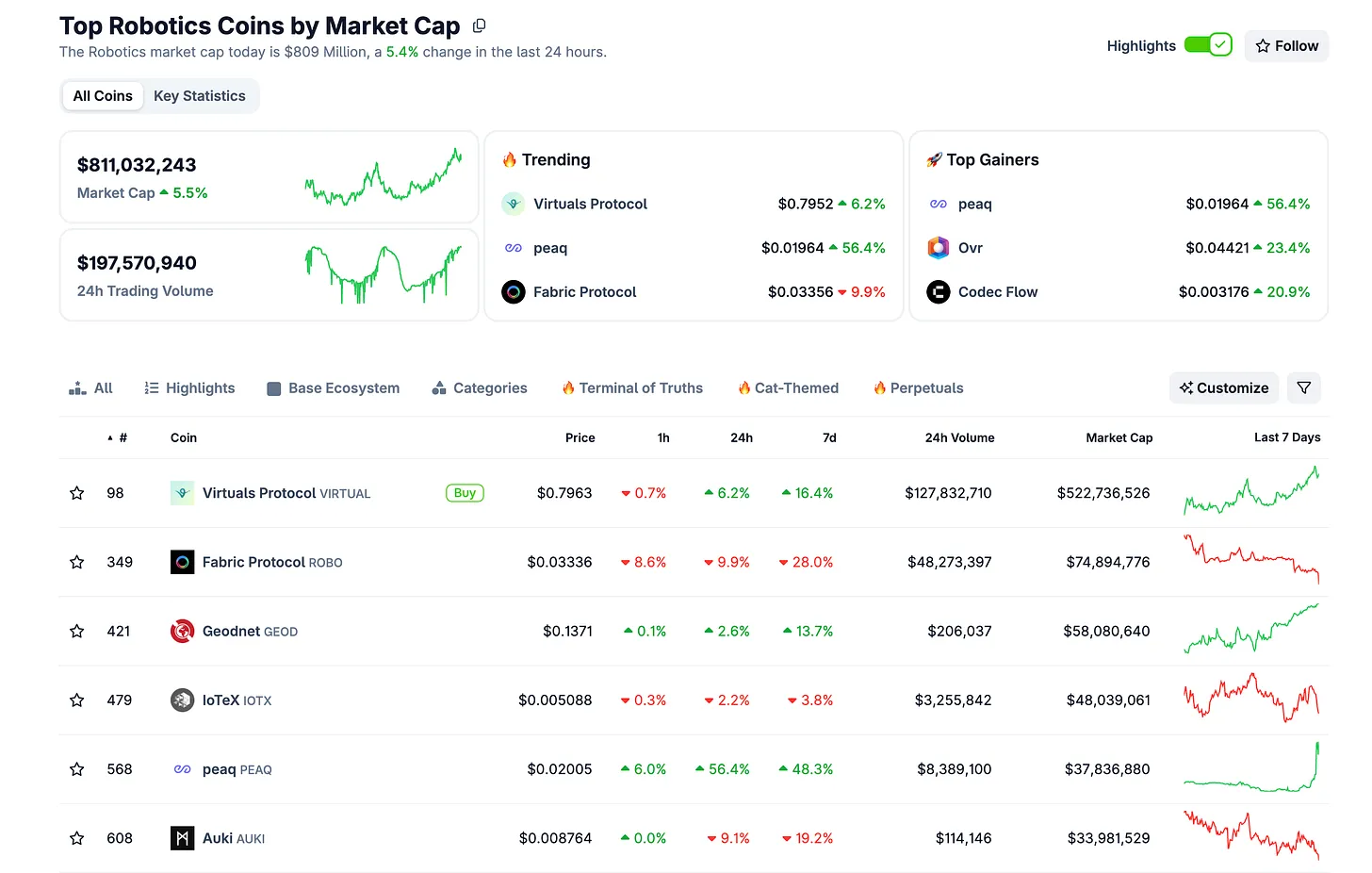
PEAQ (7-day +48%): $0.02005, market cap $37.8 million. Top performer. peaq released a new video outlining its robotics narrative and Robotics SDK (ROS 2–compatible, enabling any robot to obtain a peaq ID, execute on-chain payments/receipts, and validate data). Hashkey Capital’s “Machine Economy” research report identifies peaq as the foundational L1 for machine identity, payments, and governance. Over 60 DePIN projects across 22 industries are live on the network; Dubai’s VARA regulatory sandbox has opened for on-chain robotics business.
ROBO (7-day -28%): $0.03336, market cap $74.9 million. Fabric Protocol (OpenMind/Fabric Foundation) is seeking price equilibrium after initial listing enthusiasm. Still a relatively new entrant in the robotics category.
GEOD (7-day -14%): $0.1371, market cap $58.1 million. 24-hour volume stood at just $206,000—despite GEO-SWARM launching on Kickstarter and Lightspeed (a Solana/Blockworks–affiliated institutional platform) adding GEOD coverage. Institutional visibility is expected to improve over time.
Crypto AI Agent Sector
a) Nansen DEX Fund Flows (All Traders, 7-Day)
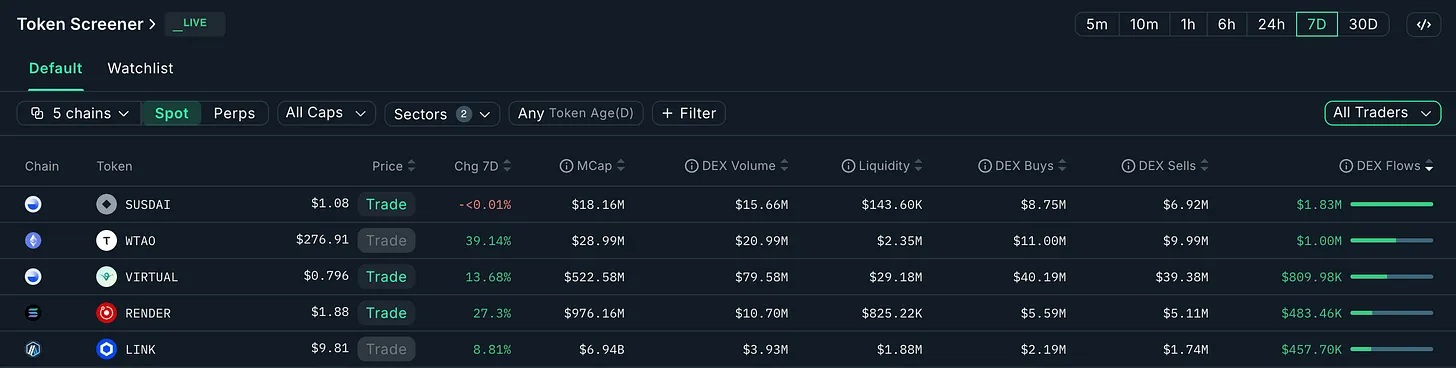
sUSDAI (+$1.83M net inflow): Largest net inflow in the AI sector. A yield layer for USDai—a GPU-collateralized stablecoin protocol (Permian Labs; backed by Dragonfly, Coinbase Ventures, YZi Labs). Loans are issued against physical GPU infrastructure; yields are returned via sUSDAI. Integrated with PayPal/PYUSD; peak TVL $658 million. CHIP governance token launched via CoinList at end-February; capital is rotating into yield layers. DeFi capital converges with real-world AI infrastructure financing.
WTAO (+$1.0M net inflow): $11M bought vs. $10M sold. Confirms Covenant-72B drove genuine DEX accumulation behavior.
VIRTUAL (+$810K net inflow): Positive net inflow despite a 16.3% weekly price decline. $40.19M bought vs. $39.38M sold. Smart money buying on the dip. Deepest liquidity in this group: $29.18M.
RENDER (+$483K net inflow): Modest positive. Sector tailwinds, no specific catalyst. Render Con 2026 approaching.
LINK (+$458K net inflow): Chainlink appearing in AI sector filters is noteworthy. Chainlink Runtime Engine serves as the connective tissue for Agent infrastructure; this week’s AWS blog explicitly cited CRE integration.
b) Nansen Public Figure Fund Flows (7-Day)

DRV (+$264K net inflow, 7 traders): Derive, a decentralized derivatives protocol built on OP Stack. 7-day +48.84%, market cap $111 million. Institutional staking launches March 23; 25% of fees go toward DRV buybacks.
FAI (+$187K net inflow, 4 traders): Freysa AI, a sovereign Agent stack on Base. Market cap $62 million. Uses TEE and zkTLS to enable Agents to hold their own keys. Similar to OpenClaw but focused on cryptographic sovereignty.
WTAO (+$105K net inflow, 3 traders): Corroborates signals seen across all traders around Covenant-72B.
c) x402 Analysis
i) Declining Transaction Count, Rising Transaction Value
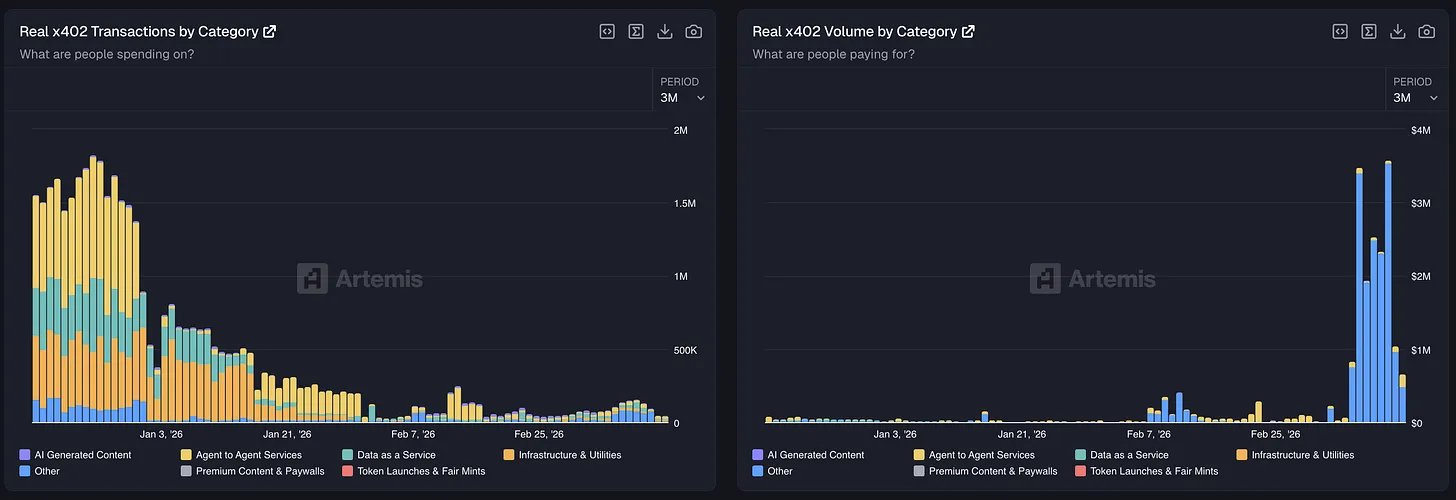
Artemis data tells two stories:
Transaction count (left chart): Clear decline from December/January peaks. Daily transactions fell from over 1.5–2 million to the low hundreds of thousands.
Transaction value (right chart): Sharply increased after a stable January/February period, pushing daily value to $3–4 million. Dominated by Infrastructure & Utilities and Data-as-a-Service categories, with Agent-to-Agent Services contributing secondarily.
This divergence is x402’s most important current signal. Falling transaction count alongside rising value implies increasing average transaction size. Fake transactions are being purged; what remains are fewer, higher-value real commercial transactions.
Given the current merchant landscape, leading categories likely represent: Agent payments for compute (cloud GPUs, inference nodes, Chutes); API data source access (Firecrawl, StableEnrich, market intelligence data); browser sessions (Browserbase); and content generation (Freepik).
Agent-to-Agent services are structurally most significant: autonomous Agents paying other Agents to complete subtasks.
AI-generated content and token launches previously dominated early transaction counts but have now been filtered out.
ii) a16z and the Data Measurement Gap
a16z partner Noah Levine noted that “real” transaction volume is far below the inflated figures generated by early-year fake volume pumping. Bloomberg reported x402’s 30-day payment volume as $24 million (data from x402.org); Allium Labs’ figure was ~$3 million; Artemis, after filtering out fake volume, estimates real volume at ~$1.6 million.
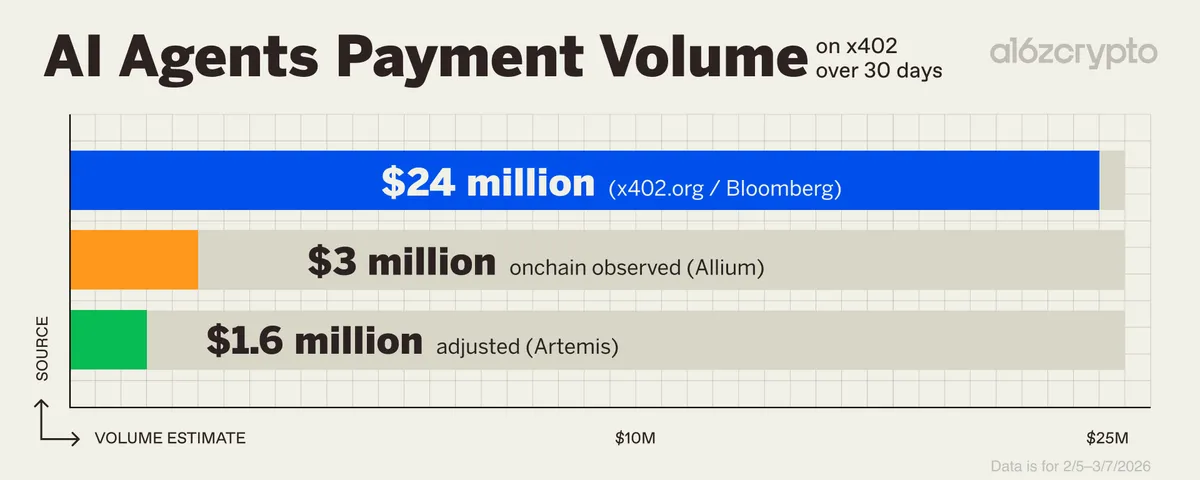
But this gap reveals how early the measurement infrastructure still is—especially as more mature institutions adopt this open protocol: Stripe, Cloudflare, Vercel, and Google have all integrated x402.
These institutions aren’t betting on $1.6 million per month—they’re betting on what that number becomes when Agents become the default buyers.
iii) Facilitator Leaderboard (Past 7 Days)
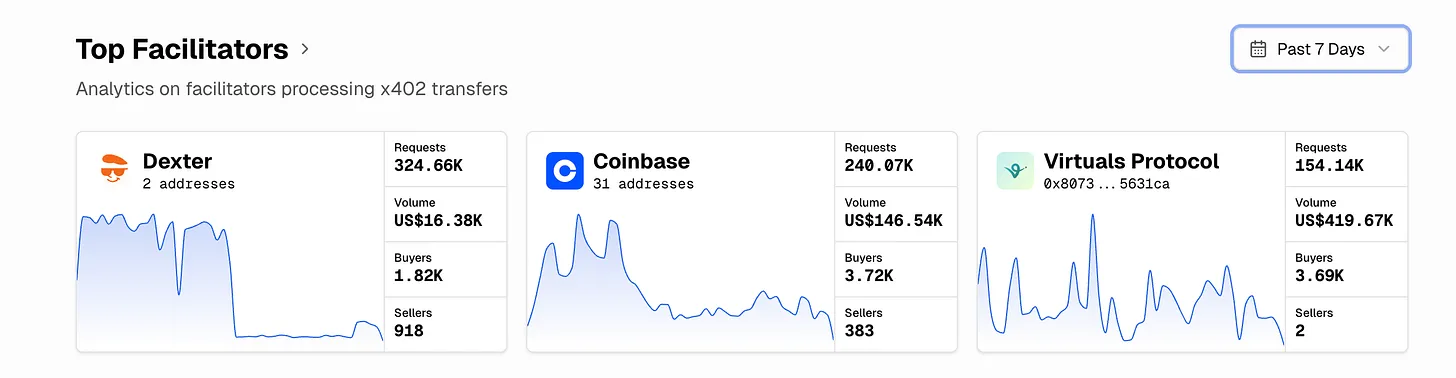
The facilitator leaderboard is diverging: high-frequency micro-settlements (Dexter), institutional API access (Coinbase), structured Agent commerce (Virtuals/ACP).
Virtuals Protocol (144,140 requests, $419,670 transaction value): Third by request count, but highest by transaction value. Average request value ~$2.72 (5× Coinbase’s, 54× Dexter’s). 3,690 buyers matched with just 2 sellers.
This reflects ACP settling structured Agent-to-Agent commercial transactions: a small number of service-oriented Agents completing high-value tasks for thousands of buyers.
On March 10, Virtuals and the Ethereum Foundation’s dAI team jointly submitted ERC-8183, formally standardizing the trusted Agent commercial transaction lifecycle alongside x402 (payments) and ERC-8004 (identity/reputation).
iv) AWS Releases Full x402 Reference Architecture
On March 15, AWS published “x402 and Agent Commerce: Redefining Autonomous Payments in Financial Services” on its industry blog, including a full technical reference architecture.
When AWS publishes a production-grade reference architecture—including open-source code—for a native crypto payment standard, that protocol moves from concept to infrastructure stage.
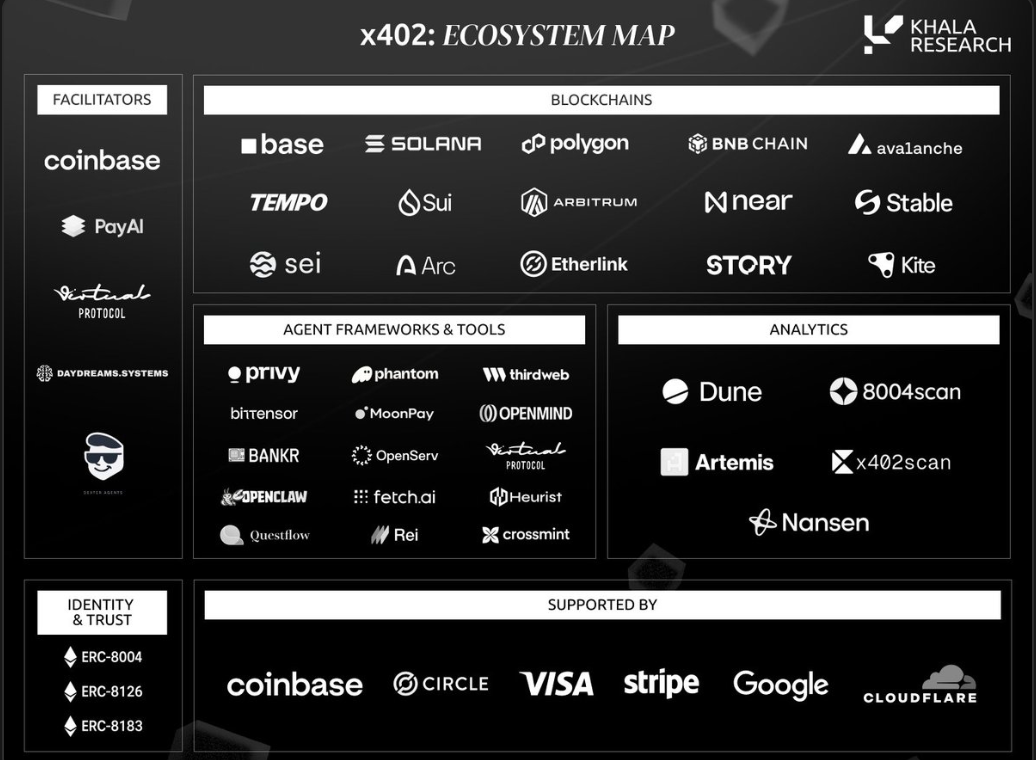
For deeper insights into x402’s development trajectory, follow Khala Research—we’ll release our full report later this week. Here’s the current ecosystem map:
Disclaimer: The content covered in this newsletter should not be construed as investment or financial advice. It is provided solely for informational and educational purposes.
Disclosure: I hold some of these assets and have collaborative relationships with certain projects mentioned in this newsletter.
Join TechFlow official community to stay tuned
Telegram:https://t.me/TechFlowDaily
X (Twitter):https://x.com/TechFlowPost
X (Twitter) EN:https://x.com/BlockFlow_News
 @0xSammy