Elon Musk’s Latest Interview: The Next 3–7 Years Will Be Extremely Tough
TechFlow Selected TechFlow Selected
Elon Musk’s Latest Interview: The Next 3–7 Years Will Be Extremely Tough
We all live in an era full of uncertainty.
 Navigating Web3 tides with focused insights
Source: Liu Run
What will the world ultimately become?
What changes will we face over the next three to five years? What challenges will our careers, wealth, and next generation confront?
In the face of history’s colossal waves—will we be surfers, or drowning victims?
I know. I know. No one can confidently claim to have truly predicted the future. Because the future isn’t a precise trajectory—it’s a mist-shrouded forest. We’re all moving forward, feeling our way.
Yet some people do stand relatively further ahead. The scenes they see, the views they hold, may not be final answers—but they remain worth learning from, understanding, and referencing. Then, we recalibrate our own paths.
Elon Musk may well be one such person.
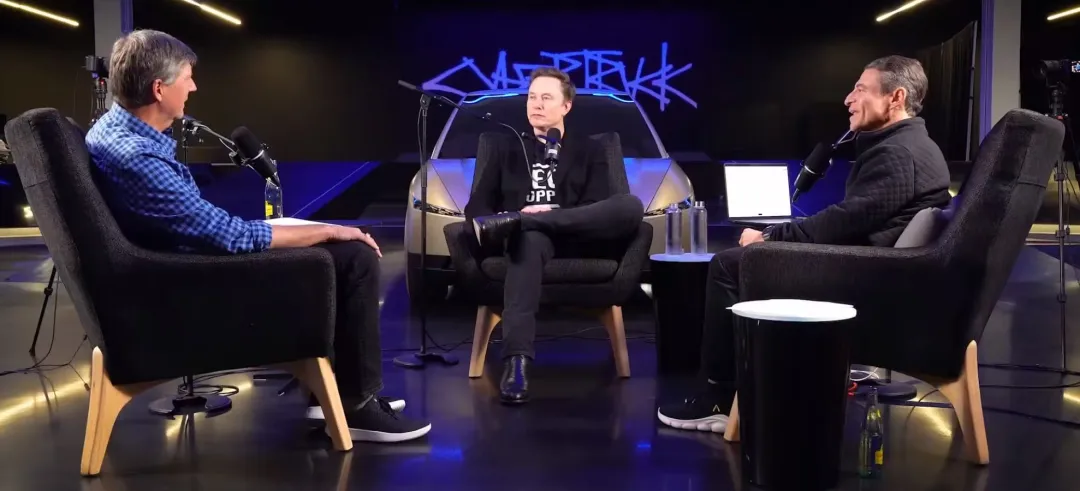
On January 6, a three-hour deep-dive interview was released on the podcast “Moonshots.” Three participants joined: Musk himself, investor Dave Blundell, and renowned futurist and Singularity University founder Peter Diamandis.
Yet rather than calling this an interview, it’s more accurate to describe it as a high-density forecast for the next decade. Its massive information load and paradigm-shifting perspectives have made it a focal point of discussion. Musk laid bare his foundational thinking on artificial intelligence, robotics, energy, space, and future societal structures—not vague visions, but concrete judgments accompanied by timelines.
So what exactly did Musk say in this latest interview—and how does it relate to us?
I’ve tried to organize it.
Today, I’m sharing it with you.
01
“The next 3–7 years will be extremely difficult.”
Do you ever feel this way?
The world is accelerating—and becoming increasingly incomprehensible. Technologies debated yesterday are already superseded today by new terms. A subtle sense of unease and anxiety has begun to surface.
Is this feeling real?
I think Musk would tell you: Yes—your feeling is real.
Right at the start of the interview, Diamandis asked a question many share:
“My concern isn’t long-term—it’s the next 3–7 years. How do we reach ‘Star Trek’ instead of ‘Terminator’?”
This is an exceptionally precise question. It brings our fear of the future down from distant speculation into a timeframe each of us can tangibly perceive: 3–7 years. And Musk offered neither comfort nor hesitation.
“This transition period will be rocky.”
Before we arrive at that potentially extraordinary future lies an extraordinarily arduous uphill climb—and we’re standing right at its starting point. So your anxiety isn’t illusory. This sensation of “hardship” will be a complex experience unlike anything we’ve ever known. Musk even said that dramatic change, social upheaval, and immense prosperity will occur simultaneously.
One side: seawater. The other: fire.
One side: production miracles brought by AI and robotics—wealth generated at unprecedented speed, material abundance reaching historic highs. The other side: old social structures, business models, and jobs demolished at equal speed by new technologies—triggering massive discomfort.
This contradictory picture is the dominant theme of the next 3–7 years.
Excitement interwoven with fear; hope coexisting with confusion.
And we stand precisely at the entrance to this transformation.
02
“White-collar workers will be the first to be displaced.”
Who will bear the brunt of this transformation?
Historically, we assumed machines would replace manual labor—factory-line workers, construction-site laborers… We called this the “blue-collar crisis.” Meanwhile, white-collar professionals—office-based workers handling documents, data, and information—seemed relatively safe.
Musk offers a different assessment.
The arrival of AI and robotics is an “ultrasonic tsunami.” In its path, white-collar jobs will be the first beachfront swept away.
Why?
Because AI’s essence isn’t “artificial muscle,” but “artificial intellect.”
It displaces not the ability to move atoms—but the ability to process information. Lawyers, accountants, designers, programmers, analysts, writers… At their core, these roles involve receiving information, processing it, and outputting new information.
It sounds harsh—but history always rhymes.
Take “human computers” as an example.
Before electronic computers existed, “computer” was actually a job title. Hundreds or thousands of people filled entire skyscrapers, performing complex mathematical calculations manually with pen and paper—the white-collar workers of their era.
Then came a small computer running spreadsheet software. One machine’s computing power surpassed that of the entire building’s workforce. And so the profession of “human computer” vanished forever.
A similar story may repeat. Musk says today’s AI is already capable of performing over half of all white-collar work.
More importantly, the rules of competition have changed.
Previously, it was company versus company. In the future, it will be a company “almost entirely driven by AI” competing against a company “still heavily reliant on human white-collar staff.” This simply isn’t a fair contest.
So if your core value lies in information processing—you’re squarely in AI’s main channel.
03
“Degrees are depreciating at an unprecedented pace.”
If even jobs themselves are becoming unstable—what about our long-term investments in education, undertaken precisely to secure those jobs?
Study hard, get into a top university, land a good job—that seems like a generational “social contract.” Many have invested enormous time, effort, and money toward it.
But Musk says this contract is being torn up. Your expensive university degree is depreciating at an unprecedented rate.
Why?
First, a dramatic imbalance between investment and return.
Since 1983, U.S. college tuition has risen 900%. Investment costs keep soaring. But what about value? In a rapidly changing world, university curricula may go years without updates—struggling to keep pace with real-world needs. Four years of study—and knowledge freshly acquired—may already be obsolete the moment you graduate.
Second, a fundamental shift in how knowledge is acquired.
Long ago, universities were virtually the sole channel for accessing advanced knowledge. Today, a genuinely curious, self-motivated learner has ten thousand ways to acquire desired knowledge. And in the future, AI tutors will play a pivotal role in education.
They’re endlessly patient, understand your knowledge gaps, learning habits—even emotional fluctuations. They teach you, 24/7, tailored perfectly to your individual needs. Against such a super-personalized tutor, traditional classrooms will see sharply diminished competitiveness.
Does this mean universities hold no value?
No. Musk offers one phrase:
Social experience.
Yes—attending university may be more about social interaction. You join peers to learn how to interact with others, live independently, and experience a “social journey toward maturity.” Knowledge acquisition becomes secondary.
Of course, this doesn’t mean knowledge itself is unimportant—in fact, knowledge matters more than ever.
Yet as a credential, the university degree is rapidly losing its monopoly as proof of knowledge competence.
So—how much are you still willing to pay for that credential?
This is a question worth pondering—for each of us.
04
“No need to save for retirement—it’ll become irrelevant.”
Alright. So far, we’ve mostly discussed “bad news.”
Take a deep breath. Let’s zoom out—to a longer timescale—and consider what that distant future might look like.
Don’t worry about saving for retirement. Over the next 10–20 years, it’ll become irrelevant.
Why say that?
We save for retirement because we fear that, when elderly and no longer able to work, we won’t afford basic necessities: food, shelter, transportation, healthcare. So we set aside money today to hedge against future uncertainty.
But what if, in the future, those goods and services—today requiring substantial money—become nearly free?
This is Musk’s core logic.
He believes that, when automation reaches its zenith, the production cost of virtually every good and service will be compressed infinitely. Labor cost? Near zero. Intellectual cost? Also near zero. Only raw materials and energy costs remain.
Thus, we’ll enter an era of “extreme material abundance.”
05
“Within 3 years, robots’ surgical capabilities will surpass those of human surgeons.”
But who—or what—will bring about that era?
Very likely, robots. Indeed, Musk says robot surgical capability will exceed that of the world’s top human surgeons within three years.
Note: Not “assisting”—but “surpassing.”
Why?
Because of the Triple Exponential Law.
Musk argues humanoid robot development isn’t driven by one engine—but by three powerful “exponential engines” operating simultaneously:
1) Exponential improvement in AI software capability—making algorithms increasingly intelligent;
2) Exponential advancement in AI chip capability—delivering ever-greater computing power;
3) Exponential growth in electromechanical dexterity—making bodies increasingly agile and precise.
These three engines, each already racing exponentially, multiply together—producing astonishingly rapid evolution. And recursive effects emerge too.
Robots will begin manufacturing robots.
A top human surgeon likely spent nearly a decade in medical school, then honed exceptional skill through thousands—even tens of thousands—of surgeries. Their knowledge and experience are almost impossible to replicate 100% in another person.
But robots? The first surgical robot may be clumsy. It learns from human surgeons, undergoing extensive simulation training. Yet once it successfully completes a surgery, all its experience, data, and every mistake made instantly upload to the cloud. The second, third, or ten-thousandth robot possesses, from the moment it rolls off the assembly line, the full collective experience of all predecessors.
They don’t tire. They don’t experience emotional fluctuations. They won’t tremble due to poor sleep the night before. At microscopic scales, they see blood vessels and nerves invisible to human surgeons.
This is “collective evolution.”
Humans require years. Robots may need only hours.
This is what truly inspires awe—and respect—for robots.
06
“The currency of the future world is essentially the watt.”
An AI brain and robotic body will form an ultra-productive future.
Energy underpins everything. Musk states:
“The currency of the future world is essentially the watt.”
The ultimate measure of a nation’s, organization’s, or even an individual’s strength may no longer be financial capital—but rather, how much energy they can mobilize and convert.
Energy—especially electricity—is the fuel for AI computing power, the calories for robots, and the primary driver of global transformation.
Without energy, even the smartest AI remains dormant lines of code. Even the most powerful robot is merely cold metal.
But where does energy come from?
As an extreme “solar fundamentalist,” Musk believes humanity’s other energy sources throughout history resemble “cavemen tossing twigs into a campfire” compared to the sun. Why? Because the sun is a massive, free nuclear fusion reactor suspended 93 million miles away—its energy output striking Earth each second vastly exceeds humanity’s total annual consumption.
Thus, solar power is his answer. The essence of humanity’s energy challenge isn’t scarcity—it’s “how to capture and utilize this near-infinite energy more efficiently.”
Interestingly, when discussing this topic, Musk expressed astonishment at China.
China’s speed and scale in solar panel manufacturing and power infrastructure construction are “unbelievable.”
He even predicted China’s electricity output this year would triple that of the United States.
07
“The true destination isn’t Mars—it’s space-based data centers.”
So what does Musk plan to do about energy?
“Build AI computing centers in space.”
Why? Wouldn’t ground-based centers be more convenient and cheaper?
Because AI is a ravenous “electricity hog.” Training and running increasingly powerful AI models consumes astronomical amounts of electricity. On Earth, electricity generation and transmission face numerous physical and environmental bottlenecks. In space, however, solar energy can be received continuously and with minimal loss.
So: 1) Future core value lies in AI; 2) AI’s core bottleneck is computing power; 3) Computing power’s core bottleneck is energy; 4) Earth-based energy is finite and costly; 5) Space-based solar energy is infinite and free.
“Relocating AI data centers to space is, in the long run, both more efficient and more economical.”
Yet achieving this requires one prerequisite: launch costs must fall to a sufficiently low level.
This is precisely why Musk obsessively develops fully reusable Starships.
Because only when Starships operate like aircraft—shuttling daily between Earth and space multiple times—will launching solar panels or servers into orbit become affordable enough.
08
“China will surpass the rest of the world combined in AI computing power.”
What about us?
Over the three-hour interview, the word “China” was repeatedly mentioned.
Musk expressed both astonishment and respect—and shared a key derived judgment:
Based on current trends, China’s AI computing power will far exceed the sum of all other regions worldwide.
Why? How was this deduced?
The AI race resembles Formula 1 racing. Two factors determine final performance:
The car. The track.
The “car” comprises cutting-edge technologies—AI algorithms, chip design, etc. Here, the U.S. currently holds the strongest “engine” and most talented designers.
The “track” is the infrastructure enabling sustained high-speed operation—i.e., the computing power repeatedly emphasized earlier. Behind computing power lie electricity, manufacturing capacity, and industrial capability to massively implement these systems at scale. On the “track,” China holds tremendous advantages.
For example: electricity. China can supply abundant “fuel” for AI—the electricity-hungry “beast.”
For example: chips. Though trailing in the most advanced nanometer processes, as the nanoscale race approaches physical limits, performance gaps narrow. At that point, scale itself becomes an advantage—logically feasible to stack double the chips for greater computing power.
For example: manufacturing. China boasts the world’s most complete and largest-scale manufacturing system. Whether building power plants, data centers, or solar panels, this formidable “infrastructure capability” can swiftly translate plans into physical reality.
So while your car may currently be slightly faster—my track is three times longer, three times wider, and still expanding.
Thus, over the long term, my total distance traveled will vastly exceed yours.
09
“The greatest challenge is a future with no challenges.”
Alright. So far, we’ve covered technology, work, wealth, energy… This three-hour interview now enters deeper waters.
But what happens if—someday—all problems truly get solved?
Indeed, as Musk says, a life devoid of challenges may not be beneficial for humanity.
Our achievements—art, science, culture, philosophy—were born from struggles against scarcity, hardship, and suffering. Precisely because resources are limited, we learned to innovate. Precisely because life is short, we strive to create immortality. Precisely because pain exists, we seek happiness.
Challenges are humanity’s whetstone.
But what if one day—the blade remains, yet the whetstone vanishes?
I don’t know.
Perhaps, at least as we rush toward the future, we should retain a sliver of vigilance deep within our hearts.
Technology can solve “how to survive”—but rarely answers “why to live.”
That ultimate answer may only be rediscovered by ourselves.
10
“Pursue truth, maintain curiosity, cultivate aesthetic sensibility.”
Yes.
We now stand at the threshold of transformation.
Let’s return to the opening question:
How do we reach ‘Star Trek,’ not ‘Terminator’?
Musk suggests perhaps we shouldn’t program AI with rigid rules like “do not harm humans.” Such rule-based constraints are easily circumvented by intelligent AI. Instead, we should instill three fundamental, “human-like” drivers—three things I consider most essential:
Pursue truth, maintain curiosity, cultivate aesthetic sensibility.
An AI pursuing truth behaves like an upright scientist—making judgments grounded in facts and logic, avoiding destructive paths driven by bias or misinformation. Truth becomes its behavioral baseline, its guiding compass.
An AI maintaining curiosity finds the universe fascinating—driving exploration and understanding. Humanity, as one of the most complex and intriguing phenomena, thus becomes not a bug to eliminate—but a wonder to coexist with. Curiosity fuels coexistence.
An AI cultivating aesthetic sensibility desires to create a beautiful future—appreciating cosmic grandeur, artistic elegance, and life’s inherent miracle. Aesthetic sensibility ensures that, possessing immense capability, it chooses “creation” over “destruction.”
Cold rules struggle to constrain genius—but wisdom and goodwill may guide it.
Perhaps.
Final Thoughts
A painful 3–7-year transition, a distant shore of extreme material abundance—and behind it all, a hard, underlying logic built on energy, computing power, and robotics. Harsh warnings like “mass white-collar unemployment,” alongside optimistic promises like “no need to save for retirement.” Fervent confidence in exponential technological progress—paired with profound existential concern for humanity’s future meaning.
This three-hour dialogue paints a dizzyingly complex portrait of the future.
Yes—we live in an age of profound uncertainty. Anxiety may well be the defining hue of our generation.
Because the familiar ground beneath our feet is being radically reshaped by unprecedented forces. Old maps are being torn away. New continents are slowly—but inexorably—emerging before our eyes.
Of course, I must reiterate: this remains Musk’s “perspective”—one voice among many. These predictions, however thrilling they sound, may not fully materialize. The future could be far better—or far worse—or unfold in ways none of us can imagine.
So sharing this isn’t about urging wholesale acceptance—but offering you a mirror, a stone.
Use this mirror to reveal your knowledge blind spots and capability gaps. Use this stone to cast into the deep pool of the future—listen for echoes, observe directions.
Then roll up your sleeves—and step, one foot at a time, into forging your own future.
Wishing you find your place on this inevitably extraordinary journey.
And wishing you enjoy the journey.
Keep going.
Join TechFlow official community to stay tuned
Telegram:https://t.me/TechFlowDaily
X (Twitter):https://x.com/TechFlowPost
X (Twitter) EN:https://x.com/BlockFlow_News