Musk Predicts AI Will Surpass Human Intelligence as Early as End of This Year
TechFlow Selected TechFlow Selected
Musk Predicts AI Will Surpass Human Intelligence as Early as End of This Year
Elon Musk "drew a lot of pie charts again" at Davos.
 Navigating Web3 tides with focused insights
Author: WallStreetCN
At the World Economic Forum (WEF) in Davos, Tesla CEO Elon Musk outlined an ambitious vision spanning humanoid robots, autonomous driving, space exploration, and artificial intelligence (AI). He predicted that AI could surpass human intelligence as early as the end of this year, and that Tesla’s humanoid robot, Optimus, could go on sale to the public as soon as the end of next year.
On Thursday, January 22 local time, Musk made a rare appearance at the Davos Forum for a dialogue with BlackRock CEO Larry Fink. He revealed that Tesla has already deployed some Optimus robots in its factories to perform simple tasks and expects them to handle more complex work by the end of this year. Musk stated that if Tesla gains full confidence in the robots’ reliability, safety, and functional scope, it will begin public sales by the end of next year.
Musk also said Tesla’s Robotaxi autonomous ride-hailing service is expected to be rolled out widely across the U.S. this year—“by year-end, this service will be extremely widespread across the United States.” The company has already launched Robotaxi operations without in-vehicle safety supervisors in Austin, Texas. SpaceX aims to achieve fully reusable Starship rockets this year. Musk predicted that AI will become “smarter than any human” by the end of this year—or at the latest, next year.
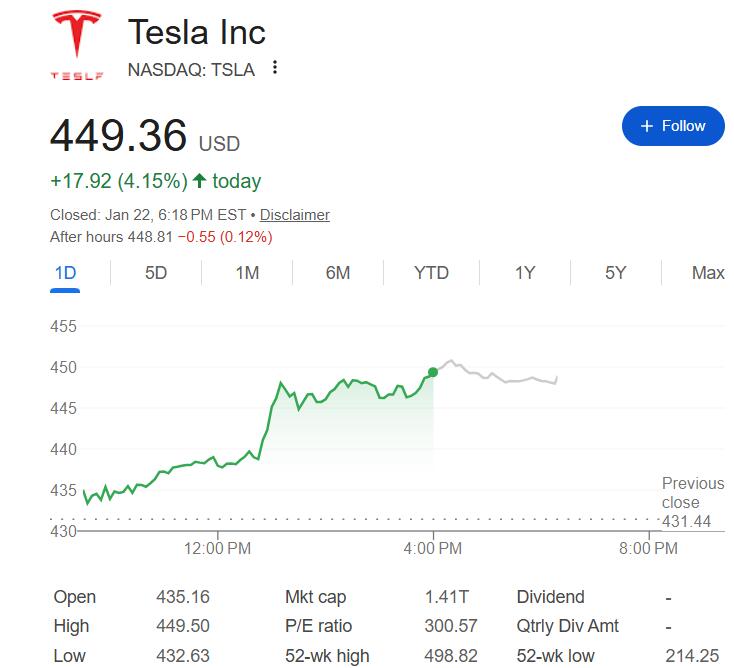
Tesla’s stock rose steadily during Musk’s remarks. By midday Thursday, its intraday gain had widened to over 4%, closing up more than 4%—its highest close since January 5, marking a two-day rally that erased most of its losses since the start of 2026.
Tesla’s core automotive business has seen two consecutive years of declining deliveries due to an aging product lineup and the expiration of U.S. EV subsidies. Musk’s recent emphasis on autonomous driving, AI, and robotics reflects his view of these areas as critical strategic priorities for Tesla. In early September last year, Musk stated that roughly 80% of Tesla’s value would stem from its Optimus robot project—the same initiative he first unveiled four years ago.
Optimus Robots to Go on Sale in 2027
Musk offered a more specific timeline for the commercialization of the Optimus humanoid robot.
He said public sales would commence once Tesla is confident the robots meet “extremely high standards of reliability, safety, and functional range,” enabling users to “essentially ask it to do almost anything you want.” Musk stated this will happen next year.
Musk has previously predicted that humanoid robots will eventually outnumber humans, with billions deployed not only in factories but also in homes—performing tasks ranging from dishwashing to childcare. At the Davos Forum, he remarked:
If we have AI that is nearly or completely free, and robots that are ubiquitous, the global economy will experience explosive growth on an unprecedented scale. What does that mean for you? Billions of AI-powered robots will outnumber humans and fulfill all human needs. At some point, you’ll struggle to imagine what else you could possibly ask a robot to do, because goods and services will be so abundant.
Tesla is currently using some Optimus robots in its factories to perform basic tasks. Musk forecasts that by the end of 2026, these robots will be capable of “performing more complex tasks.”
Although Musk frequently touts Optimus’s potential, he has historically been vague about production timelines and targets. During Tesla’s Q4 2024 earnings call in January 2025, he described a “very rough guess” that Tesla would begin delivering Optimus units to other companies in the second half of 2026. Earlier this week, Musk cautioned that initial production of both Optimus and Tesla’s newest vehicle, the Cybercab, would be “extremely slow.”
Progress in Autonomous Driving and Space Exploration
On autonomous driving, Musk declared it “essentially a solved problem.” He stated that his company’s Robotaxis will be “extremely widespread” across the U.S. by 2027.
Musk noted that Tesla’s Full Self-Driving (FSD) software is updated weekly in some cases, and several insurers offer customers who use the technology a 50% discount on premiums due to its strong safety record. Tesla has launched Robotaxi services in multiple cities and expects large-scale deployment across the U.S. by year-end; supervised FSD approval in Europe is expected as early as next month.
On space exploration, Musk said SpaceX aims to achieve fully reusable Starship rockets this year. He described Starship as “the largest flying vehicle ever built”—a breakthrough that would reduce the cost of space access by 100-fold, bringing it below $100 per pound. SpaceX has already demonstrated booster catch-and-recovery on the launchpad, but has yet to attempt recovery and reuse of the Starship spacecraft itself.
Musk also discussed plans to launch solar-powered AI satellites within the next few years. He pointed out that solar panels in space operate five times more efficiently than those on Earth, thanks to uninterrupted sunlight and no atmospheric interference. He predicted that “space will become the lowest-cost location for deploying AI”—a milestone achievable within two to three years.
AI Development and Energy Infrastructure Forecasts
Musk made bold predictions about AI development, stating that AI could become “smarter than any human” by the end of this year—or “at the latest, next year.” This forecast underscores his belief in the rapid pace of AI advancement.
On energy generation, Musk stated that a solar panel array measuring just 100 miles by 100 miles could power the entire United States. He revealed that teams at both SpaceX and Tesla are separately working toward establishing annual U.S. solar manufacturing capacity of 100 gigawatts within approximately three years.
Musk’s appearance at Davos was unexpected, given his prior criticism of the forum as “boring” and his sharp rebuke of the World Economic Forum as “increasingly becoming an unelected world government that people never asked for and don’t want.” In 2022, he posted on social media: “What is the World Economic Forum/Davos all about? Are they trying to run Earth?”
During the dialogue, Musk said the overarching goal of his companies is to maximize “the probability that civilization has a good future” and to “extend consciousness beyond Earth.”
Aliens Don’t Exist—and Human Aging Is a “Very Easy Problem to Solve”
At the forum, Musk engaged in a conversation with his friend, BlackRock CEO Larry Fink, opening with reflections on his personal values and cracking a few jokes about aliens.
“We have 9,000 satellites in orbit—but we’ve never encountered an alien spacecraft we needed to maneuver around,” Musk said. “We must assume life and consciousness are extraordinarily rare—perhaps humanity is alone.”
Musk added that he hasn’t spent much time studying human aging, but he predicts a solution will ultimately be found: “When we identify the root cause of aging, we’ll find the answer is obvious.”
Join TechFlow official community to stay tuned
Telegram:https://t.me/TechFlowDaily
X (Twitter):https://x.com/TechFlowPost
X (Twitter) EN:https://x.com/BlockFlow_News