








The Last Mile of Stablecoin C2C Cross-border Remittances
TechFlow Selected TechFlow Selected
The Last Mile of Stablecoin C2C Cross-border Remittances
This is not the last mile of C2C cross-border payments, but the starting point of on-chain financial services.
 Navigating Web3 tides with focused insights
Author: Will Awang
Stablecoins are profoundly reshaping the flow of global capital. In the enterprise sector (B2B), their potential has been fully validated, while on the individual side (C2C), it remains largely untapped. Whether sending money to family abroad, paying tuition fees, or providing emergency aid, these transactions constitute one of the most active and stable financial flows in the world.
In 2024, remittances to low- and middle-income countries reached approximately $685 billion, with South Asia, Latin America, and East Asia & the Pacific being the primary recipients. Despite this massive scale, traditional remittance channels remain inefficient and costly: average transaction fees range from 4% to 6%, and hidden exchange rate markups further burden users.
Through our research into cross-border remittances, we realized that in emerging markets, crypto technology transcends speculation—it offers real utility. Payment companies effectively serve a financial inclusion function, providing vital access to financial services for vast unbanked populations worldwide. Remittances are not just about transferring funds—they represent “support” and “care.” In many cultures, remitting money is itself an expression of love—symbolizing not only monetary value but also emotional connection.
Stablecoins offer a new pathway—one that connects thoughts across distances and enables peer-to-peer cross-border transfers. Their uniqueness lies in being built atop a global blockchain ledger, positioned at the intersection of payments, lending, and capital markets.
This leads us to ask: beyond more efficient money transfer, what else can we offer users? What other needs do they have?
If the "SWIFT + correspondent banking" model connects the global B2B network, and Visa/Mastercard power global B2C payments, then MoneyGram and Western Union have built extensive C2C remittance networks. This article begins with an overview of the stablecoin C2C remittance market, followed by three real-world case studies exploring how stablecoins create value within C2C remittance networks—and uncovering potential downstream user demands.
Clearly, this isn't the last mile of C2C cross-border payments—it's the starting point of on-chain financial services.
Key Takeaways
Crypto technology in emerging markets goes beyond speculation—it delivers real utility: dollar-denominated value storage as an inflation hedge; real-time cross-border settlement.
Stablecoins significantly reduce costs across many remittance corridors—including mature ones—with emphasis on last-mile accessibility.
Local stablecoins in Southeast Asia are growing steadily—not just as cheaper alternatives to expensive channels, but as practical tools for local currency spending, bridging the gap between receiving dollars and daily consumption in local currencies.
Pricing local markets in local currencies isn’t merely a medium (“stablecoin sandwich model”: USD stablecoin / regional stablecoin)—it can be the starting point, allowing users to stay on-chain and spend via stablecoin-powered applications without cashing out to bank accounts.
Traditional remittance providers are integrating stablecoins into their systems—not only to cut internal costs and improve efficiency, but also to leverage their global cash-out points as ready-made solutions for stablecoins’ “last mile” problem.
The significance lies here: roughly a quarter of the global population still relies primarily on cash, often excluded from purely digital economies.
Controlling the “distribution rights” of this last mile represents a rare structural advantage in the stablecoin era—tech firms can innovate quickly, but they cannot build trust networks of 500,000 physical outlets overnight.
An Argentine user can hold XYZ USD stablecoin while using a Stablecoin Card to spend in local pesos. One fish, multiple meals: issuers distribute XYZ stablecoin; users preserve dollar exposure and avoid inflation; use cases for stablecoins are created.
Some companies are adopting hybrid DeFi models—operating under corporate branding while utilizing DeFi infrastructure behind the scenes.
It can bring financial services, solutions, or products to everyone—for example, accessing loans on-chain with better rates than local banks, all technically feasible.
This isn't the last mile of C2C cross-border payments—it's the starting point of on-chain financial services.
1. Overview of the Stablecoin C2C Cross-Border Remittance Market
“We’re not targeting the U.S. market. It’s competitive, expensive, crowded. Instead, we focus on emerging markets—Latin America, Southeast Asia, parts of Africa—where crypto technology moves beyond speculation to deliver real utility. That’s where stablecoins matter most.” —Stefan George, Co-founder of Gnosis Pay
Despite annual remittance inflows reaching hundreds of billions of dollars, stablecoin activity in these regions remains early-stage—albeit growing rapidly.
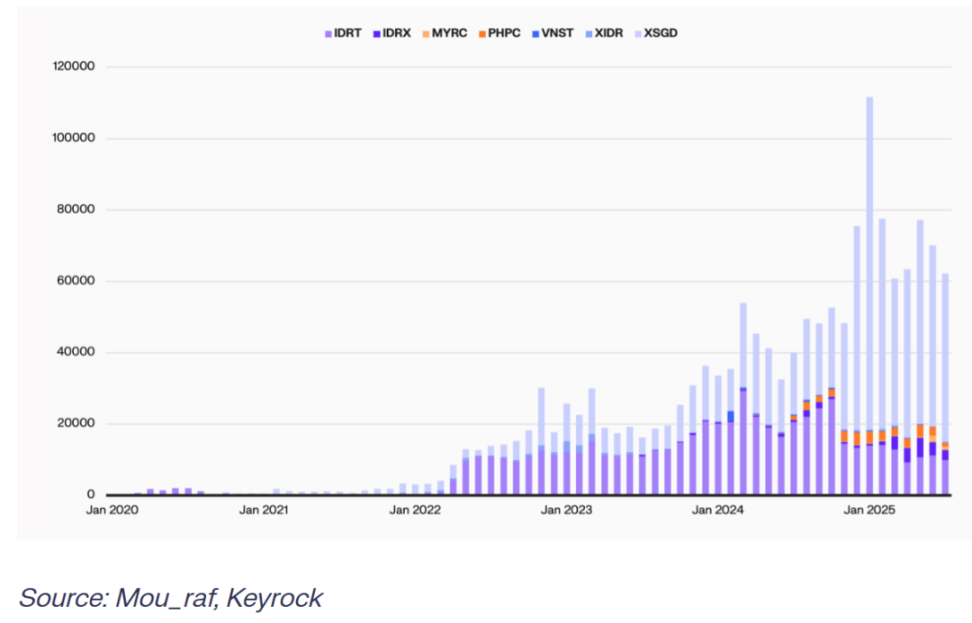
A. Rapid Growth in Local Stablecoin Transaction Volume in Southeast Asia
Given persistently high remittance costs, local stablecoins in Southeast Asia are likely to continue growing—not only as alternatives to expensive remittance channels, but also as practical tools for everyday local currency spending. While many users may prefer receiving funds in USD, daily expenses still occur in local currencies like pesos or rupees. Locally denominated stablecoins bridge this gap. As stablecoin infrastructure improves—with increased liquidity, better integrations, and expanded redemption channels—local stablecoins are poised for faster adoption.
(What are Remittances with Stablecoins? A guide)
B. High Costs of Traditional Remittance Channels
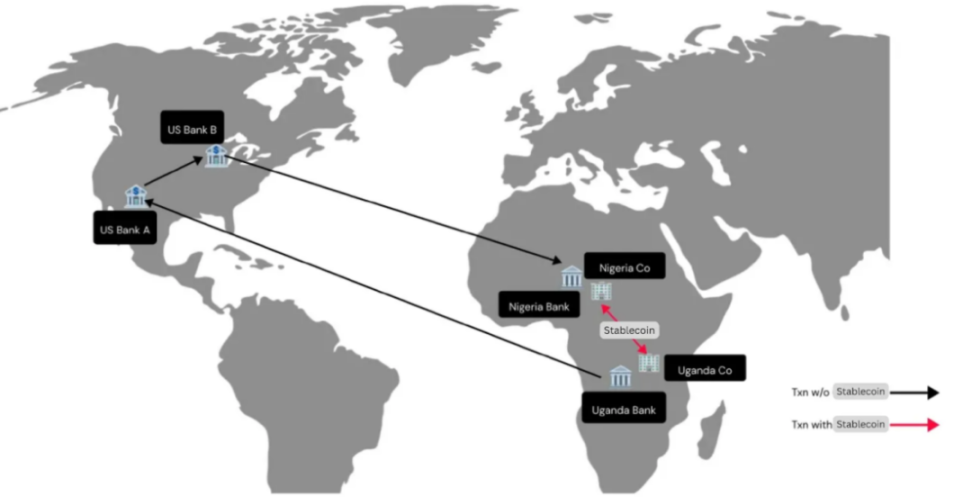
On average, sending $200 incurs a fee of about 6.3%, while $500 costs around 4.3%. These include service charges (levied by banks, Western Union, etc.) and foreign exchange markups. Providers typically offer worse exchange rates than the market and pocket the spread as profit. FX markups account for roughly 35% of total cost across different corridors—and up to 80% in some emerging markets.
(Stablecoin Payments and Global Capital Flow Patterns)
C. Cost Advantages of Stablecoins
The “Breakdown of Remittance Fees by Provider” highlights inefficiencies in traditional channels. For a $200 transfer, banks charge the highest fees (~12.66%), followed by money transfer operators (MTOs) at ~5.35%, and mobile operators at ~3.87%. By contrast, stablecoins can reduce remittance costs by approximately 92%.
(Blue Chip, The Ramping Bottleneck)
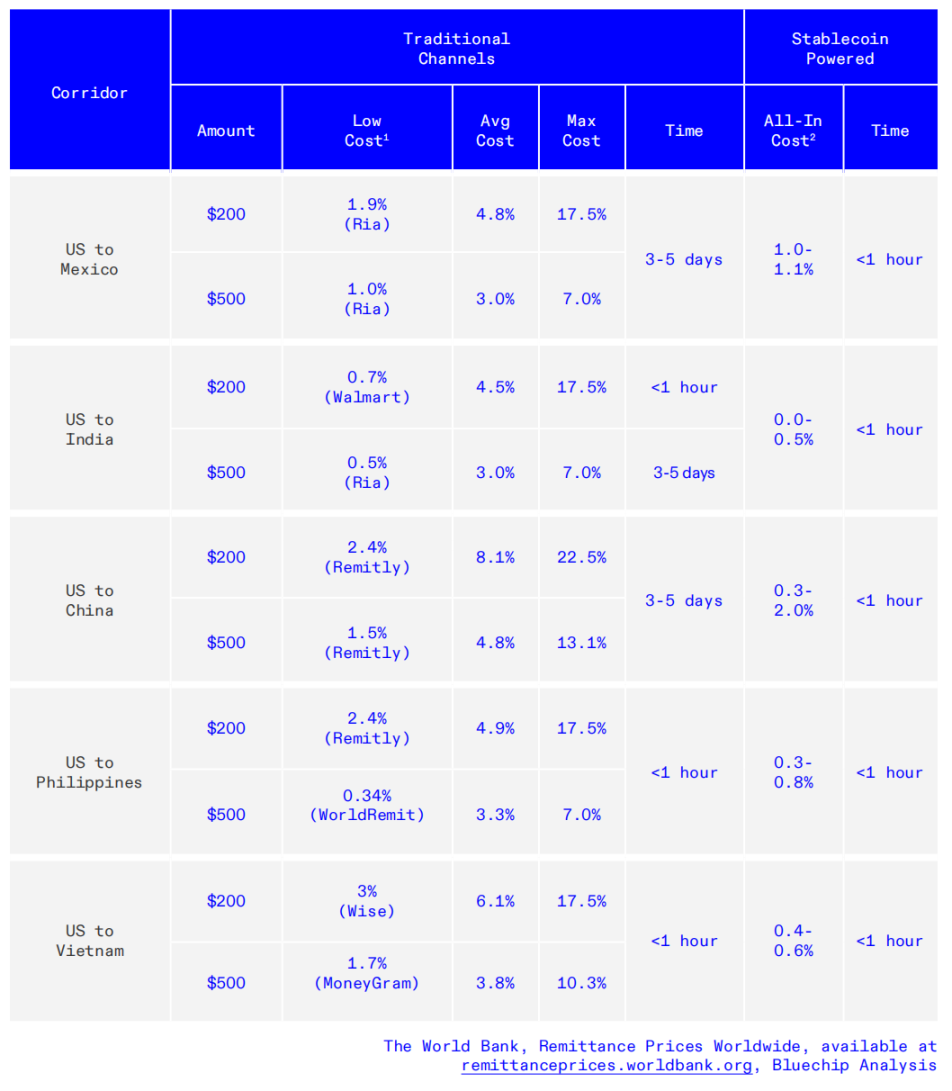
Stablecoins lower costs across many corridors, including established ones. The gap between average and lowest traditional costs indicates pricing disparities—traditional transfers often cost two to five times more than the cheapest available option. This reflects MTOs' advantages over banks. Yet, stablecoin transfers frequently undercut both.
BCRemit (serving overseas Filipino workers) reduced its total transfer cost (fees + FX) to just over 1%, avoiding the high-cost short-term loans traditional providers resort to due to liquidity constraints.
Similarly, Sling Money allows users to top up “virtual accounts” and send funds at real-time mid-market exchange rates with no hidden markups, charging only up to 0.1% on deposits—compared to ~13% for a $200 bank wire. On Sling, funds convert to USDP stablecoin and can be sent globally for free in under one second.
D. Speed of Remittance Delivery
Stablecoin channels achieve order-of-magnitude improvements in remittance economics—reducing fees by 4–13x compared to traditional methods—while offering near-instant settlement versus one or more days traditionally. This efficiency is already prompting incumbents to adapt—e.g., M-Pesa added regulated stablecoins (like USDC) to its product suite.
Despite suboptimal on/off-ramp UX, stablecoin-powered transfers settle in under an hour. Traditional methods vary from same-day to T+5, depending on funding instruments, payment types, and channels.
(Adoption Bottlenecks of Stablecoin Payments: Dual Constraints of On/Off-Ramp Cost and Quality)
E. Summary
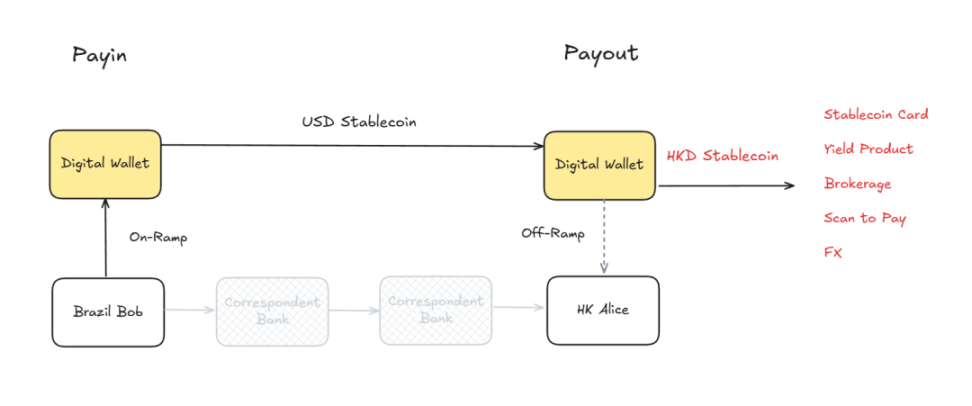
As the payments landscape evolves, centralized exchanges and crypto payment providers are increasingly expanding into payments—launching payment apps (like Kraken’s Krak) and regional stablecoins (like Bitso’s MXNB and BRL1). These regional stablecoins are crucial: not only serving as intermediaries in the “stablecoin sandwich model” (USD stablecoin / regional stablecoin), but potentially acting as starting points—enabling users to remain on-chain and spend through stablecoin-based applications without withdrawing to bank accounts.
Likewise, traditional cross-border remittance providers are incorporating stablecoins into their systems—not only for internal cost reduction and efficiency gains, but also to export their global cash-out networks as the most readily available solution for stablecoins’ “last mile,” while simultaneously exploring stablecoins’ open ecosystems and internet effects.
2. MoneyGram’s Stablecoin Re-founding
2.1 MoneyGram’s Global Reach and Transformation Vision
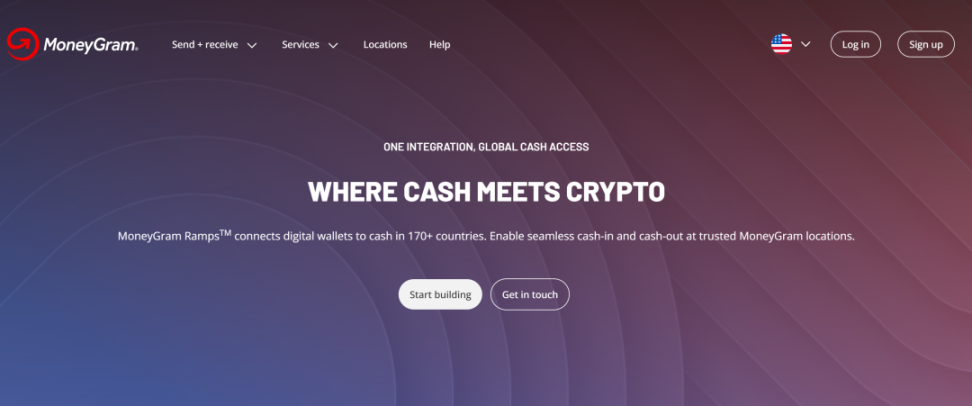
MoneyGram operates in over 200 countries and regions, with more than 20,000 remittance corridors, around 500,000 physical locations, and over 5 billion digital touchpoints. From a global payments network perspective, it is considered one of the few companies capable of rivaling world-class networks.
MoneyGram CEO Anthony Soohoo sees stablecoins as a transformative global network and has proposed a vision to “re-found” the company. This vision aims to preserve 85 years of successful DNA while reimagining its future form and mission: making cross-border money movement seamless, low-cost, secure, and reliable—helping individuals and communities reach their full potential.
(www.moneygram.com/us/en/ramps)
2.2 Value of Stablecoins for MoneyGram
MoneyGram’s business follows a “B2B2C” model—stablecoins enhance efficiency and reduce friction throughout the entire chain (from enterprise to consumer). Many only see MoneyGram’s “consumer-facing” side, but enterprise clients (e.g., agents, partner financial institutions) are equally core users.
A. Value in Reaching the Recipient (Consumer Side)
The emergence of stablecoins allows MoneyGram, for the first time, to engage directly with recipients and develop new features and services around them.
From the customer (C-side) perspective, stablecoins deliver several key benefits:
- Inflation protection—helping recipients safeguard against currency depreciation in high-inflation environments;
- Financial accessibility—granting access to financial channels previously out of reach;
- Speed and transparency—shortening wait times and improving user experience.
These characteristics not only help recipients protect against inflation-driven devaluation but also grant access to previously unreachable financial channels, reducing wait times and enhancing overall experience.
One particularly exciting project is the recent launch of a receiver-side wallet in Colombia—a digital wallet product being rolled out across seven countries. This product empowers recipients to freely retain, withdraw, or spend funds, giving them greater control over their financial lives. Traditionally, remittance businesses have long operated on a “sender-pays” model, often neglecting the recipient.
Launching any tech product shouldn’t be about chasing trends—you must deeply understand real customer needs before defining your differentiation. The current crypto industry—especially stablecoins—is full of noise and press releases. Many companies practice “innovation by PR,” not “user-driven innovation.” —Anthony Soohoo, MoneyGram
B. Optimization of B2B Processes
At the operational level, stablecoins unlock major efficiencies in B2B workflows.
Real-time settlement and its impact on corporate finance. Stablecoins eliminate the need for prefunding. Real-time settlement and synchronized ledgers are transformative for corporate treasury management. Traditional cross-border settlement requires pre-deposited funds, demanding certainty.
Instantaneous fund flow. With digital ledgers, funds settle on-chain instantly—no physical movement required. Physical transfer costs are nearly zero. Customers only withdraw cash when absolutely necessary at the final step. This is especially valuable in countries with volatile currencies. For instance, when local currency depreciates, customers can “lock in value” using stablecoins and convert to local currency only when spending—avoiding losses.
Complete overhaul of risk and liquidity management. When everything runs digitally, cash holdings drop, liquidity rises, and operational efficiency improves. But one thing is critical—consumers don’t need to know these backend changes. They don’t care about technical details—they only care that “my money arrives safely, quickly, and cheaply.”
Our job is to hide complex settlement systems behind the scenes, making the user experience as simple as sending a text or email. That’s the true “magic moment.”
2.3 MoneyGram Ramps: Bridging the Digital and Physical Worlds
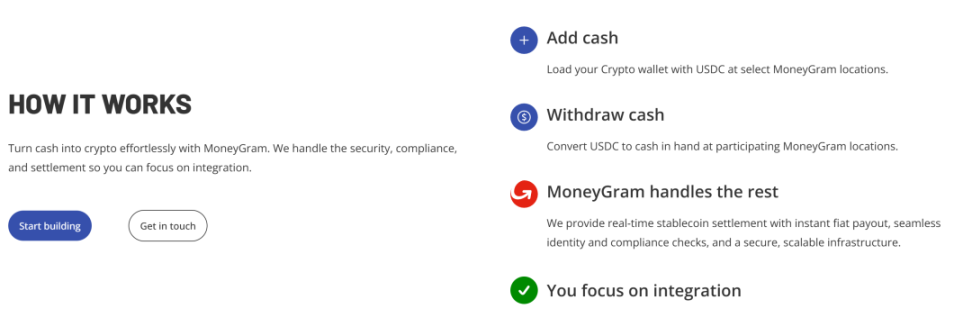
MoneyGram is advancing a project called “MoneyGram Ramps,” marking its strategic move in the stablecoin space. Previously, the company used stablecoins for B2B operations and recipient-side services, but “MoneyGram Ramps” clearly has broader ambitions. Against the backdrop of Stripe acquiring Bridge for $1.1 billion to gain best-in-class on/off-ramp access, MoneyGram holds a natural competitive edge thanks to its 500,000 physical locations and global coverage.
(www.moneygram.com/us/en/ramps)
A. Background and Strategic Significance
MoneyGram is confident in the direction of stablecoin development, and “Ramps” sits at the heart of this strategy. The company firmly believes in building an open network (Open Network), not a closed system. This is why partnering with Fireblocks is so important—it enables MoneyGram to use stablecoins within its own system while achieving interoperability with the global ecosystem.
MoneyGram Ramps is positioned as follows: any app or wallet that integrates MoneyGram’s API can use it as a “cash-in” and “cash-out” gateway. This means users can convert cash to stablecoins via MoneyGram’s network—or redeem stablecoins for cash in supported regions.
The importance of this move: roughly a quarter of the global population still relies primarily on cash, often excluded from purely digital economies.
Anthony Soohoo uses an analogy to describe the current state:
The crypto world used to be like the “Hotel California”—you could check in anytime, but you could never leave. Users could easily deposit funds, but finding use cases for stablecoins remained difficult.
MoneyGram aims to become the bridge—connecting the digital and physical worlds, enabling assets to truly “enter and exit” freely.
Currently, MoneyGram is collaborating with multiple apps and wallets (some not yet public). These partnerships transform MoneyGram from a payments company into a global financial network platform.
Soohoo draws inspiration from his time at Apple: when launching the iPhone, you couldn’t predict which “killer apps” would emerge—but you knew an open ecosystem would create miracles. For MoneyGram, “Ramps” marks the beginning of its “ecosystem-level platform.”
B. Solving the “Last Mile” Problem
While many recognize stablecoins’ potential, a persistent challenge remains—how to solve the “last mile”? Stablecoins can flow freely on-chain, but struggle to materialize as cash or integrate into local economies.
MoneyGram precisely controls the “distribution rights” of this last mile. This is a rare structural advantage in the stablecoin era—tech companies can innovate fast, but they cannot build trusted networks of 500,000 outlets overnight. In the stablecoin revolution, legacy players with distribution channels now hold a lead.
In September, MoneyGram launched its new MoneyGram App, choosing Colombia as the first market. This wallet supports USDC for receiving and exchanging funds. Colombia was selected after thorough research, for three main reasons:
- High remittance inflow country: Colombia is among the world’s top remittance recipients, with inbound flows 22 times higher than outbound—meaning many households depend on overseas remittances.
- High digital penetration: large youth population, widespread smartphone adoption, strong acceptance of digital wallets.
- Currency volatility: the Colombian peso has experienced significant fluctuations recently, driving demand for more stable value storage.
Considering these factors, MoneyGram views Colombia as the ideal launch market. The company has since expanded to six countries including Mexico and Honduras.
Through the “MoneyGram Ramps” initiative, MoneyGram not only takes a major step in the stablecoin space but also lays the foundation for interconnected global financial networks. This project offers users more convenient financial services and unlocks new growth opportunities for the company itself.
3. Western Union’s Stablecoin and Digital Network
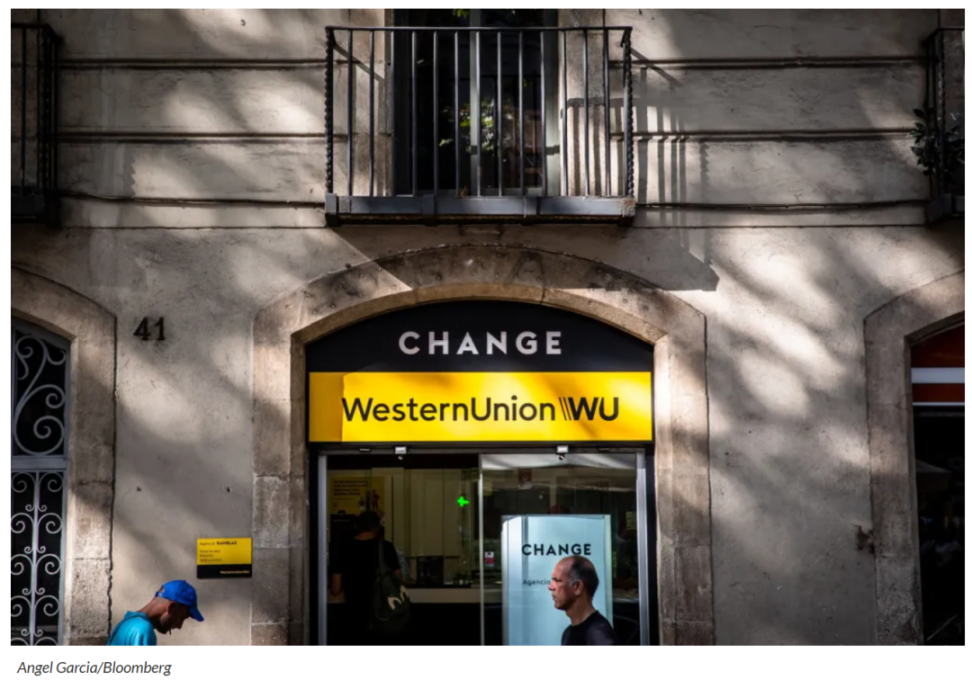
On October 28, 2025, Western Union announced the launch of its USDPT stablecoin on Solana and its digital asset network, aiming to redefine global money movement. The initiative is driven by a shared vision: modernizing financial infrastructure globally in a compliant manner and expanding the adoption of digital assets.
(Western Union plots its stablecoin move)
3.1 Western Union’s Global Influence
Western Union, commonly known as WU (NYSE: WU), founded in 1875, has a 150-year history. As one of the world’s leading cross-border remittance companies, it operates the largest and most advanced electronic financial network, with agent locations spanning nearly 200 countries and regions. A subsidiary of Fidelity National Information Services (FIS), a Fortune 500 company, Western Union offers USD remittances and USD/EUR collections. Through bank counters, online banking, and mobile banking, cross-border payments can be completed within 15 minutes, with digital channels supporting 7×24 service.
3.2 USDPT & Digital Asset Network
Western Union announced the launch of its new stablecoin—the U.S. Dollar Payment Token (USDPT)—and an innovative digital asset network designed to connect the digital world with fiat currencies, enabling digital assets to function in the real world. Built on Solana and issued by Anchorage Digital Bank, USDPT aims to expand remittance options for customers, agents, and partners while enhancing the company’s treasury management capabilities.
Western Union will provide users with access to digital assets, leveraging its robust global compliance and risk management capabilities to deliver a seamless experience in receiving, sending, spending, and holding USDPT. The company expects USDPT to launch in the first half of 2026. It plans to make USDPT accessible via partner exchanges to ensure broad availability and ease of use.
We are committed to empowering our customers and communities through emerging technologies. As we advance into digital assets, Western Union’s USDPT will allow us to capture the economic benefits associated with stablecoins. We are excited to announce the Digital Asset Network, which partners with wallets and wallet providers to offer customers seamless access to cash-out channels, solving the “last mile” problem in crypto transactions. Our Digital Asset Network and USDPT will help fulfill our mission of making financial services accessible to people everywhere. —Devin McGranahan, Western Union CEO
3.3 Underlying Drivers of Stablecoins
(Western Union partners Anchorage Digital for stablecoin launch)
The fundamental drivers are largely similar to those of MoneyGram:
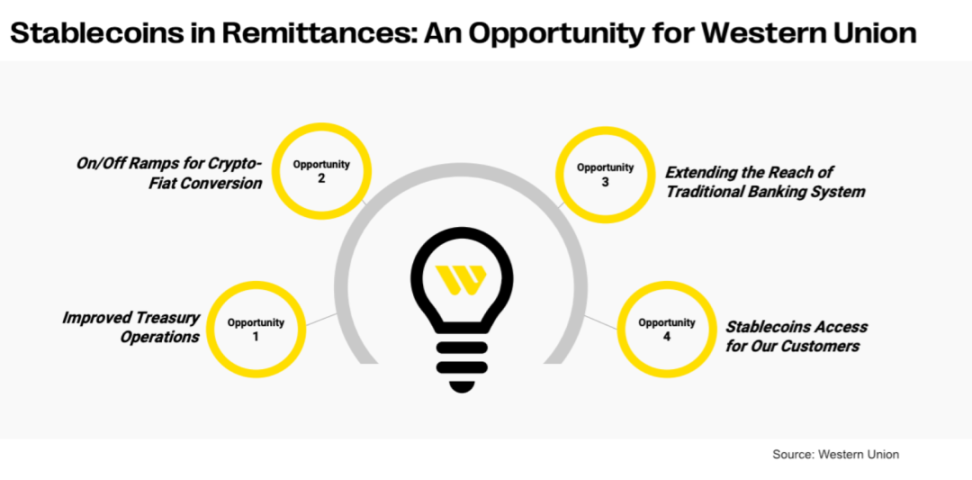
- For a giant fund-moving channel like Western Union, stablecoins perfectly address three core issues: real-time settlement and corporate financial impact; instantaneous fund flow; and complete transformation of risk and liquidity management.
- Likewise, the ability to leverage global physical网点 for “last mile” distribution can be exported externally, closing the loop of the stablecoin sandwich.
However, Western Union differs from MoneyGram in launching its own USDPT stablecoin and building the ecosystem around it—specifically, stablecoin distribution.
This explains its partnership with Rain—to distribute USDPT via crypto payment cards. Benefits include: an Argentine user can hold USDPT while using a Rain Card for local spending; preserving dollar exposure to avoid inflation. Even “send now, pay later” credit scenarios can be created based on user needs—meeting borrowing demand while hedging FX risk. A win-win outcome.
Rain is a global stablecoin infrastructure platform for enterprises, neobanks, platforms, and developers. Its technology enables partners to instantly and compliantly transfer, store, and use stablecoins via global payment cards, on/off-ramp channels, wallets, and cross-border payment rails. As a principal member of Visa, Rain-issued cards work anywhere Visa is accepted, supporting millions of transactions across 150+ countries. Rain is natively built for stablecoins and trusted by over 150 global institutions, delivering secure, scalable infrastructure for free, instant global money movement.
Rain recently announced plans to join Western Union’s new Digital Asset Network. Through this collaboration, Rain will enable users to withdraw cash locally, allowing redemption of stablecoins stored in Rain wallets at participating Western Union locations—unlocking real-world spending power.
“Rain’s ability to offer stablecoin wallets to its global customers makes them an ideal fit for the Digital Asset Network. They’ll be able to give users access to cash across multiple markets via Western Union. Our collaboration with Rain aims to deliver integrated solutions connecting traditional finance and the digital asset economy.” —Macolm Clarke, VP, Western Union
4. Bitso: From Remittance Needs to Local Currency Stablecoins
Bitso was Latin America’s first crypto unicorn, but more importantly, it now handles 10% of total remittances from the U.S. to Mexico. This clearly shows stablecoins have evolved from speculative tools to essential infrastructure.
As Bitso explores local currency stablecoins for the Mexican peso and Brazilian real, it is betting on cross-border utility. Exploring local currency stablecoins offers valuable insights into use cases and market interest:
- USD stablecoins don’t solve everything—local markets should be priced in local currencies.
- The path from USD stablecoin to local stablecoin as a “last mile” solution may differ from MoneyGram and Western Union’s approaches.
- Financial innovation around local currency stablecoins remains underexplored.
Beyond this, we’ve deeply analyzed Bitso’s bottom-up approach—starting from real user needs and gradually rolling out services—an approach highly instructive for other projects.
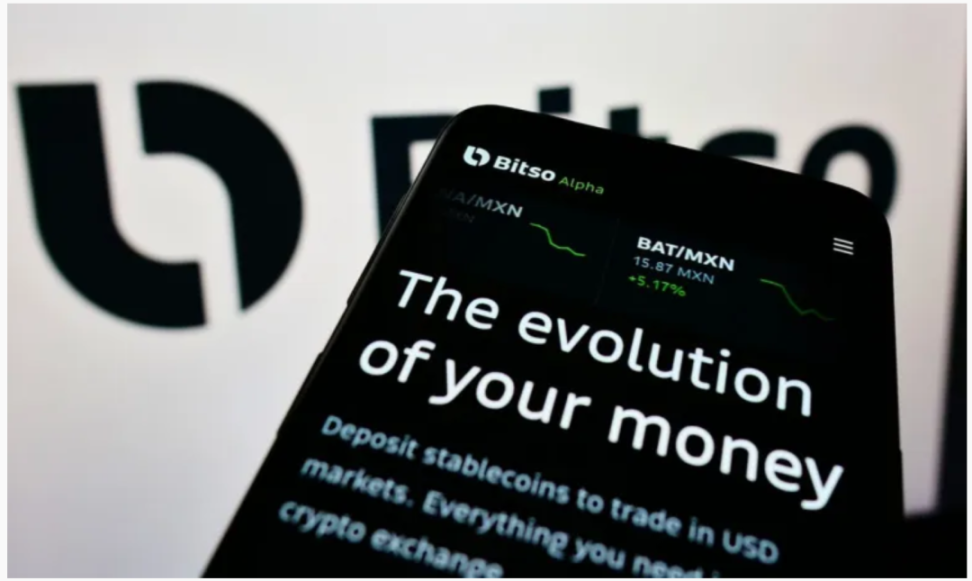
(Tribal Credit, Bitso, Stellar Collab for Latam X-Border B2B Payments)
4.1 Origins in Cross-Border Remittance Challenges
Bitso was born from its co-founders’ firsthand experiences with cross-border remittance difficulties. Daniel Vogel, one co-founder and a Mexican national, lived in San Francisco around 2010. Introduced to Bitcoin by a friend, he became fascinated by the underlying blockchain technology and began questioning the nature of money and its issuance mechanisms.
While working in San Francisco, he learned from fellow Mexican colleagues that remittances were not only expensive but also cumbersome. One colleague, Julio, borrowed $300 from him because he needed to send money home—his daughter urgently needed school supplies—but hesitated due to high fees. This experience made Vogel realize the urgent need to change the high cost and complexity of cross-border remittances.
It’s astonishing: pressing a button lets you FaceTime anyone, almost for free—but cross-border money transfer remains extremely expensive.
Other co-founders Ben and Pablo also lived outside their home countries and were drawn to Bitcoin as a mechanism for cross-border fund transfer. Thus, one of Bitso’s founding missions was to solve remittance challenges—replacing traditional SWIFT and correspondent banking systems with a more efficient, low-cost cross-border payment infrastructure.
A. Last-Mile Exchange
Before founding Bitso, Daniel Vogel tried sending money from the U.S. to Mexico via Bitcoin—but at the time, there was no way to convert Bitcoin to pesos in Mexico. This led Bitso to launch first as a cryptocurrency exchange, with core functionality centered on converting Bitcoin to Mexican pesos. Bitso became one of the earliest companies facilitating fund transfers between the U.S. and Mexico.
B. Meeting Crypto Investment Demand
As the business grew, Bitso found many customers interested in investing in Bitcoin and other cryptocurrencies, but intimidated by complex order book mechanics. So Bitso launched a simpler brokerage platform, enabling users to easily buy and sell crypto via mobile devices. This product simplified UX and became a major revenue stream.
C. Stablecoin Payment Channels
Only after stablecoins reached a certain critical mass did Bitso begin building its cross-border payment infrastructure—replacing slow, inefficient, and time-limited correspondent banking and fund transfer rails. Bitso started moving funds between countries using stablecoins, scaling rapidly.
Today, Bitso processes nearly $80 billion annually in cross-border payments, becoming Latin America’s largest digital asset infrastructure provider. About $60 billion flows annually from the U.S. to Mexico—Bitso handles roughly 10% of that volume.
Bitso serves not only individuals but also manages corporate treasury and brokerage operations. Its goal is to connect Latin America’s banking system with the global crypto ecosystem, facilitating cross-border transactions among individuals, businesses, and nations. Bitso believes money should be digital and programmable—existing on blockchains. Through APIs and end-user support, Bitso is building an open financial ecosystem where companies can build and scale on its platform.
4.2 Breaking Down the $80 Billion Business
Regarding the $80 billion total payment volume (TPV), Daniel Vogel noted:
- Approximately 75% comes from Mexico, of which 10% is from cross-border remittances, and the rest from payment service providers (PSPs) and inter-company fund transfers.
- From a B2B perspective, Mexico is still the largest market, followed by Brazil, Colombia, and Argentina.
- Retail business is slightly different—Mexico is largest, but Argentina ranks second.
A. Improving the PSP Business Model
Currently, payment service providers (PSPs) are the main source of transaction volume. These companies offer merchants and consumers payment solutions and help move funds across borders. However, traditional finance (TradFi) solutions are often inefficient.
Previously, merchants had to wait days to receive funds—PSPs would collect payments, let them sit idle or accumulate until a threshold, then conduct FX conversion and clear through traditional banking systems—a process taking several days. Now, each payment received by a merchant can be instantly converted into USDC, USDT, or other stablecoins and sent directly to the merchant, with the PSP collecting its commission. This innovation is transforming PSP operations and driving growth.
B. Cross-Border Remittances
The remittance business is highly competitive, with FX margins critical. Traditional remittance companies face high capital and operating costs, requiring prefunded accounts. If international transfers take one business day, a company must send funds on Thursday to cover Friday, Saturday, and Sunday operations—requiring three days of working capital, with holidays adding further costs.
Bitso’s solution is 24/7 service, allowing PSPs to operate nights and weekends, reducing the amount of capital held at payment partners and replenishing only when needed. The process involves converting USD to stablecoins, sending via Bitso, converting to Mexican pesos, and delivering to end customers or payment partners.
C. Tax Uncertainty Hinders Industry Development
In 2025, stablecoin applications and related businesses saw significant growth, attracting attention from enterprises of all sizes. Major payment networks like Visa and Mastercard are exploring ways to integrate stablecoins, creating opportunities for remittance companies and enterprises.
However, tax uncertainty remains a major hurdle. For example, Mexico’s tax code still lacks clarity on how to treat stablecoins. Once resolved, solutions will mature and development will accelerate. Over the next decade, stablecoin usage will become more widespread, and traditional correspondent banking and cumbersome processes may gradually fade into memory.
4.3 Opportunities in Local Stablecoins
Bitso has also launched branded stablecoins such as MXNB (Mexican Peso stablecoin) and BRL1 (Brazilian Real stablecoin, backed by a Brazilian consortium). Daniel Vogel explained the rationale—offering crucial reference points for identifying use cases and market interest in local currency stablecoins.
Observing USD stablecoins reveals they meet several key customer needs: (1) access to USD-denominated bank accounts; (2) core components of DeFi; (3) cross-border settlement.
However, global demand for USD stablecoins doesn’t directly translate to local currency stablecoins like the Mexican peso or Brazilian real.
A. Pricing Local Markets in Local Currencies
Despite belief in the future of on-chain economies and financial services, people still prefer pricing local markets in local currencies—aligning with local consumer expectations. For example, in Mexico, lenders offer credit in pesos, people earn income in pesos, and repay loans in pesos. Hence, local currency stablecoins (like MXNB) become necessary to meet local pricing demands.
B. Unified Liquidity in Foreign Exchange Markets
In FX markets, on-chain pricing, trading, and settlement offer clear advantages. As more liquidity shifts on-chain, unified market depth increases. Thus, local currency stablecoins like MXNB and BRL1 become vital—already seeing active use on chains like Avalanche.
C. Financial Innovation in Local Markets
In Mexico, a new payment system SPAY connects domestic banks and financial institutions—payments complete by entering a number. However, becoming a SPAY participant takes seven years, and innovation is limited because it’s a central bank-operated critical infrastructure, heavily regulated and costly to join.
This shows innovation on local payment systems is extremely difficult, but local stablecoins (like MXNB) can enable interesting innovations—providing a simple technical solution that allows fintech companies to innovate more easily, bypassing complex processes. As more companies experiment with stablecoins to replace outdated, complex systems, new use cases will emerge.
In summary, payments require local currencies to be tokenized like any other asset. This will allow them to play vital roles in the DeFi world. As more companies adopt stablecoins to replace outdated, complex systems, new use cases will arise.
4.4 What Will Bitso Look Like in Five Years?
Daniel Vogel shared deep insights into the crypto industry. He quoted his father, comparing life to a wheel of fate—emphasizing that no peak or valley lasts forever, a view especially relevant in crypto. He believes many traditional financial rails can be disrupted—correspondent banking, credit card processing, local and global payment rails, stock settlement, etc. Though crypto advances rapidly, it remains a tiny fraction compared to traditional finance.
Vogel hopes to see stronger integration with the on-chain world in the next five years—especially stablecoins as foundational pillars. While the on-chain world grows fast, it still serves only a small segment of users. He’s excited by companies adopting hybrid DeFi models—appearing as corporations but using DeFi in the background. It can bring financial services, solutions, or products to everyone—you can get loans on-chain with better rates than local banks, all technically achievable.
He hopes this model scales further, bringing global financial products to local users. Especially considering he comes from regions where financial services are weakly competitive, access is hard, banks are near-monopolistic, and highly profitable. If Bitso can play a key role in helping customers access these products—whether FX, lending, or others—and become a catalyst for change, enabling individuals to truly enter this new world—that would be excellent.
5. Final Thoughts
From a technological history perspective, every industry’s breakout moment stems from discovering its “killer app.” The PC’s killer app was the spreadsheet (Lotus 1-2-3), the internet’s was the browser, and mobile internet’s was instant-service apps like Uber.
From single points to local ecosystems, from global information flow to global value flow—stablecoins are becoming crypto’s “killer app,” with impacts permeating all levels of the economy. From globally used USD stablecoins to region-specific stablecoins, they can even spur regional financial innovation. We are living in an incredibly exciting era.
Currently, the stablecoin market is almost entirely USD-denominated—but this won’t last. As tokenized payment use cases expand, demand for local currency stablecoins will grow steadily.
Looking ahead, we expect more exchanges and remittance platforms to issue regional stablecoins and leverage internal liquidity for conversions. Overall, these players are shifting toward utility, focused on improving payment experiences. Building on this, they will expand into wealth management, lending, brokerage, credit/debit cards—aiming to keep users on-chain and serve them through regional stablecoin ecosystems.
Therefore, stablecoin-based C2C isn’t the last mile of cross-border payments—it’s the starting point of on-chain financial services.
Join TechFlow official community to stay tuned
Telegram:https://t.me/TechFlowDaily
X (Twitter):https://x.com/TechFlowPost
X (Twitter) EN:https://x.com/BlockFlow_News
 0xWillmfer


