110.7 billion in wages, 46 billion in taxes, $182.2 billion in procurement—Musk's "American Dream"
TechFlow Selected TechFlow Selected
110.7 billion in wages, 46 billion in taxes, $182.2 billion in procurement—Musk's "American Dream"
Musk's companies are genuine economic catalysts, turning science fiction into reality.
 Navigating Web3 tides with focused insights
By: Larry Goldberg
Translated by: AididiaoJP, Foresight News
Few realize that Elon Musk has not only made himself wealthy but has also become a significant force in job creation, tax contribution, and economic growth. Over the past five years (2021–2025), through his companies—including Tesla, SpaceX, xAI, The Boring Company, and Neuralink—Musk has injected hundreds of billions of dollars into American pockets. This is not abstract Wall Street data, but real money circulating in communities, from factory floors in Texas to engineering hubs in California. Let’s break it down with concrete figures to see how Musk’s enterprises are energizing the U.S. economy.
Employment and Income
In the past five years, Musk’s companies have paid a total of $110.7 billion in wages—enough to give every resident of Los Angeles $27,000. These earnings support the livelihoods of over 200,000 employees, from welders building the Cybertruck to software engineers designing Mars rockets. It's not just executives who benefit; Tesla’s average annual salary of around $160,000 enables employees to buy homes, educate their children, and contribute to the prosperity of local industries such as restaurants.
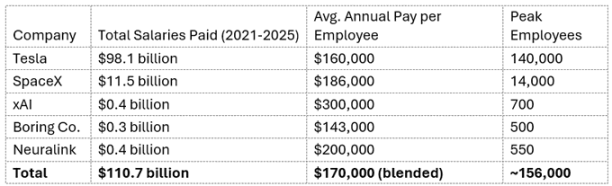
This income continues to generate ripple effects: employees spend money on daily necessities, housing, and vacations. According to the economic multiplier effect, each dollar spent can generate $1.5 to $2 in economic value.
Tax Contributions
Musk’s business empire has made substantial tax contributions. Employees alone have paid $31.8 billion in personal income taxes and payroll taxes, funding education, infrastructure, and social security systems. This amount is equivalent to fully financing NASA’s budget twice over. At the corporate level, despite enjoying tax incentives related to green technology and R&D, these companies still paid $5.2 billion in corporate income taxes. Combined with approximately $9 billion in employer-paid payroll taxes, it is clear that Musk’s companies are fulfilling their tax obligations, not evading them.
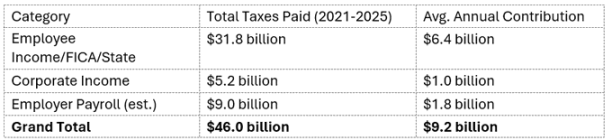
If every billionaire’s enterprise contributed at this level, public finances would be far more robust.
Supply Chain
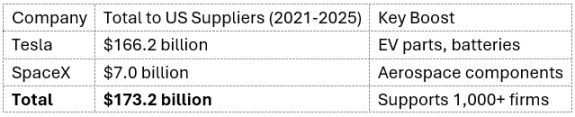
Musk doesn’t just focus on his own companies—he spreads wealth across the United States through supply chains. Tesla alone has purchased $166 billion worth of batteries, chips, and steel from U.S. suppliers, strongly supporting manufacturing in Michigan and Nevada. SpaceX adheres to its “Made in America” principle, contributing $7 billion in procurement primarily from domestic suppliers for rocket-grade alloys and avionics. Together with xAI, the total procurement of $173 billion has benefited thousands of small and medium-sized enterprises, creating vast indirect employment and enhancing the resilience of U.S. supply chains against global risks.
In addition, xAI has already invested approximately $9 billion in data centers and plans to invest another $40–60 billion over the next two years in the "Colossus 2" project.
Overall Impact: A $338 Billion Economic Engine
In total: $110.7 billion in wages + $46 billion in taxes + $182.2 billion in supplier spending = $338 billion injected into the U.S. economy since 2021. As projects like fully autonomous robotaxis, the Optimus humanoid robot, and the Colossus supercomputer scale up, these expenditures are expected to grow significantly in the short term, potentially exceeding $300 billion annually. Considering the economic multiplier effect, this is akin to installing a “turbocharger” on U.S. GDP. Where does Musk’s impact lie? He creates high-paying jobs, funds public services, and rebuilds industrial strength—proving that bold innovation ultimately benefits ordinary Americans.
Despite critics questioning the risks, the data doesn’t lie: Musk’s enterprises are genuine economic accelerators, turning science fiction into reality. As xAI and Neuralink continue to advance, their impact will only grow. In an era of stagnant wage growth and offshored industries, Elon Musk demonstrates that American innovation is still shaping—and funding—the future.
Join TechFlow official community to stay tuned
Telegram:https://t.me/TechFlowDaily
X (Twitter):https://x.com/TechFlowPost
X (Twitter) EN:https://x.com/BlockFlow_News
 @TeslaLarry