The Trillion-Dollar Battle: Musk vs. Ethereum, Who Should Prevail?
TechFlow Selected TechFlow Selected
The Trillion-Dollar Battle: Musk vs. Ethereum, Who Should Prevail?
Elon Musk's net worth will reach $1 trillion by 2035, exceeding the current combined market capitalizations of Ethereum, USDT, XRP, and BNB.
 Navigating Web3 tides with focused insights
Author: Liam Akiba Wright
Translation: Saoirse, Foresight News
When Elon Musk's net worth breaks the trillion-dollar mark, it will signify not just personal success, but a new phase in economic history—one where individual influence rivals that of sovereign nations.
As a Bitcoin holder, I see Satoshi Nakamoto’s vision of “decentralized wealth” and “financial democratization” as a blueprint for dispersing power and reducing value systems’ dependence on single entities. Yet, as capital, artificial intelligence, and policy increasingly converge around Musk’s expanding business empire, his rise reveals just how far we’ve strayed from that ideal.
The ownership of “value” is once again becoming concentrated—this time, however, not in governments or banks, but in individuals who turn technology into leverage.
Some argue that Bitcoin represents the purest form of private property: non-confiscatable, borderless, and fully controlled by individuals. From this perspective, Satoshi might not view the emergence of a trillionaire as a failure of decentralization, but rather as a logical (albeit unintended) outcome of its evolution.
Musk’s carefully engineered "wealth feast"
To date, Tesla shareholders have approved a compensation plan that could increase Musk’s net worth to $1 trillion if all milestone targets are met.
At Tesla’s annual shareholder meeting on November 6, over 75% of votes supported this multi-year, option-based plan. The payouts are conditional: Tesla must surpass specific operational and valuation thresholds, including reaching nearly $8.5 trillion in market capitalization and achieving large-scale deployment of autonomous driving technology and humanoid robots.
The numerical logic behind Tesla’s plan creates an anomalous contrast: a single individual’s equity exposure could exceed the combined current market cap of four major altcoins (ETH, USDT, XRP, and BNB).
Crossing the finish line: the interplay of wealth, power, and policy
If all of Musk’s stock options vest and are exercised—with no consideration for dilution or financing impacts—his actual ownership stake could reach approximately 25%.
Based on an $8.5 trillion Tesla valuation, just 27% of his shares would be worth about $2.295 trillion. As of mid-2025, SpaceX—the U.S. private aerospace manufacturer and space transport company Musk founded in 2002—had a private-market valuation nearing $350 billion, with public optimistic forecasts suggesting it could surpass $1 trillion by 2030 through defense and broadband ventures.
Rumors surrounding xAI, Musk’s artificial intelligence company founded in 2023, suggest valuations ranging from $75 billion to $200 billion. Collectively, the “payoff convexity” of this options package tightly binds Musk’s personal wealth to a few binary outcomes, most critically the commercialization of robotaxis and humanoid robots.
Yet achieving these goals depends not only on technology but also on policy. In California, for example, Tesla currently holds only a “testing permit with safety driver” from the DMV, not the “driverless testing and deployment permit” required for commercial operations. According to state records and Reuters reporting, phased rollouts of ride-hailing services require separate approval from the California Public Utilities Commission (CPUC).
As previously reported by tech media Ars Technica, scrutiny from the National Highway Traffic Safety Administration (NHTSA) over “Full Self-Driving (FSD)” functionality remains a potential risk point that could attract public attention.
A rational look at crypto’s “trillion-dollar challenge”
Currently, Musk’s net worth exceeds the market cap of any single altcoin. In cryptocurrency, only Bitcoin’s market cap (over $2 trillion) surpasses his personal wealth—and I remain fully optimistic about Bitcoin, believing it will continue to outperform any individual investment portfolio.
Ethereum, the second-largest cryptocurrency by market cap, has fluctuated between $390 billion and $600 billion in recent months, now sitting around $400 billion—about $100 billion less than Musk’s personal wealth.
Next, let’s conduct some basic forward-looking modeling:
Conservative scenario:
If autonomous driving deployment is delayed and Optimus humanoid robots remain limited to niche applications, Tesla’s valuation might reach $3 trillion by 2035. Musk’s 25% stake would then yield about $750 billion, plus $500 billion from SpaceX and $50–100 billion from xAI, totaling $1.3–1.35 trillion in assets. After deducting option exercise costs, taxes, and loans, his net worth would fall slightly below $1 trillion, possibly failing to cross the threshold.
In comparison, even if Ethereum reached $5,000 with 125 million circulating tokens, its market cap would be roughly $625 billion.
Base case scenario:
If Tesla reaches a $5 trillion valuation, Optimus robots are first deployed in factories, and energy businesses scale significantly, Musk’s Tesla holdings alone would be worth $1.25–1.45 trillion. Combined with $1 trillion from SpaceX and $200 billion from xAI, surpassing $1 trillion in net worth becomes a “baseline outcome.”
Even if Ethereum approached $10,000 with 120–125 million tokens in circulation, its total market cap would still only reach $1.2–1.25 trillion.
Optimistic scenario:
If Tesla hits an $8.5 trillion valuation, robotaxis become widely adopted, and humanoid robots achieve mass production; if SpaceX approaches $2.5 trillion and xAI exceeds $500 billion in valuation, Musk’s personal wealth would enter the “multi-trillion-dollar” range.
This comparison isn’t a battle between “individual hero” and “technical protocol,” but rather a contest between “equity option returns” and “network adoption rates.”
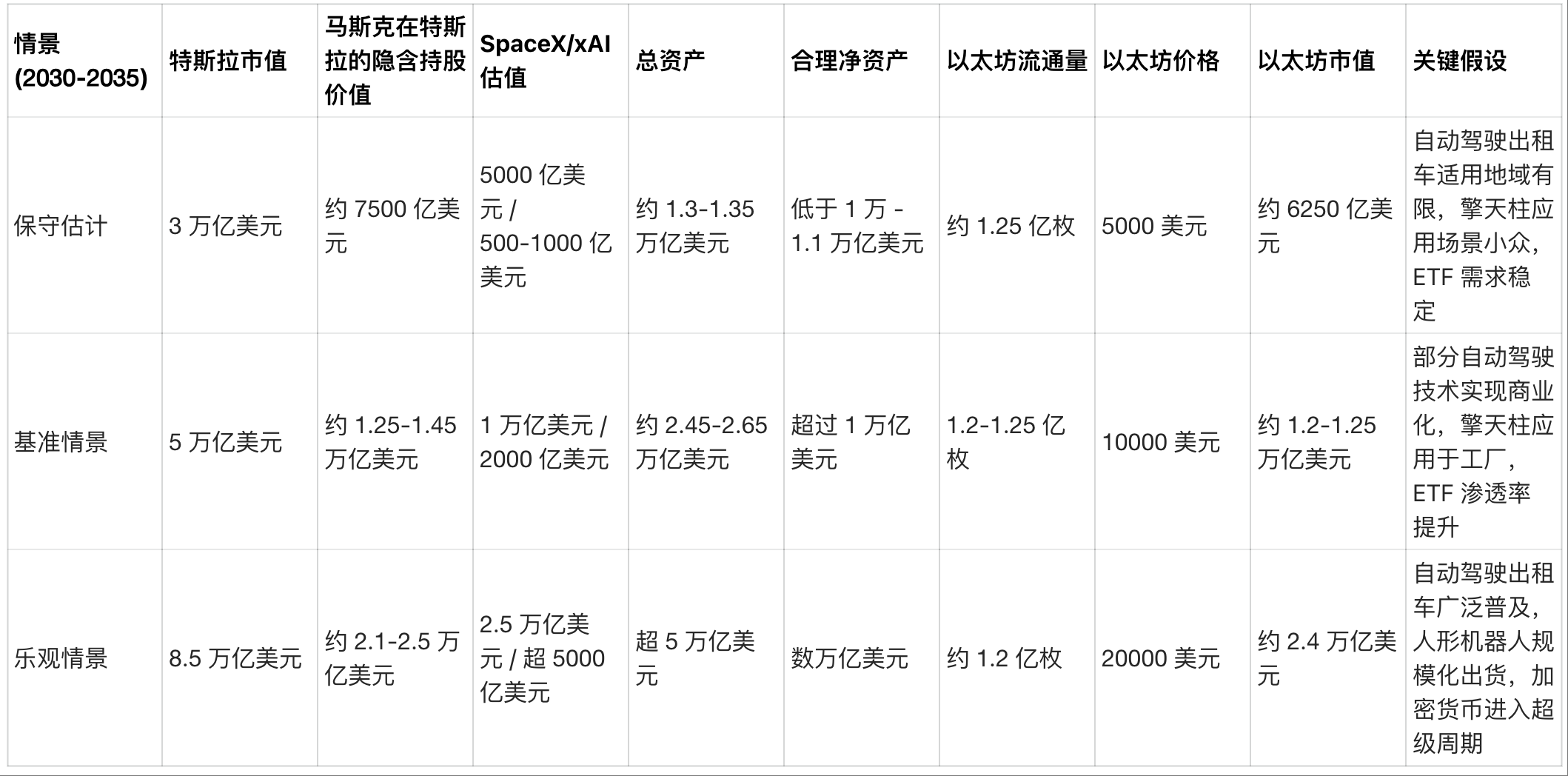
Therefore, for Ethereum to surpass Musk’s asset base and break the $1 trillion valuation within the next decade—assuming Tesla’s valuation does not exceed $3 trillion—its price would need to exceed $10,000.
Billionaires' influence and the politics of wealth
However, I believe the “social narrative framework” around these numbers matters equally.
Research published by Cambridge University Press shows that admiration for billionaires, along with accompanying beliefs in “elitism” or “system justification,” reduces public support for wealth redistribution and progressive taxation—even among low-income groups.
Longstanding political science research indicates that policy outcomes align far more closely with the preferences of the wealthy than with those of ordinary citizens. This suggests extreme wealth concentration may translate into enduring political influence.
Meanwhile, economic studies (such as those in the Quarterly Journal of Economics and related literature) find that exposure to wealthier groups lowers individual life satisfaction while increasing conspicuous consumption and borrowing—effects particularly pronounced among lower-income populations.
A 2024 Harris Poll revealed that most respondents believe “billionaires do not contribute enough to society”; UK surveys similarly show widespread concern over “excessive political influence by the super-rich.”
These are not abstract opinions about celebrities, but concrete pathways through which billionaire “halo effects” and media narratives impact fiscal budgets, voting behavior, and social debt.
Locating ethical boundaries through scale
According to Forbes, the number of global billionaires reached 3,028 in 2025, a record high. With a global population of approximately 8.23 billion, this means only about one in every 2.7 million people becomes a billionaire.
There are currently no trillionaires globally. UBS estimates global household wealth at $450 trillion, meaning $1 trillion represents just 0.22%. Reuters’ analysis of UBS data indicates the median adult wealth globally is only “a few thousand dollars,” with over 80% of adults holding less than $100,000 in wealth.
A $1 trillion personal fortune equals the combined net worth of roughly 100 to 130 million “median-wealth adults.” The odds of rising from millionaire to billionaire are already extremely low; treating “trillionaire” status as a publicly attainable goal is clearly illogical from a numerical standpoint.
Policy choices are key variables shaping the “wealth elite.” Current rules allow top-tier wealth to compound indefinitely, and combined with the earlier noted “policy bias toward the affluent,” affordability issues in essential areas like housing and healthcare often remain unaddressed.
As modeled by economist Zucman, cited by Oxfam, and reported by The Washington Post: imposing a 2% annual targeted tax on billionaire wealth could raise about $250 billion annually. This funding could support public goods or alleviate cost-of-living pressures, while modestly narrowing the gap between the ultra-wealthy and the general population.
In experimental settings, when cultural narratives shift from “individual hero stories” to “systemic interpretations of progress,” public support for progressive taxation increases significantly—offering a gentler counterbalance to the spillover effects of billionaire worship.
Policy and public perception shape the trillion-dollar race
Such measures won’t alter Tesla’s valuation logic or crypto demand curves, but they can reshape the external environment in which extreme wealth exists.
Corporate governance at Tesla also warrants attention: not only the board, but shareholders too have valued and approved the “payoff convexity” of these options—a process that answers certain criticisms while generating new ones.
If state regulators and safety agencies effectively oversee the “autonomous cash flows underpinning this pay package,” then current public oversight systems will serve as “upstream gatekeepers” for privately held wealth options worth trillions.
According to Reuters and California DMV records, Tesla still needs to obtain “driverless testing and deployment permits” to scale robotaxis in key markets. Meanwhile, NHTSA reviews continue. It is these regulatory timelines—not press conferences—that will determine whether this compensation plan succeeds.
We can assess this comparison clearly without cheering or mocking Musk:
Cryptocurrencies reaching $1–2 trillion depend on “adoption, throughput, and capital flow”; founders accumulating over $1 trillion depend on “a few technological breakthroughs and regulatory approvals.”
One can admire Musk’s execution or innovation without endorsing “billionaire worship”—a culture that undermines support for wealth redistribution and amplifies elite policy influence. The logic is clear; whether to embrace it remains a personal choice.
In the end, regardless of whether the first $1 trillion threshold is crossed by an individual or a network, the more important question is: which system do we want to empower? One built on individual ambition, or one based on collective recognition and participation?
Join TechFlow official community to stay tuned
Telegram:https://t.me/TechFlowDaily
X (Twitter):https://x.com/TechFlowPost
X (Twitter) EN:https://x.com/BlockFlow_News
 @CryptoSlate