Nvidia's Rise to Power: From Gaming Giant and Crypto Mining Dominator to AI Arms Dealer
TechFlow Selected TechFlow Selected
Nvidia's Rise to Power: From Gaming Giant and Crypto Mining Dominator to AI Arms Dealer
People with very high expectations of themselves often have low resilience.
 Navigating Web3 tides with focused insights
Written by: TechFlow
On October 30, NVIDIA's market capitalization surpassed $5 trillion, exceeding the annual GDP of developed nations such as Japan and Germany.
From its IPO price of $12 in 1999, adjusted for stock splits, NVIDIA delivered over 8,000x returns in 26 years.
What makes NVIDIA most enviable is its ability to "transcend cycles," serving consistently as foundational infrastructure—collecting perpetual "taxes." No matter what you do, you cannot escape its reach.
As the creator of the GPU, NVIDIA seized the opportunity of the "PC wave," entering households worldwide alongside the explosive growth of the gaming market;
Then, as gaming revenue weakened, the crypto bull market arrived. NVIDIA’s graphics cards were widely used for mining cryptocurrencies like Ethereum, quietly generating massive profits;
Next, with the rise of the smart automotive industry, its automotive chip business rapidly expanded;
Finally, with the sudden emergence of ChatGPT, NVIDIA transformed overnight into the "arms dealer" of AI…
Looking back at NVIDIA’s journey, it has repeatedly stood on the brink of failure and bankruptcy. Jensen Huang once declared: My will to survive exceeds nearly everyone else’s will to destroy me.
NVIDIA, Creator of the GPU
The birth of the graphics card (GPU) dates back to the 1990s.
At that time, some people in Silicon Valley proposed an idea: just as specialized chips like sound cards for audio and network cards for connectivity could offload tasks from the central processing unit (CPU), it made sense to create a dedicated chip for handling computer graphics output—what we now call a graphics card (Graphic Card). For example, Sony’s PlayStation game console, launched in late 1994, used a graphics card for image rendering.
However, there were many technical paths available for graphics cards at the time. NVIDIA’s breakthrough was using parallel computing to enable 3D graphics acceleration, particularly in gaming applications. Parallel computing means breaking down a complex task into smaller subtasks and processing them simultaneously to improve computational efficiency.
In 1999, NVIDIA launched a graphics card named GeForce. Designed specifically for gaming and centered on “parallel computing,” it significantly enhanced 3D graphics performance, delivering smoother and more realistic gaming experiences.
The success of GeForce propelled NVIDIA to rapid prominence, establishing it as a leader in the graphics card industry.
At the time, NVIDIA wasn’t the only company researching graphics processing units, but it successfully branded itself as deeply synonymous with being the “inventor of the GPU.”
Dan Vivoli, NVIDIA’s marketing executive at the time, promoted their chips using the term “graphics processing unit” (GPU). He believed that by consistently positioning themselves as the inventors of the GPU, NVIDIA could become the industry leader.
This strategy succeeded—NVIDIA became synonymous with GPU, carving out a new path through strategic marketing.
NVIDIA, Big Winner of the Crypto Bull Run
NVIDIA’s market cap soared from $14 billion in 2016 to a peak of $175 billion in 2018—an increase of over tenfold in two years—driven in part by the cryptocurrency mining boom.
In 2017, the cryptocurrency market entered a bull phase, drawing massive numbers of miners competing for GPUs. Graphics cards turned into money printers, driving global demand and prices upward sharply.
Take the NVIDIA GTX 1060, a popular model among miners: before May 2017, the wholesale price was about 1,650 yuan per unit; by June 2017, it had risen to around 2,900 yuan.
NVIDIA emerged as a major beneficiary of the crypto bull market, reaping unexpected windfalls.
Fueled by the mining craze, NVIDIA achieved a record annual revenue of $9.7 billion in fiscal year 2018. Jensen Huang publicly stated, “Our GPUs support the world’s largest distributed supercomputing system—that’s why they’re so popular in cryptocurrency.” Additionally, NVIDIA released mining-specific models such as the GTX 1060 3GB, P106, and P104 professional mining cards.
In 2020, after two years of bear market, the crypto market took off again—Bitcoin rose over 2x, Ethereum surged 4x—and NVIDIA once again benefited from the “crypto prosperity”.
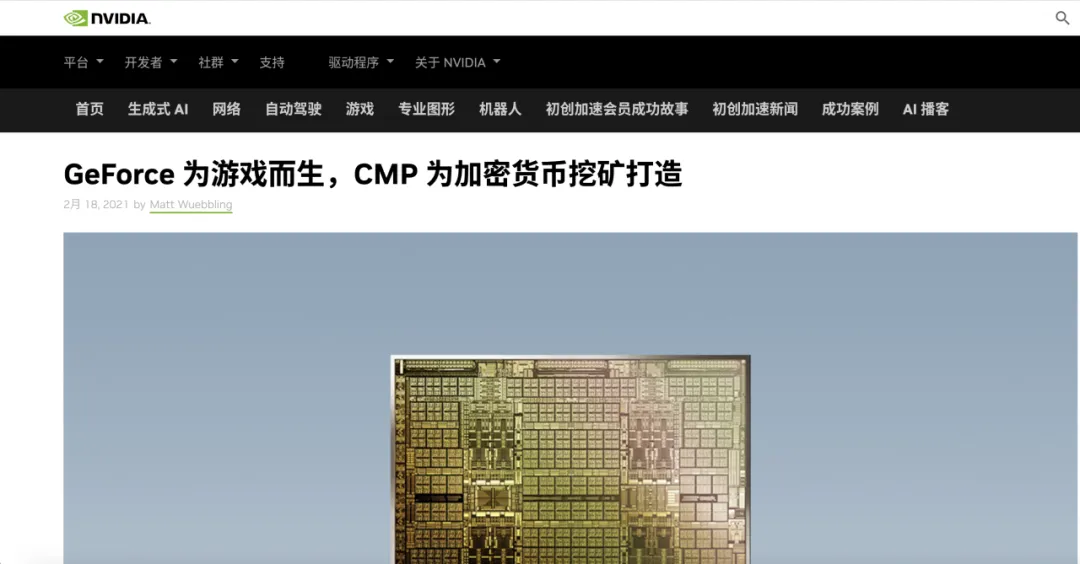
Sensing the trend, NVIDIA actively engaged in the mining market, launching the CMP series of professional mining cards. These cards removed graphics rendering functions and operated at lower core voltage and frequency peaks to enhance mining performance and efficiency.
At the end of 2020, NVIDIA launched the RTX30 series graphics cards. The entry-level RTX3060 was priced at 2,499 yuan, while the RTX3090 was set at 11,999 yuan. As cryptocurrency prices climbed, the RTX3060 sold for as high as 5,499 yuan, and the RTX3090 soared to 20,000 yuan.
After the Q1 2021 financial report was released, NVIDIA CFO Colette Kress revealed that sales of NVIDIA’s crypto-specific chips reached $155 million, with mining-oriented GPUs accounting for a quarter of total sales in the first quarter.
In 2021, NVIDIA achieved a record annual revenue of $26.91 billion, a 61% increase from the previous fiscal year, and its market cap briefly exceeded $800 billion. However, this prosperity didn’t last. In September 2022, Ethereum completed the merge between its execution layer and proof-of-stake consensus layer, transitioning the Ethereum blockchain from PoW (Proof-of-Work) to PoS (Proof-of-Stake), effectively ending the era of GPU-based mining.
This shift impacted NVIDIA’s trajectory. In Q3 2022, both revenue and net profit declined: quarterly revenue dropped to $5.931 billion, down 17% year-on-year, while net profit fell sharply to $680 million, a 72% decline. On November 23, 2022, NVIDIA’s stock closed at $165 per share, nearly half its peak value from the previous year.
At the time, both international outlets like Financial Times and domestic tech media expressed skepticism about NVIDIA’s prospects.


Just as the situation seemed dire, fortune turned—the winds of AI and large models began to blow, and NVIDIA found itself back at the forefront.
NVIDIA, the Arms Dealer of AI
In March 2016, AlphaGo defeated Lee Sedol, shocking the world and sparking widespread discussion about AI.
A month later, Jensen Huang officially announced at GTC China: NVIDIA is no longer a semiconductor company—it is now an artificial intelligence computing company.
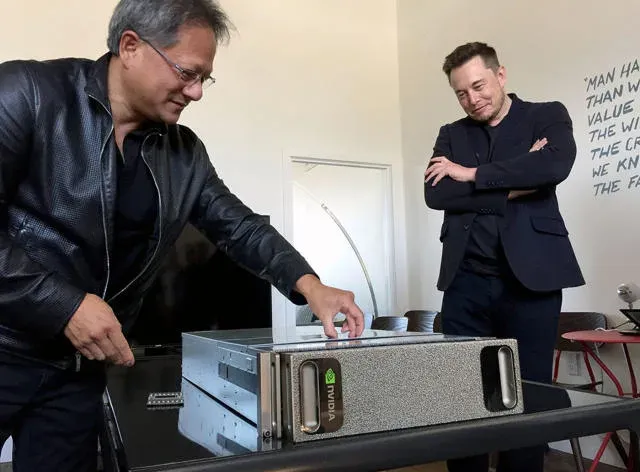
In August 2016, a historic moment occurred: NVIDIA donated the first AI supercomputer, DGX-1, to the newly founded OpenAI. Jensen Huang personally delivered the machine to OpenAI’s office, where then-chairman Elon Musk opened the package with a box cutter.
Huang left with these words: “For the future of computing and humanity, I donate the world’s first DGX-1.”

Later, OpenAI trained the globally popular ChatGPT using NVIDIA’s supercomputers. Subsequent hardware updates, such as the DGX H100, were met with overwhelming demand and severe shortages.
Rome wasn’t built in a day. NVIDIA’s dominance in AI stemmed from earlier investments.
David Kirk, NVIDIA’s former chief scientist, long dreamed of generalizing GPU’s 3D rendering power beyond gaming.
Under David Kirk and Jensen Huang’s leadership, NVIDIA launched CUDA in 2007—a revolutionary unified computing platform that unlocked vast computational resources.
Yet at the time, CUDA failed to impress investors. Heavy investment in cutting-edge “supercomputing” systems severely cut into profits, drawing criticism from Wall Street.
Ben Gilbert, host of the popular Silicon Valley podcast *Acquired*, commented: “They weren’t targeting a big market—they were chasing an obscure corner of academic and scientific computing—and they spent billions doing it.”
External criticism did not sway Jensen Huang. His persistent investment in CUDA over more than a decade secured NVIDIA’s current position.
Huang views computing power as fundamental. Whether in AI, autonomous driving, the metaverse, robotics, or cryptocurrency, NVIDIA leverages massive computing power to uncover new opportunities.
Computing power—NVIDIA’s eternal weapon.
Three Failures
In 2023, Jensen Huang delivered a commencement speech at National Taiwan University, sharing three personal stories of failure and revealing the secrets behind NVIDIA’s success.
First failure: surviving near-bankruptcy.
In 1994, NVIDIA’s first customer was Japanese game company SEGA, for which they designed a graphics card for its gaming console.
But the following year, Microsoft launched Direct3D, a graphics interface for Windows, creating conflict with NVIDIA’s existing design and causing panic within the company.
Ultimately, NVIDIA chose to terminate its contract with SEGA and pivot to developing GPUs for the Windows platform. It was a risky move—SEGA was their only client, and abandoning it meant relying solely on internal funds, which could sustain operations for only six months. Failure to launch a new product within that window would mean bankruptcy.
Luckily, just one month before running out of cash, NVIDIA successfully developed the Riva 128 chip. By the end of 1997, over one million Riva 128 units had shipped, saving the company.
Second failure: sacrificing short-term profit for long-term greatness.
In 2007, NVIDIA launched the CUDA GPU-accelerated computing initiative, envisioning CUDA as a programming model capable of accelerating diverse applications—from scientific computing and physics simulations to image processing.
Creating a new computing model was extremely difficult. Since the introduction of IBM System 360, the CPU computing model had dominated as the industry standard for 60 years.
CUDA required developers to rewrite applications to harness GPU advantages, yet developers needed a large user base and strong demand to justify such efforts—a classic chicken-and-egg problem.
To solve this, NVIDIA leveraged its existing base of millions of gamers using GeForce graphics cards to build a user foundation. However, the high cost of CUDA integration caused NVIDIA’s profits to plummet for years, keeping its market cap fluctuating around $1 billion.
Shareholders grew skeptical of CUDA during NVIDIA’s prolonged slump, preferring a focus on profitability. But NVIDIA held firm, believing the era of accelerated computing would eventually arrive.
Jensen Huang founded the GTC conference, tirelessly promoting CUDA around the world. Eventually, breakthroughs came—applications began emerging in CT reconstruction, molecular dynamics, particle physics, fluid dynamics, and image processing.
By 2012, AI researchers discovered CUDA’s potential. Renowned AI expert Alex Krizhevsky trained AlexNet on a GeForce GTX 580, triggering an explosion in artificial intelligence.
Third failure: NVIDIA exited the mobile chip market.
Remember when Lei Jun and Jensen Huang shared the stage?

In 2013, invited by Lei Jun, Jensen Huang attended the Xiaomi Mi 3 launch event.
Huang, who moved to the U.S. as a youth, struggled slightly with Mandarin when asked to speak by Lei Jun, but confidently declared in Chinese: "NVIDIA’s GPU is the best in the world."
At the time, the flagship Xiaomi 3 featured the mobile version of NVIDIA’s Tegra4 processor—this would be the final product in the series.
With the mobile phone market booming, NVIDIA had entered the mobile chip space. Despite the vast market size and potential for significant market share, NVIDIA made the tough decision to exit.
Jensen Huang explained that NVIDIA’s mission was to build computers that general-purpose machines couldn’t match. They should stay focused on this vision and make unique contributions. This strategic retreat ultimately paid off.
Life Advice: Embrace Suffering, Lower Expectations
In 2024, Jensen Huang returned to his alma mater, Stanford University, to deliver a talk at the business school, sharing life lessons.
When asked by the host for advice to Stanford students on success, he replied: I hope each of you gets the chance to experience a lot of pain and hardship.
He mentioned one of his greatest strengths is that “my expectations are very low.”
Huang noted that most Stanford graduates have high expectations of themselves—and rightly so, given they come from one of Earth’s top universities, surrounded by equally extraordinary peers. High expectations are natural.
“People with very high expectations often have low resilience,” Huang said. “Unfortunately, resilience is crucial to achieving success.”
Huang emphasized: Success doesn’t come from intelligence, but from character—and character is forged through suffering.
Join TechFlow official community to stay tuned
Telegram:https://t.me/TechFlowDaily
X (Twitter):https://x.com/TechFlowPost
X (Twitter) EN:https://x.com/BlockFlow_News
 深潮TechFlow