








Why did real gold beat digital gold Bitcoin in 2025?
TechFlow Selected TechFlow Selected
Why did real gold beat digital gold Bitcoin in 2025?
Young Bitcoin still has a long way to go in spreading its message.
 Navigating Web3 tides with focused insights
Author: Liam, TechFlow
Remember the end of 2024, when everyone was writing predictions for 2025 assets?
Stock investors were watching the S&P and China's A-shares, while crypto enthusiasts were betting on Bitcoin.
But if someone had told you back then that the top-performing asset in 2025 wouldn't be Bitcoin or stocks, but rather gold—the "old relic" dismissed by Gen Z—you'd have thought they were joking.
Yet reality is exactly that surreal.
Over the past five years, Bitcoin outperformed gold by over 10 times, with gains exceeding 1000%, repeatedly claiming the title of top annual asset. But in 2025, the script flipped completely: gold has risen more than 50% since January, while Bitcoin gained only 15%.
The aunties who bought gold early are smiling; elite traders in crypto are silent.
Even stranger, gold and Bitcoin seem to be living in parallel universes: when gold rises, Bitcoin falls; when Bitcoin falls, gold rises.
On October 21, gold suffered a heavy blow, plunging 5% in a single day—Bitcoin, as if injected with adrenaline, reversed its slump and started climbing...
Why has Bitcoin, the so-called "digital gold," decoupled from physical gold?
Buy Gold in Turbulent Times
Who has been the most aggressive buyer of gold in 2025? Not retail investors, not institutions—it's the central banks of countries worldwide.
Data doesn't lie: in 2024, global central banks net-purchased 1045 tonnes of gold, surpassing 1000 tonnes for three consecutive years.
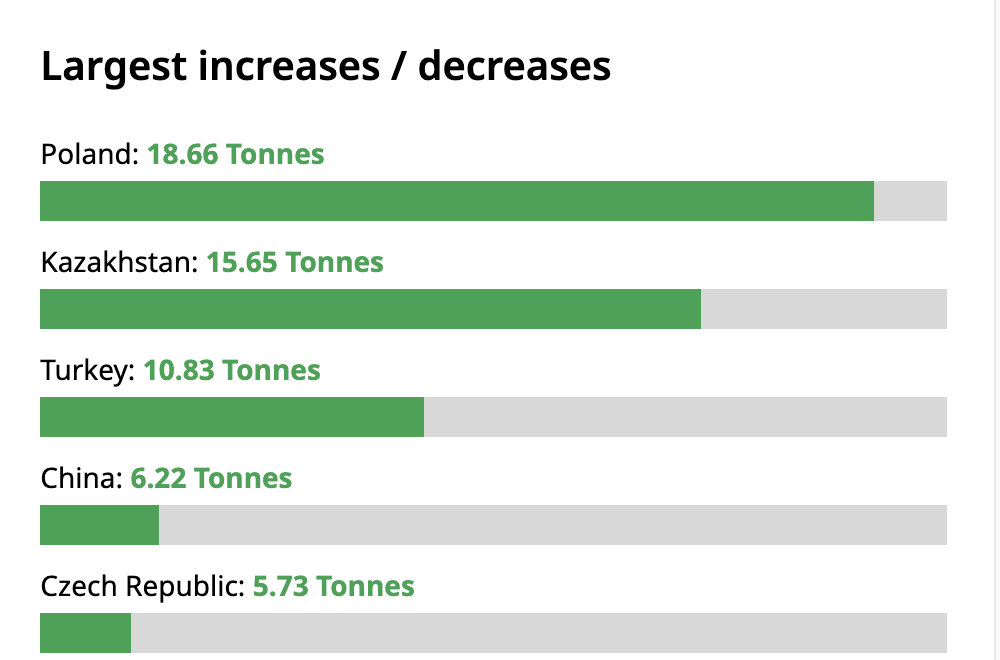
According to World Gold Council’s Q2 2025 data, Poland added 18.66 tonnes, Kazakhstan followed closely with 15.65 tonnes, and China’s central bank steadily increased its holdings by 6.22 tonnes...
Why are developing countries increasing their gold reserves?
Look at central bank gold reserve ratios—developed and developing nations live in two entirely different worlds:
The U.S. holds 77.85% of its assets in gold, with 8133 tonnes, far ahead of Germany’s second place at 3350 tonnes, followed by Italy and France with 2452 and 2437 tonnes respectively.
China’s central bank gold reserves account for just 6.7% of total assets, yet the absolute amount has already reached 2299 tonnes—and it’s still rising.
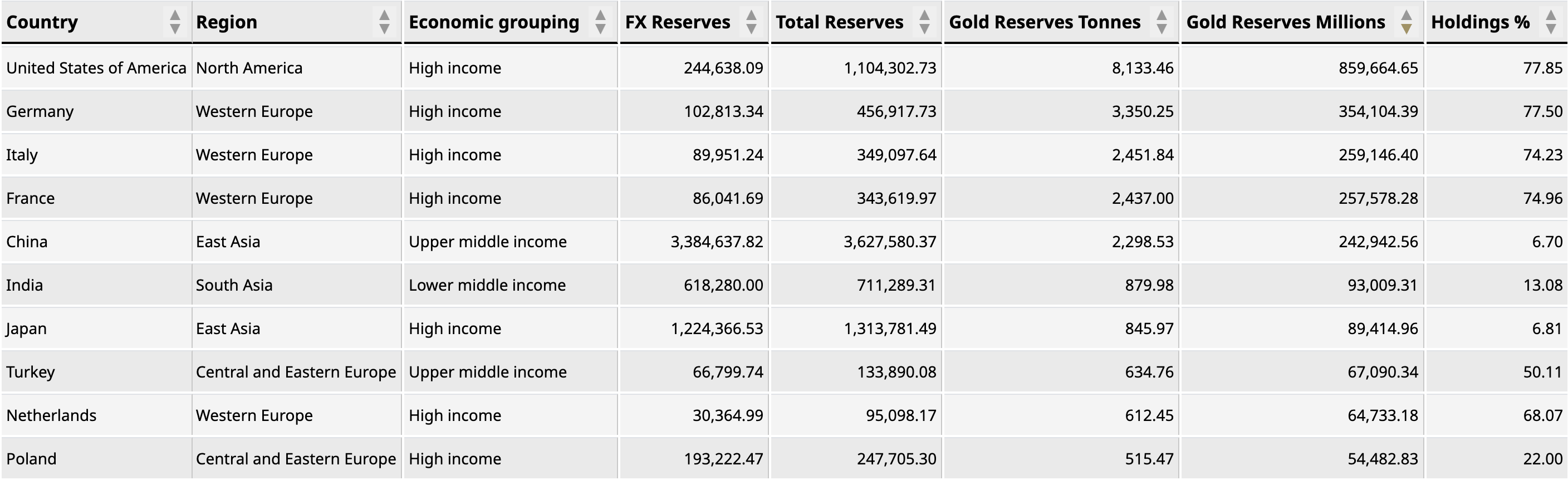
The contrast is clear: emerging markets still have massive room to grow in gold accumulation. For an economy like China, where gold makes up less than 7% of reserves, compared to over 70% in Western developed nations, this looks like a long-overdue "catch-up." The bigger the gap, the stronger the motivation to close it.
Strikingly, central bank purchases now account for 20% of total gold demand—up from under 10% in the 2000s—becoming a key pillar supporting gold prices.
Why are central banks suddenly so obsessed with gold? The answer is simple: the world is chaotic, and the dollar is no longer trustworthy.
Russia-Ukraine conflict, Middle East tensions, U.S.-China trade friction... the global village has devolved into a Warring States era.
For decades, the U.S. dollar served as the core foreign exchange reserve and safe-haven asset for central banks. But now, the U.S. is overwhelmed by its own problems—$36 trillion in debt, reaching 124% of GDP, a volatile Trump administration alienating allies abroad and deepening divisions at home...
Especially after the Russia-Ukraine war began, when the U.S. froze other countries’ foreign reserves, nations realized: only gold stored in their own vaults is truly theirs.
Gold may not yield interest, but at least it won’t suddenly vanish due to another country’s policy.
For both individuals and nations, gold is a hedge against risk—the more chaotic the world, the more gold is sought after. So when news surfaces that “the Russia-Ukraine war might end,” a sharp drop in gold prices makes perfect sense.
Digital Gold or Digital Tesla?
Bitcoin may be the most awkward asset in 2025. Its long-term narrative is “digital gold,” yet it behaves more like a “digital Tesla.”
Standard Chartered data shows Bitcoin’s correlation with the Nasdaq is now as high as 0.5, hitting 0.8 earlier this year. Its correlation with gold? A mere 0.2, even dipping to zero at the start of the year.
In plain terms: Bitcoin is now tied to tech stocks—if the Nasdaq rises, Bitcoin rises; if the Nasdaq falls, Bitcoin falls too.
There’s always a reason.
Under the Trump administration, the U.S. shifted its stance on Bitcoin—from calling it an “illegal cult” to saying “welcome aboard.” The approval of spot Bitcoin ETFs in 2024 marked Bitcoin’s formal integration into the dollar system.
This should be good news—proof of Bitcoin’s legitimacy. But the problem is, once you become part of the system, it’s hard to resist it anymore.
Bitcoin’s original appeal lay in its rebellious spirit—no reliance on governments, no control by central banks.
Now? Wall Street giants like BlackRock have become the biggest buyers, and Bitcoin’s price swings depend entirely on the Fed and Trump. Crypto traders now stay up late listening to Powell and Trump speeches, turning themselves into de facto dollar macro analysts.
In terms of consensus, Bitcoin is still at the “What is this thing?” stage in much of the world, while gold has long been “something even my grandma’s grandma loves.”
The number of Chinese aunties wearing gold bangles and necklaces likely exceeds the total number of Bitcoin HODLers worldwide.
Compared to gold, young Bitcoin still has a long road of evangelism ahead.
Left Hand Gold, Right Hand Bitcoin
Many people treat gold vs. Bitcoin as a multiple-choice question, but smart investors know it’s a fill-in-the-blank.
While central banks worldwide are aggressively buying gold and prices keep rising, this trend can’t continue indefinitely. When gold prices climb too high, issues around storage, transportation, and settlement of physical gold emerge—this is where Bitcoin’s advantages shine.
Imagine a real scenario: war breaks out in a country, and the wealthy realize gold is too heavy and conspicuous to move quickly. At that moment, Bitcoin stored in a hardware wallet becomes the best option—a situation already seen in Russia.
In short, gold is “bulky value storage,” Bitcoin is “portable value storage.”
If gold reaches an extremely high price, capital will seek similar but cheaper alternatives. In such cases, Bitcoin could gradually escape the gravitational pull of the dollar and Trump, attract spillover funds from gold, and realign itself with its “digital gold” identity.
In summary, the relationship between Bitcoin and gold shouldn’t be seen as one replacing the other, but rather as inheritance and evolution.
Gold is humanity’s wealth memory; Bitcoin is the digital age’s wealth imagination.
70-year-old Aunt Li buys gold jewelry; 25-year-old programmer Xiao Ming accumulates Bitcoin. Both have a bright future.
Join TechFlow official community to stay tuned
Telegram:https://t.me/TechFlowDaily
X (Twitter):https://x.com/TechFlowPost
X (Twitter) EN:https://x.com/BlockFlow_News
 深潮TechFlow


