Meme coin players losing money are疯狂 flooding into prediction markets
TechFlow Selected TechFlow Selected
Meme coin players losing money are疯狂 flooding into prediction markets
The manifestation principle is being validated in the market.
 Navigating Web3 tides with focused insights
Author: BUBBLE, BlockBeats
While the fierce competition among meme launch platforms like Pumpfun and Bonk is in full swing, another market is emerging across the space—just as Memecoins did in 2023—for Degen users.
Prediction markets have already grabbed Memecoins by the throat.
John Wang, who recently joined Kalshi as Head of Cryptocurrency last month, recently released a set of data showing that prediction markets now account for 38% of the total trading volume of Solana Memecoins.
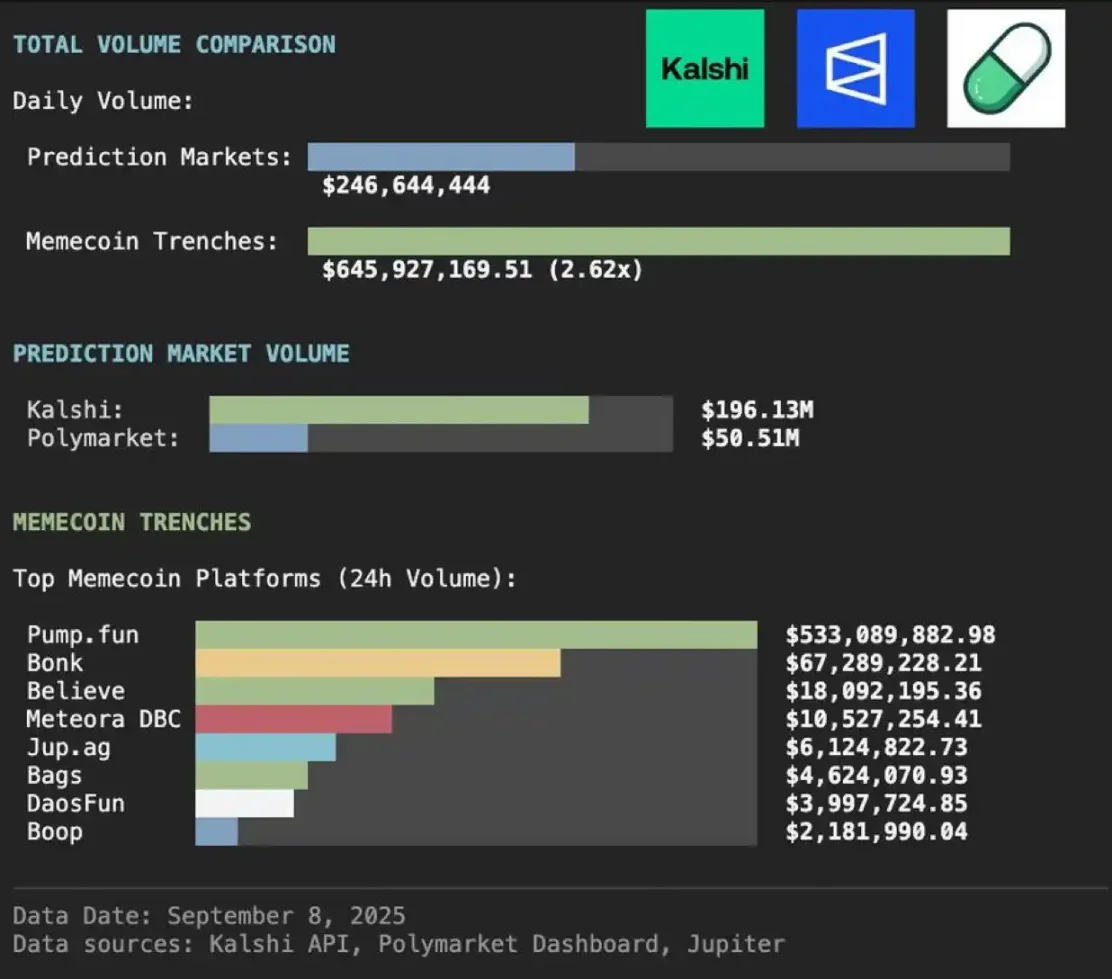
In less than a month since John joined Kalshi, he helped double the platform’s trading volume. Driven by multiple forces, overall prediction market volume has reached levels seen just before the U.S. election in October last year. Meanwhile, another striking data point shows that the number of unique addresses in Memecoins has been declining steadily since its peak in December last year, with current active traders accounting for less than 10% of that peak.
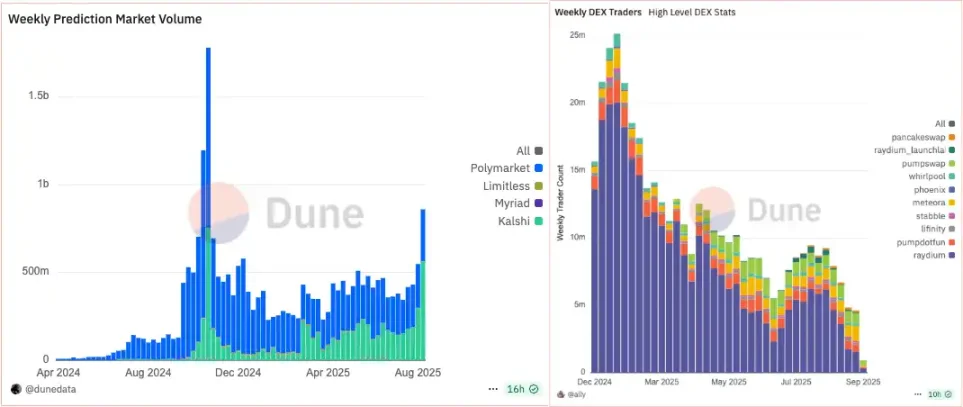
Left: Weekly trading volume of prediction markets; Right: Number of traders on Solana DEXs. Source: DUNE
Is the era of Memecoins truly coming to an end? Will prediction markets really grow to over ten times the size of the Memecoins market, as John suggests?

The Decline of the Memecoins Boom
It must be said that Memecoins in the crypto market created numerous wealth-making myths in recent years, attracting many newcomers to the industry. But now this frenzy is clearly cooling down.
Looking back at 2021, established Memecoins such as Dogecoin (DOGE) and Shiba Inu (SHIB) surged in price, driven by figures like Elon Musk, reaching market caps of $80 billion and $39 billion respectively. At their peak that year, Memecoins accounted for 12% of the entire altcoin market cap.
Meme culture then surged again in 2023–2024, especially after the emergence of Pump.fun on the Solana chain in early 2024. The zero-barrier token issuance triggered a new wave of "Meme coin creation," leading to an unprecedented explosion in Memecoins trading across the crypto space. A large number of retail investors flooded into Solana chasing the next big fortune.
However, signs of decline from over-saturation have begun to appear. Despite legendary cases on platforms like Pump.fun turning a few dollars into millions, the vast majority of speculators still end up losing money. Statistics show that nearly 99% of newly issued Memecoins eventually go to zero, while Solana's transaction fee revenue has dropped by more than 90%.
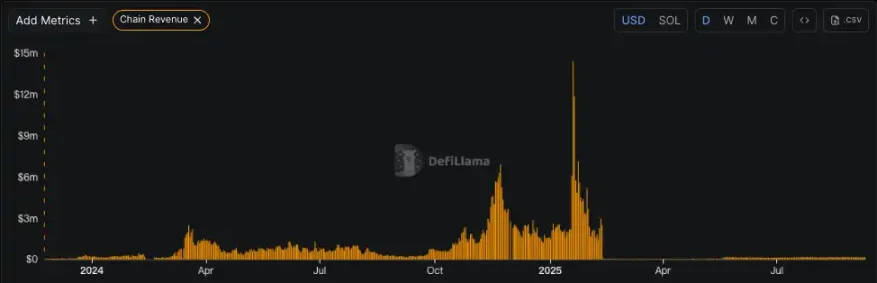
Solana transaction fee revenue. Source: Defillama
The downturn in Memecoins stems from multiple factors. Macroeconomic uncertainty makes speculative capital more cautious; lack of regulation allows manipulators to freely exploit insider trading scandals; social media influencers and celebrities repeatedly use their influence to hype and dump tokens at high prices (even presidents do so). Insider trading runs rampant, liquidity is scarce, and thousands of scams and rug pulls have left even the most risk-loving Degens feeling exhausted.
The structure of participants in the Meme sector has changed. On one hand, under regulatory pressure, many early large players acting as market manipulators are exiting this gray area. On the other hand, beyond whale-driven insider operations, the market is now mostly filled with small-to-medium retail traders competing against each other, turning Meme trading into a naked zero-sum PVP game.
P gamblers enjoy short-term excitement, while long-term holding and consensus-building fade away. This shallow PVP speculation model prevents Memecoins from forming genuine community consensus. Prices lack fundamental support and swing wildly, often resulting in a rush to buy during rallies and mass exodus when prices fall. Without stable capital willing to engage in long-term development, and big players unwilling to step in and absorb supply, a vicious cycle forms.
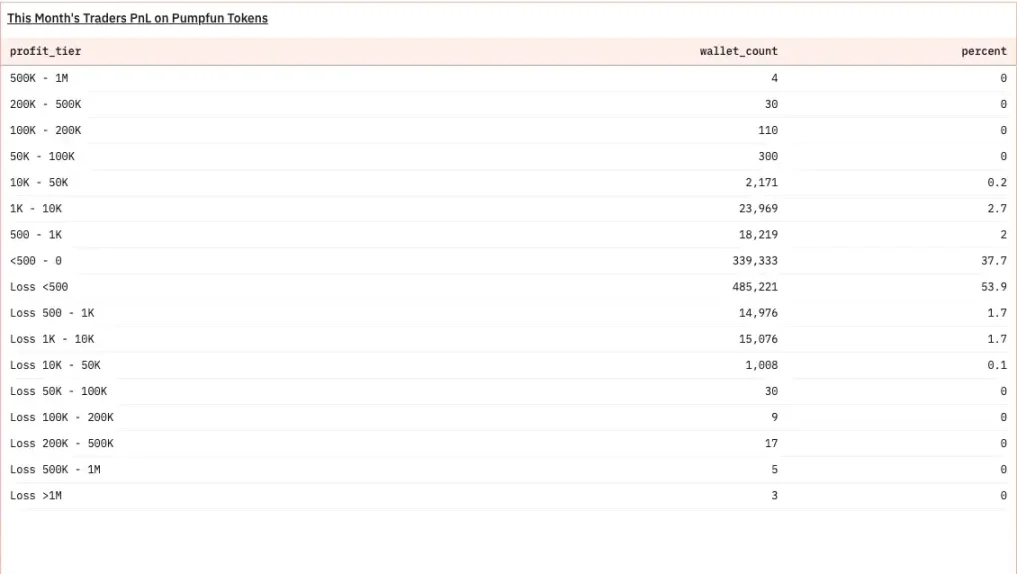
Profit vs loss ratio among pumpfun players. Previously, the (loss:profit) ratio fluctuated around 7:3, but it has now shifted to 6:4. However, both profits and losses are almost entirely concentrated within ±$500. The wealth effect of Memecoins is fading. Source: DUNE
Lack of consensus leads to price instability, which drives away capital, further limiting market cap growth. As the wealth effect diminishes, this "pass-the-parcel" gambling game is becoming increasingly quiet.
Old memes become tools for trading ranges; new memes belong to P gamblers. Cultural consensus becomes impractical. All signs indicate that the myth of Memecoins is gradually fading, and the market is shifting attention to new hot sectors.
The New Arena for Degens
As the Meme craze fades, Degens haven't stopped—they've simply redirected their passion toward prediction markets. If you frequently browse X, you may often see so-called "biographies" describing how someone turned a small amount of money into huge returns. These stories used to revolve around Memecoins or DeFi arbitrage, but now they're centered on prediction markets.
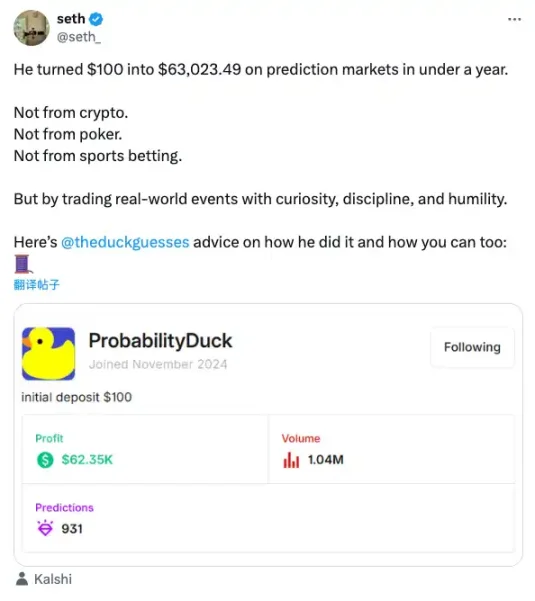
Dopamine
David Sklansky, pioneer of Texas Hold'em mathematical theory, once said in *The Theory of Poker*: "Gambling is essentially betting under conditions of information asymmetry." In other words, gamblers seek perception of odds and informational advantage—not guaranteed victory.
From this perspective, prediction markets offer dopamine stimulation similar to trading Memecoins, but with greater transparency and fairness. When you buy a contract betting on "Trump winning the election" or "the Fed cutting rates," your win or loss ultimately depends on objective real-world outcomes. There's no risk of project teams suddenly running away, nor artificial dumping causing a "rug pull." At worst, you lose your stake due to a wrong bet—unlike some vaporware tokens that crash due to insider manipulation.
This shift—from worrying whether a development team will scam and flee, to questioning whether an event will actually happen—represents an "upgrade" in speculative behavior. Gamblers are still placing bets, but now the game is anchored to real-world outcomes, backed by basic authenticity.
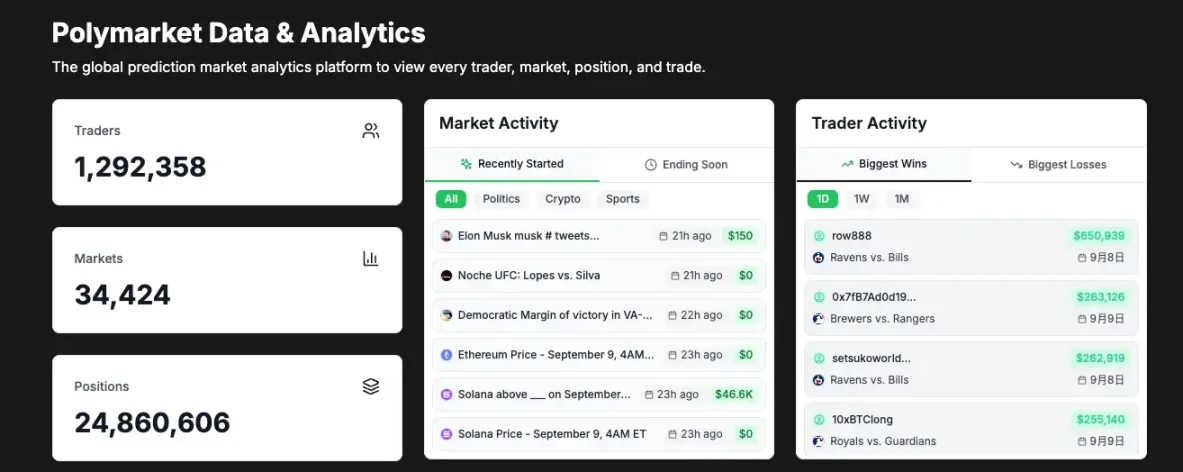
Polymarket has reached 1.3 million traders. Kalshi hasn’t disclosed user data, but its market share has already surpassed Polymarket. The number of participants in prediction markets may have reached tens of millions. Source: polymarketanalytics
Regulation
More importantly, regulatory developments have added a layer of legitimacy to prediction markets. In the past, many decentralized prediction platforms barred users from regions like the U.S. due to policy risks. Now, the situation is changing.
In the second half of 2024, a lawsuit between Kalshi and the U.S. Commodity Futures Trading Commission (CFTC) became a turning point. This U.S.-based, fully compliant prediction market exchange had previously been blocked by the CFTC from launching contracts on congressional election results. However, reports indicate that in September that year, a federal court ruled in favor of Kalshi, stating regulators had no authority to ban such political event contracts.
This ruling cleared obstacles for Kalshi to operate nationwide, making it the first truly licensed prediction market platform in the U.S. Seizing the opportunity, Kalshi made major moves during the 2024 U.S. presidential election. According to Reuters and others, the platform generated approximately $1 billion in trading volume just on election night alone, with annual volume increasing tenfold year-on-year to $1.97 billion. Leveraging its compliance edge, Kalshi rapidly expanded its reach, attracting users without geographical limits—and this propelled its valuation to $1 billion in a new funding round in early 2025.
Meanwhile, veteran decentralized prediction market Polymarket is also pursuing a path to compliance. The platform was fined $1.4 million by the CFTC in 2022 for non-compliance with U.S. regulations and temporarily blocked U.S. users. But after the Trump administration took office, the U.S. regulatory environment loosened, allowing Polymarket to re-enter the U.S. market in 2025 by acquiring a licensed entity.
Wealth Effect
For profit-seeking speculative capital, prediction markets have absorbed the momentum left by fading Memecoins not only because they offer comparable wealth effects, but also because their gameplay is more diverse.
First, in terms of potential returns, correctly predicting black swan events can yield rewards rivaling those from altcoin speculation. In prediction markets, if you early-bet on a low-probability event at extremely favorable odds, and it actually happens, you can earn multiples—even dozens of times—your initial investment. For example, ahead of the 2024 U.S. election, many bought contracts betting on Trump’s victory for hedging or speculation. One report stated that a whale invested $30 million in "Trump wins" call options and earned as much as $85 million after Trump won.
Of course, small-capital players can also take a shot at long-tail event contracts with odds exceeding tens of times, achieving "small bets, big wins." Notably, decentralized prediction markets based on binary options have started introducing leveraged contract tools to further amplify gains. Platforms like Azuro, D8X, and Drift have offered or continue to offer leverage.
This integration of DeFi derivatives broadens profit opportunities and gives skilled arbitrage players room to thrive, enabling many DeFi veterans to adapt easily to prediction markets. They can hunt for odds discrepancies across platforms, hedge risks using derivatives, and leverage increasingly sophisticated data dashboards and copy-trading bots—making the experience far richer than simply trading Memecoins or basic futures.
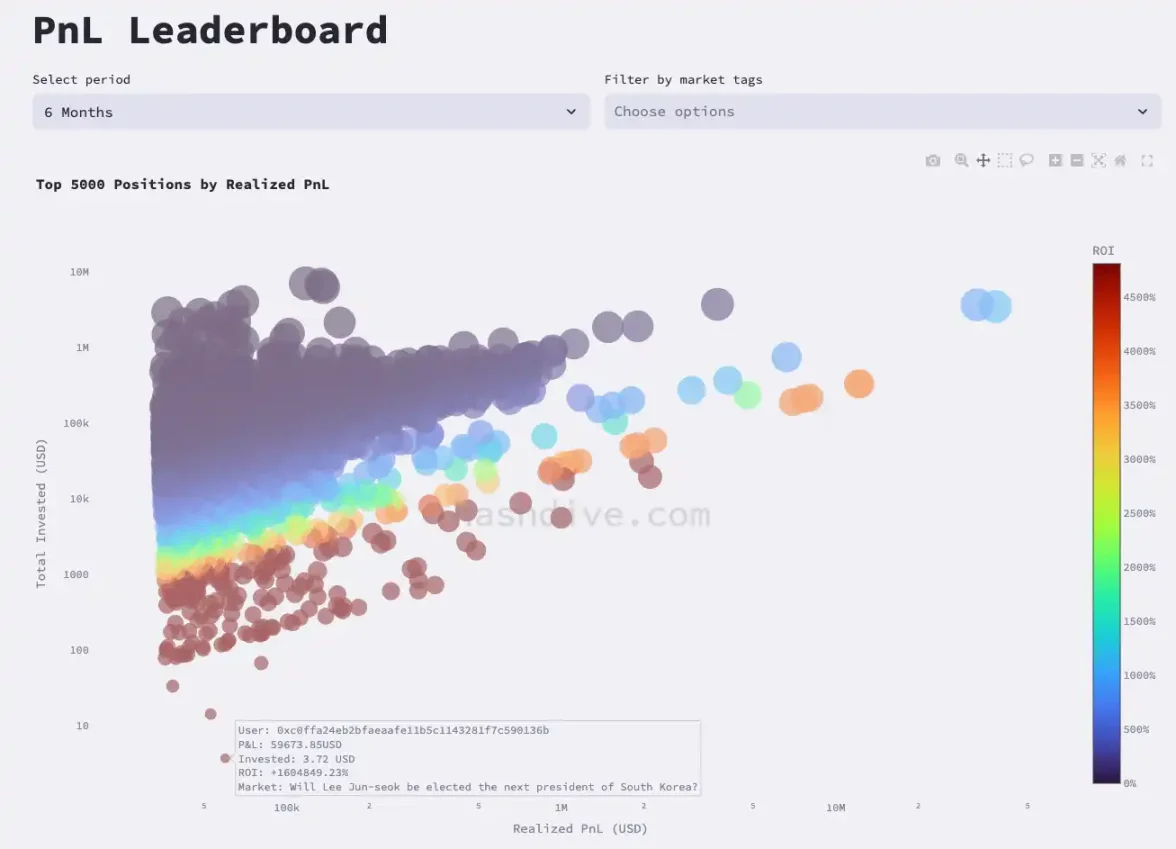
Distribution of profitable players in prediction markets over the past six months. Redder areas indicate higher ROI. One player in the bottom-left corner turned $3.72 into nearly $60,000. Source: hashdive
Low Education Barrier
Beyond high-return opportunities, the "low education barrier" is another key reason prediction markets attract capital.
Unlike Memecoins, which are limited to crypto-related hype, prediction markets cover nearly every topic imaginable—politics, economics, sports, entertainment—appealing to various audiences’ gambling instincts. Take Polymarket: it features serious macro topics (e.g., “Will Bitcoin break its all-time high before a certain date?” or “Will the Fed cut rates at its next meeting?”), alongside internet-culture-infused curiosities (e.g., “Will a member of pop band Coldplay divorce before year-end?” or “Will aliens be officially confirmed to exist in 2025?”).
Many seemingly absurd trending topics have corresponding markets on the platform, effectively integrating Meme culture into prediction trading. Users can bet on popular memes and celebrity gossip, making participation more entertaining and lowering entry barriers.

Prediction topics on Polymarket
In contrast, although Memecoins carry the name "Meme," they remain largely inside jokes within the crypto bubble—difficult for outsiders to understand their context or value. Prediction markets, however, bet on real-world events, making them easier for the general public to grasp and participate in.
Some say prediction markets simply move offline behaviors like horse or sports betting onto the blockchain, making them more open and transparent. Many ordinary investors who were once confused by crypto tokens become interested when they see contracts tied to news events and decide to place a small bet.
Moreover, some platforms (like MYRIAD) are beginning to embed prediction mechanics directly into social media or mobile apps via plugins, allowing users to casually join predictions while browsing Twitter or opening an app—boosting engagement. All of this makes prediction markets more likely to break out of niche circles and attract long-tail users beyond traditional crypto assets like Bitcoin.
Prediction Markets' Reverse Impact on the Real World
The fairness and informational value of prediction markets are also praised by some. Since contract settlements are based on objective facts, there is little room for human manipulation, making outcomes relatively fair and transparent. In the Memecoins space, retail investors often fear developer malice or whale dumps—but these concerns don’t apply in prediction markets. Additionally, participants with sharper insights can profit by placing early bets, and in doing so, provide price signals that reflect the mechanism’s original design: "using money to predict the future."
For instance, when the true probability of an event is underestimated, traders with insider knowledge or expert analysis will buy large amounts of the relevant contract, pushing the price closer to its fair level. This arbitrage process corrects mispriced odds. Research indicates that thanks to these rational arbitrageurs, mature prediction markets often produce more accurate event probabilities than opinion polls—and are increasingly referenced by media and institutions.
Of course, excessive speculation can sometimes obscure informational efficiency. If large amounts of uninformed, trend-following capital flood in, contract prices may temporarily deviate from fair probabilities. But in practice, as long as enough rational players are present, significant deviations are usually corrected quickly, and sustained mispricing is rare.
Overall, prediction markets hold unique value in aggregating public sentiment and information. The more diverse the participants and the richer the information, the more meaningful the results become. This "speculation within prediction" model has even gained recognition from mainstream figures. Because prediction markets emphasize trading based on information and judgment, many supporters avoid calling it "gambling," instead using the term "information markets" to boost social acceptance.
This rebranding has proven effective—VCs and government officials increasingly cite prediction market data to support their viewpoints. Compared to the image of Memecoins as "pure chance games," prediction markets are cultivating an aura of smarter, more valuable investment play, attracting broader participation.
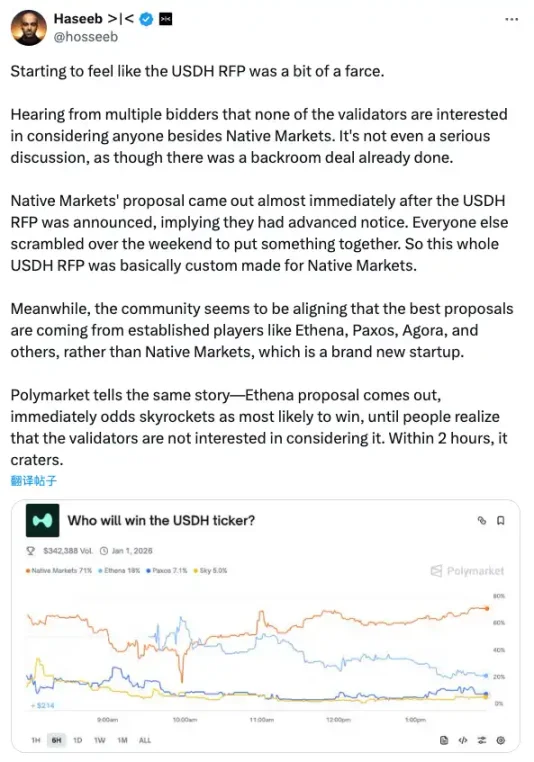
Hasseb, partner at Dragonfly, cited Polymarket predictions during discussions about USDH
Notably, capital markets are also chasing this new trend. Since last year, multiple prediction market platforms have secured substantial funding, with valuations rising rapidly. Shortly after winning its legal case, Kalshi announced a $100 million funding round, bringing its post-money valuation into the $1 billion range. Polymarket raised $200 million in early 2025, pushing its valuation to around $2 billion.
New startups are emerging constantly, and investor interest continues to grow. From just $3 million in investments in 2021 to $370 million today, institutional funding in this sector has surged dramatically.
Thomas Peterffy, founder of legacy online broker Interactive Brokers, publicly predicted in a November 2024 CNBC interview that within 15 years, the scale of prediction markets could surpass that of the stock market, given their unique ability to price public expectations.
After the rise and fall of the Memecoins boom, prediction markets may now be taking the baton as the next battleground for speculative capital.
Join TechFlow official community to stay tuned
Telegram:https://t.me/TechFlowDaily
X (Twitter):https://x.com/TechFlowPost
X (Twitter) EN:https://x.com/BlockFlow_News
 BlockBeats