








Malaysian Chinese, the invisible protagonist in the crypto world
TechFlow Selected TechFlow Selected
Malaysian Chinese, the invisible protagonist in the crypto world
Crossing cycles, this shadow army has always been doing its work in the industry.
 Navigating Web3 tides with focused insights
By: Yanz, June, TechFlow
When people talk about the main players in the crypto world, they often think of Silicon Valley geeks, Wall Street capital, investment firms from Singapore and Hong Kong, or developers from mainland China—but rarely do they turn their attention to Malaysian Chinese.
They haven't graced the cover of Fortune like SBF, nor have they been labeled the "richest ethnic Chinese" like CZ.
They rarely give high-profile interviews and often remain "invisible" on Twitter.
Yet, when you truly examine the landscape of the crypto industry, you'll be surprised to discover:
-
The world's largest cryptocurrency data platform, CoinGecko, was born in Kuala Lumpur;
-
Etherscan, an indispensable part of the Ethereum ecosystem, was built by Malaysian Chinese;
-
Virtuals Protocol, a leading narrative in the AI + Crypto bull run, also comes from a Malaysian Chinese team.
-
Jupiter, the liquidity hub of the Solana ecosystem, is from Malaysia.
These projects are not replaceable side notes—they've become foundational infrastructure and sparks of new narratives in the crypto industry.
Without Malaysian Chinese, today’s crypto industry would lose an “eye,” a “map,” and even a future “path of exploration.”
Builders
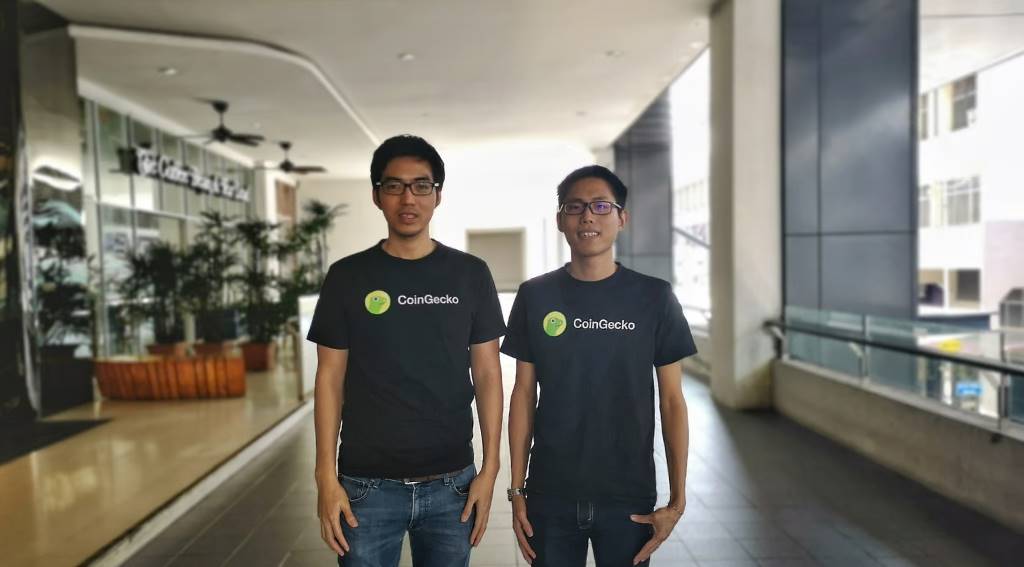
In 2014, Mt. Gox collapsed, plunging the entire crypto world into darkness. At that most chaotic moment in the market, Bobby Ong and TM Lee launched CoinGecko with just $100 in startup capital.
Source: Fintechnews
One studied economics; the other was a programmer. They met by chance but shared the same insight: the market urgently needed a transparent and reliable data platform. Thus, CoinGecko was born amid crisis.
"We wanted to build a company that serves everyone globally," they later reflected on their original vision. The results proved them right. With its Trust Score algorithm and coverage of emerging markets, CoinGecko quickly became a daily must-use tool for investors. A decade later, it has tracked over 17,000 tokens, and its API is widely used by platforms like Trezor and MetaMask.
At around the same time, another young Malaysian, Matthew Tan, was closely watching Ethereum. He had previously operated a blockchain search engine called Blockscan. When Ethereum introduced smart contracts, he敏锐ly spotted a critical issue nearly everyone else overlooked: existing block explorers could only handle simple peer-to-peer transactions and were completely unprepared for the complexity brought by smart contracts.
He then single-handedly transformed Blockscan into Etherscan.
"This is no longer just value transfer from point A to B. There’s too much that needs to be surfaced by asearch engine."
He decisively upgraded his two-year-old blockchain search engine Blockscan into Etherscan, completely re-architecting it to address the complexities of smart contracts.
Today, Etherscan has evolved from a simple tool into the de facto standard of the Ethereum ecosystem—nearly every Ethereum user relies on it. As the multi-chain era unfolded, the launch of BscScan, PolygonScan, ArbiScan, and others further solidified this Malaysian Chinese entrepreneur’s dominance in the blockchain explorer space.
Fast forward to 2021. The DeFi summer still lingered, and a young man named TN Lee turned his attention to a more complex problem: How to makeyields more predictable and tradable?
With a background in computer science and deep understanding of financial derivatives, he proposed what seemed like a crazy idea at the time: yield tokenization. He split future yields into principal tokens (PT) and yield tokens (YT), allowing users to trade these components separately.
This seemingly simple innovation took years to realize. In 2021, Pendle Protocol emerged out of nowhere.
Also in 2021, a young developer named Siong set his sights on Solana. He saw its high performance potential but also recognized the challenges of fragmented liquidity and excessive slippage. So he and his team built Jupiter, a transaction aggregator that uses smart routing algorithms to automatically find optimal trading paths.
Starting from obscurity, both Pendle and Jupiter achieved remarkable success in their respective ecosystems by 2024. Pendle became a top DeFi protocol with total value locked (TVL) exceeding $10 billion, while Jupiter emerged as the liquidity center of the Solana ecosystem, frequently recording daily trading volumes over $1 billion and briefly pushing its token market cap past $10 billion.
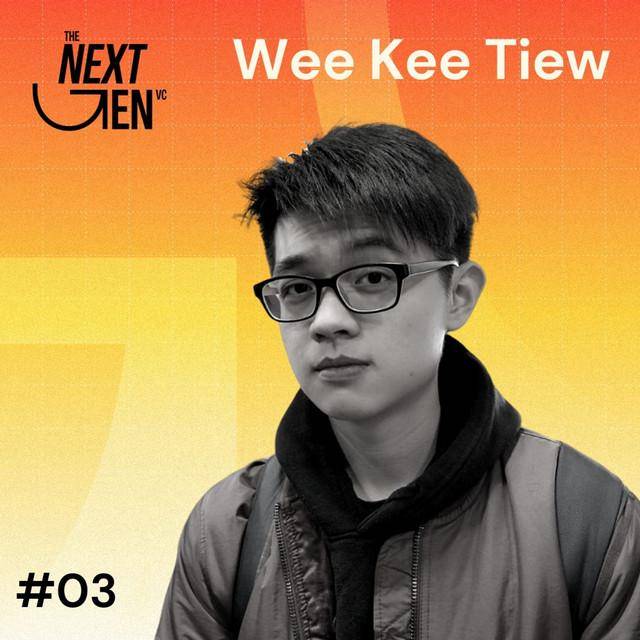
The entrepreneurial journey didn’t stop there. In 2024, Weekee Tiew, formerly of Boston Consulting Group, turned his focus to AI. He had previously founded the gaming guild PathDAO, valued at up to $600 million, only to see it crash during the bear market and struggle to find direction. In 2024, he pivoted to launch Virtuals Protocol, focusing on creating and issuing AI agents.
Source:LinkedIn
Virtuals Protocol’s token $VIRTUAL hit a market cap peak of over $4.5 billion in January 2025, becoming one of the most representative projects at the intersection of AI and crypto.
It wasn’t until Weekee Tiew made a splash and appeared on numerous podcasts that people realized, surprisingly, that this was a Malaysian project.
Beyond that, Pendle, Jupiter, Aevo, and Drift all originate from Malaysia as well.
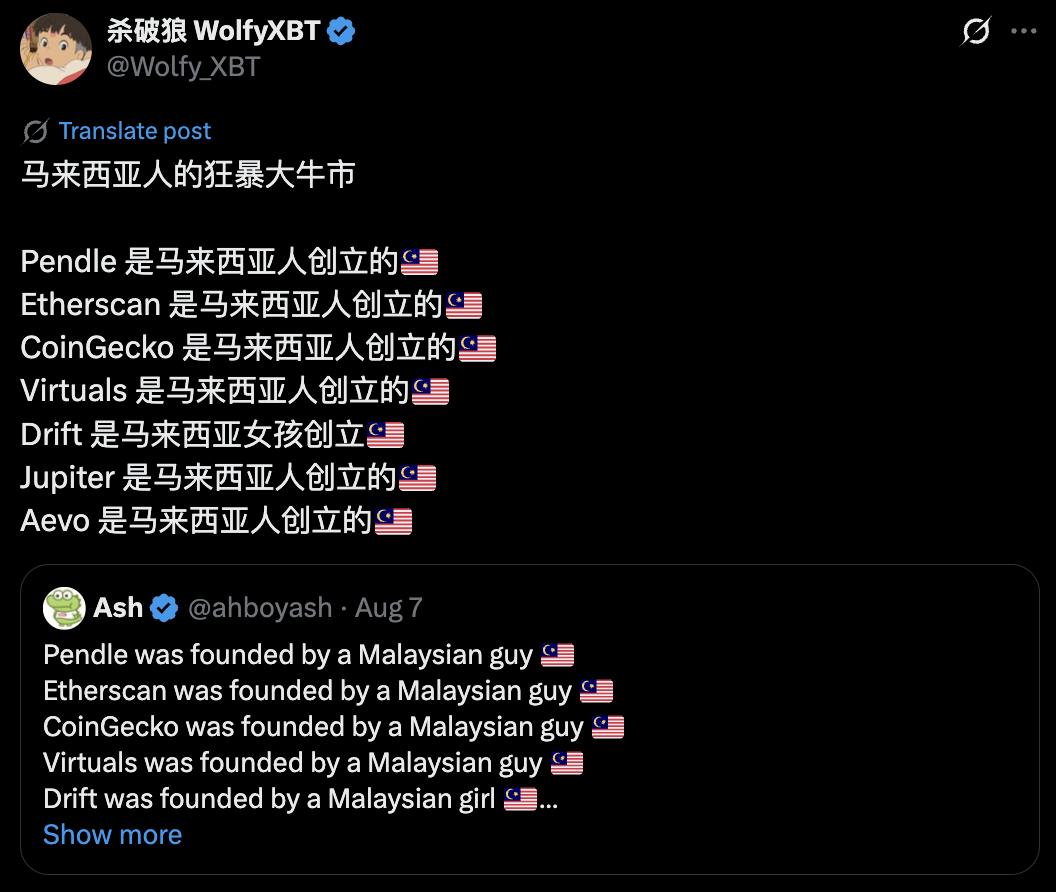
On Twitter, a consensus seems to have formed: this cycle belongs to Malaysian entrepreneurs.
Bridgers
"I have many Malaysian friends who don’t speak much on social media."
Compared to their more famous counterparts, most Malaysian Chinese operate behind the scenes across the crypto industry, functioning like connective tissue—linking different parts of the ecosystem and bridging markets across cultures.
Malaysian Chinese are natural bridge-builders.
Cova, a Malaysian Chinese, has been in the crypto industry for five years. As she interacted more with global professionals, she began to appreciate the unique advantages her community holds.
"I think Malaysian Chinese are born translators. Typically, a Malaysian Chinese speaks at least three languages—Mandarin, Malay, and English—excluding dialects. Some even add Japanese or Korean."
From kindergarten onward, they live in an environment interwoven with Chinese, English, and Malay. Combined with diverse personal backgrounds including Cantonese, Teochew, Hakka, etc., this linguistic 'multithreading' makes them thrive in teams—they can track Western trends, serve Southeast Asian markets, collaborate withinternationalteams, and engage clients worldwide.
This linguistic talent is especially valuable in the crypto world. Virtuals Protocol founder Weekee Tiew can present on English podcasts to Western audiences how Virtuals enables true fusion between AI and crypto, while also directly communicating Virtuals’ grand vision to Chinese-speaking users at offline events. This multilingual ability allows him to serve developer communities across cultural backgrounds simultaneously.
At cultural intersections, Cova believes Malaysian and Singaporean Chinese adapt faster.
"For example, American-led projects or meme culture, as well as niche cultural trends from smaller countries, Malaysian and Singaporean Chinese tend to integrate and understand them very quickly."
The cultural DNA of Malaysian Chinese acts like a universal key, unlocking doors to multiple international markets.
However, this unique multilingual advantage brings an unexpected side effect: identity ambiguity.
Whenever Malaysian Chinese manage their Twitter accounts or launch crypto projects, they face a crucial decision: should English or Chinese be the primary medium of communication? This choice often determines the audience and market reach.
A classic example: without explicit mention, you might never guess that the prominent Chinese-speaking KOL Sha Polang (@Wolfy_XBT) is actually Malaysian Chinese. Similarly, well-known English-speaking KOLs @ahboyash and @sandraaleow are also from Malaysia.
More importantly, to gain broader recognition and acceptance in global markets, many Malaysian Chinese founders consciously or unconsciously downplay their regional identity. They want their products perceived as “international” solutions rather than projects tied to a specific country.
This strategy is often commercially wise, but leads to a regrettable outcome: most users remain unaware that these world-changing products originated in Malaysia.
When you use Etherscan to check Ethereum transactions, you probably don’t realize it’s the work of a Malaysian Chinese team. When trading on Jupiter or analyzing Pendle’s yield strategies, you’re more likely to assume these are creations of elite Western teams.
Their "invisibility" reflects not only the adaptability of Malaysian Chinese in a globalized context, but also the complex reality of their identity and market positioning.
Beneath this identity ambiguity lies a deeper issue: brain drain.
To achieve greater success, many Malaysian Chinese ultimately choose to leave their homeland. This fertile ground continues producing wave after wave of talent, but due to various real-world constraints—be it policy environment, market size, or degree of globalization—these talents are often forced to seek opportunities overseas.
They shine brightly on the global stage, yet few know their true origins. This "invisible success" demonstrates their adaptability in globalization, but also represents the price this group pays in the process.
They are the best bridge-builders, yet also the most easily forgotten builders.
Perceivers
Diligent, grounded, and content—these are common traits among most Malaysian Chinese. They rarely boast about their achievements on social media, preferring instead to let solid results speak for themselves.
This low-key, action-oriented mindset is deeply rooted in their historical experiences.
During the late Qing Dynasty "Go South" migration wave, Chinese people moved from southeastern China to the Malay Peninsula. Facing unfamiliar environments and cultures, they had to rely on hard work and wisdom to carve out survival space within the British colonial economic system. Yet despite achieving commercial success through effort, colonial "divide and rule" policies consistently excluded Chinese from political power.
After Malaysia gained independence in 1957, the political ideology of "Malay supremacy" and the subsequent implementation of the New Economic Policy further restricted Chinese opportunities in education, employment, and business through quota systems. University admissions were limited, government jobs came with barriers, and even starting businesses faced policy hurdles.
This long-term systemic pressure shaped a unique philosophy among Malaysian Chinese: Since the broader environment cannot be changed, focus on excelling at what you can control. They learned to survive in the cracks, to prove value through capability, and to maintain resilience in adversity.
"Malaysian Chinese have always faced policy suppression, so most just work quietly underwater—so long as they make money, it’s fine."
This resilience forged through history has become a distinct advantage in the challenging crypto industry. When markets crash, they don’t panic; when projects face difficulties, they find solutions instead of complaining; when opportunities arise, they seize them quietly rather than making noise…
Yet changing external perceptions—by building seriously, profiting through dreams, and proving strength through project success—is not a smooth journey.
Early Malaysian crypto projects didn’t have a strong reputation. Many were suspected of market manipulation or operating pyramid schemes. A telling example: Cova says Malaysian Chinese are often prejudged by partners as “project teams running Ponzi schemes,” creating additional trust costs in business development.
This negative perception has historical roots.
Malaysia’s early lack of fintech regulation created gray zones where bad actors exploited regulatory gaps for illegal fundraising and fraud. Numerous projects branded as “blockchain innovation” repeatedly scammed investors, damaging investor interests and casting a shadow over Malaysia’s entire tech startup ecosystem.
Worse, these negative cases spread faster and wider than positive stories. When people hear “Malaysian project,” their first thought may not be technological innovation, but “watch out for scams.” This stereotype has become an invisible barrier all Malaysian Chinese entrepreneurs must overcome.
But times are changing. The global success of projects like CoinGecko, Etherscan, Pendle, Jupiter, and Virtuals Protocol is gradually placing quality Malaysian projects under the international spotlight, slowly reshaping global perceptions of Malaysian tech initiatives.
"I think these serious Builders have proven over the past few bull cycles that they’re not those stereotypical pyramid scheme operators, but creators of internationally impactful projects from day one," said one Malaysian Chinese professional.
Spanning market cycles, this shadow army has remained in the industry, building, bridging, and pursuing dreams—until they’re seen, until they’re recognized, or simply “as long as they make money.”
Join TechFlow official community to stay tuned
Telegram:https://t.me/TechFlowDaily
X (Twitter):https://x.com/TechFlowPost
X (Twitter) EN:https://x.com/BlockFlow_News
 深潮TechFlow


